Results by title
66 books match the query 'Edge' and 9 start with t
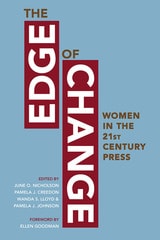
The Edge of Change
Women in the Twenty-First-Century PressEdited by June O. Nicholson, Pamela J. Creedon, Wanda S. Lloyd, and Pamela J. Jo: Foreword by Ellen Goodman
University of Illinois Press, 2008
Prominent female voices in journalism provide critical perspectives on the challenges women face in today's news organizations, such as connecting with diverse audiences, educating readers about international issues and cultures, maintaining credibility, negotiating media consolidation and corporate pressures, and overcoming the persistent barriers to professional advancement. A powerful and complex assessment of how women are transforming the news industry, The Edge of Change explores how the news industry might implement further reforms aimed at creating a more inclusive journalistic community.
Contributors are Catalina Camia, Kathleen Carroll, Pamela J. Creedon, Paula Lynn Ellis, Helen E. Fisher, Dorothy Butler Gilliam, Ellen Goodman, Sharon Grigsby, Carol Guzy, Kirsten Scharnberg Hampton, Cathy Henkel, Pamela J. Johnson, Jane Kirtley, Jan Leach, Caroline Little, Wanda S. Lloyd, Arlene Notoro Morgan, June O. Nicholson, Geneva Overholser, Marty Petty, Deb Price, Donna M. Reed, Sandra Mims Rowe, Peggy Simpson, Margaret Sullivan, Julia Wallace, and Keven Ann Willey.
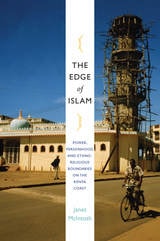
The Edge of Islam
Power, Personhood, and Ethnoreligious Boundaries on the Kenya CoastJanet McIntosh
Duke University Press, 2009
The Edge of Islam explores themes as wide-ranging as spirit possession, divination, healing rituals, madness, symbolic pollution, ideologies of money, linguistic code-switching, and syncretism and its alternatives. McIntosh shows how the differing versions of Islam practiced by Swahili and Giriama, and their differing understandings of personhood, have figured in the growing divisions between the two groups. Her ethnographic analysis helps to explain why Giriama view Islam, a supposedly universal religion, as belonging more deeply to certain ethnic groups than to others; why Giriama use Islam in their rituals despite the fact that so many do not consider the religion their own; and how Giriama appropriations of Islam subtly reinforce a distance between the religion and themselves. The Edge of Islam advances understanding of ethnic essentialism, religious plurality, spirit possession, local conceptions of personhood, and the many meanings of “Islam” across cultures.
The Edge of Meaning
James Boyd White
University of Chicago Press, 2001
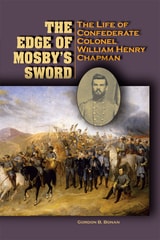
The Edge of Mosby’s Sword
The Life of Confederate Colonel William Henry ChapmanGordon B. Bonan
Southern Illinois University Press, 2009
The Edge of Mosby’s Sword is the first scholarly volume to delve into the story of one of John Singleton Mosby’s most trusted and respected officers, Colonel William Henry Chapman. Presenting both military and personal perspectives of Chapman’s life, Gordon B. Bonan offers an in-depth understanding of a man transformed by the shattering of his nation. This painstakingly researched account exposes a soldier and patriot whose convictions compelled him to battle fiercely for Southern independence; whose quest for greatness soured when faced with the brutal realities of warfare; and who sought to heal his wounded nation when the guns of war were silenced.
Born into a wealthy slave-owning family, Chapman was a student of the fiery secessionist rhetoric of antebellum Virginia who eagerly sought glory and adventure on the battlefields of the Civil War. Bonan traces Chapman’s evolution from an impassioned student at the University of Virginia to an experienced warrior and leader, providing new insight into the officer’s numerous military accomplishments. Explored here are Chapman’s previously overlooked endeavors as a student warrior, leader of the Dixie Artillery, and as second-in-command to Mosby, including his participation in the capture of Harpers Ferry, the battering of Union forces at Second Manassas, and his ferocious raids during the 1864 Shenandoah Valley campaign. Bonan reveals fresh perspectives on the intrepid maneuvers of Mosby’s Rangers, the hardships of war, and Chapman’s crucial role as the right hand of the “Gray Ghost.” But while Mosby recognized him for his bravery and daring, the fame Chapman sought always eluded him. Instead, with his honors and successes came disillusionment and sorrow, as he watched comrades and civilians alike succumb to the terrible toll of the war.
The end of the struggle between North and South saw Chapman accept defeat with dignity, leading the Rangers to their official surrender and parole at Winchester. With the horrors of the war behind him, he quickly moved to embrace the rebuilding of his country, joining the Republican party and beginning a forty-two-year career at the IRS enforcing Federal law throughout the South. In the end, Chapman’s life is a study in contradictions: nationalism and reconciliation; slavery and liberty; vengeance and chivalry.
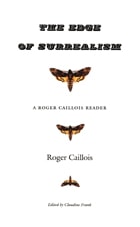
The Edge of Surrealism
A Roger Caillois ReaderRoger Caillois, Edited by Claudine Frank
Duke University Press, 2003
These thirty-two essays with commentaries strike a balance between Caillois’s political and theoretical writings and between his better known works, such as the popular essays on the praying mantis, myth, and mimicry, and his lesser-known pieces. Presenting several new pieces and drawing on interviews and unpublished correspondence, this book reveals Caillois’s consistent effort to reconcile intellectual rigor and imaginative adventure. Perhaps most importantly, The Edge of Surrealism provides an overdue look at how Caillois’s intellectual project intersected with the work of Georges Bataille and others including Breton, Bachelard, Benjamin, Lacan, and Lévi-Strauss.
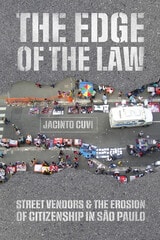
The Edge of the Law
Street Vendors and the Erosion of Citizenship in São PauloJacinto Cuvi
University of Chicago Press, 2025
With a little initiative and very little startup money, an outgoing individual might sell you a number of delights and conveniences familiar to city dwellers—from cold water bottles while you’re sitting in traffic to a popsicle from a cart on a summer afternoon in the park. Such vendors form a significant share of the workforce in São Paulo, Brazil, but their ubiquity belies perpetual struggle. Some have the right to practice their trade; others do not. All of them strive to make it—or stay afloat.
In The Edge of the Law, sociologist Jacinto Cuvi introduces us to the world of street vendors and teases out the relationship between the construction of legality and the experience of citizenship. As São Paulo’s city government undertakes a large-scale plan to cancel street vending licenses and evict street vendors, Cuvi reveals how the rights of informal workers can be revoked or withheld and how the lines can be redrawn between work that is “legal” and work that takes place under constant fear of law enforcement. Alongside the mechanics of disenfranchisement, Cuvi captures the lived experience of criminalization, dissecting the distribution of (shallow) rights among vendors who continually reinvent strategies to eke out a living while dealing with the constraints and pressures of informal citizenship at the edge of the law.
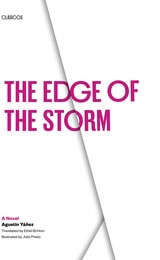
The Edge of the Storm
A NovelBy Agustín Yáñez
University of Texas Press, 1963
This tale of a repressive priest and his small Mexican village during the eighteen months preceding the Revolution of 1910 is a great novel, one that exposes the struggle between human desire and paralyzing fear—fear of humanity, fear of nature, fear of the wrath of God. Agustín Yáñez probes the actions of people caught in life’s currents, enthralling his readers with mounting dramatic tension as he shows that no power can forge saints from the human masses, that any attempt to do so, in fact, often has exactly the opposite result.
Yáñez brings to his work a deep understanding of people—his people—and he illuminates a great truth—that no one, anywhere, seems very strange when we understand the environment that has produced him or her.
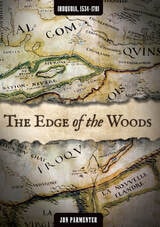
The Edge of the Woods
Iroquoia, 1534-1701Jon Parmenter
Michigan State University Press, 2010

The Porch
Meditations on the Edge of NatureCharlie Hailey
University of Chicago Press, 2021
Hailey writes from a modest porch on the Homosassa River in Florida. He sleeps there, studies the tides, listens for osprey and manatee, welcomes shipwrecked visitors, watches shadows on its screens, reckons with climate change, and reflects on his own acclimation to his environment. The profound connections he unearths anchor an armchair exploration of past porches and those of the future, moving from ancient Greece to contemporary Sweden, from the White House roof to the Anthropocene home. In his ruminations, he links up with other porch dwellers including environmentalist Rachel Carson, poet Wendell Berry, writers Eudora Welty and Zora Neale Hurston, philosopher John Dewey, architect Louis Kahn, and photographer Paul Strand.
As close as architecture can bring us to nature, the porch is where we can learn to contemplate anew our evolving place in a changing world—a space we need now more than ever. Timeless and timely, Hailey’s book is a dreamy yet deeply passionate meditation on the joy and gravity of sitting on the porch.