Results by title
2728 books match the query 'Education' and 609 start with t

THE KIRWAN YEARS
Chris Perry
The Ohio State University Press, 2006
Enter President William “Brit” Kirwan, who understood this need perfectly and whose major legacy became widely known as the Academic Plan. This document became and remains the centerpiece of Ohio State’s agenda, with budget and other priorities emanating from its six strategies and 14 initiatives.
Continuing the Ohio State tradition of chronicling the university’s history through the work of its past presidents, The Kirwan Years recounts the Academic Plan’s creation, acceptance, and initial implementation, along with many major university accomplishments from mid-1998 through mid-2002. It also details the university’s ongoing, uphill struggle to maximize state financial support and its success in private and other fundraising. It provides a compelling look at the complexity permeating today’s research universities. And yes, it describes the firing of football coach John Cooper and the hiring of Jim Tressel.
Taking It Personally
Racism In Classroom From Kinderg To CollegeAnn Berlak
Temple University Press, 2001
The "encounter" -- as it was called -- was an expression of Moyenda's anger at the institutionalized racism of our educational system, a system whose foundations are reinforced and whose assumptions about race are reproduced in the graduate school classroom. Forcing everyone involved to rethink their own race consciousness, Taking it Personally is a chronicle of two teachers and their own educational progress. In processing their own responses to the encounter, along with their students', Berlak and Moyenda meditate not only on their own ideas on teaching and learning, but also redefine the obligation a teacher has to his or her students.
Personal in its approach, yet grounded in significant currents of educational thought, Taking it Personally will be a must-read for any educator or educator-to-be who is committed to teaching in our diverse classrooms.

Talent and Education
Present Status and Future DirectionsE. Torrance
University of Minnesota Press, 1960
Talk about Sex
How Sex Ed Battles Helped Ignite the RightJanice M. Irvine
Temple University Press, 2023
“Must reading for scholars, sexuality researchers, activists, and public policy and public health planners engaged in efforts to promote education on sex, sexually transmitted diseases, and HIV infection prevention for adolescents in schools.”—JAMA
Talk about Sex is a rich social history about the political transformations, cultural dynamics, and emotional rhetorical strategies that helped the right wing manufacture controversies on the local and national levels in the United States. Although the emergence of a politicized Christian Right is commonly dated at the mid-seventies, with the founding of groups like the Moral Majority, Talk about Sex tells the story of a powerful right-wing Christian presence in politics a full decade earlier. These activists used inflammatory sexual rhetoric—oftentimes deceptive and provocative—to capture the terms of public debate, galvanize voters, and reshape the culture according to their own vision.
This 20th Anniversary Edition includes a new preface and epilogue by the author that examines current controversies over public education on sexuality, gender, and race.
Demonstrating how the right wing draws on the cultural power of sexual shame and fear to build a political movement, Talk about Sex explores the complex entanglements of sexual knowledge, politics, and discourses.
Talking Art
The Culture of Practice and the Practice of Culture in MFA EducationGary Alan Fine
University of Chicago Press, 2018
Talladega College
The First CenturyMaxine D. Jones
University of Alabama Press, 1990
In 1954 when the U.S. Supreme Court declared separate education inherently unequal, Talladega College was a notable black liberal arts school thriving in rural east Alabama. This is a study of that college, its growth, development, and significance, from its inception by freed slaves in the 1860s through the student protest movement more than a century later. Initially Talladega offered primary, secondary, nursing, and theological as well as college-level work. Under strong leadership of visionaries such as James T. Cater, the school’s first black dean, Talladega became a first-rate liberal arts institution. During its first decades the school struggled against poverty, white hostility, Ku Klux Klan threats, and internal dissension to produce a number of teachers and ministers for Alabama schools and churches.
This book examines such college issues as finance, enrollment, students, educational policy, and the often stormy relationship with black and white neighbors. It provides a sense of both the obstacles to and the positive consequences of building and nurturing a black college.
Targeting Investments in Children
Fighting Poverty When Resources Are LimitedEdited by Phillip B. Levine and David J. Zimmerman
University of Chicago Press, 2010
A substantial number of American children experience poverty: about 17 percent of those under the age of eighteen meet the government’s definition, and the proportion is even greater within minority groups. Childhood poverty can have lifelong effects, resulting in poor educational, labor market, and physical and mental health outcomes for adults. These problems have long been recognized, and there are numerous programs designed to alleviate or even eliminate poverty; as these programs compete for scarce resources, it is important to develop a clear view of their impact as tools for poverty alleviation.
Targeting Investments in Children tackles the problem of evaluating these programs by examining them using a common metric: their impact on earnings in adulthood. The volume’s contributors explore a variety of issues, such as the effect of interventions targeted at children of different ages, and study a range of programs, including child care, after-school care, and drug prevention. The results will be invaluable to educational leaders and researchers as well as policy makers.
Task-Based Listening
What Every ESL Teacher Needs to KnowSteven Brown
University of Michigan Press, 2019
Tautua
Service and Disability Activism in SamoaJuliann Anesi
Temple University Press, 2026
The Sāmoan concept of tautua is the cultural practice of service—to family, village, church, and nation. For Juliann Anesi, tautua includes an ethical responsibility that extends to caring for people living with disabilities. Anesi learned this value from her aunty Sina, who was instrumental in founding two schools for youths in the mid-1970s—Aoga Fiamalamalama and Loto Taumafailike. These schools were designed for students like Sina’s son Gele, students excluded from private and public education because of intellectual or physical disabilities.
Tautua recounts how the Indigenous community organized and resisted ableist paradigms in colonial institutions by changing the education system to a more inclusive environment. Anesi explains how funding was arranged for the schools through NGOs. She also uses oral histories, personal narratives, archival documents, and newspapers to offer insights about how students experienced oppression and erasure as well as shame and sexism in their communities.
Highlighting advocacy and belonging, Tautua argues that these schools for students with disabilities centered Sāmoan concepts of service, advocacy, and self-determination in an attempt to decolonize elementary education. In doing so, Anesi shows what disability activism in Sāmoa can teach us about educability, school inclusion, and collective care.
In the series Dis/color
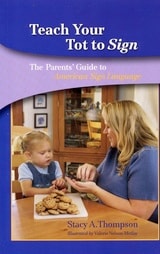
Teach Your Tot to Sign
The Parents' Guide to American Sign LanguageStacy A. Thompson
Gallaudet University Press, 2005
Research has shown that very young children can learn sign language before they learn to speak. Teach Your Tot to Sign: The Parents’ Guide to American Sign Language provides parents and teachers the opportunity to teach more than 500 basic American Sign Language (ASL) signs to their infants, toddlers, and young children. Hearing children, deaf children, and children with special needs can benefit from learning the elementary signs chosen for this handy pocket-size book. Young children who can communicate using simple signs become less frustrated and also bond in a special way with their parents. In teaching ASL to parents of toddlers and preschool teachers, author Stacy A. Thompson recognized the need for a book that could be used at home and in the classroom. Her book features fundamental signs of great appeal to young children and concise instructions on how to sign, including the critical importance of facial expression.
Teach Your Tot to Sign anticipates all of the common desires and interests of young children — food, pets, planes, trains, cars, and boats, games, holidays, vegetables, family — in short, nearly everything. Reflecting children’s endless curiosity, the vocabulary chosen ranges from signs for “baby,” “broken,” “clown,” “dinosaur,” “firefighter,” “gentle,” “hot,” “hurt,” “ketchup,” “pacifier,” “rooster,” “sad,” “spaghetti,” “wagon,” “water,” “wet,” to “you’re welcome,” and even “McDonalds.” This lively assortment of signs will help every child convey earlier in their development their thoughts, feelings, and desires to their parents and teachers.
Teacher Education across Minority-Serving Institutions
Programs, Policies, and Social JusticePetchauer, Emery
Rutgers University Press, 2017
The first of its kind, Teacher Education across Minority-Serving Institutions brings together innovative work from the family of institutions known as minority-serving institutions: Historically Black Colleges and Universities, Tribal Colleges and Universities, Hispanic Serving Institutions, and Asian American and Native American Pacific Islander Serving Institutions. The book moves beyond a singular focus on teacher racial diversity that has characterized scholarship and policy work in this area. Instead, it pushes for scholars to consider that racial diversity in teacher education is not simply an end in itself but is, a means to accomplish other goals, such as developing justice-oriented and asset-based pedagogies.

Teacher Research and Educational Reform
Edited by Sandra Hollingsworth and Hugh Sockett
University of Chicago Press, 1994
Three critiques form this postmodern approach to teacher research. An epistemological critique considers issues of power in the relationship of university researchers to teachers. A sociopolitical critique examines the relationships that a teacher may have to the research process. A professional critique argues for staff development programs that encourage teachers to take greater responsibility for curriculum and instruction and for institutional structures that support teacher research as a professional activity.
Teacher Strike!
Public Education and the Making of a New American Political OrderJon Shelton
University of Illinois Press, 2017
As Shelton shows, many working- and middle-class whites sided with corporate interests in seeing themselves as society's only legitimate, productive members. This alliance increasingly argued that public employees and the urban poor took but did not give. Drawing on a wealth of research ranging from school board meetings to TV news reports, Shelton puts readers in the middle of fraught, intense strikes in Newark, St. Louis, and three other cities where these debates and shifting attitudes played out. He also demonstrates how the labor actions contributed to the growing public perception of unions as irrelevant or even detrimental to American prosperity. Foes of the labor movement, meanwhile, tapped into cultural and economic fears to undermine not just teacher unionism but the whole of liberalism.
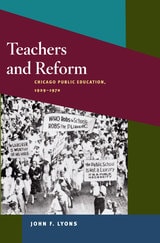
Teachers and Reform
Chicago Public Education, 1929-70John F. Lyons
University of Illinois Press, 2007
Examining teachers' unions and public education from the bottom up, Lyons shows how the CTU and its members sought rigorous reforms. A combination of political action, public relations campaigns, and community alliances helped the CTU to achieve better salaries and benefits, increased school budgets, reformed curricula, and greater equality for women within the public education system. But its agenda was also constrained by internal divisions over race and gender and by ongoing external disputes with the school administration, politicians, and business and civic organizations.
Detailed and informed by rich interviews, Teachers and Reform: Chicago Public Education, 1929-1970 tells the story of how committed union members effected changes to public education and to local politics that still benefit Chicago teachers, students, and the city today.

Teachers and Testing
David A. Goslin
Russell Sage Foundation, 1967
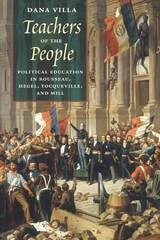
Teachers of the People
Political Education in Rousseau, Hegel, Tocqueville, and MillDana Villa
University of Chicago Press, 2017
In Teachers of the People, Dana Villa takes us back to the moment in history when “the people” first appeared on the stage of modern European politics. That moment—the era just before and after the French Revolution—led many major thinkers to celebrate the dawning of a new epoch. Yet these same thinkers also worried intensely about the people’s seemingly evident lack of political knowledge, experience, and judgment. Focusing on Rousseau, Hegel, Tocqueville, and Mill, Villa shows how reformist and progressive sentiments were often undercut by skepticism concerning the political capacity of ordinary people. They therefore felt that “the people” needed to be restrained, educated, and guided—by laws and institutions and a skilled political elite. The result, Villa argues, was less the taming of democracy’s wilder impulses than a pervasive paternalism culminating in new forms of the tutorial state.
Ironically, it is the reliance upon the distinction between “teachers” and “taught” in the work of these theorists which generates civic passivity and ignorance. And this, in turn, creates conditions favorable to the emergence of an undemocratic and illiberal populism.
Teachers on the Waves of Transformation
School Culture Before and After 1989Dana Moree
Karolinum Press, 2020
Teachers on the Waves of Transformation aims to answer this question through the lens of education. With careful exploratory research at two schools in a small town in central Bohemia, anthropologist Dana Moree follows the fates of two generations of teachers at the schools. Through interviews with teachers, school administrators, and the students’ parents, Moree focuses on the relationships, values, shared stories, and symbolic and ritual worlds that create the culture of the schools. Teachers on the Waves of Transformation offers a unique perspective of cultural flux as witnessed in the classroom.
Teachers, Leaders, and Schools
Essays by John DeweyEdited by Douglas J. Simpson and Sam F. Stack Jr.
Southern Illinois University Press, 2010
John Dewey was one of the most prominent philosophers and educational thinkers of the twentieth century, and his influence on modern education continues today. In Teachers, Leaders, and Schools: Essays by John Dewey, educators Douglas J. Simpson and Sam F. Stack Jr. have gathered some of Dewey’s most user-friendly and insightful essays concerning education with the purpose of aiding potential and practicing teachers, administrators, and policy makers to prepare students for participation in democratic society.
Selected largely, but not exclusively, for their accessibility, relevance, and breadth of information, these articles are grouped into five parts—The Classroom Teacher, The School Curriculum, The Educational Leader, The Ideal School, and The Democratic Society. Each part includes an introductory essay that connects Dewey’s thoughts not only to each other but also to current educational concerns. The sections build on one another, revealing Dewey’s educational theories and interests and illustrating how his thoughts remain relevant today.
Teaching "Race" with a Gendered Edge
Brigitte Hipfl
Central European University Press, 2012
Teaching Academic Writing in the Health Sciences
A Guide for Instructors, Mentors, and TrainersElla August
University of Michigan Press, 2026
Part 1 offers the pedagogical basis teachers need to apply best practices, as well as:
- Tips for collaborative writing and writing productivity
- Strategies for using generative artificial intelligence (AI) technology in teaching and writing
- Open-access resources and instruction planning activities
Part 2 focuses on the steps of writing a scientific paper, offering:
- A strong foundation in the structure of and strategies for successful writing
- Customizable teaching materials on how to write a scientific paper
- Strategies for planning a paper, crafting writing to reach readers, developing persuasive arguments, and building a successful author team
- How-to write each section of a paper, from the title to the conclusion
- Guidance on navigating the publishing process, including selecting the appropriate journal and effectively responding to peer-reviewer comments
Teaching Accelerated and Corequisite Composition
David Starkey
Utah State University Press, 2023
The book primarily explores accelerated composition through the lens of two-year colleges to answer a central question in the field: to what extent do educators need to alter two-year college curricular design? The contributors also delve into assessment, a crucial process for instructors and their students transitioning to accelerated learning; the key role that reading plays in the writing process; and noncognitive learning, an area of study that has been associated with accelerated learning since its inception. Together these thirteen chapters provide instructors with a strategic approach to teaching accelerated and corequisite composition.
Teaching Accelerated and Corequisite Composition points toward a new way of approaching first-year composition: a method of instruction that fosters the growth and success of writers who were once considered underprepared for college writing and are now achieving unprecedented success.

Teaching Actors
Knowledge Transfer in Actor TrainingRoss W. Prior
Intellect Books, 2012
Teaching Artist Handbook, Volume One
Tools, Techniques, and Ideas to Help Any Artist TeachNick Jaffe, Becca Barniskis, and Barbara Hackett Cox
University of Chicago Press, 2015
This book is a collection of essays, stories, lists, examples, dialogues, and ideas, all offered with the aim of helping artists create and implement effective teaching based on their own expertise and strengths. The Handbook addresses three core questions: “What will I teach?” “How will I teach it?” and “How will I know if my teaching is working?” It also recognizes that teaching is a dynamic process that requires critical reflection and thoughtful adjustment in order to foster a supportive artistic environment.
Instead of offering rigid formulas, this book is centered on practice—the actual doing and making of teaching artist work. Experience-based and full of heart, the Teaching Artist Handbook will encourage artists of every experience level to create an original and innovative practice that inspires students and the artist.
Teaching Black History to White People
By Leonard N. Moore
University of Texas Press, 2021
Leonard Moore has been teaching Black history for twenty-five years, mostly to white people. Drawing on decades of experience in the classroom and on college campuses throughout the South, as well as on his own personal history, Moore illustrates how an understanding of Black history is necessary for everyone.
With Teaching Black History to White People, which is “part memoir, part Black history, part pedagogy, and part how-to guide,” Moore delivers an accessible and engaging primer on the Black experience in America. He poses provocative questions, such as “Why is the teaching of Black history so controversial?” and “What came first: slavery or racism?” These questions don’t have easy answers, and Moore insists that embracing discomfort is necessary for engaging in open and honest conversations about race. Moore includes a syllabus and other tools for actionable steps that white people can take to move beyond performative justice and toward racial reparations, healing, and reconciliation.
Teaching Children Science
Hands-On Nature Study in North America, 1890-1930Sally Gregory Kohlstedt
University of Chicago Press, 2010
In the early twentieth century, a curriculum known as nature study flourished in major city school systems, streetcar suburbs, small towns, and even rural one-room schools. This object-based approach to learning about the natural world marked the first systematic attempt to introduce science into elementary education, and it came at a time when institutions such as zoos, botanical gardens, natural history museums, and national parks were promoting the idea that direct knowledge of nature would benefit an increasingly urban and industrial nation.
The definitive history of this once pervasive nature study movement, TeachingChildren Science emphasizes the scientific, pedagogical, and social incentives that encouraged primarily women teachers to explore nature in and beyond their classrooms. Sally Gregory Kohlstedt brings to vivid life the instructors and reformers who advanced nature study through on-campus schools, summer programs, textbooks, and public speaking. Within a generation, this highly successful hands-on approach migrated beyond public schools into summer camps, afterschool activities, and the scouting movement. Although the rich diversity of nature study classes eventually lost ground to increasingly standardized curricula, Kohlstedt locates its legacy in the living plants and animals in classrooms and environmental field trips that remain central parts of science education today.
Teaching College Writing to Diverse Student Populations
Dana R. Ferris
University of Michigan Press, 2013
Statistical and anecdotal evidence documents that even states with relatively little ethnic or cultural diversity are beginning to notice and ask questions about long-term resident immigrants in their classes. As shifts in student population become more widespread, there is an even greater need for second language specialists, composition specialists, program administrators, and developers in colleges and universities to understand and adapt to the needs of the changing student audience(s).
Teaching Composition As A Social Process
Bruce McComiskey
Utah State University Press, 2000
Bruce McComiskey is a strong advocate of social approaches to teaching writing. However, he opposes composition teaching that relies on cultural theory for content, because it too often prejudges the ethical character of institutions and reverts unnecessarily to product-centered practices in the classroom. He opposes what he calls the "read-this-essay-and-do-what-the-author-did method of writing instruction: read Roland Barthes's essay 'Toys' and write a similar essay; read John Fiske's essay on TV and critique a show."
McComiskey argues for teaching writing as situated in discourse itself, in the constant flow of texts produced within social relationships and institutions. He urges writing teachers not to neglect the linguistic and rhetorical levels of composing, but rather to strengthen them with attention to the social contexts and ideological investments that pervade both the processes and products of writing.
A work with a sophisticated theory base, and full of examples from McComiskey's own classrooms, Teaching Composition as a Social Process will be valued by experienced and beginning composition teachers alike.

Teaching Dancing with Ideokinetic Principles
Drid Williams
University of Illinois Press, 2011
Teaching Difficult Topics
Reflections from the Undergraduate Music ClassroomOlivia R. Lucas and Laura Moore Pruett
University of Michigan Press, 2024
The teaching reflections in Teaching Difficult Topics examine difficult themes that fall into three primary categories: subjects that instructors sense to be controversial or emotionally challenging to discuss, those that derive from or intersect with real-world events that are difficult to process, and bigger-picture discussions of how music studies often focuses on dominant narratives while overlooking other perspectives. Some chapters offer practical guidance, lesson plans, and teaching materials to enable instructors to build discussions of race, gender, sexuality, and traumatic histories into their own classrooms; others take a more global view, reflecting on the importance and relevance of teaching these difficult topics and on how to respond in the music classroom when external events disrupt daily life.
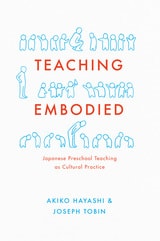
Teaching Embodied
Cultural Practice in Japanese PreschoolsAkiko Hayashi and Joseph Tobin
University of Chicago Press, 2015
Akiko Hayashi and Joseph Tobin embed themselves in the classrooms of three different teachers at three different schools to examine how teachers act, think, and talk. Drawing on extended interviews, their own real-time observations, and hours of video footage, they focus on how teachers embody their lessons: how they use their hands to gesture, comfort, or discipline; how they direct their posture, gaze, or physical location to indicate degrees of attention; and how they use the tone of their voice to communicate empathy, frustration, disapproval, or enthusiasm. Comparing teachers across schools and over time, they offer an illuminating analysis of the gestures that comprise a total body language, something that, while hardly ever explicitly discussed, the teachers all share to a remarkable degree. Showcasing the tremendous importance of—and dearth of attention to—this body language, they offer a powerful new inroad into educational study and practice, a deeper understanding of how teaching actually works, no matter what culture or country it is being practiced in.
Teaching English as a Foreign or Second Language, Second Edition
A Teacher Self-Development and Methodology GuideJerry G. Gebhard
University of Michigan Press, 2006
The second edition of Teaching English as a Foreign or Second Language includes a wider range of examples to coincide with a variety of teaching contexts-from K-12 schools, to university intensive language programs and refugee programs. It is also updated with discussions of technology throughout, and it considers ways in which technology can be used in teaching language skills. Sources for further study are included in each chapter and in the appendixes.
Teaching English as a Foreign or Second Language, Third Edition
A Self-Development and Methodology GuideJerry G. Gebhard
University of Michigan Press, 2017
This edition has the same three major sections: (1) Self-Development, Exploration, and Settings; (2) Principles of EFL/ESL Teaching; and (3) Teaching Language Skills. New to this edition are:
- a chapter on digital literacy, technology, and teaching
- the addition of technology issues as they relate to the teaching of the various skills in Part 3
- discussions of task-based teaching, student presentations, how corpus linguistics can inform teaching, metacognitive reading strategies, collaborative writing, assessing writing, and the teaching of grammar.
Teaching Evolution in a Creation Nation
Adam Laats and Harvey Siegel
University of Chicago Press, 2016
Laats and Siegel agree with most scientists: creationism is flawed, as science. But, they argue, students who believe it nevertheless need to be accommodated in public school science classes. Scientific or not, creationism maintains an important role in American history and culture as a point of religious dissent, a sustained form of protest that has weathered a century of broad—and often dramatic—social changes. At the same time, evolutionary theory has become a critical building block of modern knowledge. The key to accommodating both viewpoints, they show, is to disentangle belief from knowledge. A student does not need to believe in evolution in order to understand its tenets and evidence, and in this way can be fully literate in modern scientific thought and still maintain contrary religious or cultural views. Altogether, Laats and Siegel offer the kind of level-headed analysis that is crucial to finding a way out of our culture-war deadlock.
Teaching Expertise in Three Countries
Japan, China, and the United StatesAkiko Hayashi
University of Chicago Press, 2022
In Teaching Expertise in Three Countries, Akiko Hayashi shows how teachers from Japan, China, and the United States think about what it means to be an expert teacher. Based on interviews with teachers conducted over the span of fifteen years and videos taken in their classrooms, Hayashi gives us a valuable portrait of expert teachers in the making. While Hayashi’s research uncovered cultural variations in the different national contexts, her analysis of how teachers adapted their pedagogy throughout their careers also revealed many cross-national similarities. Younger teachers often describe themselves as being in a rush, following scripts, and “talking too much,” while experienced teachers describe themselves as being quieter, knowing children better, and being more present.
Including a foreword by scholar of early childhood education Joseph Tobin, Teaching Expertise in Three Countries provides a foundation for understanding the sequence and pathways of development over the first decade of teaching in three national contexts, demonstrating the value of the field of comparative education in the process.
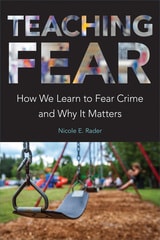
Teaching Fear
How We Learn to Fear Crime and Why It MattersNicole E. Rader
Temple University Press, 2023
Where do lessons of “stranger danger” and safety come from—and do they apply differently for women? A gender-fear paradox shows that although women are less likely to be victims of most crimes (sexual assault aside), their fear of crime is greater. Moreover, girls and women—especially White women—are taught to fear the wrong things and given impossible tools to prevent victimization. In Teaching Fear, Nicole Rader zooms in on the social learning process, tracing the ways that families, schools, and the media have become obsessed with crime myths, especially regarding girls and women.
Based on in-depth research and family studies, Rader reveals the dubious and dangerous origins of many of the most prominent safety guidelines that teach young girls to be more afraid of crime. These guidelines carry over to adulthood, influencing women’s behaviors and the way they order their worlds, with dangerous consequences. As women teach their learned behavior and conditioned fear to others, gendered crime myths are recirculated from generation to generation, making them a staple in our society.
Teaching Fear includes suggestions for taking precautionary measures and crime prevention strategies. Rader also provides guidance for instilling safety values and demonstrating how we can “teach fear better” to break this cycle and truly create greater security.
Teaching Gender with Libraries and Archives
Sara De Jong
Central European University Press, 2014

Teaching Generation M
A Handbook for Librarians and EducatorsAmerican Library Association, 2009
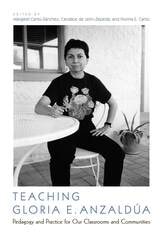
Teaching Gloria E. Anzaldúa
Pedagogy and Practice for Our Classrooms and CommunitiesEdited by Margaret Cantú-Sánchez, Candace de León-Zepeda, Norma E. Cantú
University of Arizona Press, 2020
Gloria Evangelina Anzaldúa—theorist, Chicana, feminist—famously called on scholars to do work that matters. This pronouncement was a rallying call, inspiring scholars across disciplines to become scholar-activists and to channel their intellectual energy and labor toward the betterment of society. Scholars and activists alike have encountered and expanded on these pathbreaking theories and concepts first introduced by Anzaldúa in Borderlands/La frontera and other texts.
Teaching Gloria E. Anzaldúa is a pragmatic and inspiring offering of how to apply Anzaldúa’s ideas to the classroom and in the community rather than simply discussing them as theory. The book gathers nineteen essays by scholars, activists, teachers, and professors who share how their first-hand use of Anzaldúa’s theories in their classrooms and community environments.
The collection is divided into three main parts, according to the ways the text has been used: “Curriculum Design,” “Pedagogy and Praxis,” and “Decolonizing Pedagogies.” As a pedagogical text, Teaching Gloria E. Anzaldúa also offers practical advice in the form of lesson plans, activities, and other suggested resources for the classroom. This volume offers practical and inspiring ways to deploy Anzaldúa’s transformative theories with real and meaningful action.
Contributors
Carolina E. Alonso
Cordelia Barrera
Christina Bleyer
Altheria Caldera
Norma E. Cantú
Margaret Cantú-Sánchez
Freyca Calderon-Berumen
Stephanie Cariaga
Dylan Marie Colvin
Candace de León-Zepeda
Miryam Espinosa-Dulanto
Alma Itzé Flores
Christine Garcia
Patricia M. García
Patricia Pedroza González
María del Socorro Gutiérrez-Magallanes
Leandra H. Hernández
Nina Hoechtl
Rían Lozano
Socorro Morales
Anthony Nuño
Karla O’Donald
Christina Puntasecca
Dagoberto Eli Ramirez
José L. Saldívar
Tanya J. Gaxiola Serrano
Verónica Solís
Alexander V. Stehn
Carlos A. Tarin
Sarah De Los Santos Upton
Carla Wilson
Kelli Zaytoun
Teaching History in the Digital Age
T. Mills Kelly
University of Michigan Press, 2013
Teaching History in the Digital Age serves as a guide for practitioners on how to fruitfully employ the transformative changes of digital media in the research, writing, and teaching of history. T. Mills Kelly synthesizes more than two decades of research in digital history, offering practical advice on how to make best use of the results of this synthesis in the classroom and new ways of thinking about pedagogy in the digital humanities.
Teaching In The Field
Hal Crimmel
University of Utah Press, 2003
Taking students out of the classroom and into a variety of settings, ranging from remote wilderness sites to urban or built environments is now recognized as a valuable means of teaching ecological concepts and environmental values. But field studies are also a way of encouraging explorations across the curriculum, enhancing the teaching of life sciences, literature, and creative writing.
Teaching in the Field is the first volume to specifically survey field studies conducted through colleges and universities. The essays, arranged into three sections, offer rationales, pedagogical strategies, and foundational advice and information that broaden and strengthen the collective knowledge of this increasingly popular means of instruction. The essays present theoretical information within engaging, candid narratives that report on various aspects of field experiences, whether hour-long excursions or month-long trips.
Teachers of environmental studies, of English, composition, and creative writing, and of allied humanities and science disciplines, will find here a wealth of success stories and cautionary tales to guide them in envisioning their own outdoor classrooms.
Teaching India–Pakistan Relations
Teachers' Attitudes, Practices and AgencyKusha Anand
University College London, 2023
The rivalry between India and Pakistan began with the British withdrawal from the British Indian Empire in 1947 and the sudden partition of India immediately afterward. Seventy-five years later, it remains powerful. While the countries share a long history and considerable socio-cultural affinity, relations since Partition have been marked by three wars, constant border skirmishes, and a deep distrust that permeates both societies. In each, teaching about those relations is weighted with political and cultural significance, and research shows that curricula have been used deliberately to shape the understanding of new generations.
This book explores the attitudes and pedagogical decision-making of teachers in India and Pakistan when teaching India–Pakistan relations. Situating teachers in the context of reformed textbooks and curriculums in both countries that explicitly advocate critical thinking and social cohesion, Kusha Anand explores how far teachers have enacted these changes in their classrooms. What she finds is that while there is progress towards the stated goals, teachers in both countries face pressures from the interests of school and state, and often miss opportunities to engage with multiple perspectives and stereotypes in their classrooms.
Teaching Israel
Studies of Pedagogy from the FieldEdited by Sivan Zakai and Matt Reingold
Brandeis University Press, 2024
Jewish Americans are divided in their views on Israel. While scholars have outlined philosophical principles to guide educators who teach about Israel, there has been less scholarship focused on the pedagogy surrounding the country. This book resituates teaching—the questions, dilemmas, and decision-making that teachers face—as central to both Israel studies and Israel education. Contributors illuminate how educators from differing pedagogical orientations, who teach in a range of educational settings learn, understand, undertake, and ultimately improve the work of teaching Israel. The volume also looks at the professional support and learning opportunities teachers may need to engage with these pedagogical questions.

Teaching Life
Letters from a Life in LiteratureDale Salwak
University of Iowa Press, 2008
Written in response to the sudden death of one of his students, who died tragically in an automobile accident on her way to Salwak’s office to talk over her career plans, Teaching Life is an effort to impart lessons to the next generation of teachers: “It was the suddenness of her death, I think, along with the utter loss of so much potential, which struck me forcibly, and I found myself wondering if anything I had said in class had made a difference in her too-short life or, for that matter, in the lives of any of my students.”
By turns analytical, reflective, and exhortatory, Teaching Life unselfconsciously captures the fascination, enlightenment, and sheer joy that literary studies can offer professors and students. It also implicitly speaks to society's prevailing—and disturbing—prejudice against the profession.
Teaching Lives
Essays & StoriesWendy Bishop
Utah State University Press, 1997
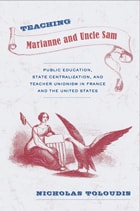
Teaching Marianne and Uncle Sam
Public Education, State Centralization, and Teacher Unionism in France and the United StatesNicholas Toloudis
Temple University Press, 2012
Offering the first systematic, comparative examination of the origins of teachers’ unions in two countries—France and the United States—Teaching Marianne and Uncle Sam shows how teachers’ unions came into existence not because of the willful efforts of particular actors, but over the course of decades of conflict over the proper role of professional educators in public politics.
Nicholas Toloudis traces teacher unionism back to the first efforts of governments to centralize public education. He carefully documents how centralization created new understandings of the role of teachers in their societies and generated new sources of conflict within teachers’ corps. Using rare archival source materials, Toloudis illustrates how these internal conflicts became salient in teachers’ battles with governments over their legitimate right to exist as collective claim-makers within the polity.
In the series Politics, History, and Social Change, edited by John C. Torpey
Teaching Matters
A Guide for Graduate StudentsAeron Haynie
West Virginia University Press, 2022
In a book written directly for graduate students that includes graduate student voices and experiences, Aeron Haynie and Stephanie Spong establish why good teaching matters and offer a guide to helping instructors-in-training create inclusive and welcoming classrooms.
Teaching Matters is informed by recent research while being grounded in the personal perspectives of current and past graduate students in many disciplines. Graduate students can use this book independently to prepare to teach their courses, or it can be used as a guide for a teaching practicum. With a just-in-time checklist for graduate students who are assigned to teach courses right before the semester starts, step-by-step directions for writing a compelling teaching philosophy, and an emphasis on teaching well regardless of modality, Teaching Matters will remain relevant for graduate students throughout their careers.
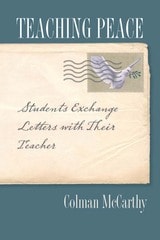
Teaching Peace
Students Exchange Letters with Their TeacherColman McCarthy
Vanderbilt University Press, 2015
The discussions range from peace and war to a host of other issues of social justice, such as the death penalty, human rights, poverty, the living wage, animal rights, and vegetarianism. The wide-ranging letters suggest how teacher and students co-create a world of more love and less hate.

Teaching Shakespeare into the Twenty-First Century
Ronald E. Salomone
Ohio University Press, 1997
Shakespeare is a central shaping and defining figure in our culture. His plays are being taught, filmed, and performed every day in many places and in most of the world’s languages. At the same time, teachers and students from junior high through the early undergraduate years often struggle with the Bard in discomfort and negativity that can only be counter-productive.
Teaching Shakespeare into the Twenty-First Century is by teachers and for teachers. Specifically, it is a collection of essays in which teachers describe their best ideas and experiences as they confront the challenges of bringing Shakespeare alive for students who often feel intimidated and less than eager to participate.
It is on behalf of these students that this book has been prepared. Written by middle school, high school, and college teachers from around the country, the essays record successful efforts at bringing Shakespeare and the student together in fresh, exciting, and productive ways.
From today’s performance techniques, designed to make students active participants in the learning process, through a host of extra-textual resources such as festivals and films, to a look at applications of the computer and cyberspace, Teaching Shakespeare into the Twenty-First Century is a book of success stories.
Covering the most contemporary issues, critical theory, and classroom approach, it is designed to provide teachers with a useful, friendly, and forward-looking resource as they continue to make Shakespeare available into the future.
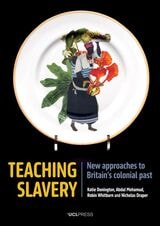
Teaching Slavery
New Approaches to Britain's Colonial PastKatie Donington, Abdul Mohamud, Robin Whitburn, and Nicholas Draper
University College London, 2023
This groundbreaking book combines the latest academic research on Britain’s involvement in colonial slavery with innovative thinking on teaching “difficult histories” in the classroom. It addresses three main shortcomings in how slavery is taught in British secondary schools: insufficient teacher training in both historical content and pedagogy; a shortage of high-quality, research-informed teaching resources; and a lack of published guidance to support ethical and effective classroom engagement. Offering educators both historical and pedagogical approaches to discussing slavery, it examines key themes of race, gender, resistance, and abolition through illuminating historical examples.
Teaching Speaking Online
What Every ESL Teacher Needs to KnowPamela S.H. Bogart
University of Michigan Press, 2020