Results by title
72 books match the query 'English drama' and 14 start with t
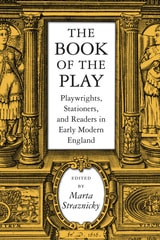
The Book of the Play
Playwrights, Stationers, and Readers in Early Modern EnglandMarta Straznicky
University of Massachusetts Press, 2006
The Book of the Play is a collection of essays that examines early modern drama in the context of book history. Focusing on the publication, marketing, and readership of plays opens fresh perspectives on the relationship between the cultures of print and performance and more broadly between drama and the public sphere. Marta Straznicky's introduction offers a survey of approaches to the history of play reading in this period, and the collection as a whole consolidates recent work in textual, bibliographic, and cultural studies of printed drama.
Individually, the essays advance our understanding of play reading as a practice with distinct material forms, discourses, social settings, and institutional affiliation. Part One, “Real and Imagined Communities,” includes four essays on play-reading communities and the terms in which they are distinguished from the reading public at large. Cyndia Clegg surveys the construction of readers in prefaces to published plays; Lucy Munro traces three separate readings of a single play, Edward Sharpham's The Fleer; Marta Straznicky studies women as readers of printed drama; and Elizabeth Sauer describes how play reading was mobilized for political purposes in the period of the Civil War.
In Part Two, “Play Reading and the Book Trade,” five essays consider the impact of play reading on the public sphere through the lens of publishing practices. Zachary Lesser offers a revisionist account of black-letter typeface and the extent to which it may be understood as an index of popular culture; Alan Farmer examines how the emerging news trade of the 1620s and 1630s affected the marketing of printed drama; Peter Berek traces the use of generic terms on title pages of plays to reveal their intersection with the broader culture of reading; Lauren Shohet demonstrates that the Stuart masque had a parallel existence in the culture of print; and Douglas Brooks traces the impact print had on eclipsing performance as the medium in which the dramatist could legitimately lay claim to having authored his text.
The individual essays focus on selected communities of readers, publication histories, and ideologies and practices of reading; the collection as a whole demonstrates the importance of textual production and reception to understanding the place of drama in the early modern public sphere.
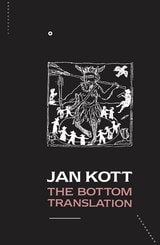
The Bottom Translation
Marlowe and Shakespeare and the Carnival TraditionJan Kott
Northwestern University Press, 1987
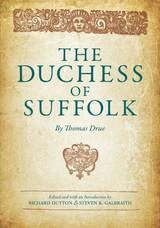
The Duchess of Suffolk
Thomas Drue. Edited and with an Introduction by Richard Dutton and Steven K. Galbraith
The Ohio State University Press, 2015
With this volume, Dutton and Galbraith provide a critical apparatus that situates The Duchess of Suffolk in historical context and suggests an explanation for its continued resonance. They account for the play’s censorship in 1624 by detailing how it evoked contemporary parallels to the controversial foreign policy of King James I. More specifically, the editors offer an introduction that includes a historical overview of the author, staging, printing, and reception. Facing facsimiles of the original are pages with the updated text, complete with annotations to clarify language and staging details. This edition of The Duchess of Suffolk will have something to offer to early modern drama scholars as well as scholars of book history.
The Ethos of Drama
Rhetorical Theory and Dramatic WorthRobert L. King
Catholic University of America Press, 2010
The Making of Theatrical Reputations
Studies from the Modern London TheatreYael Zarhy-Levo
University of Iowa Press, 2008
Today's successful plays and playwrights achieve their prominence not simply because of their intrinsic merit but because of the work of mediators, who influence the whole trajectory of a playwright's or a theatre company's career. Critics and academic writers are primarily considered the makers of reputations, but funding organizations and various media agents as well as artistic directors, producers, and directors also pursue separate agendas in shaping the reputations of theatrical works. In The Making of Theatrical Reputations Yael Zarhy-Levo demonstrates the processes through which these mediatory practices by key authority figures situate theatrical companies and playwrights within cultural and historical memory.
To reveal how these authorizing powers-that-be promote theatrical events, companies, and playwrights, Zarhy-Levo presents four detailed case studies that reflect various angles of the modern London theatre. In the case of the English Stage Company's production of John Osborne's Look Back in Anger, she centers on a specific event. She then focuses on the trajectory of a single company, the Theatre Workshop, particularly through its first decade at the Theatre Royal, Stratford East, London. Next, she explores the career of the dramatist John Arden, especially its first ten years, in part drawing upon an interview with Arden and his wife, actress and playwright Margaretta D'Arcy, before turning to her fourth study: the playwright Harold Pinter's shifting reputation throughout the different phases of his career.
Zarhy-Levo's accounts of these theatrical events, companies, and playwrights through the prism of mediation bring fresh insights to these landmark productions and their creators.

The Media Players
Shakespeare, Middleton, Jonson, and the Idea of NewsStephen Wittek
University of Michigan Press, 2015
The Novel Stage
Narrative Form from the Restoration to Jane AustenMarcie Frank
Bucknell University Press, 2020
2020 Choice Outstanding Academic Title
Marcie Frank’s study traces the migration of tragicomedy, the comedy of manners, and melodrama from the stage to the novel, offering a dramatic new approach to the history of the English novel that examines how the collaboration of genres contributed to the novel’s narrative form and to the modern organization of literature. Drawing on media theory and focusing on the less-examined narrative contributions of such authors as Aphra Behn, Frances Burney, and Elizabeth Inchbald, alongside those of Samuel Richardson, Henry Fielding, and Jane Austen, The Novel Stage tells the story of the novel as it was shaped by the stage.
Published by Bucknell University Press. Distributed worldwide by Rutgers University Press.
The Philosopher's Toothache
Embodied Stoicism in Early Modern English DramaDonovan Sherman
Northwestern University Press, 2022
Informed by work in both classical philosophy and performance studies, Donovan Sherman argues that Stoicism infused the complex theatrical culture of early modern England. Plays written and performed during this period gave life to Stoic exercises that instructed audiences to cultivate their virtue, self-awareness, and creativity. By foregrounding Stoicism’s embodied nature, Sherman recovers a vital dimension too often lost in reductive portrayals of the Stoics by early modern writers and contemporary scholars alike. The Philosopher’s Toothache features readings of dramatic works by William Shakespeare, Cyril Tourneur, and John Marston alongside considerations of early modern adaptations of classical Stoics (Seneca, Epictetus, and Marcus Aurelius) and Neo-Stoics such as Justus Lipsius. These plays model Stoic virtues like unpredictability, indifference, vulnerability, and dependence—attributes often framed as negative but that can also rekindle a sense of responsible public action.
The Place of the Stage
License, Play, and Power in Renaissance EnglandSteven Mullaney
University of Michigan Press, 1995
In this richly textured multidisciplinary work, Steven Mullaney examines the cultural situation of popular drama in Elizabethan and Jacobean England. Relying upon a dynamic model of cultural production, Mullaney defines an original and historically grounded perspective on the emergence of popular theater and illustrates the critical, revisionary role it played in the symbolic economy of Renaissance England. Combining literary, historical, and broadly conceived cultural analysis, he investigates, among other topics, the period's exhaustive "rehearsal" of other cultures and its discomfiting apprehensions of the self; the politics of vanished forums for ideological production such as the wonder-cabinet and the leprosarium; the cultural poetics of royal entries; and the incontinent, uncanny language of treason. As Mullaney demonstrates, Shakespearean drama relied upon and embodied the marginal license of the popular stage and, as a result, provides us with powerful readings of the shifting bases of power, license, and theatricality in Elizabethan and Jacobean England. "A major study, not merely of selected Shakespearean plays but of the very conditions of the possibility of Renaissance drama." --Louis Montrose, University of California, San Diego "Mullaney's rich and engaged reading of the place of Shakespeare's stage represents the texture of early modern life and its cultural productions in the vivid tradition of annales history and brilliantly exemplifies his theoretical call for a poetics of culture." -- Shakespeare Quarterly "Mullaney marshals an impressive range of cultural representations which, taken together, will undoubtedly force a reconsideration of the semiotics of the Elizabethan stage." --Times Higher Education Supplement ". . . something of a dramatic feat in cultural studies: literary critic Mullaney calls in a cast ranging from Clifford Geertz and Pierre Bourdieu to Raymond Williams, Mary Douglas, and Michel Foucault." --Contemporary Sociology.
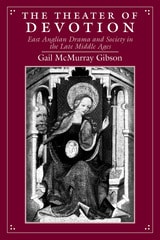
The Theater of Devotion
East Anglian Drama and Society in the Late Middle AgesGail McMurray Gibson
University of Chicago Press, 1989
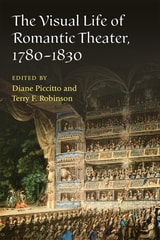
The Visual Life of Romantic Theater, 1780-1830
Edited by Diane Piccitto and Terry F. Robinson
University of Michigan Press, 2023
The Visual Life of Romantic Theater examines the dynamism and vibrancy of stage spectacle and its impact in an era of momentous social upheaval and aesthetic change. Situating theatrical production as key to understanding visuality ca. 1780-1830, this book places the stage front and center in Romantic scholarship—a field in a period long defined by its focus on poetry—by reenvisioning traditional approaches to artistic and social production. How, it asks, did dramaturgy and stagecraft influence aesthetic and sociopolitical concerns? How does a focus on visuality expand our understanding of the historical experience of theatergoing? In what ways did stage performance converge with visual culture beyond the theater? How did extra-theatrical genres engage with theatrical sight and spectacle? Finally, how does a focus on dramatic vision change the way we conceive of Romanticism itself? The volume’s essays by emerging and established scholars provide exciting and suggestive answers to these questions, along with a more capacious conception of Romantic theater as a locus of visual culture that reached well beyond playhouse walls.
Theaters of Translation
Cosmopolitan Vernaculars in Shakespeare's EnglandAndrew S. Keener
University of Alabama Press, 2025
Explores the profound influence of multilingual dictionaries, dialogues, and grammars on English Renaissance playwrights
In Theaters of Translation, Andrew S. Keener offers a fascinating account of the ways that plays by Thomas Kyd, Mary Sidney Herbert, Ben Jonson, and their fellow English contemporaries were shaped by and part of a multilingual Europe where dictionaries, grammars, and language-learning materials circulated widely. He proposes a fresh, multilingual approach to English Renaissance drama that challenges the histories of early modern European languages as sites of national and linguistic cohesion.
Covering the period between 1570 and 1640, when England’s drama and the English language itself were evolving, Keener uses the term “cosmopolitan vernaculars” to examine how nonclassical European languages modeled transnational forms of belonging for playgoers, readers, and authors in Renaissance England. Combining recent contributions to cosmopolitan theory and transnational studies of early modern literature and culture, Keener highlights both the ways in which cosmopolitanism manifests through Europe’s vernacular languages—in print and performance—and the ways languages themselves can exhibit cosmopolitanism for those who encounter them on the page or on the stage.
Theaters of Translation opens up new transnational interpretations of English Renaissance plays and casts fresh light on historical anecdotes, such as Jonson inscribing a copy of Pietro Aretino’s scandalous Italian dialogues or Shakespeare’s First Folio being advertised for sale in Germany before its London publication. It offers much of interest to readers and scholars of Renaissance Europe, early modern drama, and the development of national European languages.
Theatre of the Real
Yeats, Beckett, and SondheimGina Masucci MacKenzie
The Ohio State University Press, 2008
Thomas Holcroft’s Revolutionary Drama
Reception and AfterlivesAmy Garnai
Bucknell University Press, 2023