60 books match the query 'Environmental justice' and 12 start with t

cover of The Climate Trial: Law and Justice on a Melting Planet

The Climate Trial

Law and Justice on a Melting Planet

Noah Walker-Crawford

Duke University Press, 2026
Saúl Luciano Lliuya guides tours in the mountains and his family grow corn, wheat, barley, and potatoes on their farm in Huaraz, Peru, a community of more than 100,000 people in the Andes near Palcacocha, a glacial lake. Palcacocha, however, is growing, as is the major flood risk to Huaraz. Climate change through the emission of greenhouse gases continues to melt the Peruvian glaciers—greenhouse gases that come from corporate polluters not just in Peru, but across the industrialized world. So, Luciano Lliuya decided to sue. Although the German energy company RWE has never operated in Peru, Luciano Lliuya sought to hold the company, which uses coal power generation, liable for damages in a groundbreaking case that, despite being dismissed, established that major emitters can be held liable for climate harms. In The Climate Trial, anthropologist Noah Walker-Crawford draws on years of personal involvement with the lawsuit and extensive fieldwork in Peru and Germany to follow the people, legal strategies, scientific arguments, and political tensions that have shaped the trial. More than a courtroom drama, The Climate Trial is a deeply human story about moral responsibility in a changing world and what it means to be a “good neighbor” while living thousands of miles away.
[more]
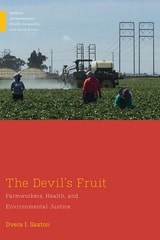
cover of The Devil's Fruit: Farmworkers, Health, and Environmental Justice

The Devil's Fruit

Farmworkers, Health, and Environmental Justice

Dvera I. Saxton

Rutgers University Press, 2021
The Devil's Fruit describes the facets of the strawberry industry as a harm industry, and explores author Dvera Saxton’s activist ethnographic work with farmworkers in response to health and environmental injustices. She argues that dealing with devilish—as in deadly, depressing, disabling, and toxic—problems requires intersecting ecosocial, emotional, ethnographic, and activist labors. Through her work as an activist medical anthropologist, she found the caring labors of engaged ethnography take on many forms that go in many different directions. Through chapters that examine farmworkers’ embodiment of toxic pesticides and social and workplace relationships, Saxton critically and reflexively describes and analyzes the ways that engaged and activist ethnographic methods, frameworks, and ethics aligned and conflicted, and in various ways helped support still ongoing struggles for farmworker health and environmental justice in California. These are problems shared by other agricultural communities in the U.S. and throughout the world.
 
[more]
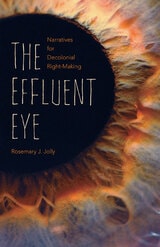
cover of The Effluent Eye: Narratives for Decolonial Right-Making

The Effluent Eye

Narratives for Decolonial Right-Making

Rosemary J. Jolly

University of Minnesota Press, 2024

Why human rights don’t work

In The Effluent Eye, Rosemary J. Jolly argues for the decolonization of human rights, attributing their failure not simply to state and institutional malfeasance but to the very concept of human rights as anthropocentric—and, therefore, fatally shortsighted. In an engaging mix of literary and cultural criticism, Indigenous and Black critique, and substantive forays into the medical humanities, Jolly proposes right-making in the demise of human rights.


Using what she calls an “effluent eye,” Jolly draws on “Fifth Wave” structural public health to confront the concept of human rights—one of the most powerful and widely entrenched liberal ideas. She builds on Indigenous sovereignty work from authors such as Robin Wall Kimmerer, Leanne Betasamosake Simpson, and Mark Rifkin as well as the littoral development in Black studies from Christine Sharpe, Saidiya Hartman, and Tiffany Lethabo King to engage decolonial thinking on a range of urgent topics such as pandemic history and grief; gender-based violence and sexual assault; and the connections between colonial capitalism and substance abuse, the Anthropocene, and climate change. 


Combining witnessed experience with an array of decolonial texts, Jolly argues for an effluent form of reading that begins with the understanding that the granting of “rights” to individuals is meaningless in a world compromised by pollution, poverty, and successive pandemics.


Retail e-book files for this title are screen-reader friendly.

[more]
cover of The Elsewhere Is Black: Ecological Violence and Improvised Life

The Elsewhere Is Black

Ecological Violence and Improvised Life

Marisa Solomon

Duke University Press, 2025
In The Elsewhere Is Black, Marisa Solomon examines how waste is a mundane part of poor Black survival and a condition of settler colonial racial capitalism. Tracing the flow of trash and waste across Black spaces, from Brooklyn’s historically Black Bedford-Stuyvesant to the post-plantation towns of Virginia’s Tidewater, Solomon contends that waste infrastructures concentrate environmental risk in an elsewhere that is routinely Black. Solomon emphasizes that ecological violence is a form of racialized heteropatriarchal environmental control that upholds whiteness as a propertied way of life and criminalizes Black survival. As she points to acute sites of toxicity, Solomon theorizes the relationship between the devaluation of land and Black and more-than-human life to reveal how the risks of poisoning, police violence, dispossession, and poverty hold Black life captive. Locating Black survival as a site from which alternative eco-political imaginations spring, she foregrounds how people live and dream amidst waste’s daily accumulation. Solomon opens new ecological horizons to ask: What forms of environmentalism emerge when Black un/freedom has never been distant from waste?
[more]
cover of The Environmental Justice Reader: Politics, Poetics, and Pedagogy

The Environmental Justice Reader

Politics, Poetics, and Pedagogy

Edited by Joni Adamson, Mei Mei Evans, and Rachel Stein

University of Arizona Press, 2002

From the First National People of Color Congress on Environmental Leadership to WTO street protests of the new millennium, environmental justice activists have challenged the mainstream movement by linking social inequalities to the uneven distribution of environmental dangers. Grassroots movements in poor communities and communities of color strive to protect neighborhoods and worksites from environmental degradation and struggle to gain equal access to the natural resources that sustain their cultures.

This book examines environmental justice in its social, economic, political, and cultural dimensions in both local and global contexts, with special attention paid to intersections of race, gender, and class inequality. The first book to link political studies, literary analysis, and teaching strategies, it offers a multivocal approach that combines perspectives from organizations such as the Southwest Network for Environmental and Economic Justice and the International Indigenous Treaty Council with the insights of such notable scholars as Devon Peña, Giovanna Di Chiro, and Valerie Kuletz, and also includes a range of newer voices in the field.

This collection approaches environmental justice concerns from diverse geographical, ethnic, and disciplinary perspectives, always viewing environmental issues as integral to problems of social inequality and oppression. It offers new case studies of native Alaskans' protests over radiation poisoning; Hispanos' struggles to protect their land and water rights; Pacific Islanders' resistance to nuclear weapons testing and nuclear waste storage; and the efforts of women employees of maquiladoras to obtain safer living and working environments along the U.S.-Mexican border.

The selections also include cultural analyses of environmental justice arts, such as community art and greening projects in inner-city Baltimore, and literary analyses of writers such as Jimmy Santiago Baca, Linda Hogan, Barbara Neely, Nez Perce orators, Ken Saro-Wiwa, and Karen Yamashita—artists who address issues such as toxicity and cancer, lead poisoning of urban African American communities, and Native American struggles to remove dams and save salmon. The book closes with a section of essays that offer models to teachers hoping to incorporate these issues and texts into their classrooms. By combining this array of perspectives, this book makes the field of environmental justice more accessible to scholars, students, and concerned readers.


[more]
cover of The Environmental Justice: William O. Douglass and American Conservation

The Environmental Justice

William O. Douglass and American Conservation

Adam M. Sowards

Oregon State University Press, 2009

[more]
cover of The Garden of God

The Garden of God

Pope Benedict XVI

Catholic University of America Press, 2014
This book gathers together the audiences, addresses, letters, and homilies of Benedict on a wide-ranging set of topics that deal with the world about us. The major themes and connections he explores are creation and the natural world; the environment, science, and technology; and hunger, poverty, and the earth's resources.
[more]
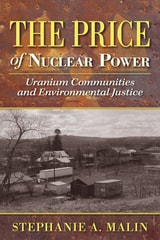
cover of The Price of Nuclear Power: Uranium Communities and Environmental Justice

The Price of Nuclear Power

Uranium Communities and Environmental Justice

Malin, Stephanie A.

Rutgers University Press, 2015

Rising fossil fuel prices and concerns about greenhouse gas emissions are fostering a nuclear power renaissance and a revitalized uranium mining industry across the American West. In The Price of Nuclear Power, environmental sociologist Stephanie Malin offers an on-the-ground portrait of several uranium communities caught between the harmful legacy of previous mining booms and the potential promise of new economic development. Using this context, she examines how shifting notions of environmental justice inspire divergent views about nuclear power’s sustainability and equally divisive forms of social activism. 
 
Drawing on extensive fieldwork conducted in rural isolated towns such as Monticello, Utah, and Nucla and Naturita, Colorado, as well as in upscale communities like Telluride, Colorado, and incorporating interviews with community leaders, environmental activists, radiation regulators, and mining executives, Malin uncovers a fundamental paradox of the nuclear renaissance: the communities most hurt by uranium’s legacy—such as high rates of cancers, respiratory ailments, and reproductive disorders—were actually quick to support industry renewal. She shows that many impoverished communities support mining not only because of the employment opportunities, but also out of a personal identification with uranium, a sense of patriotism, and new notions of environmentalism. But other communities, such as Telluride, have become sites of resistance, skeptical of industry and government promises of safe mining, fearing that regulatory enforcement won’t be strong enough. Indeed, Malin shows that the nuclear renaissance has exacerbated social divisions across the Colorado Plateau, threatening social cohesion. Malin further illustrates ways in which renewed uranium production is not a socially sustainable form of energy development for rural communities, as it is utterly dependent on unstable global markets. 
 
The Price of Nuclear Power is an insightful portrait of the local impact of the nuclear renaissance and the social and environmental tensions inherent in the rebirth of uranium mining.
 
 
[more]
cover of The Promise of Multispecies Justice

The Promise of Multispecies Justice

Sophie Chao, Karin Bolender, and Eben Kirksey, editors

Duke University Press, 2022

What are the possibilities for multispecies justice? How do social justice struggles intersect with the lives of animals, plants, and other creatures? Leading thinkers in anthropology, geography, philosophy, speculative fiction, poetry, and contemporary art answer these questions from diverse grounded locations. In America, Indigenous peoples and prisoners are decolonizing multispecies relations in unceded territory and carceral landscapes. Small justices are emerging in Tanzanian markets, near banana plantations in the Philippines, and in abandoned buildings of Azerbaijan as people navigate relations with feral dogs, weeds, rats, and pesticides. Conflicts over rights of nature are intensifying in Colombia’s Amazon. Specters of justice are emerging in India, while children in Micronesia memorialize extinct bird species. Engaging with ideas about environmental justice, restorative justice, and other species of justice, The Promise of Multispecies Justice holds open the possibility of flourishing in multispecies worlds, present and to come.

Contributors. Karin Bolender, Sophie Chao, M. L. Clark, Radhika Govindrajan, Zsuzsanna Dominika Ihar, Noriko Ishiyama, Eben Kirksey, Elizabeth Lara, Jia Hui Lee, Kristina Lyons, Michael Marder, Alyssa Paredes, Craig Santos Perez, Kim TallBear

[more]
cover of The Solutions are Already Here: Strategies of Ecological Revolution from Below

The Solutions are Already Here

Strategies of Ecological Revolution from Below

Peter Gelderloos

Pluto Press, 2022

Are alternative energies and Green New Deals enough to deliver environmental justice? Peter Gelderloos argues that international governmental responses to the climate emergency are structurally incapable of solving the crisis. But there is hope.

Across the world, grassroots networks of local communities are working to realize their visions of an alternative revolutionary response to planetary destruction, often pitted against the new megaprojects promoted by greenwashed alternative energy infrastructures and the neocolonialist, technocratic policies that are the forerunners of the Green New Deal.

Gelderloos interviews food sovereignty activists in Venezuela, Indigenous communities reforesting their lands in Brazil and anarchists fighting biofuel plantations in Indonesia, looking at the battles that have cancelled airports, stopped pipelines, and helped the most marginalized to fight borders and environmental racism, to transform their cities, to win a dignified survival.
[more]
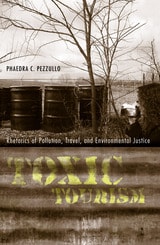
cover of Toxic Tourism: Rhetorics of Pollution, Travel, and Environmental Justice

Toxic Tourism

Rhetorics of Pollution, Travel, and Environmental Justice

Phaedra C. Pezzullo

University of Alabama Press, 2009

Winner of the:
2010 Jane Jacobs Urban Communication Book Award, sponsored by National Communication Association
2007 James A. Winans-Herbert A. Wichelns Memorial Award for Distinguished Scholarship in Rhetoric and Public Address, sponsored by National Communication Association
2007 Best Book of the Year for Critical and Cultural Studies, sponsored by National Communication Association
2007 Christine L. Oravec Research Award, sponsored by Environmental Communications Division of the National Communication Association

The first book length study of the environmental justice movement, tourism, and the links between race, class, and waste
 
Tourism is at once both a beloved pastime and a denigrated form of popular culture. Romanticized for its promise of pleasure, tourism is also potentially toxic, enabling the deadly exploitation of the cultures and environments visited. For many decades, the environmental justice movement has offered “toxic tours,” non-commercial trips intended to highlight people and locales polluted by poisonous chemicals. Out of these efforts and their popular reception, a new understanding of democratic participation in environmental decision-making has begun to arise. Phaedra C. Pezzullo examines these tours as a tactic of resistance and for their potential in reducing the cultural and physical distance between hosts and visitors.
 
Pezzullo begins by establishing the ambiguous roles tourism and the toxic have played in the U.S. cultural imagination since the mid-20th century in a range of spheres, including Hollywood films, women’s magazines, comic books, and scholarly writings. Next, drawing on participant observation, interviews, documentaries, and secondary accounts in popular media, she identifies and examines a range of tourist performances enabled by toxic tours. Extended illustrations of the racial, class, and gender politics involved include Louisiana’s “Cancer Alley,” California’s San Francisco Bay Area, and the Mexican border town of Matamoros. Weaving together social critiques of tourism and community responses to toxic chemicals, this critical, rhetorical, and cultural analysis brings into focus the tragedy of ongoing patterns of toxification and our assumptions about travel, democracy, and pollution.
[more]
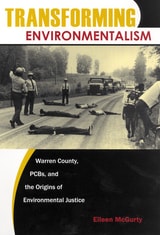
cover of Transforming Environmentalism: Warren County, PCBs, and the Origins of Environmental Justice

Transforming Environmentalism

Warren County, PCBs, and the Origins of Environmental Justice

McGurty, Eileen

Rutgers University Press, 2006

Contemporary public policy circles are quick to acknowledge that environmental factors contribute to ill health and pose a particular threat to poor and minority communities. But public officials rarely examined the distribution of environmental hazards such as polluted air and contaminated water. In the 1980s, as toxic waste facilities proliferated, the environmental justice movement demanded that impoverished communities no longer be burdened by excessive environmental risks.    
In Transforming Environmentalism, Eileen McGurty explores a moment central to the emergence of the environmental justice movement. In 1978, residents of predominantly African American Warren County, North Carolina, were horrified to learn that the state planned to build a landfill in their county to hold forty thousand cubic yards of soil that was contaminated with PCBs from illegal dumping. They responded to the state's plans with a four-year resistance, ending in a month of protests with over 500 arrests from civil disobedience and disruptive actions.McGurty traces the evolving approaches that residents took to contest "environmental racism" in their community and shows how activism in Warren County spurred greater political debate and became a model for communities across the nation. Transforming Environmentalism explores how the specific circumstances of the Warren County events shaped the formation of the environmental justice movement and influenced contemporary environmentalism.
[more]