60 books match the query 'Europe, Central' and 11 start with t
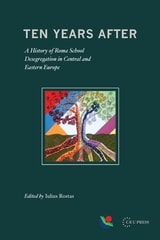
cover of Ten Years After: A History of Roma School Desegregation in Central and Eastern Europe

Ten Years After

A History of Roma School Desegregation in Central and Eastern Europe

Iulius Rostas

Central European University Press, 2012
The volume presents the results collated in the frames of the fact finding project led by the editor. The analysis includes the examination of a large number of legal documents and policy statements issued by national authorities and the international community on the matter. A critical overview is also made about the various Roma-specific political campaigns on national and European scale. The second half of the book contains interviews with activists that assumed a leading role in school desegregation. These testimony pieces have been critically reviewed by educational and policy analysts from the concerned countries.
[more]
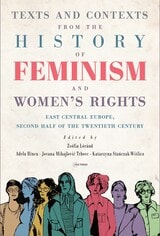
cover of Texts and Contexts from the History of Feminism and Women’s Rights: East Central Europe, Second Half of the Twentieth Century

Texts and Contexts from the History of Feminism and Women’s Rights

East Central Europe, Second Half of the Twentieth Century

Zsofia Lorand

Central European University Press, 2024

A compendium of one hundred sources, preceded by a short author’s bio and an introduction, this volume offers an English language selection of the most representative texts on feminism and women’s rights from East Central Europe between the end of the Second World War and the early 1990s. While communist era is the primary focus, the interwar years and the post-1989 transition period also receive attention. All texts are new translations from the original.

The book is organised around themes instead of countries; the similarities and differences between nations are nevertheless pointed out. The editors consider women not only in their local context, but also in conjunction with other systems of thought—including shared agendas with socialism, liberalism, nationalism, and even eugenics.

The choice of texts seeks to demonstrate how feminism as political thought was shaped and organised in the region. They vary in type and format from political treatises, philosophy to literary works, even films and the visual arts, with the necessary inclusion of the personal and the private. Women’s political rights, right to education, their role in nation-building, women, and war (and especially women and peace) are part of the anthology, alongside the gendered division of labour, violence against women, the body, and reproduction.
[more]
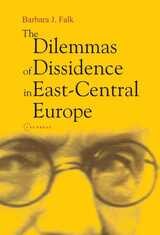
cover of The Dilemmas of Dissidence in East-Central Europe: Citizen Intellectuals and Philosopher Kings

The Dilemmas of Dissidence in East-Central Europe

Citizen Intellectuals and Philosopher Kings

Barbara J. Falk

Central European University Press, 2003
Discusses one of the major currents leading to the fall of communism. Falk examines the intellectual dissident movements in Poland, Czechoslovakia and Hungary from the late 1960s through to 1989. In spite of its historic significance, no other comprehensive survey has appeared on the subject. In addition to the huge list of written sources from samizdat works to recent essays, Falks sources include interviews with many personalities of those events as well as videos and films (including Oscar winners).
[more]
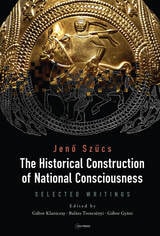
cover of The Historical Construction of National Consciousness: Selected Writings

The Historical Construction of National Consciousness

Selected Writings

Jeno Szucs

Central European University Press, 2022

A long essay entitled Three Historical Regions of Europe, appearing first in a samizdat volume in Budapest in 1980, instantly put its author into the forefront of the transnational debate on Central Europe, alongside such intellectual luminaries as Milan Kundera and Czesław Miłosz. The present volume offers English-language readers a rich selection of the depth and breadth of the legacy of Jenő Szűcs (1928–1988).

The selection documents Szűcs’s seminal contribution to many contemporary debates in historical anthropology, nationalism studies, and conceptual history. It contains his key texts on the history of national consciousness and patterns of collective identity, as well as medieval and early modern political thought. The works published here, most of them previously unavailable in English, provide a sophisticated analysis of a wide range of subjects from the myths of origins of Hungarians before Christianization to the political and religious ideology of the Dózsa peasant uprising in 1514, the medieval roots of civil society, or the revival of ethnic nationalism during the communist era. The volume, with an introduction by the editors locating Szűcs in a transnational context, offers a unique insight into the complex and sensitive debate on national identity in post-1945 East Central Europe.
[more]
cover of The Privatization Process in Central Europe

The Privatization Process in Central Europe

Roman Frydman

Central European University Press, 1993
In this work, comprehensive comparative information on five Central European countries has been collected by teams of researchers from both within the region and from the West. Following an introduction to the economic environment in each country, it provides an overview of the privatization process, including an account of the legal framework of ownership, institutions for state regulation, an overview of privatization programmes and the initial transformation of enterprises. A key feature of the book is the authors' access to hitherto unavailable information and their ability to present a vast amount of material in an easily available format. Aimed at policy makers and business people, the work should provide a strong foundation for future research.
[more]
cover of The Rise of Comparative History

The Rise of Comparative History

Balázs Trencsényi

Central European University Press, 2021
This book—the first of a three-volume overview of comparative and transnational historiography in Europe—focuses on the complex engagement of various comparative methodological approaches with different transnational and supranational frameworks. It considers scales from universal history to meso-regional (i.e. Balkans, Central Europe, etc.) perspectives. In the form of a reader, it displays 18 historical studies written between 1900 and 1943. The collection starts with the French and German methodological discussions around the turn of the twentieth century, stemming from the effort to integrate history with other emerging social sciences on a comparative methodological basis. The volume then turns to the question of structural and institutional comparisons, revisiting various historiographical ventures that tried to sketch out a broader (regional or European-level) interpretative framework to assess the legal systems, patterns of agrarian production, and the common ethnographic and sociocultural features. 
  
In the third part, a number of texts are presented, which put forward a supra-national research framework as an antidote to national exclusivism. While in Western Europe the most obvious such framework was pan-European, in East Central Europe the agenda of comparison was linked usually to a meso-regional framework.

The studies are accompanied by short contextual introductions including biographical information on the respective authors.
[more]
cover of The Sanctity of the Leaders: Holy Kings, Princes, Bishops and Abbots from Central Europe (11th to 13th Centuries)

The Sanctity of the Leaders

Holy Kings, Princes, Bishops and Abbots from Central Europe (11th to 13th Centuries)

Gábor Klaniczay

Central European University Press, 2023

The latest title in the Central European Medieval Texts series contains the lives of saints who were canonized in the eleventh through thirteenth centuries in the newly Christianized countries of Central and Eastern Europe (Bohemia, Poland, Hungary, and Dalmatia). A rejoinder to the earlier volume in the series, the Saints of the Christianization Age of Central Europe (CEMT, Vol. 6), containing hermits, missionaries, and martyrs, this second volume of hagiography is dominated by political or ecclesiastical leaders who became saintly patrons of their region and were highly venerated throughout the Middle Ages.

The legends in the volume present the two Hungarian holy kings Stephen and Ladislas, the holy duke Emeric, the Czech holy abbot Prokop of Sázava, three bishops, the Venetian-Hungarian Gellért of Csanád, the Polish Stanislas of Cracow (both martyrs), and the Dalmatian holy bishop Saint John of Trogir. Each “vita” is published in Latin original with an English translation and with prefaces discussing the textual tradition.

Saints’ lives have been recognized as an invaluable source of information on social and economic history, the history of mentalities and everyday life, cultural history, and, above all, as a special genre with crucial importance and prevalence in medieval literature.
[more]
cover of Thinking through Transition: Liberal Democracy, Authoritarian Pasts, and Intellectual History in East Central Europe After 1989

Thinking through Transition

Liberal Democracy, Authoritarian Pasts, and Intellectual History in East Central Europe After 1989

Michal Kopecek

Central European University Press, 2015
Thinking through Transition is the first concentrated effort to explore the most recent chapter of East Central European past from the perspective of intellectual history. Post-communism can be understood as a period of scarcity and preponderance of ideas, the dramatic eclipsing of the dissident legacy (as well as the older political traditions), and the rise of technocratic and post-political governance.  This book, grounded in empirical research sensitive to local contexts, proposes instead a history of adaptations, entanglements, and unintended consequences. In order to enable and invite comparison, the volume is structured around major domains of political thought, some of them generic (liberalism, conservatism, the Left), others (populism and politics of history) deemed typical for post-socialism. However, as shown by the authors, the generic often turns out to be heavily dependent on its immediate setting, and the typical resonates with processes that are anything but vernacular.
[more]
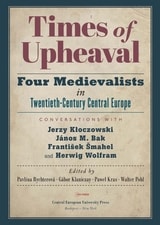
cover of Times of Upheaval: Four Medievalists in Twentieth-Century Central Europe. Conversations with Jerzy Kloczowski, János M. Bak, František Šmahel, and Herwig Wolfram

Times of Upheaval

Four Medievalists in Twentieth-Century Central Europe. Conversations with Jerzy Kloczowski, János M. Bak, František Šmahel, and Herwig Wolfram

Pavlína Rychterová

Central European University Press, 2019
The volume unites conversations with four masters of Medieval Studies from east-central Europe: János Bak from Hungary, Jerzy Kloczowski from Poland, František Šmahel from the Czech Republic, and Herwig Wolfram from Austria. The interviews, made by younger colleagues, reveal engaging life stories, with numerous observations, anecdotes and experiences. The four scholars grew up before and during the war, under Nazi occupation, emerged as young scholars in the difficult post-war period, and, for most of their careers worked in the shadow of the Iron Curtain, two of them spending most of their lifetimes under communist regimes. The conversations focus on ways in which open-minded young intellectuals became medieval historians under difficult circumstances, how they experienced the long shadows of totalitarian regimes with their acute sensitivity for historical change, and how their perceptions of the world around them reflected back on their approach to medieval history. The histories of their nations were broken, most of them ceased to exist and then were re-established during their lifetimes, came under foreign domination, were split up, or had their territories shifted. These changes affected these scholars' identities and patriotic feelings, and their present was reflected in the distant mirror of the medieval past.
[more]
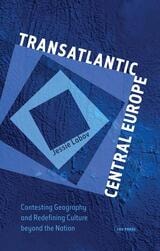
cover of Transatlantic Central Europe: Contesting Geography and Redifining Culture beyond the Nation

Transatlantic Central Europe

Contesting Geography and Redifining Culture beyond the Nation

Jessie Labov

Central European University Press, 2019

While there are still occasional uses of it today, the term "Central Europe" carries little of the charge that it did in the 1980s and early 1990s, and as a political and intellectual project it has receded from the horizon. Proponents of a distinct cultural profile of these countries—all involved now in the process of Transatlantic integration—used "Central European", as a contestation with the geo-political label of Eastern Europe. This book discusses the transnational set of practices connecting journals with other media in the mid-1980s, disseminating the idea of Central Europe simultaneously in East and West. A range of new methodologies, including GIS-mapping visualization, is used, repositing the political-cultural journal as one central node of a much larger cultural system. What has happened to the liberal humanist philosophy that "Central Europe" once evoked? In the early years of the transition era, the liberal humanist perspective shared by Havel, Konrád, Kundera, and Michnik was quickly replaced by an economic liberalism that evolved into neoliberal policies and practices. The author follows the trajectories of the concept into the present day, reading its material and intellectual traces in the postcommunist landscape. She explores how the current use of transnational, web-based media follows the logic and practice of an earlier, 'dissident' generation of writers.
[more]
cover of Transnational Trajectories and Diaspora Policies: The Case of Czechia in Comparison to Poland, Hungary and Slovakia

Transnational Trajectories and Diaspora Policies

The Case of Czechia in Comparison to Poland, Hungary and Slovakia

Edited by Eva Janská

Karolinum Press, 2025

A fascinating examination of Central European diasporic policy bolstered by individual case studies of the new Czech diaspora.

The book examines diaspora policy in Central European countries in the context of changes following their accession to the EU, utilizing the Czech Republic, Slovakia, Poland, and Hungary as case studies. With a focus on the previously underexplored new Czech diaspora (i.e., the emigration of Czechs/Czechoslovaks after 1990), individual case studies provide a comprehensive description of the contemporary Czech diaspora while also elucidating key inquiries directed towards its current character and specific needs.
[more]