Results by title
234 books match the query 'Families' and 30 start with t
The Aesthetics of Kinship
Form and Family in the Long Eighteenth CenturyHeidi Schlipphacke
Bucknell University Press, 2023
The Body in Late-Capitalist USA
Donald M. Lowe
Duke University Press, 1995
Moving beyond studies of representations and images of the body, Lowe focuses on the intersection of body practices, language, and the Social to describe concretely the reality of a lived body. His strongly synthetic work brings together Marxist critique, semiotics, Foucaultian discourse analysis, and systems and communications theory to examine those practices that construct the body under late capitalism: habits of work and consumption, the ways we give birth and raise children, socialization, mental and physical healing, reconstructions and contestations of sexuality and gender. Lowe draws upon a wide range of sources, including government and labor studies and statistics, diagnostic and statistical manuals on mental illness, computer manuals, self-help books, and guides to work-related stress disorders, to illustrate the transformation of the body into a nexus of exchange value in postmodern society.

The Bottomland
PoemsHarry Humes
University of Arkansas Press, 1995
The Changing Rhythms of American Family Life
Suzanne M. Bianchi
Russell Sage Foundation, 2006
The Color of Family
History, Race, and the Politics of AncestryMichael O'Malley
University of Chicago Press, 2024
A zealous eugenicist ran Virginia’s Bureau of Vital Statistics in the first half of the twentieth century, misusing his position to reclassify people he suspected of hiding their “true” race. But in addition to being blinded by his prejudices, he and his predecessors were operating more by instinct than by science. Their whole dubious enterprise was subject not just to changing concepts of race but outright error, propagated across generations.
This is how Michael O’Malley, a descendant of a Philadelphia Irish American family, came to have “colored” ancestors in Virginia. In The Color of Family, O’Malley teases out the various changes made to citizens’ names and relationships over the years, and how they affected families as they navigated what it meant to be “white,” “colored,” “mixed race,” and more. In the process, he delves into the interplay of genealogy and history, exploring how the documents that establish identity came about, and how private companies like Ancestry.com increasingly supplant state and federal authorities—and not for the better.
Combining the history of O’Malley’s own family with the broader history of racial classification, The Color of Family is an accessible and lively look at the ever-shifting and often poisoned racial dynamics of the United States.
The Color of Opportunity
Pathways to Family, Welfare, and WorkHaya Stier and Marta Tienda
University of Chicago Press, 2000
The culmination of a six-year collaboration analyzing the Urban Poverty and Family Life Survey of Chicago, The Color of Opportunity is the first major work to compare Chicago's inner city minorities with national populations of like race and ethnicity from a life course perspective. The authors find that blacks, whites, Mexicans, and Puerto Ricans living in poor neighborhoods differ in their experiences with early material deprivation and the lifetime disadvantages that accumulate—but they do not differ much from the urban poor in their family formation, welfare participation, or labor force attachment. Stier and Tienda find little evidence for ghetto-specific behavior, but they document the myriad ways color still restricts economic opportunity.
The Color of Opportunity stands as a much-needed corrective to increasingly negative views of poor people of color, especially the poor who live in deprived neighborhoods. It makes a key and lasting contribution to ongoing debates about the origins and nature of urban poverty.
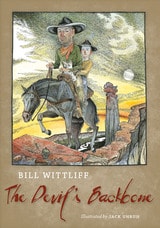
The Devil's Backbone
By Bill Wittliff, illustrated by Jack Unruh
University of Texas Press, 2014
The last the boy Papa saw of his Momma, she was galloping away on her horse Precious in the saddle her father took from a dead Mexican officer after the Battle of San Jacinto, fleeing from his Daddy, Old Karl, a vicious, tight-fisted horse trader. Momma’s flight sets Papa on a relentless quest to find her that thrusts him and his scrappy little dog Fritz into adventures all across the wild and woolly Hill Country of Central Texas, down to Mexico, and even into the realm of the ghostly “Shimmery People.” In The Devil’s Backbone, master storyteller Bill Wittliff takes readers on an exciting journey through a rough 1880s frontier as full of colorful characters and unexpected turns of events as the great American quest novel Adventures of Huckleberry Finn.
Wittliff grew up listening to stories and memories like these in his own family, and in this imaginative novel, they come to vivid life, creating an engrossing story of a Texas Huck Finn that brims with folk wisdom and sly humor. A rogue’s gallery of characters thwart and aid Papa’s path—Old Karl, hell-bent on bringing the boy back to servitude on his farm, and Herman, Papa’s brother who’s got Old Karl’s horse-trading instincts and greed; Calley Pearsall, an enigmatic cowboy with “other Fish to Fry” who might be an outlaw or a trustworthy “o’Amigo”; o’Jeffey, a black seer who talks to the spirits but won’t tell Papa what she has divined about his Momma; Mister Pegleg, a three-legged coyote with whom Papa forms a poignant, nearly tragic friendship; the “Mexkins” Pepe and Peto and their father Old Crecencio, whose longing for his lost family is as strong as Papa’s; and blind Bird, a magical “blue baby” who can’t see with his eyes but who helps other people see what they hold in their hearts. Papa’s adventures draw him ever nearer to a mysterious cave that haunts his dreams—an actual cave that he discovers at last in the canyons of the Devil’s Backbone—but will he find Momma before Old Karl finds him?
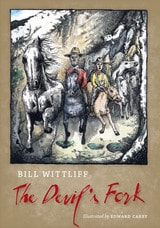
The Devil's Fork
By Bill Wittliff
University of Texas Press, 2018
The Devil’s Fork opens with the boy Papa exclaiming, “They was gonna hang my o’Amigo Calley Pearsall out there in front a’the Alamo down in San Antoneya come Saturday Noon and if I was gonna stop it I better Light a Shuck and Get on with it. And I mean Right Now.” And so Papa and his sweetheart Annie Oster set off to rescue Calley, thereby launching themselves into another series of hair-raising adventures.
The Devil’s Fork concludes the enthralling journey through wild and woolly Central Texas in the 1880s that began in The Devil’s Backbone and The Devil’s Sinkhole. Papa springs Calley from jail, but their troubles are far from over. Framed for murder, the two amigos have to flee for their lives. Joining their flight this time is o’Johnny, the evil Sheriff Pugh’s disabled little brother, who has uncanny abilities. Escaping danger for a while, Papa and Calley try to start a new life as horse traders, only to find themselves branded as horse thieves when o’Johnny and a mysterious white ghost horse begin rescuing abused horses from their masters. Can Papa and Calley escape the noose and save all the horses that Johnny and the White Horse liberate? Or will their own hot tempers send them down the Devil’s Fork, from which no one ever returns?
Proving himself a master storyteller once again, Bill Wittliff spins a yarn as engrossing as the stories his own Papa told him long ago, stories that inspired The Devil’s Backbone, The Devil’s Sinkhole, and The Devil’s Fork.
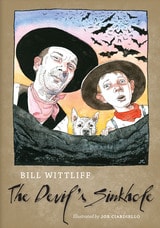
The Devil's Sinkhole
By Bill Wittliff; illustrated by Joe Ciardiello
University of Texas Press, 2016
When last we saw the boy Papa in The Devil’s Backbone, he had finally learned the fate of his missing Momma and his vicious daddy, Old Karl. But hardly has he concluded that quest before another one is upon him. Now a white-haired man with a hangman’s noose around his neck and death in his eye—o’Pelo Blanco—is coming. And he means to hang Papa.
In The Devil’s Sinkhole, the master storyteller Bill Wittliff takes us on another enthralling journey through wild and woolly Central Texas in the 1880s. When Papa and his o’amigo Calley Pearsall confront Pelo Blanco before he can ambush Papa, the encounter sets them on a pursuit with a promise of true love at the end, if only they can stay alive long enough for Calley to win the beautiful Pela Rosa, the captive/companion of Pelo Blanco. But before they can even hope to be united with Pela and Annie Oster, Papa’s plucky sweetheart, Papa and Calley have to defeat not only Pelo Blanco but also the evil, murdering Arlon Clavic and deliver Little Missey, the mysterious Wild Woman a’the Navidad, to the safe haven of the Choat farm. With dangers and emergencies around every bend, it’s a rough ride to the Devil’s Sinkhole, where this world and the next come together, bringing Papa and Calley, Pelo Blanco and Arlon to a climax that will leave readers clamoring for the next adventure.
The Dynastic Imagination
Family and Modernity in Nineteenth-Century GermanyAdrian Daub
University of Chicago Press, 2021
Daub builds this conception of dynasty in a syncretic study of literature, sciences, and the history of ideas, engaging with remnants of dynastic ideology in the work of Richard Wagner, Émile Zola, and Stefan George, and in the work of early feminists and pioneering psychoanalysts. At every stage of cultural progression, Daub reveals how the relation of dynastic to nuclear families inflected modern intellectual history.
The Failure of Our Fathers
Family, Gender, and Power in Confederate AlabamaVictoria E. Ott
University of Alabama Press, 2023
An in-depth study of non-elite white families in Alabama—from the state’s creation through the end of the Civil War
The Failure of Our Fathers: Family, Gender, and Power in Confederate Alabama examines the evolving position of non-elite white families in Alabama during one of the most pivotal epochs in the state’s history. Drawing on a wide range of personal and public documents reflecting the state’s varied regions and economies, Victoria E. Ott uses gender and family as a lens to examine the yeomanry and poor whites, a constituency that she collectively defines as “common whites,” who identified with the Confederate cause.
Ott provides a nuanced examination of how these Alabamians fit within the antebellum era’s paternalistic social order, eventually identifying with and supporting the Confederate mission to leave the Union and create an independent, slaveholding state. But as the reality of the war slowly set in and the Confederacy began to fray, the increasing dangers families faced led Alabama’s common white men and women to find new avenues to power as a distinct socioeconomic class.
Ott argues that family provided the conceptual framework necessary to understand why common whites supported a war to protect slavery despite having little or no investment in the institution. Going to war meant protecting their families from outsiders who threatened to turn their worlds upside down. Despite class differences, common whites envisioned the Confederacy as a larger family and the state as paternal figures who promised to protect its loyal dependents throughout the conflict. Yet, as the war ravaged many Alabama communities, devotion to the Confederacy seemed less a priority as families faced continued separations, threats of death, and the potential for starvation. The construct of a familial structure that once created a sense of loyalty to the Confederacy now gave them cause to question its leadership. Ott shows how these domestic values rooted in highly gendered concepts ultimately redefined Alabama’s social structure and increased class distinctions after the war.
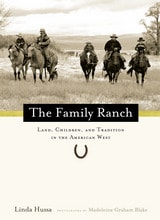
The Family Ranch
Land, Children, and Tradition in the American WestLinda Hussa
University of Nevada Press, 2010
Ranch families in the twenty-first century face many challenges, from competition with government-subsidized agribusiness corporations to tax laws that encourage development over agriculture and prevent the smooth transfer of land from one generation to the next. As a stabilizing force in the American West, ranch families play a critical role in our country, perhaps more so today than ever before, yet their stories have rarely been told. They contribute to our nation with the food they raise, the environments they protect, and the resources they manage, and they preserve our western heritage while holding the West open for the rest of us. In The Family Ranch, award-winning author Linda Hussa offers readers a personal, inside view into the lives of six diverse ranching families and the land that shapes their days and nights. Photographer Madeleine Graham Blake provides engaging and often moving images that portray each family at work and at play. With chapters on the critical issues that face each of them—from grazing rights and water use, to children's education and the emerging rural marketplace—these family profiles are set in a larger context. This is family ranching as it is now, a tracing of how it always was, but made far more complex in modern times. By combining their traditions with the tools of modern technology, these people strengthen the ideal of family and give the business of ranching a vibrant and viable future.The Family Ranch is rich in remarkable stories of what happens when parents, children, work, and nature come together for a lifetime of commitment. It speaks to urban and rural people in important ways, illuminating the realities of the western ranch and the people who make their living, and their lives, on it. Essential reading for people who love the West and care about its future. The Family Ranch inspires thoughts about tradition, values, and responsibility that are applicable to all communities.
The Family as Basic Social Unit
Living Out Catholic Social TeachingKevin Schemenauer
Catholic University of America Press, 2024
The Functional Dialectic System Approach to Therapy for Individuals, Couples, and Families
Moshe Almagor
University of Minnesota Press, 2011
The functional dialectic system approach to therapy has been widely embraced and is now used internationally, with individuals and couples as well as with families. It differs substantially from the common psychotherapeutic models that have prevailed in the West for more than a century. According to the system model, an individual who is in treatment is not considered to be the primary focus of interest but is seen instead as part of a social context, the network of relationships that play significant roles in his or her life.
In this book, Moshe Almagor offers a comprehensive view of the contemporary system approach—from theory to practice—and shows how it can be applied to a variety of psychological problems and in a variety of therapeutic modes. The system approach to therapy concentrates on the present situation of a client, aware that people are always in transition yet seeking order, safety, belonging, and identity. Their behavior is thus goal oriented and functional. The principles of dialectics assert that everything includes its opposite, that there is an ongoing conflict between the poles, and that this inevitable conflict creates pressure that leads to a continuous alteration.
These principles, thoroughly explained in the book and practically illustrated by case examples drawn from the author’s own practice, show how the system approach is optimistic in its orientation and is designed to help clients change their lives by broadening their understanding of themselves, their situations, and their options.
The Future of the Family
Daniel Patrick Moynihan
Russell Sage Foundation, 2004
The Kin Who Count
Family and Society in Ottoman Aleppo, 1770-1840By Margaret L. Meriwether
University of Texas Press, 1999
The history of the Middle Eastern family presents as many questions as there are currently answers. Who lived together in the household? Who married whom and for how long? Who got a piece of the patrimonial pie? These are the questions that Margaret Meriwether investigates in this groundbreaking study of family life among the upper classes of the Ottoman Empire in the pre-modern and early modern period.
Meriwether recreates Aleppo family life over time from records kept by the Islamic religious courts that held jurisdiction over all matters of family law and property transactions. From this research, she asserts that the stereotype of the large, patriarchal patrilineal family rarely existed in reality. Instead, Aleppo's notables organized their families in a great diversity of ways, despite the fact that they were all members of the same social class with widely shared cultural values, acting under the same system of family law. She concludes that this had important implications for gender relations and demonstrates that it gave women more authority and greater autonomy than is usually acknowledged.
The Kukotsky Enigma
A NovelLudmila Ulitskaya; Translated from the Russian by Diane Nemec Ignashev
Northwestern University Press, 2016
Translated from the Russian by Diane Nemec Ignashev
The central character in Ludmila Ulitskaya’s celebrated novel The Kukotsky Enigma is a gynecologist contending with Stalin’s prohibition of abortions in 1936. But, in the tradition of Russia’s great family novels, the story encompasses the history of two families and unfolds in Moscow, St. Petersburg, and the ruins of ancient civilizations on the Black Sea. Their lives raise profound questions about family heritage and genetics, nurture and nature, and life and death. In his struggle to maintain his professional integrity and to keep his work from dividing his family, Kukotsky confronts the moral complexity of reproductive science. Winner of the 2001 Russian Booker Prize and the basis for a blockbuster television miniseries, The Kukotsky Enigma is an engrossing, searching novel by one of contemporary literature’s most brilliant writers.
The Politics of Kinship
Race, Family, GovernanceMark Rifkin
Duke University Press, 2024
The Price of Independence
The Economics of Early AdulthoodSheldon Danziger
Russell Sage Foundation, 2007
The Reformation of Machismo
Evangelical Conversion and Gender in ColombiaBy Elizabeth E. Brusco
University of Texas Press, 1995
Protestant evangelicalism has spread rapidly in Latin America at the same time that foreign corporations have taken hold of economies there. These concurrent developments have led some observers to view this religious movement as a means of melding converts into a disciplined work force for foreign capitalists rather than as a reflection of conscious individual choices made for a variety of personal, as well as economic, reasons.
In this pioneering study, Elizabeth Brusco challenges such assumptions and explores the intra-household motivations for evangelical conversion in Colombia. She shows how the asceticism required of evangelicals (no drinking, smoking, or extramarital sexual relations are allowed) redirects male income back into the household, thereby raising the living standard of women and children. This benefit helps explain the appeal of evangelicalism for women and questions the traditional assumption that organized religion always disadvantages women.
Brusco also demonstrates how evangelicalism appeals to men by offering an alternative to the more dysfunctional aspects of machismo. Case studies add a fascinating human dimension to her findings.
With the challenges this book poses to conventional wisdom about economic, gender, and religious behavior, it will be important reading for a wide audience in anthropology, women’s studies, economics, and religion. For all students of Latin America, it offers thoughtful new perspectives on a major, grass-roots agent of social change.
The Scattered Family
Parenting, African Migrants, and Global InequalityCati Coe
University of Chicago Press, 2013

The Summers
Ronya Othmann, translated by Gary Schmidt
University of Wisconsin Press, 2023
Leyla’s sexual awakening proves far less traumatic than her growing disenchantment with her German classmates and friends, who appear completely indifferent to the fate of her Yazidi community. Thoughtful and poignant, The Summers addresses issues of gender, sexuality, cultural difference, politics, and identity. Othmann draws readers into multiple worlds, ultimately revealing the hopes and dreams that bind us all together when forces threaten to tear us apart.
The Theater Will Rock
A History of the Rock Musical, from Hair to HedwigElizabeth L. Wollman
University of Michigan Press, 2010
"A much-needed study of the impact of rock music on the musical theater and its resulting challenges, complexities, failures, and successes. Anyone interested in Broadway will learn a great deal from this book."
---William Everett, author of The Musical: A Research Guide to Musical Theatre
"As Wollman weaves her historical narrative, she compellingly returns to . . . the conflict between the aesthetics and ideologies of rock music and the disciplined and commercial practices of the musical stage."
---Theatre Research International
"This well-written account puts the highs and lows of producing staged rock musicals in New York City into perspective and is well worth reading for the depth of insight it provides."
---Studies in Musical Theatre
Despite the genre’s influence and fame, there are still some critics who claim that the term “rock musical” is an oxymoron. The relationship between rock and the musical theater has been stormy from the start, and even the comparatively recent success of Rent has done little to convince theater producers that rock musicals are anything but highly risky ventures. Elizabeth L. Wollman explores the reasons behind these problematic connections and looks at the socioeconomic forces that underlie aesthetic decisions. She weighs the influence on the rock musical by mass media, sound, and recording technology, and the economic pressures that have affected New York theater in general over the past three decades. Finally, Wollman offers a meditation on the state of the musical, its relation to rock, and, ultimately, its future.
Packed with candid commentary by members of New York's vibrant theater community, The Theater Will Rock traces the rock musical’s evolution over nearly fifty years, in popular productions such as Hair, The Who's Tommy, Jesus Christ Superstar, The Rocky Horror Picture Show, Little Shop of Horrors, Rent, and Mamma Mia!—and in notable flops such as The Capeman.
Elizabeth L. Wollman is Assistant Professor of Music at Baruch College of the City University of New York.
The Turn
A NovellaRachel Feder
Northwestern University Press, 2026
A contemporary gothic delving into the power of unmoored lust and familial bonds
When Baxter, a young writer and recent college graduate, accepts a live-in nanny position for an affluent professor’s family in the foothills of the Rocky Mountains, she rapidly becomes aware of strange happenings orbiting the family and their children, Quinn and Thebes. After the father becomes estranged and the mother disappears into the night with only one child, Baxter is left utterly lost and in charge of the baby, Thebes, as she struggles to make sense of the bizarre occurrences within the family, the house, and even her own body. But the unnatural occurrences are far from over, and as Baxter stumbles in the dark to protect the child, something sinister stalks the night, looking to sink in its teeth.
For fans of gothic classics such as The Turn of the Screw and Carmilla, The Turn is an eerie and magnificent modern gothic tale about the monstrous bond of love between caregiver and child.
The Two-Parent Privilege
How Americans Stopped Getting Married and Started Falling BehindMelissa S. Kearney
University of Chicago Press, 2023
In The Two-Parent Privilege, Melissa S. Kearney makes a provocative, data-driven case for marriage by showing how the institution’s decline has led to a host of economic woes—problems that have fractured American society and rendered vulnerable populations even more vulnerable. Eschewing the religious and values-based arguments that have long dominated this conversation, Kearney shows how the greatest impacts of marriage are, in fact, economic: when two adults marry, their economic and household lives improve, offering a host of benefits not only for the married adults but for their children. Studies show that these effects are today starker, and more unevenly distributed, than ever before. Kearney examines the underlying causes of the marriage decline in the US and draws lessons for how the US can reverse this trend to ensure the country’s future prosperity.
Based on more than a decade of economic research, including her original work, Kearney shows that a household that includes two married parents—holding steady among upper-class adults, increasingly rare among most everyone else—functions as an economic vehicle that advantages some children over others. As these trends of marriage and class continue, the compounding effects on inequality and opportunity grow increasingly dire. Their effects include not just children’s behavioral and educational outcomes, but a surprisingly devastating effect on adult men, whose role in the workforce and society appears intractably damaged by the emerging economics of America’s new social norms.
For many, the two-parent home may be an old-fashioned symbol of the idyllic American dream. But The Two-Parent Privilege makes it clear that marriage, for all its challenges and faults, may be our best path to a more equitable future. By confronting the critical role that family makeup plays in shaping children’s lives and futures, Kearney offers a critical assessment of what a decline in marriage means for an economy and a society—and what we must do to change course.
The Unwanted Child
The Fate of Foundlings, Orphans, and Juvenile Criminals in Early Modern GermanyJoel F. Harrington
University of Chicago Press, 2009
The baby abandoned on the doorstep is a phenomenon that has virtually disappeared from our experience, but in the early modern world, unwanted children were a very real problem for parents, government officials, and society. The Unwanted Child skillfully recreates sixteenth-century Nuremberg to explore what befell abandoned, neglected, abused, or delinquent children in this critical period.
Joel F. Harrington tackles this question by focusing on the stories of five individuals. In vivid and poignant detail, he recounts the experiences of an unmarried mother-to-be, a roaming mercenary who drifts in and out of his children’s lives, a civic leader handling the government’s response to problems arising from unwanted children, a homeless teenager turned prolific thief, and orphaned twins who enter state care at the age of nine. Braiding together these compelling portraits, Harrington uncovers and analyzes the key elements that link them, including the impact of war and the vital importance of informal networks among women. From the harrowing to the inspiring, The Unwanted Child paints a gripping picture of life on the streets five centuries ago.
The Weather Changed, Summer Came and So On
Pedro Carmona-Alvarez
Seagull Books, 2015
The Weather Changed, Summer Came and So On is a haunting novel about love, loss, and identity that focuses on the survival of trauma. Translated beautifully from its original Norwegian by Diane Oatley, it constructs and inhabits a liminal world as the protagonists seek to stay afloat amid grief and estrangement. This is a gripping, heartbreaking story that will move readers with its timelessness and universal relevance.
Thundering Sneakers
By Prudence Mackintosh
University of Texas Press, 2002
To Have and to Hold
Marriage, the Baby Boom, and Social ChangeJessica Weiss
University of Chicago Press, 2000
Jessica Weiss delves beneath these mythic images and paints a far more complex picture that reveals strong continuities between the baby boomers and their parents. Drawing on interviews with American couples from the 1950s to the 1980s, Weiss creates a dynamic portrait of family and social change in the postwar era. She pairs these firsthand accounts with a deft analysis of movies, television shows, magazines, and advice books from each decade, providing an unprecedented and intimate look at ordinary marriages in a time of sweeping cultural change.
Weiss shows how young couples in the 1950s attempted to combine egalitarian hopes with traditional gender roles. Middle-class women encouraged their husbands to become involved fathers. Midlife wives and mothers reshaped the labor force and the home by returning to work in the 1960s. And couples strove for fulfilling marriages as they dealt with the pressures of childrearing in the midst of the sexual and divorce revolutions of the 1960s and 1970s. By the 1980s, they were far more welcoming to the ideas of the women's movement than has often been assumed. More than simply changing with the times, the parents of the baby boom contributed to changing times themselves.
Weiss's excellent use of family interviews that span three decades, her imaginative examination of popular culture, and her incisive conclusions make her book an invaluable contribution not only to our understanding of the past but also to our understanding of men's and women's roles in today's family.
"Weiss has written an enlightening book that examines the dynamics of American families past and present. . . . Since Weiss is a historian, she provides analyses of her arguments that are factual rather than emotive, and her use of family interviews further contributes to a strong presentation. Overall, this is a unique works because its multidisciplinary approach informs but never preaches on the emotionally charged topic of the American family.—Sheila Devaney, Library Journal
Troubling the Family
The Promise of Personhood and the Rise of MultiracialismHabiba Ibrahim
University of Minnesota Press, 2012
Troubling the Family argues that the emergence of multiracialism during the 1990s was determined by underlying and unacknowledged gender norms. Opening with a germinal moment for multiracialism—the seemingly massive and instantaneous popular appearance of Tiger Woods in 1997—Habiba Ibrahim examines how the shifting status of racial hero for both black and multiracial communities makes sense only by means of an account of masculinity.
Ibrahim looks across historical events and memoirs—beginning with the Loving v. Virginia case in 1967 when miscegenation laws were struck down—to reveal that gender was the starting point of an analytics that made categorical multiracialism, and multiracial politics, possible. Producing a genealogy of multiracialism’s gendered basis allows Ibrahim to focus on a range of stakeholders whose interests often ran against the grain of what the multiracial movement of the 1990s often privileged: the sanctity of the heteronormative family, the labor of child rearing, and more precise forms of racial tabulation—all of which, when taken together, could form the basis for creating so-called neutral personhood.
Ibrahim concludes with a consideration of Barack Obama as a representation of the resurrection of the assurance that multiracialism extended into the 2000s: a version of personhood with no memory of its own gendered legacy, and with no self-account of how it became so masculine that it can at once fill the position of political leader and the promise of the end of politics.