Results by title
207 books match the query 'Feminist theory' and 22 start with t

Taboo Memories, Diasporic Voices
Ella Shohat
Duke University Press, 2006
Shohat’s critical method boldly transcends disciplinary and geographical boundaries. She explores such issues as the relations between ethnic studies and area studies, the paradoxical repercussions for audio-visual media of the “graven images” taboo, the allegorization of race through the refiguring of Cleopatra, the allure of imperial popular culture, and the gender politics of medical technologies. She also examines the resistant poetics of exile and displacement; the staging of historical memory through the commemorations of the two 1492s, the anomalies of the “national” in Zionist discourse, the implications of the hyphen in the concept “Arab-Jew,” and the translation of the debates on orientalism and postcolonialism across geographies. Taboo Memories, Diasporic Voices not only illuminates many of the concerns that have animated the study of cultural politics over the past two decades; it also points toward new scholarly possibilities.
Technocreep and the Politics of Things Not Seen
Neda Atanasoski and Nassim Parvin, editors
Duke University Press, 2025
Contributors. Neda Atanasoski, Katherine Bennett, Iván Chaar López, Sushmita Chatterjee, Hayri Dortdivanlioglu, Sanaz Haghani, Jacob Hagelberg, Jennifer Hamilton, Antonia Hernández, Marjan Khatibi, Tamara Kneese, Erin McElroy, Vernelle A. A. Noel, Jessica Olivares, Nassim Parvin, Beth Semel, Renee Shelby, Tanja Wiehn
Technologies of the Gendered Body
Reading Cyborg WomenAnne Balsamo
Duke University Press, 1996
Technologies of the Gendered Body combines close readings of popular texts—such as Margaret Atwood’s novel The Handmaid’s Tale, the movie Pumping Iron II: The Women, cyberpunk magazines, and mass media—with analyses of medical literature, public policy documents, and specific technological practices. Balsamo describes the ways in which certain biotechnologies are ideologically shaped by gender considerations and other beliefs about race, physical abilities, and economic and legal status. She presents a view of the conceptual system that structures individuals’ access to and participation in these technologies, as well as an overview of individuals’ rights and responsibilities in this sometimes baffling area. Examining the ways in which the body is gendered in its interactions with new technologies of corporeality, Technologies of the Gendered Body counters the claim that in our scientific culture the material body has become obsolete. With ample evidence that the techno-body is always gendered and marked by race, this book sets the stage for a renewed feminist engagement with contemporary technological narratives.

Tendings
Feminist Esoterisms and the Abolition of ManNathan Snaza
Duke University Press, 2024
The Brain's Body
Neuroscience and Corporeal PoliticsVictoria Pitts-Taylor
Duke University Press, 2016

The Child to Come
Life after the Human CatastropheRebekah Sheldon
University of Minnesota Press, 2016
Generation Anthropocene. Storms of My Grandchildren. Our Children’s Trust. Why do these and other attempts to imagine the planet’s uncertain future return us—again and again—to the image of the child? In The Child to Come, Rebekah Sheldon demonstrates the pervasive conjunction of the imperiled child and the threatened Earth and blisteringly critiques the logic of catastrophe that serves as its motive and its method.
Sheldon explores representations of this perilous future and the new figurations of the child that have arisen in response to it. Analyzing catastrophe discourse from the 1960s to the present—books by Joanna Russ, Margaret Atwood, and Cormac McCarthy; films and television series including Southland Tales, Battlestar Galactica, and Children of Men; and popular environmentalism—Sheldon finds the child standing in the place of the human species, coordinating its safe passage into the future through the promise of one more generation. Yet, she contends, the child figure emerges bound to the very forces of nonhuman vitality he was forged to contain.
Bringing together queer theory, ecocriticism, and science studies, The Child to Come draws on and extends arguments in childhood studies about the interweaving of the child with the life sciences. Sheldon reveals that neither life nor the child are what they used to be. Under pressure from ecological change, artificial reproductive technology, genetic engineering, and the neoliberalization of the economy, the queerly human child signals something new: the biopolitics of reproduction. By promising the pliability of the body’s vitality, the pregnant woman and the sacred child have become the paradigmatic figures for twenty-first century biopolitics.
The Erotic as Rhetorical Power
Archives of Romantic Friendship between Women TeachersPamela VanHaitsma
The Ohio State University Press, 2024
Winner, 2025 Marie Hochmuth Nichols Award from the National Communication Association’s Public Address Division
The Erotic as Rhetorical Power offers a queer feminist history of rhetoric that recovers the civic contributions of women teachers in same-sex romantic friendships. Extending perspectives from ancient rhetoric to nineteenth-century progressivism, from Audre Lorde’s Black lesbian feminist theory to its present-day uptakes, Pamela VanHaitsma conceives of the erotic as an interanimation of desires that, in being passionately shared, becomes imbued with the power to forge connection and foment change.
VanHaitsma’s theory of the erotic as rhetorical power emerges from both historiographic and imaginative engagements with more than twenty archives of romantic friendships between women: Sallie Holley and Caroline Putnam, Irene Leache and Anna Wood, Gertrude Buck and Laura Wylie, and Rebecca Primus and Addie Brown. VanHaitsma considers how even as the erotic in these romantic friendships fueled the women’s rhetorical activities toward transformational ends—whether working toward the abolition of slavery, greater educational access, or voting rights—it also energized rhetorical activities that sometimes challenged but also reinforced troubling power dynamics. The Erotic as Rhetorical Power uncovers the erotic’s significance as a conflicted site of power that is central to rhetorical theory and history as well as feminist and LGBTQ+ studies.

The Fantasy of Feminist History
Joan Wallach Scott
Duke University Press, 2012

The Fate of Law
Austin Sarat and Thomas R. Kearns, Editors
University of Michigan Press, 1993
For law and legal theory the end of the twentieth century is a time of contradiction; while the newly emerging politics of Eastern Europe seek to establish a new rule of law, voices in this country proclaim the "death of law." For the former, law provides hope for stability and fairness. For the latter, the fundamental values that provide a grounding for legality seem no longer secure or satisfying. The Fate of Law is a collection of five original essays, each of which discusses the problems and prospects of law in the late twentieth century. The essays pay particular attention to the impact of broad intellectual and political movements, especially feminism and postmodernism, on law and legal theory.
The Fate of Law investigates what happens under the critical scrutiny of those movements and in an era of growing skepticism about law's central claim to objectivity, neutrality, and reason. It describes the struggles that ensue and the responses that are made. Each of the essays that comprise this books is written in its own style and voice; each makes it own judgments and assessments.

The Gloria Wekker Reader
Gloria Wekker. Chandra Frank, Nancy Jouwe, and Mikki Stelder, editors. Foreword by Angela Y. Davis.
Duke University Press, 2026

The International Relations of Middle-earth
Learning from The Lord of the RingsAbigail E. Ruane and Patrick James
University of Michigan Press, 2012
Based on their successful undergraduate course at the University of Southern California, Abigail E. Ruane and Patrick James provide an introduction to International Relations using J. R. R. Tolkien's fantastically popular trilogy The Lord of the Rings. Because Tolkien's major themes---such as good versus evil and human agency versus determinism---are perennially relevant to International Relations, The Lord of the Rings is well suited for application to the study of politics in our own world. This innovative combination of social science and humanities approaches to illustrate key concepts engages students and stimulates critical thinking in new and exciting ways.
The Perils of Populism
Sarah Tobias
Rutgers University Press, 2022
The Perils of Populism shows how a feminist lens can help diagnose the factors behind the global rise of right-wing populism and teach us how to resist the threat it presents to democracy. Featuring interdisciplinary essays about politics in the United States, the Middle East, Europe, and India from a variety of acclaimed theorists and activists, the volume contributes to a rapidly expanding literature on gender and the far right. Together, these chapters offer a truly intersectional analysis of the problem, addressing everything from how populism has thrived in a “post-truth” era to the ways it appeals to working-class voters looking for an alternative to neoliberalism. Yet the authors also find reasons to be hopeful, as they showcase forms of grassroots feminist activism that challenge right-wing populism by advocating for racial and economic justice.
The Question of Women in Chinese Feminism
Tani E. Barlow
Duke University Press, 2004
The Ruptures Of American Capital
Women Of Color Feminism And The Culture Of Immigrant LaborGrace Kyungwon Hong
University of Minnesota Press, 2006

The Second Signs Reader
Feminist Scholarship, 1983-1996Edited by Ruth-Ellen Boetcher Joeres and Barbara Laslett
University of Chicago Press, 1996
The Terrible We
Thinking with Trans MaladjustmentCameron Awkward-Rich
Duke University Press, 2022
Duke University Press Scholars of Color First Book Award recipient

The Unnatural Lottery
Character and Moral LuckClaudia Card
Temple University Press, 1996
The opportunities to become a good person are not the same for everyone. Modern European ethical theory, especially Kantian ethics, assumes the same virtues are accessible to all who are capable of rational choice. Character development, however, is affected by circumstances, such as those of wealth and socially constructed categories of gender, race, and sexual orientation, which introduce factors beyond the control of individuals. Implications of these influences for morality have, since the work of Williams and Nagel in the seventies, raised questions in philosophy about the concept of moral luck. In The Unnatural Lottery, Claudia Card examines how luck enters into moral character and considers how some of those who are oppressed can develop responsibility.
Luck is often best appreciated by those who have known relatively bad luck and have been unable to escape steady comparison of their lot with those of others. The author takes as her paradigms the luck of middle and lower classes of women who face violence and exploitation, of lesbians who face continuing pressure to hide or self-destruct, of culturally Christian whites who have ethnic privilege, and of adult survivors of child abuse. How have such people been affected by luck in who they are and can become, the good lives available to them, the evils they may be liable to embody? Other philosophers have explored the luck of those who begin from privileged positions and then suffer reversals of fortune. Claudia Card focuses on the more common cases of those who begin from socially disadvantaged positions, and she considers some who find their good luck troubling when its source is the unnatural lottery of social injustice.

Third Wave Agenda
Being Feminist, Doing FeminismLeslie Heywood
University of Minnesota Press, 1997
Discusses the challenges and pleasures of creating a new feminism.
Young feminists have grown up with a plethora of cultural choices and images-in the distance from Gloria Steinem to Courtney Love, a chasm has been traversed and an entire history made. In Third Wave Agenda, feminists born between the years 1964 and 1973 discuss the things that matter now, both in looking back at the accomplishments and failures of the past and in planning for the challenges of the future.
The women and men writing here are activists, teachers, cultural critics, artists, and journalists. They distinguish themselves from a group of young, conservative feminists, including Naomi Wolf and Katie Roiphe, who criticize second wave feminists and are regularly called on to speak for the “next generation” of feminism. In contrast, Third Wave Agenda seeks to complicate our understanding of feminism by not only embracing the second wave critique of beauty culture, sexual abuse, and power structures, but also emphasizing ways that desires and pleasures such as beauty and power can be used to enliven activist work, even while recognizing the importance of maintaining a critique of them.Combining research, theory, and social practice with an autobiographical style, these writers are hard at work creating a new feminism that draws on the submerged histories of other feminisms-black feminism, “womanism,” and working-class feminism, among others. Some topics explored in Third Wave Agenda include feminism in popular music, interracial coalitions, and tensions between individual ambitions and collective action. Contributors: Barry Baldridge, Ana Marie Cox, Ophira Edut, Tali Edut, Carol Guess, Freya Johnson, Melissa Klein, Dyann Logwood, Annalee Newitz, Jeff Niesel, Jennifer Reed, Jillian Sandel, Leigh Shoemaker, Michelle Sidler, Deborah L. Siegel, Jen Smith, Carolyn Sorisio, and Lidia Yukman.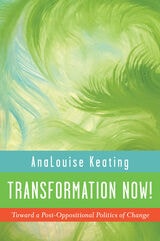
Transformation Now!
Toward a Post-Oppositional Politics of ChangeAnaLouise Keating
University of Illinois Press, 2013

Transforming Knowledge 2Nd Edition
Elizabeth Kamarck Minnich
Temple University Press, 2004
* Updated to consider recent scholarship in Gender, Multicultural, Postcolonial, Disability, Native American, and Queer Studies, among other fields of study
* Revised to include an extended analysis of the conceptual errors that legitimate domination, including the construction of kinds ("genders") of human beings
* Revised to include new materials from a variety of cultures and times, and engages with today's contemporary debates about affirmative action, postmodernism, and religion

Transnational Feminist Itineraries
Situating Theory and Activist PracticeAshwini Tambe and Millie Thayer, editors
Duke University Press, 2021
Contributors. Mary Bernstein, Isabel Maria Cortesão Casimiro, Rafael de la Dehesa, Carmen L. Diaz Alba, Inderpal Grewal, Cricket Keating, Amy Lind, Laura L. Lovett, Kathryn Moeller, Nancy A. Naples, Jennifer C. Nash, Amrita Pande, Srila Roy, Cara K. Snyder, Ashwini Tambe, Millie Thayer, Catarina Casimiro Trindade
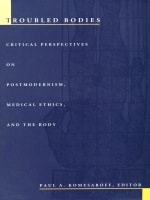
Troubled Bodies
Critical Perspectives on Postmodernism, Medical Ethics, and the BodyPaul A. Komesaroff
Duke University Press, 1995
These essays examine the ways in which the consideration of ethical questions is shaped by the structures of knowledge and communication at work in clinical practice, by current assumptions regarding the concept of the body, and by the social and political implications of both. Representing various perspectives including medicine, nursing, philosophy, and sociology, these essays look anew at issues of abortion, reproductive technologies, the doctor-patient relationship, the social construction of illness, the cultural assumptions and consequences of medicine, and the theoretical presuppositions underlying modern psychiatry. Diverging from the tenets of mainstream bioethics, Troubled Bodies suggests that, rather than searching for the correct "coherent perspective" from which to draw ethical principles, we must apprehend the complexity and diversity of the discursive systems within which we dwell.