Results by title
377 books match the query 'French' and 106 start with t
Take It or Leave It
Raymond Federman
University of Alabama Press, 1976
Moving freely from past to present (and Vice Versa), and from place to place leap-frogging from digression to digression, Take It or Leave It explores new possibilities of narrative technique. Whie the story of Frenchy is being told, the narrator involves his listeners in digressive arguments about politics, sex, America, literature, laughter, death, and the telling of the story itself. Consequently, as this "exaggerated second-hand tale to be read aloud either standing or sitting" progresses, it also deviates from its course, and eventually cancels itself as the voices of the fiction multiply. Take It or Leave It, the ultimate postmodern novel, makes a shamble of traditional fiction and conventional modes of writing, and does so with effrontery and laughter.
Tales and Trials of Love, Concerning Venus’s Punishment of Those Who Scorn True Love and Denounce Cupid’s Sovereignty
A Bilingual Edition and StudyJeanne Flore
Iter Press, 2014
Talk and Textual Production in Medieval England
Marisa Libbon
The Ohio State University Press, 2021
The Age of Eclecticism
Literature and Culture in Britain, 1815–1885Christine Bolus-Reichert
The Ohio State University Press, 2009

The Anchor’s Long Chain
Yves Bonnefoy
Seagull Books, 2015
Yves Bonnefoy has wowed the literary world for decades with his diffuse volumes. First published in France in 2008, The Anchor’s Long Chain is an indispensable addition to his oeuvre. Enriching Bonnefoy’s earlier work, the volume, translated by Beverley Bie Brahic, also innovates, including an unprecedented sequence of nineteen sonnets. These sonnets combine the strictness of the form with the freedom to vary line length and create evocative fragments. Compressed, emotionally powerful, and allusive, the poems are also autobiographical—but only in glimpses. Throughout, Bonnefoy conjures up life’s eternal questions with each new poem.
Longer, discursive pieces, including the title poem’s meditation on a prehistoric stone circle and a legend about a ship, are also part of this volume, as are a number of poetic prose pieces in which Bonnefoy, like several of his great French predecessors, excels. Long-time fans will find much to praise here, while newer readers will quickly find themselves under the spell of Bonnefoy’s powerful, discursive poetry.
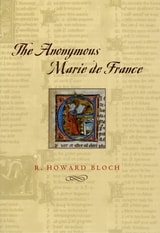
The Anonymous Marie de France
R. Howard Bloch
University of Chicago Press, 2003
Evidence about Marie de France's life is so meager that we know next to nothing about her-not where she was born and to what rank, who her parents were, whether she was married or single, where she lived and might have traveled, whether she dwelled in cloister or at court, nor whether in England or France. In the face of this great writer's near anonymity, scholars have assumed her to be a simple, naive, and modest Christian figure. Bloch's claim, in contrast, is that Marie is among the most self-conscious, sophisticated, complicated, and disturbing figures of her time-the Joyce of the twelfth century. At a moment of great historical turning, the so-called Renaissance of the twelfth century, Marie was both a disrupter of prevailing cultural values and a founder of new ones. Her works, Bloch argues, reveal an author obsessed by writing, by memory, and by translation, and acutely aware not only of her role in the preservation of cultural memory, but of the transforming psychological, social, and political effects of writing within an oral tradition.
Marie's intervention lies in her obsession with the performative capacities of literature and in her acute awareness of the role of the subject in interpreting his or her own world. According to Bloch, Marie develops a theology of language in the Lais, which emphasize the impossibility of living in the flesh along with a social vision of feudalism in decline. She elaborates an ethics of language in the Fables, which, within the context of the court of Henry II, frame and form the urban values and legal institutions of the Anglo-Norman world. And in her Espurgatoire, she produces a startling examination of the afterlife which Bloch links to the English conquest and occupation of medieval Ireland.
With a penetrating glimpse into works such as these, The Anonymous Marie de France recovers the central achievements of one of the most pivotal figures in French literature. It is a study that will be of enormous value to medievalists, literary scholars, historians of France, and anyone interested in the advent of female authorship.

The Arkansas Post of Louisiana
Morris S. Arnold
University of Arkansas Press, 2017
Arkansas Post, the first European settlement in what would become Jefferson’s Louisiana, had an important mission as the only settlement between Natchez and the Illinois Country, a stretch of more than eight hundred miles along the Mississippi River. The Post was a stopping point for shelter and supplies for those travelling by boat or land, and it was of strategic importance as well, as it nurtured and sustained a crucial alliance with the Quapaw Indians, the only tribe that occupied the region.
The Arkansas Post of Louisiana covers the most essential aspects of the Post’s history, including the nature of the European population, their social life, the economy, the architecture, and the political and military events that reflected and shaped the Post’s mission.
Beautifully illustrated with maps, portraits, lithographs, photographs, documents, and superb examples of Quapaw hide paintings, The Arkansas Post of Louisiana is a perfect introduction to this fascinating place at the confluence of the Arkansas and Mississippi Rivers, a place that served as a multicultural gathering spot, and became a seminal part of the history of Arkansas and the nation.
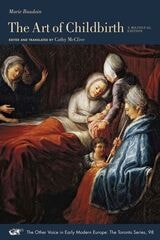
The Art of Childbirth
A Seventeenth-Century Midwife’s Epistolary Treatise to Doctor Vallant: A Bilingual EditionMarie Baudoin
Iter Press, 2022
In 1671, Marie Baudoin (1625–1700), head midwife and governor of the Hôtel-Dieu of Clermont-Ferrand, sent a treatise on the art of childbirth to her powerful Parisian patron, Dr. Vallant. The story of how Baudoin’s knowledge and expertise as a midwife came to be expressed, recorded, and archived raises the question: Was Baudoin exceptional because she was herself extraordinary, or because her voice has reached us through Vallant’s careful archival practices? Either way, Baudoin’s treatise invites us to reconsider the limits of what we thought we knew midwives “could be and do” in seventeenth-century France. Grounding Marie Baudoin’s text in a microanalysis of her life, work, and the Jansenist network between Paris and Clermont-Ferrand, this book connects historiographies of midwifery, Jansenism, hospital administration, public health, knowledge and record-keeping, and women’s work, underscoring both Baudoin’s capabilities and the archival accidents and intentions behind the preservation of her treatise in a letter.
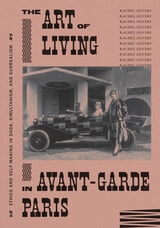
The Art of Living in Avant-Garde Paris
Ethics and Self-Making in Dada, Simultanism, and SurrealismRachel Silveri
University of Chicago Press, 2026
With The Art of Living in Avant-Garde Paris, Rachel Silveri takes a fresh look at the desire to unify art and life, an ambition long regarded as foundational to the European historical avant-gardes. She reveals how many early twentieth-century artists saw their own everyday lives—their bodies, identities, and relationships—as a type of creative material and a central component to their avant-garde practice. These artists abandoned traditional forms of artmaking and venues of art viewing, instead aspiring to integrate art with everyday life, creating an “art of living.”
Considering Tristan Tzara’s performances of Dadaist identity, Sonia Delaunay’s simultaneous fashions and self-branding, and the collective endeavor to open and operate the Surrealist Research Bureau, Silveri offers a new narrative about how the artists of interwar Paris developed experiential life practices that resisted dominant forms of “lifestyle” and normative discourses surrounding gender, ethnicity, and office work. This book argues that ethical questions of “How should I live?” and “How should I relate to others?” were as important to the avant-garde as politics, and that aspirations to change the world played out in daily practices of self-making.
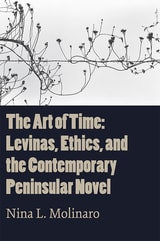
The Art of Time
Levinas, Ethics, and the Contemporary Peninsular NovelNina L. Molinaro
Bucknell University Press, 2019
Academicians and journalists in Spain and abroad have recently fastened on an emerging cluster of peninsular writers who, they argue, pertain to a discernible literary generation, provisionally referred to as Generación X. These writers are distinct from their predecessors; they and their literary texts are closely related to the specific socio-political and historical circumstances in Spain and their novels relate stories of more and less proximity, more and less responsibility, and more and less temporality. In short, they trace the temporal movement of alterity through narrative.
Published by Bucknell University Press. Distributed worldwide by Rutgers University Press.

The Beast, and Other Tales
Jóusè d'Arbaud; Translated from the Provençal by Joyce Zonana
Northwestern University Press, 2020
Winner of the Global Humanities Prize
A classic of modern Provençal literature, Jóusè d’Arbaud’s 1926 masterpiece “The Beast of Vacarés” (also known as “The Beast of Vaccarès”) is a haunting parable. Set during the fifteenth century, the tale is narrated by a solitary bull herder—known as a gardian—who stumbles upon a starving creature that is half man, half goat. Terrified, the gardian is nonetheless drawn to the eloquent Beast, a dying demigod who laments the loss of his glorious past even as he wields power over the animals around him. Torn between pity and fear, unable to understand his experiences and afraid he will be condemned for heresy, the gardian records his encounters in a journal, hoping that one day readers will make sense of what he cannot.
Set in the vast, lonely landscape of the Camargue delta, where the Rhône meets the Mediterranean, The Beast seamlessly melds fantasy with naturalistic detail about the region’s flora and fauna. Three additional stories—“The Caraco,” “Pèire Guilhem’s Remorse,” and “The Longline”—explore the lives of twentieth-century gardians in the region. Each man succumbs to fears and social pressure, tragically losing what he most loves.
The Book as Instrument
Stéphane Mallarmé, the Artist's Book, and the Transformation of Print CultureAnna Sigrídur Arnar
University of Chicago Press, 2011
Stéphane Mallarmé (1842–98) was a French Symbolist poet, theorist, and teacher whose ideas and legendary salons set the stage for twentieth-century experimentation in poetry, music, theater and art. A canonical figure in the legacy of modernism, Mallarmé was also a lifelong champion of the book as both a literary endeavor and a carefully crafted material object.
In The Book as Instrument, Anna Sigrídur Arnar explores how this object functioned for Mallarmé and his artistic circle, arguing that the book became a strategic site for encouraging a modern public to actively partake in the creative act, an idea that informed later twentieth-century developments such as conceptual and performance art. Arnar demonstrates that Mallarmé was invested in creating radically empowering reading experiences, and the diverse modalities he proposed for both reading and looking anticipate interactive media prevalent in today’s culture. In describing the world of books, visual culture, and mass media of the late nineteenth century, Arnar touches upon an array of themes that continues to preoccupy us in our own moment, including speculations on the future of the book. Enhanced by gorgeous illustrations, The Book as Instrument is sure to fascinate anyone interested in the ever-vibrant experiment between word and image that makes the page and the multi-sensory pleasures of reading.
The Book of Margins
Edmond Jabès
University of Chicago Press, 1993
In The Book of Margins, his most critical as well as most accessible book, Jabès is again concerned with the questions that inform all of his work: the nature of writing, of silence, of God and the Book. Jabès considers the work of several of his contemporaries, including Georges Bataille, Maurice Blanchot, Roger Caillois, Paul Celan, Jacques Derrida, Michel Leiris, Emmanuel Lévinas, Pier Paolo Pasolini, and his translator, Rosmarie Waldrop. This book will be important reading for students of Jewish literature, French literature, and literature of the modern and postmodern ages.
Born in Cairo in 1912, Edmond Jabès lived in France from 1956 until his death in 1991. His extensively translated and widely honored works include The Book of Questions and The Book of Shares. Both of these were translated into English by Rosmarie Waldrop, who is also a poet.
Religion and Postmodernism series

The Book of Shares
Edmond Jabès
University of Chicago Press, 1989
Balance sheet of a life ratified by death.
Whatever exists has no existence unless shared.
Possessions under seal are lost possessions.
At first sight, giving, offering yourself in order to receive an equivalent gift in return, would seem to be ideal sharing.
But can All be divided?
Can a feeling, a book, a life be shared entirely?
On the other hand, if we cannot share all, what remains and will always remain outside sharing? What has never, at the heart of our possessions, been ours?
And what if we can share the vital desire to share, our only means of escape from solitude, from nothingness?
The Book of the Mutability of Fortune
Christine de Pizan
Iter Press, 2017
Christine de Pizan (ca. 1364–ca. 1431) has long been recognized as France’s first professional woman of letters, and interest in her voluminous and wide-ranging corpus has been steadily rising for decades. During the tumultuous later years of the Hundred Years’ War, Christine’s lone but strong feminine voice could be heard defending women, expounding the highest ideals for good governance, and lamenting France’s troubled times alongside her own personal trials. In The Mutability of Fortune, Christine fuses world history with autobiography to demonstrate mankind’s subjugation to the ceaselessly changing, and often cruel, whims of Fortune. Now, for the first time, this poem is accessible to an English-speaking audience, further expanding our appreciation of this ground-breaking woman author and her extraordinary body of work.
The Brush and the Pen
Odilon Redon and LiteratureDario Gamboni
University of Chicago Press, 2011
French symbolist artist Odilon Redon (1840–1916) seemed to thrive at the intersection of literature and art. Known as “the painter-writer,” he drew on the works of Poe, Baudelaire, Flaubert, and Mallarmé for his subject matter. And yet he concluded that visual art has nothing to do with literature. Examining this apparent contradiction, The Brush and the Pen transforms the way we understand Redon’s career and brings to life the interaction between writers and artists in fin-de-siècle Paris.
The Burden of Responsibility
Blum, Camus, Aron, and the French Twentieth CenturyTony Judt
University of Chicago Press, 1998
Through the prism of the lives of Leon Blum, Albert Camus, and Raymond Aron, Judt examines pivotal issues in the history of contemporary French society—antisemitism and the dilemma of Jewish identity, political and moral idealism in public life, the Marxist moment in French thought, the traumas of decolonization, the disaffection of the intelligentsia, and the insidious quarrels rending Right and Left. Judt focuses particularly on Blum's leadership of the Popular Front and his stern defiance of the Vichy governments, on Camus's part in the Resistance and Algerian War, and on Aron's cultural commentary and opposition to the facile acceptance by many French intellectuals of communism's utopian promise. Severely maligned by powerful critics and rivals, each of these exemplary figures stood fast in their principles and eventually won some measure of personal and public redemption.
Judt constructs a compelling portrait of modern French intellectual life and politics. He challenges the conventional account of the role of intellectuals precisely because they mattered in France, because they could shape public opinion and influence policy. In Blum, Camus, and Aron, Judt finds three very different men who did not simply play the role, but evinced a courage and a responsibility in public life that far outshone their contemporaries.
"An eloquent and instructive study of intellectual courage in the face of what the author persuasively describes as intellectual irresponsibility."—Richard Bernstein, New York Times

The Cadottes
A Fur Trade Family on Lake SuperiorRobert Silbernagel
Wisconsin Historical Society Press, 2023

The Centenary Edition of the Works of Nathaniel Hawthorne
Vol. XIV, The French and Italian NotebooksNathaniel Hawthorne
The Ohio State University Press, 1980
The Chief Rivals of Corneille and Racine
Lacy Lockert
Vanderbilt University Press, 0
No play by any of these dramatists, except Voltaire, has ever before been translated into English. The faithfulness and literary qualities of Dr. Lockert's translations are avouched by his two previous volumes in this field, The Chief Plays of Corneille and The Best Plays of Racine.
The Complete Fables of Jean de La Fontaine
Jean de La Fontaine
University of Illinois Press, 2007
Told in an elegant style, Jean de la Fontaine's (1621-95) charming animal fables depict sly foxes and scheming cats, vain birds and greedy wolves, all of which subtly express his penetrating insights into French society and the beasts found in all of us. Norman R. Shapiro has been translating La Fontaine's fables for over twenty years, capturing the original work's lively mix of plain and archaic language. This newly complete translation is destined to set the English standard for this work.
Awarded the Lewis Galantière Prize by the American Translators Association, 2008.
The Complete Fables of Jean de la Fontaine
Jean de la Fontaine, edited and with a rhymed verse translation by Norman B. Spector
Northwestern University Press, 1988
The Crime of Jean Genet
Dominique Eddé
Seagull Books, 2016
Dominique Eddé met novelist and playwright Jean Genet in the 1970s. And she never forgot him. “His presence,” she writes, “gave me the sensation of icy fire. Like his words, his gestures were full, calculated, and precise. . . . Genet’s movements mimicked the movement of time, accumulating rather than passing.”
This book is Eddé’s account of that meeting and its ripples through her years of engaging with Genet’s life and work. Rooted in personal reminiscences, it is nonetheless much broader, offering a subtle analysis of Genet’s work and teasing out largely unconsidered themes, like the absence of the father, which becomes a metaphor for Genet’s perpetual attack on the law. Tying Genet to Dostoevsky through their shared fascination with crime, Eddé helps us more clearly understand Genet’s relationship to France and Palestine, Judaism, Christianity, Islam, the theater, and even death. A powerful personal account of the influence of one writer on another, The Crime of Jean Genet is also one of the most penetrating explorations yet of Genet’s work and achievement.
The Culture of Disaster
Marie-Hélène Huet
University of Chicago Press, 2012
The Curved Cliché and the Filtering Net
Keywords in Nineteenth-Century French Print CultureCary Hollinshead-Strick
Northwestern University Press, 2027
Tracing multivalent words of nineteenth-century French print culture
The production of printed text changed radically over the course of the nineteenth century: Everything from the material used to make paper to the gender of the people assembling books shifted. Examining ten key terms as they took on new meanings in the world of print, Cary Hollinshead-Strick shows how the words, borrowed to name technical transformations, reveal the social expectations surrounding the birth of industrial print culture. Through these homonyms she connects papermaking to both Renaissance ceramics and fin-de-siècle japonisme, reveals the politics behind typos and the reasons women went to work in Parisian suburbs, shows how newspaper formats mapped onto rural and urban forms of entertainment and food, and explores the fantasy that information itself could be gathered and distributed in reliable, comprehensive ways.
By lingering over the resonances set in motion when ordinary words like canard and filet became terms for modern media formats, this book situates communication practices in the social, economic, and political environments that gave rise to them. This innovative approach not only elucidates nineteenth-century French print culture’s influence on the literature of the period but also invites us to consider the relationships between contemporary forms of information, media, labor, and language.

The Death Penalty, Volume I
Jacques Derrida
University of Chicago Press, 2013
With his signature genius and patient yet dazzling readings of an impressive breadth of texts, Derrida examines everything from the Bible to Plato to Camus to Jean Genet, with special attention to Kant and post–World War II juridical texts, to draw the landscape of death penalty discourses. Keeping clearly in view the death rows and execution chambers of the United States, he shows how arguments surrounding cruel and unusual punishment depend on what he calls an “anesthesial logic,” which has also driven the development of death penalty technology from the French guillotine to lethal injection. Confronting a demand for philosophical rigor, he pursues provocative analyses of the shortcomings of abolitionist discourse. Above all, he argues that the death penalty and its attendant technologies are products of a desire to put an end to one of the most fundamental qualities of our finite existence: the radical uncertainty of when we will die.
Arriving at a critical juncture in history—especially in the United States, one of the last Christian-inspired democracies to resist abolition—The Death Penalty is both a timely response to an important ethical debate and a timeless addition to Derrida’s esteemed body of work.
The Desert Is Alive
Aesthetic Cartographies and the SaharaJill Jarvis
University of Chicago Press, 0
How contemporary writers and filmmakers from across the African Sahara confront the colonial ideology of desert emptiness.
Jill Jarvis’s The Desert Is Alive challenges the image of the Sahara desert as a historical and cultural blank zone through a new “aesthetic cartography” that combines literary and film study with interdisciplinary thinking about space, borders, and infrastructures. In fields that still bear the imprint of a French colonial mindset, the Sahara has long been overlooked as a site of intellectual and cultural vitality. The Desert Is Alive breaks with a longstanding conceptual divide between “North” and “Subsaharan” Africa by resolutely centering the African Sahara and recognizing that the desert is not just full, but “peopled” in unexpected ways.
Jarvis accounts for colonial transformations of Saharan land during the twentieth century, attesting to the tactical and symbolic allure that this desert’s purported “emptiness” has held for French empire-building. Jarvis also considers how such tactics have been repurposed by postcolonial states. She takes up the last manuscript composed by Swiss writer Isabelle Eberhardt, who died in a flood at Aïn Sefra, Algeria in 1904, and examines the first novel published by French writer and aviator Antoine de Saint-Exupéry, composed while he worked as a pilot at Tarfaya, Morocco, in order to build the first trans-Saharan flight line during the 1920s. Jarvis then explores depictions of Timbuktu (Mali) and Nouadhibou (Mauretania) in films by Mauritanian-French director Abderrahmane Sissako. Jarvis concludes with chapters that unfold the unfinished history of French nuclear violence in the Sahara. First, she discusses multimedia and documentary works that reckon with the enduring impact of the seventeen nuclear bombs that France detonated in the Algerian desert in the 1960s. Finally, Jarvis turns to works by Tuareg poet and artist Hawad that confront the ongoing legacy of uranium mining on Indigenous land in northern Niger. The result is a rich contribution to Francophone cultural studies, African studies, postcolonial studies, and ecocriticism.
The Dream of Absolutism
Louis XIV and the Logic of ModernityHall Bjørnstad
University of Chicago Press, 2021
What was absolutism, and how did it work? What was the function of the ostentatious display surrounding Louis XIV at Versailles? What is gained—and what is lost—by approaching such expressions of absolutism as propaganda, as present-day scholars tend to do?
In this sweeping reconsideration of absolutist culture, Hall Bjørnstad argues that the exuberance of Louis XIV’s reign was not top-down propaganda in any modern sense, but rather a dream dreamt collectively, by king, court, image-makers, and nation alike. Bjørnstad explores this dream through a sustained close analysis of a corpus of absolutist artifacts, ranging from Charles Le Brun’s famous paintings in the Hall of Mirrors at Versailles via the king’s secret Mémoires to two little-known particularly extravagant verbal and textual celebrations of the king. The dream of absolutism, Bjørnstad concludes, lives at the intersection of politics and aesthetics. It is the carrier of a force that emerges as a glorious image; a participatory emotional reality that requires reality to conform to it. It is a dream, finally, that still shapes our collective political imaginary today.
The Early Novel in French
Poetics of a Genre in the MakingVirginia Krause
Northwestern University Press, 2027
Examining the role of changes in print technologies and poetics in the early novel
Around the same time that Aristotle’s Poetics was reemerging from obscurity, Rabelais was composing his Pantagruel series, while a host of influential works in a chivalric, sentimental, or pastoral vein were being imported from Spain and Italy. From this emergent corpus, Rabelais’s is the only name to have unambiguously made it into our modern canon of literary history, where he appears to stand alone as an early pioneer of the novel. The Early Novel in French: Poetics of a Genre in the Making explores the literary, cultural, and eminently material soil in which these early forms of what we would come to know as the novel originally took root, showing how they were imaginatively responding to the practices and uncertainties of the literary texts of their own era as well as to works of classical antiquity.
Within the flowering of experimental fictional forms in mid-sixteenth-century France, Virginia Krause identifies historical subplots shaping the development of this genre. As rhetorical culture continued to animate fictions through an active literary tradition, print culture was changing the very fabric of books. The early novel was thus at once rhetorically fashioned and technologically manufactured. Meanwhile, the legacy of medieval romance adventure persisted, making the early novel in French both a new laboratory for Aristotelian immersion and a vehicle for a mysterious and fugitive romanesque. Krause sheds fresh light on this new and rapidly evolving genre: its lifelike personas or “person-fictions”; its material forms, from pocket-sized volumes to vast literary serials; its immersive powers; and its underappreciated role in the production of the modern author.
The Economy of Glory
From Ancien Régime France to the Fall of NapoleonRobert Morrissey
University of Chicago Press, 2013
The Ethics of Persuasion
Derrida's Rhetorical LegaciesBrooke Rollins
The Ohio State University Press, 2020
Drawing on Derrida’s (non)definition of ethics and his pointed accounts of performativity, Rollins argues that this vital ethical component of many ancient theories, practices, and pedagogies of persuasion has been undertheorized for more than two millennia. Through deconstructive readings of some of these texts, she shows us that we are not simply sovereign beings who both wield and guard against linguistic techniques of rule. Our persuasive endeavors, rather, are made possible by an ethics—an always prior encounter with otherness that interrupts self-presence.
The Family Idiot
Gustave Flaubert, 1821-1857, Volume 2Jean-Paul Sartre
University of Chicago Press, 1987
Volume 2, consisting of the first book of part 2 of the original French work, takes the reader through Flaubert's adolescence well into his evolution as an artist. Sartre's approach to his complex subject, whether jaunty or ponderous, psychoanalytical or political, is captured in all of its rich variety of Carol Cosman's translation.
The Family Idiot
Gustave Flaubert, 1821-1857, Volume 3Jean-Paul Sartre
University of Chicago Press, 1989
Volume 3 consists of "School Years" and "Preneurosis," which are the second and third books of part 2 of the original French work. In vivid detail, Sartre renders Flaubert's secondary-school experiences and relationships: his part in a student rebellion against the faculty, his teenage infatuation with Romantic literature, his friendships and rivalries with his classmates, and the ironies inherent in the schoolboys' bourgeois existence. Sartre then discusses Flaubert's years at law school, where he studied at his father's insistence. This volume also contains Sartre's most sustained analysis of Madame Bovary. Sartre's approach to his complex subject, whether jaunty or judicious, psychoanalytical or political, is captured in all of its rich variety in Carol Cosman's translation.
The Family Idiot
Gustave Flaubert, 1821-1857, Volume 4Jean-Paul Sartre
University of Chicago Press, 1991
Volume 4 consists of part three, books one and two, of the original French work. This volume, the fourth in a projected five-volume English-language edition, includes Sartre's discussion of the onset of Flaubert's illness, or neurosis, in 1844, and a significant reading of his L'Education sentimentale.
Sartre's approach to his complex subject, whether jaunty or judicious, psychoanalytic or political, is captured in all of its rich variety in Carol Cosman's translation.
The Family Idiot
Gustave Flaubert, 1821-1857, Volume 5Jean-Paul Sartre
University of Chicago Press, 1993
That Sartre's study of Flaubert, The Family Idiot, is a towering achievement in intellectual history has never been disputed. Yet critics have argued about the precise nature of this novel or biography or "criticism-fiction" which is the summation of Sartre's philosophical, social, and literary thought. In the preface, Sartre writes: "The Family Idiot is the sequel to Search for a Method. The subject: what, at this point in time, can we know about a man? It seemed to me that this question could only be answered by studying a specific case."
Sartre discusses Flaubert's personal development, his relationship to his family, his decision to become a writer, and the psychosomatic crisis or "conversion" from his father's domination to the freedom of his art. Sartre blends psychoanalysis with a sociological study of the ideology of the period, the crisis in literature, and Flaubert's influence on the future of literature.
While Sartre never wrote the final volume he envisioned for this vast project, the existing volumes constitute in themselves a unified work—one that John Sturrock, writing in the Observer, called "a shatteringly fertile, digressive and ruthless interpretation of these few cardinal years in Flaubert's life."
"A virtuoso perfomance. . . . For all that this book does to make one reconsider his life, The Family Idiot is less a case study of Flaubert than it is a final installment of Sartre's mythology. . . . The translator, Carol Cosman, has acquitted herself brilliantly."—Frederick Brown, New York Review of Books
"A splendid translation by Carol Cosman. . . . Sartre called The Family Idiot a 'true novel,' and it does tell a story and eventually reach a shattering climax. The work can be described most simply as a dialectic, which shifts between two seemingly alternative interpretations of Flaubert's destiny: a psychoanalytic one, centered on his family and on his childhood, and a Marxist one, whose guiding themes are the status of the artist in Flaubert's period and the historical and ideological contradictions faced by his social class, the bourgeoisie."—Fredric Jameson, New York Times Book Review
Jean-Paul Sartre (1906-1980) was offered, but declined, the Nobel Prize for literature in 1964. His many works of fiction, drama, and philosophy include the monumental study of Flaubert, The Family Idiot, and The Freud Scenario, both published in translation by the University of Chicago Press.

The Family Idiot
Gustave Flaubert, 1821–1857, An Abridged EditionJean-Paul Sartre
University of Chicago Press, 2023
From 1981 to 1994, the University of Chicago Press published a five-volume translation of Jean-Paul Sartre’s The Family Idiot: Gustave Flaubert, 1821-1857, a sprawling masterwork by one of the greatest intellects of the twentieth century. This new volume delivers a compact abridgment of the original by renowned Sartre scholar, Joseph Catalano.
Sartre claimed that his existential approach to psychoanalysis required a new Freud, and in his study of Gustave Flaubert, Sartre becomes that Freud. The work summarizes Sartre’s overarching aim to reveal that human life is a meaningful adventure of freedom. In discussing Flaubert’s work, particularly his classic novel Madame Bovary, Sartre unleashes a fierce critique of modernity as nihilistic and demeaning of human dignity.

The Fevered Novel from Balzac to Bernanos
Frenetic Catholicism in Crisis, Delirium and RevolutionFrancesco Manzini
University of London Press, 2010
The Flowers of Tarbes
or, Terror in LiteratureJean Paulhan
University of Illinois Press, 2005

The Frankenstein of 1790 and Other Lost Chapters from Revolutionary France
Julia V. Douthwaite
University of Chicago Press, 2012
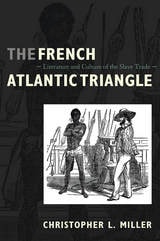
The French Atlantic Triangle
Literature and Culture of the Slave TradeChristopher L. Miller
Duke University Press, 2008
Miller offers a historical introduction to the cultural and economic dynamics of the French slave trade, and he shows how Enlightenment thinkers such as Montesquieu and Voltaire mused about the enslavement of Africans, while Rousseau ignored it. He follows the twists and turns of attitude regarding the slave trade through the works of late-eighteenth- and early-nineteenth-century French writers, including Olympe de Gouges, Madame de Staël, Madame de Duras, Prosper Mérimée, and Eugène Sue. For these authors, the slave trade was variously an object of sentiment, a moral conundrum, or an entertaining high-seas “adventure.” Turning to twentieth-century literature and film, Miller describes how artists from Africa and the Caribbean—including the writers Aimé Césaire, Maryse Condé, and Edouard Glissant, and the filmmakers Ousmane Sembene, Guy Deslauriers, and Roger Gnoan M’Bala—have confronted the aftermath of France’s slave trade, attempting to bridge the gaps between silence and disclosure, forgetfulness and memory.
The French Writers' War, 1940-1953
Gisèle Sapiro
Duke University Press, 2014

The French in Texas
History, Migration, CultureEdited by François Lagarde
University of Texas Press, 2003
2005 — San Antonio Conservation Society Citation
Original articles that explore the French presence and influence on Texas history, arts, education, religion, and business.
The flag of France is one of the six flags that have flown over Texas, but all that many people know about the French presence in Texas is the ill-fated explorer Cavelier de La Salle, fabled pirate Jean Laffite, or Cajun music and food. Yet the French have made lasting contributions to Texas history and culture that deserve to be widely known and appreciated. In this book, François Lagarde and thirteen other experts present original articles that explore the French presence and influence on Texas history, arts, education, religion, and business from the arrival of La Salle in 1685 to 2002.
Each article covers an important figure or event in the France-Texas story. The historical articles thoroughly investigate early French colonists and explorers, the French pirates and privateers, the Bonapartists of Champ-d'Asile, the French at the Alamo, Dubois de Saligny and French recognition of the Republic of Texas, the nineteenth-century utopists of Icaria and Reunion, and the French Catholic missions. Other articles deal with French immigration in Texas, including the founding of Castroville, Cajuns in Texas, and the French economic presence in Texas today (the first such study ever published). The remaining articles look at painters Théodore and Marie Gentilz, sculptor Raoul Josset, French architecture in Texas, French travelers from Théodore Pavie to Simone de Beauvoir who have written on Texas, and the French heritage in Texas education. More than seventy color and black-and-white illustrations complement the text.

The Great Syrian Revolt and the Rise of Arab Nationalism
By Michael Provence
University of Texas Press, 2005
The Great Syrian Revolt of 1925 was the largest and longest-lasting anti-colonial insurgency in the inter-war Arab East. Mobilizing peasants, workers, and army veterans, rather than urban elites and nationalist intellectuals, it was the first mass movement against colonial rule in the Middle East. The revolt failed to liberate Syria from French occupation, but it provided a model of popular nationalism and resistance that remains potent in the Middle East today. Each subsequent Arab uprising against foreign rule has repeated the language and tactics of the Great Syrian Revolt.
In this work, Michael Provence uses newly released secret colonial intelligence sources, neglected memoirs, and popular memory to tell the story of the revolt from the perspective of its participants. He shows how Ottoman-subsidized military education created a generation of leaders of modest background who came to rebel against both the French Mandate rulers of Syria and the Syrian intellectuals and landowners who helped the colonial regime to function. This new popular nationalism was unprecedented in the Arab world. Provence shows compellingly that the Great Syrian Revolt was a formative event in shaping the modern Middle East.
The Groove of the Poem
Reading Philippe BeckJacques Rancière
University of Minnesota Press, 2016
“Music is the brute that shows.
It is the avowal of materials,
And stutters between its clanging of things.”
How should one think this musical groove of the poem whose back and forth motion shuffles the material of ordinary language and revives the frozen speech of old chants? This question by renowned French thinker Jacques Rancière is the entry point for his earnest and careful reading of one of France’s most singular and important contemporary poets. For Rancière, Philippe Beck sets himself the task of a poetry after poetry whereby Beck re-writes and transforms the poems of the past, reanimating faded genres, poetizing the prose of popular tales and even commentaries regarding poems. To read and follow this groove traced as such cannot simply be done by way of taking the poems as objects of study. It supposes a dialogue regarding what these poems attempt to do as well as an idea of a poetry which serves as their foundation. This book on Philippe Beck is thus also a book made with him.
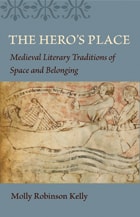
The Hero's Place
Medieval Literary Traditions of Space and BelongingMolly Robinson Kelly
Catholic University of America Press, 2009
The Huguenot Experience of Persecution and Exile
Three Women’s StoriesCharlotte Arbaleste Duplessis-Mornay, Anne de Chaufepié, and Anne Marguerite Petit Du Noyer
Iter Press, 2019
Edited by Colette H. Winn. Translated by Lauren King and Colette H. Winn
The Other Voice in Early Modern Europe: The Toronto Series, Vol. 68
The Hysteric's Revenge
French Women Writers at the Fin de SiecleRachel Mesch
Vanderbilt University Press, 2006
This book argues, however, that the fear of sexual abandon--though real--veiled an even more insidious fear: that women might be capable of intellectual equality with men and thus pose a threat to the most basic structures of French patriarchal society. In demonstrating the pervasiveness of this anxiety through analysis of nineteenth-century medical texts, literary criticism, and fiction, The Hysteric's Revenge brings into relief a critical relationship between the female mind and body that is essential to understanding the discursive position of the turn-of-the-century woman writer.
The novels presented here confront this mind/body problem through a wide variety of styles and genres that challenge conventional fin-de-siecle notions of femininity. From the compelling autobiography of Liane de Pougy--one of Paris's most renowned courtesans--to Colette's frank discussions of female pleasure in one of her early novels, to the violent creativity of Rachilde's androgynous heroine, Mesch demonstrates how both canonical and non-canonical writers promoted women's intellectual authority through the development of a sexual counter-discourse. In engaging the relationship between women's minds and bodies, these novels challenge the conclusions of a century of doctors who sought to prove a physiological basis for female intellectual inferiority. At the same time, they point the way towards later French feminists who sought to subvert patriarchal structures through literary explorations of sexuality.
The Inheritor
A PlayKate Bredeson and Thalia Wolff
Northwestern University Press, 2025
The first English-language translation of the 1968 activist play about inequality and access to education
In The Inheritor, surrealist imagery and experimental forms convey the radically different experience of two students, the Inheritor and the Non-Inheritor, as they prepare for a high-stakes exam. Revealing a world of privilege where “there is no such thing as luck,” the play features a beheaded knight, a talking record player, and a boisterous chorus of professors depicted as a flock of squawking birds.
Based on sociologists Pierre Bourdieu and Jean-Claude Passeron’s The Inheritors: French Students and Their Relations to Culture, the play was collectively created by Théâtre de l’Aquarium, a company then composed entirely of students. It proved a powerful success when it premiered in May 1968 amid student and worker protests in Paris, and it continues to speak forcefully to education inequity on campuses across anglophone countries today.
The Inventors
And Other PoemsRené Char
Seagull Books, 2015
The Inventors includes a brief introduction to Char’s life and work, as well as a series of notes on the backstories of the works, which explain allusions that may not be immediately familiar to the English-speaking reader. These new translations stay true to the originals, while at the same time conveying much of the music and beauty of the French poems.
Praise for René Char
“Char, I believe, is a poet who will tower over twentieth-century French poetry.”—George Steiner
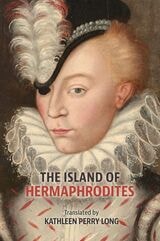
The Island of Hermaphrodites
Translated by Kathleen Perry Long
Arizona Center for Medieval and Renaissance Studies, 2025
A scandalous and subversive satire, Island of Hermaphrodites skewers the decadence and corruption of early seventeenth-century French society with razor-sharp wit. Published anonymously in 1605, this daring Menippean satire created an uproar for its irreverent portrayal of the French court, critique of absolute monarchy, and radical questioning of gender and power. A blend of political critique and biting humor, the novel follows an imagined land of aristocratic excess, where opulent feasts, elaborate fashion, and absurd rituals mask the deeper instability of a society built on privilege and deception.
Republished throughout the eighteenth century and connected to the intellectual ferment leading up to the French Revolution, Island of Hermaphrodites remains a strikingly modern indictment of unchecked power and economic exploitation. In its first full English translation, Kathleen P. Long offers new audiences a satirical romp through a world of absurdist power—one that feels politically salient today.