Results by title
81 books match the query 'French literature' and 21 start with t
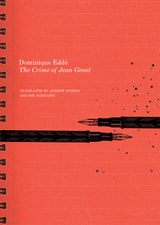
The Crime of Jean Genet
Dominique Eddé
Seagull Books, 2016
Dominique Eddé met novelist and playwright Jean Genet in the 1970s. And she never forgot him. “His presence,” she writes, “gave me the sensation of icy fire. Like his words, his gestures were full, calculated, and precise. . . . Genet’s movements mimicked the movement of time, accumulating rather than passing.”
This book is Eddé’s account of that meeting and its ripples through her years of engaging with Genet’s life and work. Rooted in personal reminiscences, it is nonetheless much broader, offering a subtle analysis of Genet’s work and teasing out largely unconsidered themes, like the absence of the father, which becomes a metaphor for Genet’s perpetual attack on the law. Tying Genet to Dostoevsky through their shared fascination with crime, Eddé helps us more clearly understand Genet’s relationship to France and Palestine, Judaism, Christianity, Islam, the theater, and even death. A powerful personal account of the influence of one writer on another, The Crime of Jean Genet is also one of the most penetrating explorations yet of Genet’s work and achievement.
The Culture of the Body
Genealogies of ModernityDalia Judovitz
University of Michigan Press, 2001
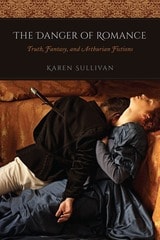
The Danger of Romance
Truth, Fantasy, and Arthurian FictionsKaren Sullivan
University of Chicago Press, 2018
Yet is it possible that romance is expressing a truth—and a truth unrecognized by realist genres? The Arthurian literature of the Middle Ages, Karen Sullivan argues, consistently ventriloquizes in its pages the criticisms that were being made of romance at the time, and implicitly defends itself against those criticisms. The Danger of Romance shows that the conviction that ordinary reality is the only reality is itself an assumption, and one that can blind those who hold it to the extraordinary phenomena that exist around them. It demonstrates that that which is rare, ephemeral, and inexplicable is no less real than that which is commonplace, long-lasting, and easily accounted for. If romance continues to appeal to audiences today, whether in its Arthurian prototype or in its more recent incarnations, it is because it confirms the perception—or even the hope—of a beauty and truth in the world that realist genres deny.
The Flowers of Tarbes
or, Terror in LiteratureJean Paulhan
University of Illinois Press, 2005
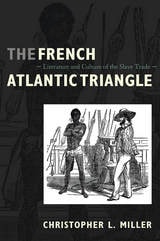
The French Atlantic Triangle
Literature and Culture of the Slave TradeChristopher L. Miller
Duke University Press, 2008
Miller offers a historical introduction to the cultural and economic dynamics of the French slave trade, and he shows how Enlightenment thinkers such as Montesquieu and Voltaire mused about the enslavement of Africans, while Rousseau ignored it. He follows the twists and turns of attitude regarding the slave trade through the works of late-eighteenth- and early-nineteenth-century French writers, including Olympe de Gouges, Madame de Staël, Madame de Duras, Prosper Mérimée, and Eugène Sue. For these authors, the slave trade was variously an object of sentiment, a moral conundrum, or an entertaining high-seas “adventure.” Turning to twentieth-century literature and film, Miller describes how artists from Africa and the Caribbean—including the writers Aimé Césaire, Maryse Condé, and Edouard Glissant, and the filmmakers Ousmane Sembene, Guy Deslauriers, and Roger Gnoan M’Bala—have confronted the aftermath of France’s slave trade, attempting to bridge the gaps between silence and disclosure, forgetfulness and memory.
The Hero's Place
Medieval Literary Traditions of Space and BelongingMolly Robinson Kelly
Catholic University of America Press, 2009
The Hysteric's Revenge
French Women Writers at the Fin de SiecleRachel Mesch
Vanderbilt University Press, 2006
This book argues, however, that the fear of sexual abandon--though real--veiled an even more insidious fear: that women might be capable of intellectual equality with men and thus pose a threat to the most basic structures of French patriarchal society. In demonstrating the pervasiveness of this anxiety through analysis of nineteenth-century medical texts, literary criticism, and fiction, The Hysteric's Revenge brings into relief a critical relationship between the female mind and body that is essential to understanding the discursive position of the turn-of-the-century woman writer.
The novels presented here confront this mind/body problem through a wide variety of styles and genres that challenge conventional fin-de-siecle notions of femininity. From the compelling autobiography of Liane de Pougy--one of Paris's most renowned courtesans--to Colette's frank discussions of female pleasure in one of her early novels, to the violent creativity of Rachilde's androgynous heroine, Mesch demonstrates how both canonical and non-canonical writers promoted women's intellectual authority through the development of a sexual counter-discourse. In engaging the relationship between women's minds and bodies, these novels challenge the conclusions of a century of doctors who sought to prove a physiological basis for female intellectual inferiority. At the same time, they point the way towards later French feminists who sought to subvert patriarchal structures through literary explorations of sexuality.
The Medieval Imagination
Jacques Le Goff
University of Chicago Press, 1988
"Le Goff is one of the most distinguished of the French medieval historians of his generation . . . he has exercised immense influence."—Maurice Keen, New York Review of Books
"The whole book turns on a fascinating blend of the brutally materialistic and the generously imaginative."—Tom Shippey, London Review of Books
"The richness, imaginativeness and sheer learning of Le Goff's work . . . demand to be experienced."—M. T. Clanchy, Times Literary Supplement

The Militant Hackwriter
French Popular Literature 1800–1848 and Its Influence, Artistic and PoliticalLucian W. Minor
University of Wisconsin Press, 1975
While Louis XVIII, Charles X, and Louis Philippe ruled in France, a vast majority of politically unenfranchised Frenchmen were developing their own subculture. Only recently literate, they fashioned their own literature. It consisted of two important genres: the popular novel and the melodrama. As we trace these genres from the turn of the nineteenth century until that moment of February 25, 1848, when the Second Republic was declared, we are also led to a detailed scrutiny of the injustices which the immense majority of the French suffered and of the political causes they espoused. The succession of heroes and villains in their literature mirrored accurately the fears and hopes they felt.
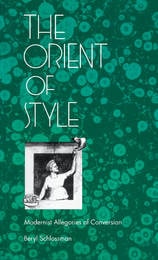
The Orient of Style
Modernist Allegories of ConversionBeryl Schlossman
Duke University Press, 1991
Toward the end of Remembrance of Things Past, the narrator describes the act of creating a work of art as a conversion of sensation into a spiritual equivalent. By means of such allegories of “conversion,” Schlossman shows, the modernist artist disappeared within the work of art and left behind the trace of his sublime vocation, a vocation in which he was transformed, in Schlossman’s words, “into a kind of priest kneeling at the altar of beauty before the masked divinity of representation.”
The author shows how allegory—the representation of the symbolic as something real—was adapted by modernist writers to reflect subjectivity while masking an authorial origin. She reveals how modernist allegory arose, as Walter Benjamin suggests, at the crossroads of history, sociology, economics, urban architecture, and art—providing a kind of map of capitalism—and was produced through the eyes of a melancholic gazing at a “monument of absence.”
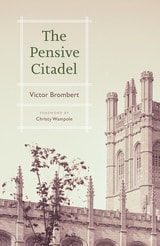
The Pensive Citadel
Victor Brombert
University of Chicago Press, 2023
In The Pensive Citadel, Victor Brombert looks back on a lifetime of learning within a university world greatly altered since he entered Yale on the GI Bill in the 1940s. Yet for all that has changed, much of Brombert’s long experience as a reader and teacher is richly familiar: the rewards of rereading, the joy of learning from students, and most of all the insight to be found in engaging works of literature. The essays gathered here range from meditations on laughter and jealousy to new appreciations of Brombert’s lifelong companions Shakespeare, Montaigne, Voltaire, and Stendhal.
A veteran of D-day and the Battle of the Bulge who witnessed history’s worst nightmares firsthand, Brombert nevertheless approaches literature with a lightness of spirit, making the case for intellectual mobility and openness to change. The Pensive Citadel is a celebration of a life lived in literary study, and of what can be learned from attending to the works that form one’s cultural heritage.
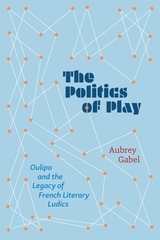
The Politics of Play
Oulipo and the Legacy of French Literary LudicsAubrey Gabel
Northwestern University Press, 2026
Showing the political importance of play in postwar French literature
In postwar France, authors approached writing ludically, placing rules and conditions on language and on the context of composition itself. They eliminated “e’s” and feminized texts; they traveled according to strict rules and invented outright silly public personas. The Politics of Play: Oulipo and the Legacy of French Literary Ludics is a comprehensive examination of how and why French authors turned to these ludic methods to grapple with their political moment.
These writers were responding to a range of historical upheavals, from the rise and fall of French feminist and Third-Worldist groups to the aftermath of international socialism both at home, in the former Parisian Belt and in France more broadly, and abroad, in post-Yugoslavia Balkan states and elsewhere. Juxtaposing an array of case studies and drawing on cross-disciplinary methodologies, Aubrey Gabel reads three generations of the formalist literary group Oulipo, including Raymond Queneau, Georges Perec, and Jacques Jouet, alongside writers not traditionally deemed ludic—or sometimes not even conventionally known as novelists—such as the lesbian activist-writer Monique Wittig and the editor François Maspero. Gabel argues that literary ludics serve as both an authorial strategy and a political form: playful methods allow writers not only to represent history in code but also to intervene creatively—as political actors—in the fraught social fields of midcentury France and beyond.
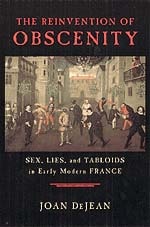
The Reinvention of Obscenity
Sex, Lies, and Tabloids in Early Modern FranceJoan DeJean
University of Chicago Press, 2002
The Reinvention of Obscenity casts a fresh light on the mythical link between sexual impropriety and things French. Exploring the complicity between censorship, print culture, and obscenity, DeJean argues that mass market printing and the first modern censorial machinery came into being at the very moment that obscenity was being reinvented—that is, transformed from a minor literary phenomenon into a threat to society. DeJean's principal case in this study is the career of Moliére, who cannily exploited the new link between indecency and female genitalia to found his career as a print author; the enormous scandal which followed his play L'école des femmes made him the first modern writer to have his sex life dissected in the press.
Keenly alert to parallels with the currency of obscenity in contemporary America, The Reinvention of Obscenity will concern not only scholars of French history, but anyone interested in the intertwined histories of sex, publishing, and censorship.
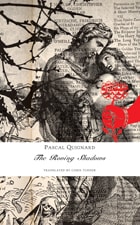
The Roving Shadows
Pascal Quignard
Seagull Books, 2011
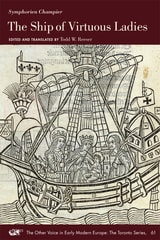
The Ship of Virtuous Ladies
Symphorien Champier
Iter Press, 2018
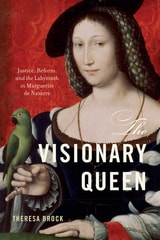
The Visionary Queen
Justice, Reform, and the Labyrinth in Marguerite de NavarreTheresa Brock
University of Delaware Press, 2024
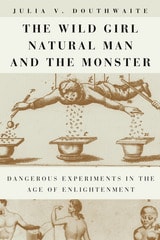
The Wild Girl, Natural Man, and the Monster
Dangerous Experiments in the Age of EnlightenmentJulia V. Douthwaite
University of Chicago Press, 2002
A variety of educational experiments failed to tame these feral children by the standards of the day. After telling their stories, Douthwaite turns to literature that reflects on similar experiments to perfect human subjects. Her examples range from utopian schemes for progressive childrearing to philosophical tales of animated statues, from revolutionary theories of regenerated men to Gothic tales of scientists run amok. Encompassing thinkers such as Rousseau, Sade, Defoe, and Mary Shelley, Douthwaite shows how the Enlightenment conceived of mankind as an infinitely malleable entity, first with optimism, then with apprehension. Exposing the darker side of eighteenth-century thought, she demonstrates how advances in science gave rise to troubling ethical concerns, as parents, scientists, and politicians tried to perfect mankind with disastrous results.

The Writing of Melancholy
Modes of Opposition in Early French ModernismRoss Chambers
University of Chicago Press, 1993
After the failed revolution of 1848, the sense of disillusion that swept through France deeply affected the literature of the time. Chambers argues that literary melancholy and disorientation constituted a symptom of historical conditions rather than, as many other critics contend, a willful resistance to them.
Enriched by careful readings of works by Flaubert, Nerval, Baudelaire, Gautier, and Hugo, this book is a subtle meditation on the powers of writing and reading and a suggestive contribution to current debates over the historical status of literary texts. Originally published in French, the book has been revised and expanded to include a new chapter on Gérard de Nerval's "Sylvie."
The Written World
Space, Literature, and the Chorological Imagination in Early Modern FranceJeffrey N. Peters
Northwestern University Press, 2018
In analyses of well-known authors such as Corneille, Molière, Racine, and Madame de Lafayette, Peters demonstrates that the apparent absence of physical space in seventeenth-century literary depiction indicates a subtle engagement with, rather than a rejection of, evolving principles of cosmological understanding. Space is not absent in these works so much as transformed in keeping with contemporaneous developments in early modern natural philosophy. The Written World will appeal to philosophers of literature and literary theorists as well as scholars of early modern Europe and historians of science and geography
Tropicopolitans
Colonialism and Agency, 1688–1804Srinivas Aravamudan
Duke University Press, 1999
“Tropicalization” is the central metaphor of this analysis, a term that incorporates both the construction of various dynamic tropes by which the colonized are viewed and the site of the study, primarily the tropics. Tropicopolitans, then, are those people who bear and resist the representations of colonialist discourse. In readings that expose new relationships between literary representation and colonialism in the eighteenth century, Aravamudan considers such texts as Behn’s Oroonoko, Defoe’s Robinson Crusoe and Captain Singleton, Addison’s Cato, and Swift’s Gulliver’s Travels and The Drapier’s Letters. He extends his argument to include analyses of Johnson’s Rasselas, Beckford’s Vathek, Montagu’s travel letters, Equiano’s autobiography, Burke’s political and aesthetic writings, and Abbé de Raynal’s Histoire des deux Indes. Offering a radical approach to literary history, this study provides new mechanisms for understanding the development of anticolonial agency.
Introducing eighteenth-century studies to a postcolonial hermeneutics, Tropicopolitans will interest scholars engaged in postcolonial studies, eighteenth-century literature, and literary theory.
Truth and the Heretic
Crises of Knowledge in Medieval French LiteratureKaren Sullivan
University of Chicago Press, 2005
Exploring the figure of the heretic in Catholic writings of the twelfth and thirteenth centuries as well as the heretic's characterological counterpart in troubadour lyrics, Arthurian romance, and comic tales, Truth and the Heretic seeks to understand why French literature of the period celebrated the very characters who were so persecuted in society at large. Karen Sullivan proposes that such literature allowed medieval culture a means by which to express truths about heretics and the epistemological anxieties they aroused.
The first book-length study of the figure of the heretic in medieval French literature, Truth and the Heretic explores the relation between orthodoxy and deviance, authority and innovation, and will fascinate historians of ideas and literature as well as scholars of religion, critical theory, and philosophy.