Results by title
252 books match the query 'Future' and 63 start with t

Tarsiers
Past, Present, and FutureWright, Patricia C.
Rutgers University Press, 2003
Tarsiiformes, or tarsiers for short, are a group of living species of special interest to primatologists because their combination of derived and ancient characters make them pivotal to understanding the roots of primate evolution. These small-bodied, nocturnal, solitary creatures resemble lower primates in their behavior but genetically, DNA evidence aligns them more closely with higher primates, such as monkeys, apes, and humans. These astounding creatures exhibit an ability found in no other living mammal¾they can turn their heads 180 degrees in either direction to see both prey and predators. The world’s only exclusive carnivorous primate, they eat live food (primarily insects, but the occasional vertebrate, such as lizards, snakes, or frogs will also do). This unique combination of behavior and anatomy makes the tarsier an especially interesting and controversial animal for study among primate behaviorists, evolutionists, and taxonomists, who view the tarsiers as “living fossils” that link past and present, lower and higher, primates in the long chain of evolutionary history.
This new volume presents alternative and contrasting perspectives on the most debated questions that have arisen in tarsier studies. Top researchers bring together perspectives from anatomical, behavioral, genetic, and conservation studies in this new and exciting addition to the understanding of primate evolution.
This book is a volume in the Rutgers Series on Human Evolution, edited by Robert Trivers, Lee Cronk, Helen Fischer, and Lionel Tiger.

Technology and the Future of Schooling in America
Edited by Stephen T. Kerr
University of Chicago Press, 1996
Guiding this volume is the conviction that advances in technology do not necessarily translate into improvements in education even as the basic structure of teaching programs must be changed to fully exploit the educational uses of technology. The contributors argue that technology should be distributed throughout the educational system, not just in wealthy districts; they examine the impact of communications technologies on relationships between teachers and students, parents and children, and men and women; they consider the ways in which new technologies change the dynamics of learning and teaching; and they show how teachers and administrators can tailor technology-based programs to the particular needs of their school or district.

The Age of Immunology
Conceiving a Future in an Alienating WorldA. David Napier
University of Chicago Press, 2003
To illustrate these destructive consequences, Napier likens the current craze for embracing diversity and the use of politically correct speech to a cultural potluck to which we each bring different dishes, but at which no one can eat unless they abide by the same rules. Similarly, loaning money to developing nations serves as a tool both to make the peoples in those nations more like us and to maintain them in the nonthreatening status of distant dependents. To break free of the resulting downward spiral of homogenization and self-focus, Napier suggests that we instead adopt a new defining concept based on embryology, in which development and self-growth take place through a process of incorporation and transformation. In this effort he suggests that we have much to learn from non-Western peoples, such as the Balinese, whose ritual practices require them to take on the considerable risk of injecting into their selves the potential dangers of otherness—and in so doing ultimately strengthen themselves as well as their society.
The Age of Immunology, with its combination of philosophy, history, and cultural inquiry, will be seen as a manifesto for a new age and a new way of thinking about the world and our place in it.
The Cultural Turn in U. S. History
Past, Present, and FutureEdited by James W. Cook, Lawrence B. Glickman, and Michael O'Malley
University of Chicago Press, 2008

The Electric Car
Development and future of battery, hybrid and fuel-cell carsMike H. Westbrook
The Institution of Engineering and Technology, 2001
The Electric Grid of the Future
Paulo F. Ribeiro
The Institution of Engineering and Technology, 2027
The End of the Future
Trauma, Memory, and Reconciliation in Peruvian AmazoniaBartholomew Dean
Vanderbilt University Press, 2023
To give context to the causes and consequences of the MRTA's presence in the lower and central Huallaga, this book relies on the written works and testimony of Sístero García Torres, an MRTA rebel commander; the government's Truth and Reconciliation Commission; MRTA propaganda; media accounts; and critical historical texts. Besides exposing Huallaga Valley human rights abuses, the book's contribution to political anthropology is consequential for its insistence that reconciliation is by no means equivalent to local, Indigenous notions of "justice" or customary forms of dispute resolution. Without deliberately addressing the diverse socio-cultural contours defining overlapping epistemologies of justice, freedom, and communal well-being, enduring reconciliation will likely remain elusive.

The Evangelical Crackup?
The Future of the Evangelical-Republican CoalitionEdited by Paul Djupe and Ryan L. Claassen
Temple University Press, 2019
Why did Donald Trump attract a record number of white evangelical voters without unified support—and despite nontrivial antipathy from evangelical leaders? The editors and leading scholars that contribute to the timely volume The Evangelical Crackup? answer this question and provide a comprehensive assessment of the status of evangelicals and the Christian Right in the Republican coalition.
The expected “crackup” with the Republican Party never happened. Each chapter in this cogent volume includes analyses of the 2016 election to explain why—and why that is critical. Chapters examine policy priorities, legal advocacy, and evangelical loyalty to the Republican Party; rhetoric, social networks, and evangelical elite influence; and the political implications of movements within evangelicalism, such as young evangelicals, Hispanics, and the Emergent Church movement.
Contributors include: Daniel Bennett, Mark Brockway, Ryan P. Burge, Brian R. Calfano, Jeremy Castle, Kimberly Conger, Daniel A. Cox, Kevin den Dulk, Sarah Allen Gershon, Tobin Grant, Robert P. Jones, Geoffrey Layman, Andrew R. Lewis, Ronald J. McGauvran, Joshua Mitchell, Juhem Navarro-Rivera, Jacob R. Neiheisel, Elizabeth Oldmixon, Adrian D. Pantoja, David Searcy, Anand Edward Sokhey, J. Benjamin Taylor, Robert Wuthnow, and the editors.
The Fourth Great Awakening and the Future of Egalitarianism
Robert William Fogel
University of Chicago Press, 2000
"To take a trip around the mind of Robert Fogel, one of the grand old men of American economic history, is a rare treat. At every turning, you come upon some shiny pearl of information."—The Economist
In this broad-thinking and profound piece of history, Robert William Fogel synthesizes an amazing range of data into a bold and intriguing view of America's past and future—one in which the periodic Great Awakenings of religion bring about waves of social reform, the material lives of even the poorest Americans improve steadily, and the nation now stands poised for a renewed burst of egalitarian progress.

The Freudian Robot
Digital Media and the Future of the UnconsciousLydia H. Liu
University of Chicago Press, 2011
The identity and role of writing has evolved in the age of digital media. But how did writing itself make digital media possible in the first place? Lydia H. Liu offers here the first rigorous study of the political history of digital writing and its fateful entanglement with the Freudian unconscious.
Liu’s innovative analysis brings the work of theorists and writers back into conversation with one another to document significant meetings of minds and disciplines. She shows how the earlier avant-garde literary experiments with alphabetical writing and the word-association games of psychoanalysis contributed to the mathematical making of digital media. Such intellectual convergence, she argues, completed the transformation of alphabetical writing into the postphonetic, ideographic system of digital media, which not only altered the threshold of sense and nonsense in communication processes but also compelled a new understanding of human-machine interplay at the level of the unconscious.
Ranging across information theory, cybernetics, modernism, literary theory, neurotic machines, and psychoanalysis, The Freudian Robot rewrites the history of digital media and the literary theory of the twentieth century.
The Future
Monica Ferrell
Four Way Books, 2026
The Future is a book about time. The tender, vulnerable, and bitingly funny poems of Monica Ferrell's third collection confront the hours as they stream by, our relatively brief lives that feel so long while we are living them, successive generations and the unwinding story of our species, and the bewilderingly vast geological age of the planet. Traveling across eras, through ice ages to the eighteenth century and the modern day of Ozempic and chatbots, these poems also square up to the obscurity of what comes next as they peer forward into time still to come.
At once irreverent yet elegant, sophisticated yet conversational, these poems capture what it means to get by day to day in a 21st century destabilized by ecological collapse, political havoc, and the incursion of technology into our most private and intimate spaces. “Every day I wake up,” Ferrell writes, “and ask, is it today? The volcano?” Restless in their imaginative scope, these poems leap across the world, from the enduring statues at Angkor Wat and Hampi to Alpine meadows contaminated with plastic to a supermarket in Vermont. Without papering over any of the difficulties we face today, Ferrell nonetheless expands our capacity to wonder, especially about the experience of motherhood, how the future keeps finding a way of breaking through.
This book manifests as that impossible, unimaginable collision that annihilates the world as we thought it was and sees it emerge as pure energy. Ferrell includes us in “the bequest of this battered planet, this sweetly belabored thing,” from one generation to the next, reminding us of the genesis contained inside obliteration: “one November night I too once opened my eyes to the bright.”
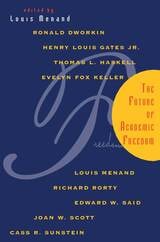
The Future of Academic Freedom
Edited by Louis Menand
University of Chicago Press, 1996
"Louis Menand has assembled The Future of Academic Freedom to better define and delineate what should and should not happen within our colleges and universities. . . . The whole extremely learned yet accessible debate exploits the freedoms it extols, tackling sensitive subjects such as ethnicity and ethics head-on."—Publishers Weekly
"The essays are not only sharp, elegant and lucid, but extremely well-informed about the history of American battles over academic freedom."—Alan Ryan, Times Higher Education Supplement
"[A] superb inquiry into some of the most vexing and significant issues in higher education today."—Zachary Karabell, Boston Book Review

The Future of Alienation
Richard Schacht
University of Illinois Press, 1994
They call for a renewed interest in alienation theory; they counter the myth that, with the collapse of the Soviet empire, Marx's thinking has been "refuted"; and they argue for an enhanced sensitivity to the problem of how we describe, interpret, and evaluate the world around us in light of the complexity and diversity that alienation theory reveals.
The Future of American Democratic Politics
Principles and PracticesPomper, Gerald M
Rutgers University Press, 2003
In this book, fifteen major scholars assess the current state of American democracy, offering a spirited dialogue on the future of democratic politics. Contributors focus on three principles fundamental to democracyequality, liberty, and participation. They examine these principles within the context of the basic institutions of American democracy: Congress and the state legislatures, the president, political parties, interest groups, and the Supreme Court. They raise questions regarding the checks and balances among formal governmental institutions as well as the role of political parties and interest groups.
Topics discussed include the incomplete mobilization of the electorate, the debates over campaign finance reform and term limits, the Supreme Courts activist role in the Florida recount, the dangers of teledemocracy and state initiatives, the separation of political participation from residential location, "identity politics," the clash of "negative" and "positive" liberty, and the prospects for personal freedom in an era of terrorist threats.
This timely collection covers the issues relevant to the future of American democracy today not only for lawmakers, students, and historians, but for any concerned citizen.

The Future of Art in a Postdigital Age
From Hellenistic to Hebraic Consciousness - Second EditionMel Alexenberg
Intellect Books, 2011
In The Future of Art in a Postdigital Age, artist and educator Mel Alexenberg offers a vision of a postdigital future that reveals a paradigm shift from the Hellenistic to the Hebraic roots of Western culture. He ventures beyond the digital to explore postdigital perspectives rising from creative encounters among art, science, technology, and human consciousness. The interrelationships between these perspectives demonstrate the confluence between postdigital art and the dynamic, Jewish structure of consciousness. Alexenberg’s pioneering artwork––a fusion of spiritual and technological realms––exemplifies the theoretical thesis of this investigation into interactive and collaborative forms that imaginatively envisages the vast potential of art in a postdigital future.
The Future of Black Studies
Abdul
Pluto Press, 2022
'A timely, future-oriented and necessary contribution which provides clarity to the multivalent tendencies in this field' - Carole Boyce Davies
The marginalization of Black voices from the academy is a problem in the Western world. But Black Studies, where it exists, is a powerful, boundary-pushing discipline, grown out of struggle and community action. Here, Abdul Alkalimat, one of the founders of Black Studies in the US, presents a reimagining of the future trends in the study of the Black experience.
Taking Marxism and Black Experientialism, Afro-Futurist and Diaspora frameworks, he projects a radical future for the discipline at this time of social crisis. Choosing cornerstones of culture, such as the music of Sun Ra, the movie Black Panther and the writer Octavia Butler, he looks at the trajectory of Black liberation thought since slavery, including new research on the rise in the comparative study of Black people all over the world.
Turning to look at how digital tools enhance the study of the discipline, this book is a powerful read that will inform and inspire students and activists.

The Future of Black Studies
Abdul Alkalimat
Pluto Press, 2022
At a turning point for the growing field of Black Studies, one of its founders looks to its future
'A timely, future-oriented and necessary contribution which provides clarity to the multivalent tendencies in this field' - Carole Boyce Davies
The marginalization of Black voices from the academy is a problem in the Western world. But Black Studies, where it exists, is a powerful, boundary-pushing discipline, grown out of struggle and community action. Here, Abdul Alkalimat, one of the founders of Black Studies in the US, presents a reimagining of the future trends in the study of the Black experience.
Taking Marxism and Black Experientialism, Afro-Futurist and Diaspora frameworks, he projects a radical future for the discipline at this time of social crisis. Choosing cornerstones of culture, such as the music of Sun Ra, the movie Black Panther and the writer Octavia Butler, he looks at the trajectory of Black liberation thought since slavery, including new research on the rise in the comparative study of Black people all over the world.
Turning to look at how digital tools enhance the study of the discipline, this book is a powerful read that will inform and inspire students and activists.
The Future of Class in History
What's Left of the Social?Geoff Eley and Keith Nield
University of Michigan Press, 2007
Unifying concepts are essential when studying history. They provide students and scholars with ways to organize their thoughts, research, and writings. However, these concepts are also the focus of myriad conflicts within the field. Social history has experienced more than its share of such conflicts since its inception some forty years ago. In recent times the fields of “the social” and of “culture” have sometimes been presented as mutually exclusive and even hostile. Once again, conceptual innovation in history has been cast as a closure by which the new drives out the old: in this case, cultural history radically displacing social history. The Future of Class in History analyzes the effect of the conflict that followed the “turn to culture” in historical work by examining the use of class and demonstrates how practitioners in multiple fields can collaborate to produce the highest quality scholarship.
“Offers new ways of thinking about ‘class’ and ‘society’ in a world in which such categories have been radically called into question.”
—Sherry Ortner, University of California, Los Angeles
“Brilliantly charts social history’s past achievement, present dilemma, and future promise in a work distinguished by intellectual openness and generosity.”
—James A. Epstein, Vanderbilt University
“Eley and Nield seek to rescue the deluded follower of social history from the enormous condescension of the cultural turn. They succeed admirably, making the case for a new hybrid socio-cultural history.”
—Donald Reid, University of North Carolina at Chapel Hill
“This terrific double act has once again produced a text that demands to be read by all those tired of the juxtaposition of social and cultural histories and still interested in the problematic of class and the politics of its past and present.”
—James Vernon, University of California, Berkeley
“Eley and Nield tackle a contentious debate with a gracious plea for collaboration. Their strong desire to get past the ‘culture wars’ and to engage social and cultural historians in fruitful dialogue is a welcome move, stylishly executed.”
—Philippa Levine, University of Southern California
Geoff Eley is Professor of History at the University of Michigan.
Keith Nield is Professor Emeritus of History at the University of Hull.

The Future of Conservation in America
A Chart for Rough WaterGary E. Machlis and Jonathan B. Jarvis
University of Chicago Press, 2018
Written by the first scientist appointed as science advisor to the director of the National Park Service and the eighteenth director of the National Park Service, this is a candid, passionate, and ultimately hopeful book. The authors describe a unified vision of conservation that binds nature protection, historical preservation, sustainability, public health, civil rights and social justice, and science into common cause—and offer real-world strategies for progress. To be read, pondered, debated, and often revisited, The Future of Conservation in America is destined to be a touchstone for the conservation movement in the decades ahead.
The Future of Democracy
Developing the Next Generation of American CitizensPeter Levine
University Press of New England, 2015
The Future of Digital Surveillance
Why Digital Monitoring Will Never Lose Its Appeal in a World of Algorithm-Driven AIYong Jin Park
University of Michigan Press, 2021
Are humans hard-wired to make good decisions about managing their privacy in an increasingly public world? Or are we helpless victims of surveillance through our use of invasive digital media? Exploring the chasm between the tyranny of surveillance and the ideal of privacy, this book traces the origins of personal data collection in digital technologies including artificial intelligence (AI) embedded in social network sites, search engines, mobile apps, the web, and email. The Future of Digital Surveillance argues against a technologically deterministic view—digital technologies by nature do not cause surveillance. Instead, the shaping of surveillance technologies is embedded in a complex set of individual psychology, institutional behaviors, and policy principles.
The Future of Fallout, and Other Episodes in Radioactive World-Making
Joseph Masco
Duke University Press, 2020

The Future of Family Farms
Practical Farmers' Legacy Letters ProjectTeresa Opheim
University of Iowa Press, 2016
The Farm Legacy Letters project, developed by the member-driven nonprofit Practical Farmers of Iowa, is designed to help farmers and farmland owners think about their farm’s future and talk about it with their families. An essential complement to handbooks on business succession, this book gathers the letters and stories of midwestern families about the land they cherish—how they acquired it, what they treasure most about it, and their hopes for its future. Some of the writers descend from families who have owned a particular patch of the earth since the 1800s, while others became farmland owners more recently—one as recently as 2015. Some are no longer farmland owners at all, because—after careful thought about what mattered most to them—they sold their land to the next generation of farmers.
All of these writers hope that, by sharing their farmland legacies, they will encourage others to ponder and then write about the histories, accomplishments, challenges, and hopes for their farmland for the generations who come after they are gone.
The Future of Futurity
Affective Capitalism and Potentiality in a Global CityPurnima Mankekar and Akhil Gupta
Duke University Press, 2025

The Future of Germanistik in the USA
Changing Our ProspectsJohn A. McCarthy
Vanderbilt University Press, 1996

The Future of Healthcare Reform in the United States
Edited by Anup Malani and Michael H. Schill
University of Chicago Press, 2015
In the years since the passage of the Patient Protection and Affordable Care Act (PPACA, or, colloquially, Obamacare), most of the discussion about it has been political. But as the politics fade and the law's many complex provisions take effect, a much more interesting question begins to emerge: How will the law affect the American health care regime in the coming years and decades?
This book brings together fourteen leading scholars from the fields of law, economics, medicine, and public health to answer that question. Taking discipline-specific views, they offer their analyses and predictions for the future of health care reform. By turns thought-provoking, counterintuitive, and even contradictory, the essays together cover the landscape of positions on the PPACA's prospects. Some see efficiency growth and moderating prices; others fear a strangling bureaucracy and spiraling costs. The result is a deeply informed, richly substantive discussion that will trouble settled positions and lay the groundwork for analysis and assessment as the law's effects begin to become clear.
The Future of Humanity (Third edition)
From Global Civilization to Great CivilizationZhouying Jin
Intellect Books, 2026
This study, now in its third edition and with an expanded chapter, explores the future trajectories of industrial civilization—and of futures studies itself.
From the perspective of sublating Eastern and Western cultures and civilizations, this book argues for the urgency of industrial civilization's transformation. Zhouying Jin explores the future trajectories of humanity, the world, and human civilization; puts forward for the first time the concepts of “global civilization” and “great civilization” as two forms of advanced future civilizations for humanity, elucidating their core significance and practical approaches; and advocates for integrating the values of global civilization into the practice of sustainable development.
This revised edition of Future of Humanity includes a substantially expanded chapter that addresses seven major contemporary topics in artificial intelligence, including setting red lines for AI development as well as the advantages and misconceptions of AI in education. A new appendix outlines major trends and methodologies in futures studies, bringing together contributions from one hundred thinkers, futurists, and thirty-five pioneering institutions.
The Future of Humanity
From Global Civilization to Great CivilizationZhouying Jin
Intellect Books, 2022
This book seeks to underscore the importance of dealing with our planet’s common crises—climate change, species extinction, land and food shortages, water pollution, and many more global catastrophes. In the face of these calamities, this book calls for the transformation of human development model and civilization paradigm: Promote the transformation from industrial civilization to global Civilization and then strive to realize the great civilization.
The far-reaching effects of the COVID-19 pandemic have gone beyond the fields of health, deeply impacting economic, social, and geopolitical affairs worldwide. The still-unfolding health crisis has forced many to rethink the axioms of what they know as “civilization.” In this book, Zhouying Jin contends that if the human beings who share the earth cannot guide the direction of technological innovation to create a more advanced human civilization, then they are doomed to move toward self-destruction. The Future of Humanity calls on human beings to prepare for the future by altering their destructive relationship with nature and abandoning people-centered thinking to promote an awakening of all mankind.
The Future of Humanity
Global Civilization and China's RejuvenationZhouying Jin
Intellect Books, 2018
To navigate these many and complex topics, Jin combines the spiritual insights of ancient Chinese thinkers with a deep respect for the accomplishments and discoveries of modern Western science, exploring and explaining her distinct vision for a what a better, global future civilization could be.
The Future of Illusion
Political Theology and Early Modern TextsVictoria Kahn
University of Chicago Press, 2013
Kahn draws on theorists such as Carl Schmitt, Leo Strauss, Walter Benjamin, and Hannah Arendt and their readings of Shakespeare, Hobbes, Machiavelli, and Spinoza to illustrate that the dialogue between these modern and early modern figures can help us rethink the contemporary problem of political theology. Twentieth-century critics, she shows, saw the early modern period as a break from the older form of political theology that entailed the theological legitimization of the state. Rather, the period signaled a new emphasis on a secular notion of human agency and a new preoccupation with the ways art and fiction intersected the terrain of religion.
The Future of Medical Education
William G. Anlyan, M.D.
Duke University Press, 1973

The Future of Memory
A History of Lossless Format Standards in the Moving Image ArchiveJimi Jones and Marek Jancovic
University of Illinois Press, 2025
Drawing on interviews with archivists and developers, Jones and Jancovic reveal the archive as a dynamic space where deeply entrenched social practices produce disagreements but also resourceful collaborations. They contrast the unprecedented rise of archivist-driven standardization and controversies around non-standard technology with the historical dominance of the film and broadcast industries. Throughout, the authors clarify the role of tech companies, software developers, film pirates, hackers, and other players with poorly understood roles in the process.
A timely look at the state of audiovisual preservation, The Future of Memory provides a history of recent innovations alongside a snapshot of a field in the midst of profound technological change.

The Future of Meta-Analysis
Kenneth W. Wachter
Russell Sage Foundation, 1990
The Future of NATO
Regional Defense and Global SecurityAndrew A. Michta and Paal Sigurd Hilde, editors
University of Michigan Press, 2014
The Future of National Urban Policy
Marshall Kaplan, ed.
Duke University Press, 1989

The Future of Reality
Marine de Dardel
Diaphanes, 2026

The Future of Social Movement Research
Dynamics, Mechanisms, and ProcessesJacquelien van Stekelenburg
University of Minnesota Press, 2013
Are the dynamics of contention changing? This is the question confronted by the contributors of this volume, among the most influential scholars in the field of social movements. The answers, arriving at a time of extraordinary worldwide turmoil, not only provide a wide-ranging and varied understanding of how social movements arise and persist, but also engender unanswered questions, pointing to new theoretical strands and fields of research.
The Future of Social Movement Research asks: How are the dynamics of contention shaped by globalization? By societies that are becoming increasingly more individualized and diverse? By the spread of new communication technologies such as social media, cell phones, and the Internet? Why do some movements survive while others dissipate? Do local and global networks differ in nature? The authors’ essays explore such questions with reference to changes in three domains of contention: the demand of protest (changes in grievances and identities), the supply of protest (changes in organizations and networks), and how these changes affect the dynamics of mobilization. In doing so, they theorize and make empirically insightful how globalization, individualization, and virtualization create new grievances, new venues for action, new action forms, and new structures of contention.
The resulting work—brought together through engaging discussions and debates between the contributors—is interdisciplinary and unusually broad in scope, constituting the most comprehensive overview of the dynamics of social movements available today.
Contributors: Marije Boekkooi, VU-U, Amsterdam; Pang Ching Bobby Chen, U of California, Merced; Donatella della Porta, European U Institute; Mario Diani, U of Trento, Italy; Jan Willem Duyvendak, U of Amsterdam; Myra Marx Ferree, U of Wisconsin–Madison; Beth Gharrity Gardner; Ashley Gromis; Swen Hutter, U of Munich; Ruud Koopmans, WZB, Berlin; Hanspeter Kriesi, U of Zurich; Nonna Mayer, National Centre for European Studies; Doug McAdam, Stanford U; John D. McCarthy, Pennsylvania State U; Debra Minkoff, Barnard College, Columbia U; Alice Motes; Pamela E. Oliver, U of Wisconsin–Madison; Francesca Polletta, U of California, Irvine; Jacomijne Prins, VU-U, Amsterdam; Patrick Rafail, Tulane U; Christopher Rootes, U of Kent, Canterbury; Dieter Rucht, Free U of Berlin; David A. Snow, U of California, Irvine; Sarah A. Soule, Stanford U; Suzanne Staggenborg, U of Pittsburgh; Sidney Tarrow, Cornell U; Verta Taylor, U of California, Santa Barbara; Marjoka van Doorn; Martijn van Zomeren, U of Groningen; Stefaan Walgrave, U of Antwerp; Saskia Welschen.
The Future of Survival
Kevin B. Lee
Diaphanes, 2025
The Future of Totality
Fredric Jameson and the Prospects of Critical TheoryNicholas Brown, Maria Elisa Cevasco, Fabio Akcelrud Durão, and Robert T. Tally Jr., editors
Duke University Press, 2026

The Future of Youth Violence Prevention
A Mixtape for Practice, Policy, and ResearchPaul Boxer
Rutgers University Press, 2025

The Future of an Illusion
Film, Feminism, and PsychoanalysisConstance Penley
University of Minnesota Press, 1989
The Future of an Illusion was first published in 1989. Minnesota Archive Editions uses digital technology to make long-unavailable books once again accessible, and are published unaltered from the original University of Minnesota Press editions.
The Future of an Illusion documents the pivotal role Constance Penley has played in the development of feminist film theory. Penley analyzes the primary movements that have shaped the field: the conjunction of feminism, film theory, and psychoanalysis, and the inherent debates surrounding the politics of women and representation. These debates center on the position of women in the classical Hollywood narrative, the construction of the spectator's desire in pornography and eroticism, and the implicitly male bias in psychoanalytically oriented film theory. Essential to anyone studying the sexual policies of representation, The Future of an Illusion ranges from avant-garde films to video, popular cinema, television, literature, and critical and cultural theory.
Constance Penley is associate professor of English and film studies at the University of Rochester. A co-editor of the journal Camera Obscura,she is the editor of Feminism and Film Theory.

The Future of the Biblical Past
Envisioning Biblical Studies on a Global KeyRoland Boer
SBL Press, 2012

The Future of the Family
Daniel Patrick Moynihan
Russell Sage Foundation, 2004

The Future of the South China Sea
Disputes and NegotiationsJiye Kim
University of Michigan Press, 2026
By incorporating negotiation records, such as the 1958 Declaration on China’s Territorial Sea, the 1992 ASEAN Declaration, and the 2005 Tripartite Agreement, Jiye Kim traces how China reshapes its interests into negotiation agendas, providing critical insights into the nation’s diplomacy and making a significant contribution to an existing literature on the South China Sea that has been largely dominated by analyses of great power rivalry. This book sheds light on China’s underlying interests as living and adaptable entities, providing scholars with a detailed, evidence-based understanding of the complexities that define one of the world’s most contested maritime regions.

The Future of the Voting Rights Act
David Epstein
Russell Sage Foundation, 2006
The Great University Gamble
Money, Markets and the Future of Higher EducationAndrew McGettigan
Pluto Press, 2013
Displaying a stunning grasp of the financial and policy details, Andrew McGettigan surveys the emerging brave new world of higher education. He looks at the big questions: What will be the role of universities within society? How will they be funded? What kind of experiences will they offer students? Where does the public interest lie?
Written in a clear and accessible style, The Great University Gamble outlines the architecture of the new policy regime and tracks the developments on the ground. It is an urgent warning that our universities and colleges are now open to commercial pressures, which threaten to transform education from a public good into a private, individual financial investment.
The Green Economy
Environment, Sustainable Development and the Politics of the FutureMichael Jacobs
Pluto Press, 1992
The Heretic's Guide to Global Finance
Hacking the Future of MoneyBrett Scott
Pluto Press, 2013
Popular anger against the financial system has never been higher, yet the practical workings of the system remain opaque to many people. The Heretic's Guide to Global Finance aims to bridge the gap between protest slogans and practical proposals for reform.
Brett Scott is a campaigner and former derivatives broker who has a unique understanding of life inside and outside the financial sector. He builds up a framework for approaching it based on the three principles of 'Exploring', 'Jamming' and 'Building', offering a practical guide for those who wish to deepen their understanding of, and access to, the inner workings of financial institutions.
Scott covers aspects frequently overlooked, such as the cultural dimensions of the financial system, and considers major issues such as agricultural speculation, carbon markets and tar-sands financing. Crucially, it also showcases the growing alternative finance movement, showing how everyday people can get involved in building a new, democratic, financial system.
The Impossible Woman
Television, Feminism, and the FutureKristen Hoerl
Rutgers University Press, 2026
The Japanese Automotive Industry
Model and Challenge for the Future?Robert E. Cole, Editor
University of Michigan Press, 1981