Results by title
59 books match the query 'Gay' and 16 start with t
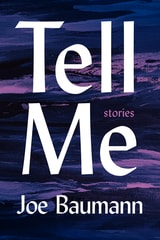
Tell Me
StoriesJoe Baumann
Northwestern University Press, 2024
Queer stories about love, loneliness, the surreal, and the self
The stories in Tell Me feature queer men of various ages reckoning with loneliness, selfishness, and the struggle for self-discovery and identity. In “The Vanisher,” a young bisexual man struggling with his own desire to be seen receives a bandana that allows him to become invisible. In “Retreat,” a widower travels to an artists’ colony to seek an audience with his recently deceased husband. And in “We Are Rendered Silent,” people lose their ability to speak when a man they love dies. Through Baumann’s inventive employment of the strange and surreal, these stories set out to explore the bizarre and often confounding experience of navigating modern-day queerness. With his unique voice and magnificent imagination, Baumann fully immerses readers in the queer experience.
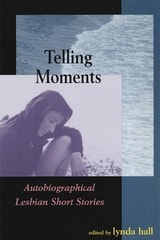
Telling Moments
Autobiographical Lesbian Short StoriesEdited by Lynda Hall
University of Wisconsin Press, 2003
The stories are by well-known contemporary writers—Gloria Anzaldúa, Mary Cappello, Emma Donoghue, Jewelle Gomez, Karla Jay, Anna Livia, Valerie Miner, Lesléa Newman, Minnie Bruce Pratt, Ruthann Robson, Sarah Schulman, and Jess Wells—and exciting newer voices, such as Donna Allegra and Marion Douglas. There are also stories from performance artists Carmelita Tropicana, Peggy Shaw, and Maya Chowdhry. Anna Livia’s protagonist appreciates her mother’s artful garden creation. Ruthann Robson tells of a survivor of the health care system. In Marion Douglas’s story a teenager dances with an alluring classmate. Donna Allegra’s strong construction worker copes with the death of her mother. And Karla Jay sets her character forth to swim with sharks. Most of the stories are accompanied by an author photo, biographical sketch, and—a most significant feature—a commentary from the author on her writing process and the autobiographical nature of her story, illustrating the truth behind the fiction.
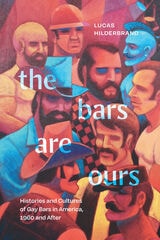
The Bars Are Ours
Histories and Cultures of Gay Bars in America,1960 and AfterLucas Hilderbrand
Duke University Press, 2024
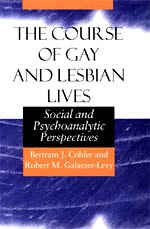
The Course of Gay and Lesbian Lives
Social and Psychoanalytic PerspectivesBertram J. Cohler and Robert M. Galatzer-Levy
University of Chicago Press, 2000
Drawing on their own work with gays, lesbians, and bisexuals as well as other pertinent studies, psychoanalysts Bertram J. Cohler and Robert Galatzer-Levy have written a groundbreaking work that examines how psychological development and clinical intervention as well as social and historical change across generations contribute to how we think about sexuality. The authors argue that there is little support for assuming that homosexuality has a biological basis. Recognizing the many pathways that lead to same-gender sexual orientation, the authors conclude that the cause is much less important than understanding the meaning of being homosexual. They consider the destructive nature of an intolerant society that fosters so-called conversion psychotherapy and stress the importance of helping to rebuild a sense of coherence and personal integrity among homosexuals.
The Deaf-Mute Boy
Joseph Geraci
University of Wisconsin Press, 2006
The Disintegrations
A NovelAlistair McCartney
University of Wisconsin Press, 2019
Within this dizzying investigation into the mystery of death is another mystery: who is the companion igniting these memories? This enigmatic novel blurs the line between fiction and nonfiction, story and eulogy, poetry and obituary. Wry yet somber, astringent yet tender, The Disintegrations confronts both the impossibility of understanding death and the timeless longing for immortality.
The End of the World Book
A NovelAlistair McCartney
University of Wisconsin Press, 2008
This is no ordinary novel. An encyclopedia of memory—from A to Z—The End of the World Book deftly intertwines fiction, memoir, and cultural history, reimagining the story of the world and one man’s life as they both hurtle toward a frightening future. Alistair McCartney’s alphabetical guide to the apocalypse layers images like a prose poem, building from Aristotle to da Vinci, hip-hop to lederhosen, plagues to zippers, while barreling from antiquity to the present.
In this profound book about mortality, McCartney composes an irreverent archive of philosophical obsessions and homoerotic fixations, demonstrating the difficulty of separating what is real from what is imagined.
Finalist, Edmund White Award for Debut Fiction, The Publishing Triangle
Finalist, PEN USA Literary Award for Fiction
The Faith Healer of Olive Avenue
StoriesManuel Muñoz and Cherríe Moraga
Northwestern University Press, 2025
From the divergent paths of triplet brothers to a grieving father confronting his mistreatment of his son, these stories interweave a recurring cast of neighborhood characters, many of them in search of escape or release. Lauded for its empathetic portrayals of communities often ignored, The Faith Healer of Olive Avenue won a Whiting Award and an O. Henry Award; it was shortlisted for the Frank O’Connor International Short Story Award as one of the best collections published in English worldwide. A new foreword by author and activist Cherríe Moraga gives testament to Muñoz’s status as “the cartographer of a people.”
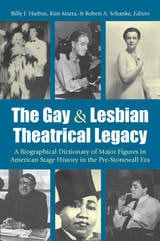
The Gay and Lesbian Theatrical Legacy
A Biographical Dictionary of Major Figures in American Stage History in the Pre-Stonewall EraBilly J. Harbin, Kim Marra, and Robert A. Schanke, Editors
University of Michigan Press, 2005
“A superb tribute to theatrical pioneers—The Gay and Lesbian Theatrical Legacy is required reading for both theatre scholars and gay/lesbian/bisexual history aficionados. A fascinating journey awaits them all in this highly recommended volume.”
—Broadside: Newsletter of the Theatre Library Association
The Gay and Lesbian Theatrical Legacy collects in a single volume biographies of more than one hundred notable figures whose careers flourished in the years before the 1969 Stonewall Riots marked the beginning of the gay and lesbian civil rights movement in the United States. The leading lights in American theater have included innumerable individuals whose sexualities have deviated from prevailing norms, but this history has until recently been largely unwritten and unknown. This book contributessignificantly to the recovery of this history, fashioning a much fuller, more nuanced portrait of American theater as it evolved and shedding light on the influence that sexual desire may have had on professional choices, relationships, and artistic achievements.
The Gay and Lesbian Theatrical Legacy collects biographies and portraits of influential actors, playwrights, composers, directors, designers, dancers, producers, managers, critics, choreographers, and technicians who made their mark on the American theater. Its broad coverage provides an extended glimpse into lives and careers that intersected and into networks of affiliation that made theatrical history and, by extension, social and cultural history.
The late Billy J. Harbin was Professor of Theater, Louisiana State University. Kim Marra is Associate Professor of Theater, University of Iowa. Robert A. Schanke is Professor of Theater Emeritus, Central College, Pella, Iowa.
The German Officer’s Boy
Harlan Greene
University of Wisconsin Press, 2005
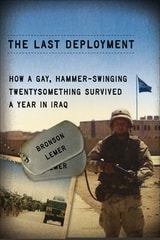
The Last Deployment
How a Gay, Hammer-Swinging Twentysomething Survived a Year in IraqBronson Lemer
University of Wisconsin Press, 2011
In 2003, after serving five and a half years as a carpenter in a North Dakota National Guard engineer unit, Bronson Lemer was ready to leave the military behind. But six months short of completing his commitment to the army, Lemer was deployed on a yearlong tour of duty to Iraq. Leaving college life behind in the Midwest, he yearns for a lost love and quietly dreams of a future as an openly gay man outside the military. He discovers that his father’s lifelong example of silent strength has taught him much about being a man, and these lessons help him survive in a war zone and to conceal his sexuality, as he is required to do by the U.S. military.
Finalist, Minnesota Book Awards
Finalist, Over the Rainbow Selection, American Library Association
Amazon Top Ten 10 Gay & Lesbian Books of 2011
The Last Syrian
Omar Youssef Souleimane
Seagull Books, 2024
Youssef’s mother has always told him that he is named after the biblical prophet Joseph who had the power of foresight. But when Youssef participated in the first demonstration in Damascus in 2011, he felt that the uprising against the Bashar al-Assad regime after forty years of silence and fear was “a miracle more powerful than that of the prophet.”
While Josephine, a charming young Alawite, gathers in her home a group of youth to fight for their visions of a promising future, a forbidden love story unfolds between two men, Youssef and Mohammad. Meanwhile, young Khalid’s love for Josephine is brutally interrupted by the agents of the oppressive regime. Homosexuality clashes with tradition, emancipation with persecution, and feelings with loyalties, leading to an upheaval that sweeps away the destinies of the young as well as that of an entire nation.
Omar Youssef Souleimane’s eloquent novel is not only a narrative of the Syrian Revolution; it is also a story about inter-generational conflicts, rebellion, and liberation. With intense, poetic prose, he brilliantly captures the indomitable yearning for freedom that, despite all obstacles and setbacks, always survives in a hopeful person’s heart until it’s attained.
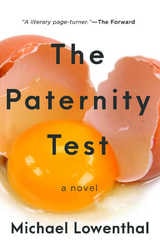
The Paternity Test
A NovelMichael Lowenthal
University of Wisconsin Press, 2018
Pat Faunce is a faltering romantic, a former poetry major who now writes textbooks. A decade into his relationship with Stu, an airline pilot from a fraught Jewish family, he fears he’s losing Stu to other men—and losing himself in their “no rules” arrangement. Yearning for a baby and a deeper commitment, he pressures Stu to move from Manhattan to Cape Cod, to the cottage where Pat spent boyhood summers.
As they struggle to adjust to their new life, they enlist a surrogate: Debora, a charismatic Brazilian immigrant, married to Danny, an American carpenter. Gradually, Pat and Debora bond, drawn together by the logistics of getting pregnant and away from their spouses. Pat gets caught between loyalties—to Stu and his family, to Debora, to his own potent desires—and wonders: is he fit to be a father?
In one of the first novels to explore the experience of gay men seeking a child through surrogacy, Michael Lowenthal writes passionately about marriages and mistakes, loyalty and betrayal, and about how our drive to create families can complicate the ones we already have. The Paternity Test is a provocative look at the new “family values.”
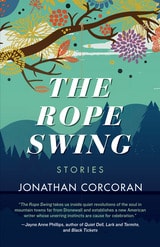
The Rope Swing
StoriesJonathan Corcoran
West Virginia University Press, 2016
A once-booming West Virginia rail town no longer has a working train. The residents left behind in this tiny hamlet look to the mountains that surround them on all sides: The outside world encroaches, and the buildings of the gilded past seem to crumble more every day.
These are the stories of outsiders—the down and out. What happens to the young boy whose burgeoning sexuality pushes him to the edge of the forest to explore what might be love with another boy? What happens when one lost soul finally makes it to New York City, yet the reminders of his past life are omnipresent? What happens when an old woman struggles to find a purpose and reinvent herself after decades of living in the shadow of her platonic life partner? What happens to those who dare to live their lives outside of the strict confines of the town’s traditional and regimented ways?
The characters in The Rope Swing—gay and straight alike—yearn for that which seems so close but impossibly far, the world over the jagged peaks of the mountains.
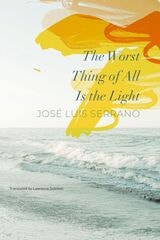
The Worst Thing of All Is the Light
José Luis Serrano
Seagull Books, 2023
The Worst Thing of All Is the Light tells two stories. First, that of the friendship of two heterosexual men, Koldo and Edorta, through the decades of the late twentieth century in Spain’s Basque Country. In the book Edorta writes in order to try and save from oblivion his relationship with Koldo—a bond for which the word “friendship” falls short yet for which he is too afraid to use the word “love.” It is the story of two men who are in love and don’t know it, or don’t want to know it. The second story is that of its author, José Luis Serrano, in the present day as he enjoys his summer holiday in the same Basque Country and talks with his husband at length about many different things, but mostly about how to narrate the relationship of Koldo and Edorta, two men who did not allow themselves to construct the domestic life that their counterparts enjoy today. Together these stories show a love that the lovers hope will outlive them, a love that is the same even if we give it different labels.
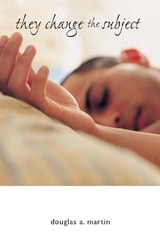
They Change the Subject
Douglas A. Martin
University of Wisconsin Press, 2005
Treacherously comic and poignant, the autobiographical stories in They Change the Subject follow a young man’s quest for identity through love and desire. Sustained by a single voice, the stories simultaneously offer a fractured novel and stand, powerfully, on their own. At the center of each tale is the heightened, visceral possibility of unexpected emotional encounters—from an escort’s dates in Manhattan hotels to a photo shoot that doubles as seduction. Always pushing toward a bigger shiver of passion, Martin’s young-man-on-the-make learns how to adapt his persona to suit his lovers’ needs and tries to embrace his own experience—and his self—by becoming the purest object of desire.