Results by title
66 books match the query 'Genealogy' and 22 start with t
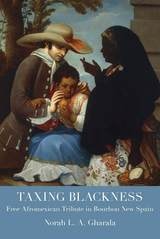
Taxing Blackness
Free Afromexican Tribute in Bourbon New SpainNorah L. A. Gharala
University of Alabama Press, 2019
A definitive analysis of the most successful tribute system in the Americas as applied to Afromexicans
During the eighteenth century, hundreds of thousands of free descendants of Africans in Mexico faced a highly specific obligation to the Spanish crown, a tax based on their genealogy and status. This royal tribute symbolized imperial loyalties and social hierarchies. As the number of free people of color soared, this tax became a reliable source of revenue for the crown as well as a signal that colonial officials and ordinary people referenced to define and debate the nature of blackness.
Taxing Blackness: Free Afromexican Tribute in Bourbon New Spain examines the experiences of Afromexicans and this tribute to explore the meanings of race, political loyalty, and legal privileges within the Spanish colonial regime. Norah L. A. Gharala focuses on both the mechanisms officials used to define the status of free people of African descent and the responses of free Afromexicans to these categories and strategies. This study spans the eighteenth century and focuses on a single institution to offer readers a closer look at the place of Afromexican individuals in Bourbon New Spain, which was the most profitable and populous colony of the Spanish Atlantic.
As taxable subjects, many Afromexicans were deeply connected to the colonial regime and ongoing debates about how taxpayers should be defined, whether in terms of reputation or physical appearance. Gharala shows the profound ambivalence, and often hostility, that free people of African descent faced as they navigated a regime that simultaneously labeled them sources of tax revenue and dangerous vagabonds. Some free Afromexicans paid tribute to affirm their belonging and community ties. Others contested what they saw as a shameful imposition that could harm their families for generations. The microhistory includes numerous anecdotes from specific cases and people, bringing their history alive, resulting in a wealth of rural and urban, gender, and family insight.

Tents, Tigers and the Ringling Brothers
Jerry Apps
Wisconsin Historical Society Press, 2007

Texas Cemeteries
The Resting Places of Famous, Infamous, and Just Plain Interesting TexansBy Bill Harvey
University of Texas Press, 2003
Winner, Journalistic Achievement Award, Texas Historical Foundation, 2004
From the simplest slab of weathered stone to the most imposing mausoleum, every marker in a Texas cemetery bears witness to a life that—in ways small or large—helped shape the history and culture of the state. Telling the stories of some of these significant lives is the purpose of this book. Within its pages, you'll meet not only the heroes of the Texas Revolution, for example, but also one of the great African American cowboys of the traildriving era (Bose Ikard) and the first woman in Texas elected to statewide office (Annie Webb Blanton). Visiting cemeteries from every era and all regions of the state, Bill Harvey recounts the histories of famous, infamous, and just plain interesting Texans who lie at rest in Texas cemeteries.
The book is organized alphabetically by city for easy reference. For each city, Harvey lists one or more cemeteries, giving their location and history, if significant. At the heart of the book are his profiles of the noteworthy people buried in each cemetery. They include not only famous but also lesser-known and even unknown Texans who made important contributions to the state in the arts, sports, business, military service, politics—truly every area of communal life. For those who want to visit these resting places, Harvey also includes tips on finding cemeteries, locating gravesites, and taking good photographs. Spend time with him in the graveyards of Texas, and you'll soon appreciate what fascinating stories the silent stones can tell.

Text
The Genealogy of an Antidisciplinary ObjectJohn Mowitt
Duke University Press, 1992
Beginning with the Tel Quel group in France in the sixties and seventies, Mowitt's study details how a certain interdisciplinary crisis prompted academics to rethink the conditions of cultural interpretation. Concentrating on three disciplinary projects—literary analysis, film studies, and musicology—Mowitt shows how textuality's emergence called into question not merely the relations among these disciplines, but also the cultural logic of disciplinary reason as such.
At once an effort to define "the text" and to explore and extend the theory of textuality, this book illustrates why the notion of interdisciplinary research has recently acquired such urgency. At the same time, by emphasizing the genealogical dimension of the textual object, Mowitt raises the issues of its "antidisciplinary" character, and by extension its immediate pertinence for the current debates over multiculturalism and Eurocentrism.
The Ascent of Affect
Genealogy and CritiqueRuth Leys
University of Chicago Press, 2017
Ruth Leys’s brilliant, much anticipated history, therefore, is a story of controversy and disagreement. The Ascent of Affect focuses on the post–World War II period, when interest in emotions as an object of study began to revive. Leys analyzes the ongoing debate over how to understand emotions, paying particular attention to the continual conflict between camps that argue for the intentionality or meaning of emotions but have trouble explaining their presence in non-human animals and those that argue for the universality of emotions but struggle when the question turns to meaning. Addressing the work of key figures from across the spectrum, considering the potentially misleading appeal of neuroscience for those working in the humanities, and bringing her story fully up to date by taking in the latest debates, Leys presents here the most thorough analysis available of how we have tried to think about how we feel.
The Beggar and the Professor
A Sixteenth-Century Family SagaEmmanuel Le Roy Ladurie
University of Chicago Press, 1997
"Le Roy Ladurie paints a remarkably contemporary picture of life in the sixteenth century. . . . It's a good story, told with a deft narrative touch."—Michael S. Kimmel, The Nation
"Le Roy Ladurie is a master of the representative detail and uses the Platters' lives as a means to see a whole century 'through a glass, darkly'."—The Independent
"Le Roy Ladurie has not only thoroughly sketched out the Platters' particular brand of gusto, he has also made it seem a defining characteristic of the sixteenth century."—The New Republic
"All [of] the drama and pathos of a Disney film."—Emily Eakin, Lingua Franca
The Cadottes
A Fur Trade Family on Lake SuperiorRobert Silbernagel
Wisconsin Historical Society Press, 2023
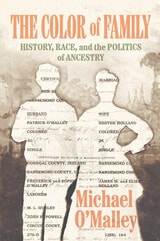
The Color of Family
History, Race, and the Politics of AncestryMichael O'Malley
University of Chicago Press, 2024
A zealous eugenicist ran Virginia’s Bureau of Vital Statistics in the first half of the twentieth century, misusing his position to reclassify people he suspected of hiding their “true” race. But in addition to being blinded by his prejudices, he and his predecessors were operating more by instinct than by science. Their whole dubious enterprise was subject not just to changing concepts of race but outright error, propagated across generations.
This is how Michael O’Malley, a descendant of a Philadelphia Irish American family, came to have “colored” ancestors in Virginia. In The Color of Family, O’Malley teases out the various changes made to citizens’ names and relationships over the years, and how they affected families as they navigated what it meant to be “white,” “colored,” “mixed race,” and more. In the process, he delves into the interplay of genealogy and history, exploring how the documents that establish identity came about, and how private companies like Ancestry.com increasingly supplant state and federal authorities—and not for the better.
Combining the history of O’Malley’s own family with the broader history of racial classification, The Color of Family is an accessible and lively look at the ever-shifting and often poisoned racial dynamics of the United States.
The Cypress and Other Writings of a German Pioneer in Texas
By Hermann Seele
University of Texas Press, 1979
When Hermann Seele anived in New Braunfels in 1845, the raw colony was plagued by poverty, disease, lack of food, and hostile Indians. This personal record of the Germans in Texas shows their evolution from struggling colonists to prosperous citizens.
From his viewpoint of a hardworking yet imaginative pioneer, Seele presents first a history of German immigration and settlement in Texas during the nineteenth century. Next, his autobiographical writings range from a "sentimental recollection" of his first Christmas Eve in Texas to his first day of teaching in New Braunfels, from accounts of the popular singing society to murder and justice along the Comal River. In addition, Seele's romantic novel, The Cypress, is a delightful though improbable tale of a traveling botanist, a chieftain's daughter, and a savage Indian cult.
Hermann Seele—farmer, lawyer, teacher, lay preacher, mayor, state representative, Civil War major, and editor—epitomizes the best of the German immigrants who established their communities as models of respectability and prosperity.
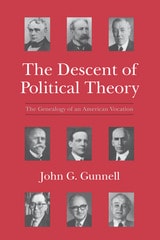
The Descent of Political Theory
The Genealogy of an American VocationJohn G. Gunnell
University of Chicago Press, 1993
Gunnell reconstructs the evolution of the field by locating it within the broader development of political science and American social science in general. During the behavioral revolution that swept political science in the 1950s, the relationship between political theory and political science changed dramatically, relegating theory to the margins of an increasingly empirical discipline. Gunnell demonstrates that the estrangement of political theory is rooted in a much older quarrel: the authority of knowledge versus political theory is rooted in a much older quarrel: the authority of knowledge versus political authority, academic versus public discourse. By disclosing the origin of this dispute, he opens the way for a clearer understanding of the basis and purpose of political theory.
As critical as it is revelatory, this thoughtful book should be read by any one interested in the history of political theory or science—or in the relationship of social science to political practice in the United States.
The Dialectics of Our America
Genealogy, Cultural Critique, and Literary HistoryJosé David Saldívar
Duke University Press, 1991
Saldívar pursues this goal through an array of oppositional critical and creative practices. He analyzes a range of North American writers of color (Rolando Hinojosa, Gloria Anzaldúa, Arturo Islas, Ntozake Shange, and others) and Latin American authors (José Martí, Roberto Fernández Retamar, Gabriel García Márquez, and others), whose work forms a radical critique of the dominant culture, its politics, and its restrictive modes of expression. By doing so, Saldívar opens the traditional American canon to a dialog with other voices, not just the voices of national minorities, but those of regional cultures different from the prevalent anglocentric model.
The Dialectics of Our America, in its project to expand the “canon” and define a pan-American literary tradition, will make a critical difference in ongoing attempts to reconceptualize American literary history.
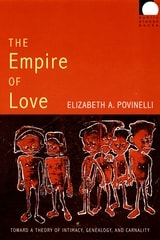
The Empire of Love
Toward a Theory of Intimacy, Genealogy, and CarnalityElizabeth A. Povinelli
Duke University Press, 2006
For more than twenty years, Povinelli has traveled to the social worlds of indigenous men and women living at Belyuen, a small community in the Northern Territory of Australia. More recently she has moved across communities of alternative progressive queer movements in the United States, particularly those who identify as radical faeries. In this book she traces how liberal binary concepts of individual freedom and social constraint influence understandings of intimacy in these two worlds. At the same time, she describes alternative models of social relations within each group in order to highlight modes of intimacy that transcend a reductive choice between freedom and constraint.
Shifting focus away from identities toward the social matrices out of which identities and divisions emerge, Povinelli offers a framework for thinking through such issues as what counts as sexuality and which forms of intimate social relations result in the distribution of rights, recognition, and resources, and which do not. In The Empire of Love Povinelli calls for, and begins to formulate, a politics of “thick life,” a way of representing social life nuanced enough to meet the density and variation of actual social worlds.
The Enlightenment
A GenealogyDan Edelstein
University of Chicago Press, 2010
What was the Enlightenment? Though many scholars have attempted to solve this riddle, none has made as much use of contemporary answers as Dan Edelstein does here. In seeking to recover where, when, and how the concept of “the Enlightenment” first emerged, Edelstein departs from genealogies that trace it back to political and philosophical developments in England and the Dutch Republic. According to Edelstein, by the 1720s scholars and authors in France were already employing a constellation of terms—such as l’esprit philosophique—to describe what we would today call the Enlightenment. But Edelstein argues that it was within the French Academies, and in the context of the Quarrel of the Ancients and the Moderns, that the key definition, concepts, and historical narratives of the Enlightenment were crafted.
A necessary corrective to many of our contemporary ideas about the Enlightenment, Edelstein’s book turns conventional thinking about the period on its head. Concise, clear, and contrarian, The Enlightenment will be welcomed by all teachers and students of the period.
The Force of Truth
Critique, Genealogy, and Truth-Telling in Michel FoucaultDaniele Lorenzini
University of Chicago Press, 2023
Many blame Michel Foucault for our post-truth and conspiracy-laden society. In this provocative work, Daniele Lorenzini argues that such criticism fundamentally misunderstands the philosopher’s project. Foucault did not question truth itself but what Lorenzini calls “the force of truth,” or how some truth claims are given the power to govern our conduct while others are not. This interest, Lorenzini shows, drove Foucault to articulate a new ethics and politics of truth-telling precisely in order to evade the threat of relativism. The Force of Truth explores this neglected dimension of Foucault’s project by putting his writings on regimes of truth and parrhesia in conversation with early analytic philosophy and by drawing out the “possibilizing” elements of Foucault’s genealogies that remain vital for practicing critique today.
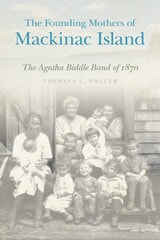
The Founding Mothers of Mackinac Island
The Agatha Biddle Band of 1870Theresa L. Weller
Michigan State University Press, 2021
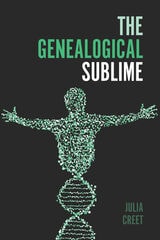
The Genealogical Sublime
Julia Creet
University of Massachusetts Press, 2020
In The Genealogical Sublime, Julia Creet traces the histories of the largest, longest-running, most lucrative, and most rapidly growing genealogical databases to delineate a broader history of the industry. As each unique case study reveals, new database and DNA technologies enable an obsessive completeness—the desire to gather all of the world's genealogical records in the interests of life beyond death. Archival research and firsthand interviews with Church of Jesus Christ of Latter-day Saints officials, key industry players (including Ancestry.com founders and Family Search executives), and professional and amateur family historians round out this timely and essential study.
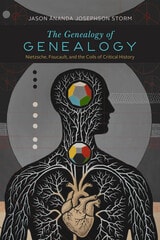
The Genealogy of Genealogy
Nietzsche, Foucault, and the Coils of Critical HistoryJason Ananda Josephson Storm
University of Chicago Press, 2026
The genealogical method—a mode of historical analysis that shows that what looks timeless is in fact contingent, bound to shifting relations of meaning, knowledge, and power—has become the dominant paradigm of humanistic inquiry. In The Genealogy of Genealogy, Jason Ānanda Josephson Storm turns this influential practice back on itself, tracing its unlikely rise through Nietzsche and Foucault and uncovering its suppressed ties to eugenics and racism. He rethinks the very stakes of critical history and proposes new tools for thinking about historical continuity, change, and difference.
Provocative and timely, The Genealogy of Genealogy offers both a diagnosis and a vision, challenging scholars across the humanities and social sciences to rethink how we write history and whether our most trusted methods are fit for the futures we seek to build.
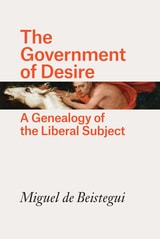
The Government of Desire
A Genealogy of the Liberal SubjectMiguel de Beistegui
University of Chicago Press, 2018
By critically exploring Foucault’s claim that Western civilization is a civilization of desire, de Beistegui crafts a provocative and original genealogy of this shift in thinking. He shows how the relationship between identity, desire, and government has been harnessed and transformed in the modern world, shaping our relations with others and ourselves, and establishing desire as an essential driving force for the constitution of a new and better social order. But is it? The Government of Desire argues that this is precisely what a contemporary politics of resistance must seek to overcome. By questioning the supposed universality of a politics based on recognition and the economic satisfaction of desire, de Beistegui raises the crucial question of how we can manage to be less governed today, and explores contemporary forms of counter-conduct.
Drawing on a host of thinkers from philosophy, political theory, and psychoanalysis, and concluding with a call for a sovereign and anarchic form of desire, The Government of Desire is a groundbreaking account of our freedom and unfreedom, of what makes us both governed and ungovernable.
The Impossible Machine
A Genealogy of South Africa's Truth and Reconciliation CommissionAdam Sitze
University of Michigan Press, 2016
Adam Sitze meticulously traces the origins of South Africa’s Truth and Reconciliation Commission back to two well-established instruments of colonial and imperial governance: the jurisprudence of indemnity and the commission of inquiry. This genealogy provides a fresh, though counterintuitive, understanding of the TRC’s legal, political, and cultural importance. The TRC’s genius, Sitze contends, is not the substitution of “forgiving” restorative justice for “strict” legal justice but rather the innovative adaptation of colonial law, sovereignty, and government. However, this approach also contains a potential liability: if the TRC’s origins are forgotten, the very enterprise intended to overturn the jurisprudence of colonial rule may perpetuate it. In sum, Sitze proposes a provocative new means by which South Africa’s Truth and Reconciliation Commission should be understood and evaluated.
The Otherness of Self
A Genealogy of Self in Contemporary ChinaXin Liu
University of Michigan Press, 2002

The Search for Ancestors
A Swedish-American Family SagaH. Arnold Barton
Southern Illinois University Press, 1979
A metaphor for the Swedish migration to America in the mid-nineteenth century, the Sven Svensson family, traced here by historian H. Arnold Barton, a descendant, provides a model for genealogical research with which all persons interested in ancestors can identify and from which anyone can learn.
The field of migration history has taken on new importance as a result of accelerating interest in ethnicity and genealogical research. Though a family history, and in a sense an inner voyage of self-discovery, the search for ancestors told here reveals the broader contours of Swedish and American history in the nineteenth century.
The Search for Ancestors is a microanalysis of those social, economic, and cultural developments that led to the gradual breakup of an ancient way of life in the Swedish countryside and the migration of growing numbers of Swedish peasants across the Atlantic to America.
Barton’s personal odyssey took him to Gowrie, Iowa, the heart of Swedish America, and to the province of Småland in southern Sweden. Research in the Swedish Statistical Central Bureau in Stockholm, contacts with emigration historians in Stockholm, and search in Swedish provincial and national archives, finally gave him the impressive mass of information and statistical data with which to chart his family’s history—over four centuries, back to the 1530s.
A kind of “history with the works showing” or do-it-yourself genealogical kit, the book will be fascinating as well as informative for general readers as well as students of history.
Trauma
A GenealogyRuth Leys
University of Chicago Press, 2000
In a book that is bound to ignite controversy, Ruth Leys investigates the history of the concept of trauma. She explores the emergence of multiple personality disorder, Freud's approaches to trauma, medical responses to shellshock and combat fatigue, Sándor Ferenczi's revisions of psychoanalysis, and the mutually reinforcing, often problematic work of certain contemporary neurobiological and postmodernist theorists. Leys argues that the concept of trauma has always been fundamentally unstable, oscillating uncontrollably between two competing models, each of which tends at its limit to collapse into the other.
A powerfully argued work of intellectual history, Trauma will rewrite the terms of future discussion of its subject.