Results by title
64 books match the query 'Georgia' and 17 start with t
The Archaeology of Ocmulgee Old Fields, Macon, Georgia
Carol I. Mason, with a new foreword by Marvin T. Smith
University of Alabama Press, 2005
A 17th-century trading post and Indian town in central Georgia reveal evidence of culture contact and change
Ocmulgee Old Fields near Macon, Georgia, is the site of a Lower Creek village and associated English trading house dating from the late 17th and early 18th centuries. It was excavated in the early 1930s as part of a WPA project directed by A. R. Kelly, which focused primarily on the major Mississippian temple mounds of Macon Plateau. The specific data for the Old Fields was not analyzed until nearly 30 years after the excavation.
Part of the significance of this site lies in its secure identification with a known group of people and the linkage of those people with recognizable archaeological remains. The Old Fields site was among the very first for which this kind of identification was possible and stands at the head of a continuing tradition of historic sites archaeology in the Southeast.
Carol I. Mason's classic study of the Ocmulgee Old Fields site has been a model for contact-period Indian archaeology since the 1960s. The report includes a discussion of the historic setting and an analysis of the archaeological materials with an identification of the Lower Creek town and possibly of the English trader who lived there. Now, for the first time, the original report is widely available in book form. With a new foreword by the author and a new introduction from Southeastern archaeology expert Marvin T. Smith, readers have the benefit of a contemporary view of this very fine piece of careful scholarship.

The Atlanta Youth Murders and the Politics of Race
Bernard Headley
Southern Illinois University Press, 1998
At least twenty-nine black children and young adults were murdered by an Atlanta serial killer between the summer of 1979 and the spring of 1981. Drawing national media attention, the “Atlanta tragedy,” as it became known, was immediately labeled a hate crime. However, when a young black man was arrested and convicted for the killings, public attention quickly shifted. Noted criminologist Bernard Headley was in Atlanta as the tragedy unfolded and provides here a thoughtful exploration of the social and political implications of the case both locally and nationally. Focusing on a singular historical event, Headley exposes broader tensions of race and class in contemporary America.
The Bahá'í
The Religious Construction of a Global IdentityMcMullen, Michael
Rutgers University Press, 2000
The Bahá’í Faith is one of the fastest growing, but least studied, of the world’s religions. Adherents view themselves as united by a universal belief that transcends national boundaries. Michael McMullen examines how the Bahá’í develop and maintain this global identity. Taking the Bahá’í community in Atlanta, Georgia, as a case in point, his book is the first to comprehensively examine the tenets of this little-understood faith.
McMullen notes that, to the Bahá’í, Buddha, Moses, Jesus, and Mohammed are all divinely sent teachers of ‘the Truth’, whose messages conform to the needs of their individual cultures and historical periods. But religion—which draws from the teaching of Bahá’u’lláh, a nineteenth-century Persian—encourages its members to think of themselves as global citizens. It also seeks to establish unity among its members through adherence to a Bahá’í worldview.
By examining the Atlanta Bahá’í community, McMullen shows how this global identity is interpreted locally. He discusses such topics as: the organizational structure and authority relations in the Bahá’í “Administrative Order”; Bahá’í evangelicalism; and the social boundaries between Bahá’ís and the wider culture.

The Best Station of Them All
The Savannah Squadron, 1861-1865Maurice Melton
University of Alabama Press, 2012
The Confederate Navy’s Savannah Squadron, its relationship with the people of Savannah, Georgia, and its role in the city’s economy
In this well-written and extensively researched narrative, Maurice Melton charts the history of the unit, the sailors (both white and black), the officers, their families, and their activities aboard ship and in port.
The Savannah Squadron worked, patrolled, and fought in the rivers and sounds along the Georgia coast. Though they saw little activity at sea, the unit did engage in naval assault, boarding, capture, and ironclad combat. The sailors finished the war as an infantry unit in Robert E. Lee’s Army of Northern Virginia, fighting at Sayler’s Creek on the road to Appomattox.
Melton concentrates on navy life and the squadron’s place in wartime Savannah. The book reveals who the Confederate sailors were and what their material, social, and working lives were like.
The Best Station of Them All is an essential piece of historical literature for anyone interested in the Civil War, its navies, or Savannah.

The Closing Door
Conservative Policy and Black OpportunityGary Orfield and Carole Ashkinaze
University of Chicago Press, 1991
"The Closing Door is a crucial breath of fresh air . . . an important and timely text which will help to alter the 'underclass' debate in favor of reconsidering race-specific policies. Orfield and Ashkinaze construct a convincing argument with which those who favor 'race-neutrality' will have to contend. In readable prose they make a compelling case that economic growth is not enough."—Preston H. Smith II, Transition
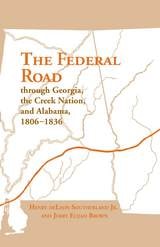
The Federal Road Through Georgia, the Creek Nation, and Alabama, 1806–1836
Henry deLeon Southerland
University of Alabama Press, 1990
The Federal Road was a major influence in settlement of the Mississippi Territory during the period between the Louisiana Purchase and removal of the Creek Indians
The Georgia Florida Contest
Martha C. Searcy
University of Alabama Press, 1985
Almost from the time of Georgia’s settlement by Oglethorpe in 1733, both Georgians and Carolinians had made periodic unsuccessful attempts to conquer the Spanish Castillo San Marcos in St. Augustine; and during the American Revolution (in 1776, 1777, and 1778) the rebels tried without success to take the fortification, which was then a British stronghold. Each of the three expeditions was less successful than the preceding one, and between the formal campaigns vicious partisan warfare between loyalists and rebels devastated much of the area between the Altamaha and St. Johns rivers.
This book presents a detailed history of the three Georgia-Florida campaigns. Indecisive and lacking the glamour of either the contemporary campaigns in the North, or the later campaigns in the South, they appeared isolated from the mainstream of the revolutionary struggle. The rebels were handicapped by divided command, personal quarrels, difficult terrain, and miserable weather. While Searcy emphasizes the military aspects of the period, she also treats the conflict between civil and military authorities, the effects of war on the civilian populace, and the interaction of economic matters with military affairs. Her work clarifies the importance of these military activities in the subsequent British strategy in the occupation of Georgia and the Carolinas.
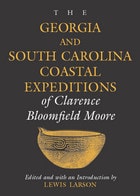
The Georgia and South Carolina Coastal Expeditions of Clarence Bloomfield Moore
Clarence Bloomfield Moore, edited by Lewis Larson
University of Alabama Press, 1998
A Dan Josselyn Memorial Publication
This facsimile edition of Moore's Georgia and South Carolina expeditions includes an extensive new introduction from Georgia's senior archaeologist.
This compilation of Clarence Bloomfield Moore's investigations along the rich coastal and river drainages of Georgia and South Carolina makes
available in a single volume valuable works published a century ago. By modern standards Moore's excavation techniques were crude, but his results were nothing less than spectacular. He recorded data with care, and much information can be learned from his works. In some cases his publications are the only documentation extant for sites that have since been destroyed. In one case, relic collectors had destroyed six mounds at Mason's Plantation—the largest Mississippian center in the Savannah River valley—by the time Moore visited the site in 1897.
Moore also documented prehistoric urn burials, a ritual widely practiced in eastern North America but more frequently on the Gulf Coastal Plain
of Alabama and coastal sites in Georgia and South Carolina. In the introduction, Lewis Larson discusses Moore's investigations within the framework of the current understanding of Georgia and South Carolina coastal archaeological chronology.
The Georgia of the North
Black Women and the Civil Rights Movement in New JerseyHettie V. Williams
Rutgers University Press, 2024
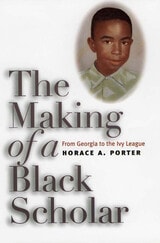
The Making of a Black Scholar
From Georgia to the Ivy LeagueHorace A. Porter
University of Iowa Press, 2003
The Making of a Black Scholar is structured around schools. Porter attends Georgia's segregated black schools until he enters the privileged world of Amherst College. He graduates (spending one semester at Morehouse College) and moves on to graduate study at Yale. He starts his teaching career at Detroit's Wayne State University and spends the 1980s at Dartmouth College and the 1990s at Stanford University.
The New Metropolis
Power, Place, and Inequality in Twenty-First-Century AmericaMargaret Weir
University of Chicago Press, 2027
A path-breaking investigation of changing patterns of inequality and contestation in America’s metropolises.
Since 1990, a new political geography of winners and losers has emerged in metros across America. This new metropolis looks nothing like the old. In many exurbs, suburban mansions abut declining towns and distressed communities. In historic central cities, African American communities reel from institutional stripping, even as gentrification and immigration revitalize once forgotten neighborhoods. The New Metropolis considers why, despite all the changes over the past four decades, we have recreated a metropolis that makes it harder for low-income Americans—especially low-income Americans of color—to thrive and why some efforts to promote equitable opportunity succeed against the odds.
With a focus on Chicago, Atlanta, and Houston, The New Metropolis shows how multi-level political actors and translocal networks build power across political boundaries to determine the pool of local public resources and the scope of local powers. Weir demonstrates how the timing of urbanization set up distinct conflicts over the public sector in Frostbelt versus Sunbelt metropolises, explaining how partisan divisions now supercharge these conflicts.
The New Metropolis shows why the battle over the metropolis sits at the center of American politics. It determines the shape of the public arenas where we make decisions and, ultimately, the kinds of connections Americans have with one another.

The Reconstruction of Georgia
Alan Conway
University of Minnesota Press, 1966
The Reconstruction of Georgia was first published in 1966. Minnesota Archive Editions uses digital technology to make long-unavailable books once again accessible, and are published unaltered from the original University of Minnesota Press editions.
In this study of the reconstruction period in Georgia following the Civil War, a British historian provides a dispassionate account of a highly controversial subject. A revisionist reappraisal, Dr. Conway's study is the first substantial history of the period to be published in fifty years. The sources include considerable material that has become available since the publication of the last major work on the subject in 1915.
The author gives close attention to the last days of the Civil War and its aftermath in Georgia, the early attempts at political reconstruction in 1865, the work of the Freedmen's Bureau, the economic problems involved in reshaping the state's economy, the development of the state-cropping and crop-lien systems, the imposition of Congressional reconstruction on Georgia under military supervision, the political maneuverings and economic ventures of such prominent figures as Joseph E. Brown, Benjamin Hill, and Hannibal I. Kimball, the efforts of the Ku-Klux Klan to nullify Negro voting rights and re-establish "white supremacy" concepts, and, finally, the investigations by the Democratic party of Republication misgovernment during the administration of Governor Rufus B. Bullock.
Dr. Conway, who did the research for the book in Georgia, has made considerable use of primary manuscripts, travelers' accounts, state and federal reports, and contemporary newspaper material to arrive at an account which judiciously assesses the claims and counter-claims of violently opposed groups which were vitally concerned with the place of the Negro in Southern society after emancipation and with the return of Georgia to the Union.
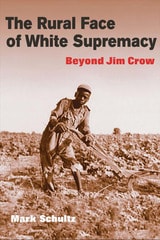
The Rural Face of White Supremacy
BEYOND JIM CROWMark Schultz
University of Illinois Press, 2007

The Secret Trust of Aspasia Cruvellier Mirault
The Life and Trials of a Free Woman of Color in Antebellum GeorgiaJanice L. Sumler-Edmond
University of Arkansas Press, 2008
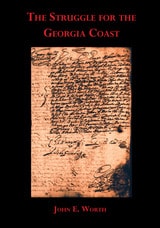
The Struggle for the Georgia Coast
John E. Worth
University of Alabama Press, 2007
In 1733, General James Edward Oglethorpe officially established the colony of Georgia, and within three years had fortified the coast southward toward St. Augustine. Although this region, originally known as the provinces of Guale and Mocama, had previously been under Spanish control for more than a century, territorial fighting had emptied the region of Spanish missionaries, soldiers, and their Indian allies. Spanish officials maintained that the long history of Spanish authority over the territory guaranteed Spain the right to defy and repel the English intruders. By 1739, with diplomatic negotiations failing and the potential for war imminent, King Philip V requested that Don Manuel de Montiano, Governor of Spanish Florida, provide him with every document from both governmental and ecclesiastical sources that would demonstrate prior Spanish presence and control over the region. Original documents and translations were delivered within the year and safely filed for future use--then forgotten. With the outbreak of open war six months earlier, the diplomatic utility of the documents had passed.
For over 250 years, the documents languished safely in the Archive of the Indies in Seville until recognized, recovered, translated, and published by John Worth. Within this volume, Worth brings to light the history of the documents, provides complete translations and full explanations of their contents and a narrative exposition of the Spanish presence along the Atlantic coast never before fully understood. David Hurst Thomas provides an introduction that places Worth's translations and his historical overview into the context of ongoing archaeological excavations on the Georgia coast. With the publication of this volume, one of the least known chapters of Georgia history is finally examined in detail.
The Very Worst Road
Travellers' Accounts of Crossing Alabama's Old Creek Indian Territory, 1820-1847Jeffrey C. Benton
University of Alabama Press, 2009
Thirteen Georgia Ghosts and Jeffrey
Commemorative EditionKathryn Tucker Windham
University of Alabama Press, 1987
Haunting tales from Georgia—where history lingers in every shadow.
Petrifying the Peach State, hosts of haints have beset the state of Georgia throughout its storied history. In Thirteen Georgia Ghosts and Jeffrey, best-selling folklorist Kathryn Tucker Windham, along with her trusty spectral companion Jeffrey, introduce thirteen of Georgia’s most famous ghost stories.
Windham won hearts across the nation in her regular radio broadcasts and many public appearances. The South’s most prolific raconteur of revenants, Windham, giving new meaning to the phrase “ghost-writer,” does more than tell ghost stories—she captures the true spirit of the place.
Evoking Georgia’s colonial era, “The Eternal Dinner Party” explains why the sounds of an elegant dinner soirée still waft from the grove of Savannah’s Bonaventure estate. At the onset of the Revolution, the Tattnall family abandoned Bonaventure and slipped away to England. Young Josiah Tattnall eventually returned to fight in the Revolution, restored Bonaventure, and later became Georgia’s governor. One holiday eve, when the mansion was bedecked with magnolia and holly and crowded with visitors, a fire too large to control swept through the old house. Tattnall, exhibiting his cool head and impeccable manners, ordered the massive dinner table carried out to the garden where he enjoined his holiday revelers to continue their stately meal. The melancholy strains of Tattnall’s dinner guests still echo through Bonaventure’s ancient oaks on moonlight nights.
In “The Ghost of Andersonville,” Windham takes visitors near the woebegone Confederate prisoner-of-war camp. A plaque there still recounts the tale of Swiss immigrant and Confederate captain Henry Wirz. Convicted—many thought wrongly—of war crimes, Wirz’s restless ghost still perambulates the highways of south Georgia. Writing for the Georgia Historical Commission, Miss Bessie Lewis quips in her preface to this beloved collection, “Who should be better able to tell of happenings long past than the ghosts of those who had a part in them?”
A perennial favorite, this commemorative edition restores Thirteen Georgia Ghosts and Jeffrey to the ghastly grandeur of its original 1973 edition.