Results by title
106 books match the query 'Grammar' and 16 start with t
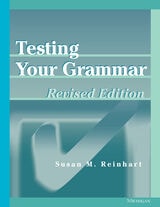
Testing Your Grammar, Revised Edition
Susan M. Reinhart
University of Michigan Press, 2002
With all units enlarged or significantly modified, the new and improved edition of Testing Your Grammar features reworked grammatical explanations and more example sentences so grammar points are easier to understand. Other features of the new edition:
- Explanations have been added to the answer key.
- A review test is found at the end of every two units.
- At the end of the book are four examinations that can be used for either pre-testing or post-testing.

Textbook of Israeli Hebrew
Haiim B. Rosén
University of Chicago Press, 1976
The work is organized into sections that can be worked through in an academic year—presentation of features, text samples, exercises, grammatical synopses, and individual and comprehensive glossaries. This text may be used by teachers without specialized training in linguistics. It can be used by self-teaching students as well as by those at college level, and it will valuable for immigrants to Israel.

The Afro-Bolivian Spanish Determiner Phrase
A Microparametric AccountSandro Sessarego
The Ohio State University Press, 2014
This dialect presents phenomena that offer a real challenge to current linguistic theory. The Afro-Bolivian Spanish Determiner Phrase elaborates on the importance of enhancing a stronger dialogue between formal generative theory and sociolinguistic methodology, in line with recent work in the field of minimalist syntax. Sessarego’s study combines sociolinguistic techniques of data collection with generative models of data analysis to obtain more fine-grained, empirically testable generalizations.
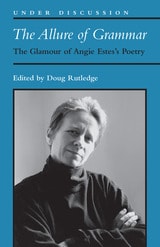
The Allure of Grammar
The Glamour of Angie Estes's PoetryDoug Rutledge, Editor
University of Michigan Press, 2019
In addition to presenting an overview of critical reactions to Estes’s oeuvre, reviews by Langdon Hammer, Julianne Buchsbaum, and Christopher Spaide also provide a helpful context for approaching a poet who claims to distrust narrative. Original essays consider the craft of Estes’s poetry and offer literary analysis. Ahren Warner uses line breaks to explore a postmodern analysis of Estes’s work. Mark Irwin looks at her poetic structure. Lee Upton employs a feminist perspective to explore Estes’s use of italics, and B. K. Fischer looks at the way she uses dance as a poetic image. Doug Rutledge considers her relationship to Dante and to the literary tradition through her use of ekphrasis. An interview with Estes herself, in which she speaks of a poem as an “arranged place . . . where experience happens,” adds her perspective to the mix, at turns resonating with and challenging her critics.
The Allure of Grammar will be useful for teachers and students of creative writing interested in the craft of non-narrative poetry. Readers of contemporary poetry who already admire Estes will find this collection insightful, while those not yet familiar with her work will come away from these essays eager to seek out her books.
The Arapaho Language
Andrew Cowell
University Press of Colorado, 2015
Cowell and Moss detail strategies used by speakers of this highly polysynthetic language to form complex words and illustrate how word formation interacts with information structure. They discuss word order and discourse-level features, treat the special features of formal discourse style and traditional narratives, and list gender-specific particles, which are widely used in conversation. Appendices include full sets of inflections for a variety of verbs.
Arapaho is spoken primarily in Wyoming, with a few speakers in Oklahoma. The corpus used in The Arapaho Language spans more than a century of documentation, including multiple speakers from Wyoming and Oklahoma, with emphasis on recent recordings from Wyoming. The book cites approximately 2,000 language examples drawn largely from natural discourse - either recorded spoken language or texts written by native speakers.
With The Arapaho Language, Cowell and Moss have produced a comprehensive document of a language that, in its departures from its nearest linguistic neighbors, sheds light on the evolution of grammar.
The Basque Language
A Practical IntroductionAlan R. King
University of Nevada Press, 2012
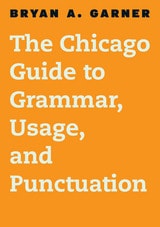
The Chicago Guide to Grammar, Usage, and Punctuation
Bryan A. Garner
University of Chicago Press, 2016
Throughout the book Garner describes standard literary English—the forms that mark writers and speakers as educated users of the language. He also offers historical context for understanding the development of these forms. The section on grammar explains how the canonical parts of speech came to be identified, while the section on syntax covers the nuances of sentence patterns as well as both traditional sentence diagramming and transformational grammar. The usage section provides an unprecedented trove of empirical evidence in the form of Google Ngrams, diagrams that illustrate the changing prevalence of specific terms over decades and even centuries of English literature. Garner also treats punctuation and word formation, and concludes the book with an exhaustive glossary of grammatical terms and a bibliography of suggested further reading and references.
The Chicago Guide to Grammar, Usage, and Punctuation is a magisterial work, the culmination of Garner’s lifelong study of the English language. The result is a landmark resource that will offer clear guidelines to students, writers, and editors alike.
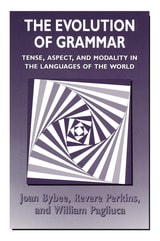
The Evolution of Grammar
Tense, Aspect, and Modality in the Languages of the WorldJoan Bybee, Revere Perkins, and William Pagliuca
University of Chicago Press, 1994
Through a survey of seventy-six languages in twenty-five different phyla, the authors show that the same paths of change occur universally and that movement along these paths is in one direction only. This analysis reveals that lexical substance evolves into grammatical substance through various mechanisms of change, such as metaphorical extension and the conventionalization of implicature. Grammaticization is always accompanied by an increase in frequency of the grammatical marker, providing clear evidence that language use is a major factor in the evolution of synchronic language states.
The Evolution of Grammar has important implications for the development of language and for the study of cognitive processes in general.
The Grammar of Negation
Jong-Bok Kim
CSLI, 2000
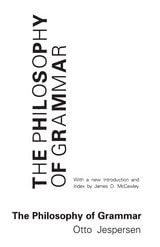
The Philosophy of Grammar
Otto Jespersen
University of Chicago Press, 1992
University in 1909-10, called “An Introduction to English Grammar.”
It is the connected presentation of Jespersen's views of the general
principles of grammar based on years of studying various languages
through both direct observation of living speech and written and
printed documents.
“[The Philosophy of Grammar and Analytic Syntax] set
forth the most extensive and original theory of universal grammar
prior to the work of Chomsky and other generative grammarians of the
last thirty years.”—Arne Juul and Hans F. Nielsen, in Otto
Jespersen: Facets of His Life and Work
“Besides being one of the most perceptive observers and original
thinkers that the field of linguistics has ever known, Jespersen was
also one of its most entertaining writers, and reading The
Philosophy of Grammar is fun. Read it, enjoy it.”—James D.
McCawley, from the Introduction
Otto Jespersen (1860-1943), an authority on the growth and structure
of language, was the Chair of the English Department at the University
of Copenhagen. Among his many works are A Modern English
Grammar and Analytic Syntax, the latter published by the
University of Chicago Press.
The Semantics of Syntax
A Minimalist Approach to GrammarDenis Bouchard
University of Chicago Press, 1995
The Semantics of Syntax is an elegant and powerful analysis of the relationship between syntax and semantics. Noting that meaning is underdetermined by form even in simple cases, Denis Bouchard argues that it is impossible to build knowledge of the world into grammar and still have a describable grammar. He thus proposes simple semantic representations and simple rules to relate linguistic levels. Focusing on a class of French verbs, Bouchard shows how multiple senses can be accounted for by the assumption of a single abstract core meaning along with background information about how objects behave in the world. He demonstrates that this move simplifies the syntax at no cost to the descriptive power of the semantics. In two important final chapters, he examines the consequences of his approach for standard syntactic theories.
The Structure of English
Studies in Form and Function for Language TeachingJeanette S. DeCarrico
University of Michigan Press, 2000
With an emphasis on discourse function throughout, students are never expected to rely on lists of unrelated, constructed example sentences. Rather, when major points of grammar are presented, the structures are illustrated with rich, "real world" contexts excerpted from literature (mostly American), including novels, short stories, poems, essays, and drama. Exercises in the companion workbook are likewise based on naturally occurring stretches of discourse.
Theoretical Aspects of Bantu Grammar 1
Edited by Sam Mchombo
CSLI, 1993
Thucydides Book I
A Students' Grammatical CommentaryH. D. Cameron
University of Michigan Press, 2003
Because Book I is not primarily historical narrative, it inevitably proves difficult for inexperienced readers. Despite the convolutions and density of Thucydides' prose style, no authoritative commentary has been published since the early days of the last century. H. D. Cameron is a renowned expert in Greek and comparative grammar and has written this handbook for all levels of classical students and scholars. His commentary authoritatively accounts for the last one hundred years of evolving grammatical and linguistic theory as they apply to the seminal work of Thucydides.
H. D. Cameron is Professor of Greek and Latin and Director of the Great Books Program at the University of Michigan.
Tondi Songway Kiini
Reference Grammar and TSK-English-French DictionaryJeffrey Heath
CSLI, 2005
Toward a Grammar of Passages
Richard M. Coe
Southern Illinois University Press, 1988
Richard M. Coe has developed such a “grammar,” one which uses a simple graphic instrument to analyze the meaningful relationships between sentences in a passage and to clarify the function of structure in discourse. Working in the tradition of Christensen’s generative rhetoric, Coe presents a two-dimensional graphic matrix that effectively analyzes the logical relations between statements by mapping coordinate, subordinate, and superordinate relationships.
Coe demonstrates the power of his discourse matrix by applying it to a variety of significant problems, such as how to demonstrate discourse differences between cultures (especially between Chinese and English), how to explain precisely what is “bad” about the structure of passages that do not work, and how best to teach structure. This new view of the structure of passages helps to articulate crucial questions about the relations between form and function, language, thought and culture, cognitive and social processes.