100 books match the query 'Grammar & Punctuation' and 22 start with t
cover of The Chicago Guide to Grammar, Usage, and Punctuation

The Chicago Guide to Grammar, Usage, and Punctuation

Bryan A. Garner

University of Chicago Press, 2016

Few people can write on the English language with the authority of Bryan A. Garner. The author of The Chicago Manual of Style’s popular “Grammar and Usage” chapter, Garner explains the vagaries of English with absolute precision and utmost clarity. With The Chicago Guide to Grammar, Usage, and Punctuation, he has written the definitive guide for writers who want their prose to be both memorable and correct.

Throughout the book Garner describes standard literary English—the forms that mark writers and speakers as educated users of the language. He also offers historical context for understanding the development of these forms. The section on grammar explains how the canonical parts of speech came to be identified, while the section on syntax covers the nuances of sentence patterns as well as both traditional sentence diagramming and transformational grammar. The usage section provides an unprecedented trove of empirical evidence in the form of Google Ngrams, diagrams that illustrate the changing prevalence of specific terms over decades and even centuries of English literature. Garner also treats punctuation and word formation, and concludes the book with an exhaustive glossary of grammatical terms and a bibliography of suggested further reading and references.

The Chicago Guide to Grammar, Usage, and Punctuation is a magisterial work, the culmination of Garner’s lifelong study of the English language. The result is a landmark resource that will offer clear guidelines to students, writers, and editors alike.

[more]
cover of The Chicago Manual of Style, 17th Edition

The Chicago Manual of Style, 17th Edition

The University of Chicago Press Editorial Staff

University of Chicago Press, 2017

Technologies may change, but the need for clear and accurate communication never goes out of style. That is why for more than one hundred years The Chicago Manual of Style has remained the definitive guide for anyone who works with words.

In the seven years since the previous edition debuted, we have seen an extraordinary evolution in the way we create and share knowledge. This seventeenth edition of The Chicago Manual of Style has been prepared with an eye toward how we find, create, and cite information that readers are as likely to access from their pockets as from a bookshelf. It offers updated guidelines on electronic workflows and publication formats, tools for PDF annotation and citation management, web accessibility standards, and effective use of metadata, abstracts, and keywords. It recognizes the needs of those who are self-publishing or following open access or Creative Commons publishing models. The citation chapters reflect the ever-expanding universe of electronic sources—including social media posts and comments, private messages, and app content—and also offer updated guidelines on such issues as DOIs, time stamps, and e-book locators.

Other improvements are independent of technological change. The chapter on grammar and usage includes an expanded glossary of problematic words and phrases and a new section on syntax as well as updated guidance on gender-neutral pronouns and bias-free language. Key sections on punctuation and basic citation style have been reorganized and clarified. To facilitate navigation, headings and paragraph titles have been revised and clarified throughout. And the bibliography has been updated and expanded to include the latest and best resources available.

This edition continues to reflect expert insights gathered from Chicago’s own staff and from an advisory board of publishing experts from across the profession. It also includes suggestions inspired by emails, calls, and even tweets from readers. No matter how much the means of communication change, The Chicago Manual of Style remains the ultimate resource for those who care about getting the details right.
[more]
cover of The Design of Agreement: Evidence from Chamorro

The Design of Agreement

Evidence from Chamorro

Sandra Chung

University of Chicago Press, 1998

Sandra Chung proposes that linguistic theory must recognize not one but two agreement relations—a featural relation that lies behind agreement's impact on the form of words and a configurational relation that lies behind agreement's impact on syntactic structure. She identifies the two relations and argues that neither can be reduced to the other. Chung offers the most comprehensive analysis of the syntax of Chamorro that has appeared to date and relates her proposals to what is known about analogous constructions in English, Italian, Irish, Japanese, Maori, and other languages.
[more]
cover of The Empirical Base of Linguistics: Grammaticality Judgments and Linguistic Methodology

The Empirical Base of Linguistics

Grammaticality Judgments and Linguistic Methodology

Carson T. Schütze

University of Chicago Press, 1996

Grammaticality judgments—intuitions about the well-formedness of sentences—often rest on subtle discriminations that are notoriously unstable and unreliable. Carson T. Schütze presents a detailed critical overview of the vast literature on the nature and utility of grammaticality judgments and other linguistic intuitions, and the ways they have been used in linguistic research. He shows how variation in the judgment process can arise and assesses the status of judgments as reliable indicators of a speaker's grammar.

Integrating substantive and methodological findings, Schütze proposes a model in which judgments result from interactions of linguistic competence with general cognitive processes, and offers practical suggestions about collecting more useful data. The result is a work of importance to linguists, cognitive psychologists, and philosophers of language alike.

[more]
cover of The Evolution of Grammar: Tense, Aspect, and Modality in the Languages of the World

The Evolution of Grammar

Tense, Aspect, and Modality in the Languages of the World

Joan Bybee, Revere Perkins, and William Pagliuca

University of Chicago Press, 1994

Joan Bybee and her colleagues present a new theory of the evolution of grammar that links structure and meaning in a way that directly challenges most contemporary versions of generative grammar. This study focuses on the use and meaning of grammatical markers of tense, aspect, and modality and identifies a universal set of grammatical categories. The authors demonstrate that the semantic content of these categories evolves gradually and that this process of evolution is strikingly similar across unrelated languages.

Through a survey of seventy-six languages in twenty-five different phyla, the authors show that the same paths of change occur universally and that movement along these paths is in one direction only. This analysis reveals that lexical substance evolves into grammatical substance through various mechanisms of change, such as metaphorical extension and the conventionalization of implicature. Grammaticization is always accompanied by an increase in frequency of the grammatical marker, providing clear evidence that language use is a major factor in the evolution of synchronic language states.

The Evolution of Grammar has important implications for the development of language and for the study of cognitive processes in general.
[more]
cover of The Generic Book: The Semantics of Generics

The Generic Book

The Semantics of Generics

Edited by Gregory N. Carlson and Francis Jeffry Pelletier

University of Chicago Press, 1995
In an attempt to address the theoretical gap between linguistics and philosophy, a group of semanticists, calling itself the Generic Group, has worked to develop a common view of genericity. Their research has resulted in this book, which consists of a substantive introduction and eleven original articles on important aspects of the interpretation of generic expressions. The introduction provides a clear overview of the issues and synthesizes the major analytical approaches to them. Taken together, the papers that follow reflect the current state of the art in the semantics of generics, and afford insight into various generic phenomena.
[more]
cover of The Grammar of Negation

The Grammar of Negation

Jong-Bok Kim

CSLI, 2000
This book addresses three fundamental questions in the study of negation: What are the main ways of expressing sentential negation? What are the distributional properties of lexically-encoded negative elements? And, what implications do the answers to these two questions have for the theory of grammar? In answering these questions, Jong-Bok Kim investigates various aspects of negation in Korean, English, French and Italian. Addressing both empirical and theoretical issues relating to negation in these languages, he develops a nonderivational, lexicalist analysis within the constraint-based framework of Head-driven Phrase Structure Grammar. This work demonstrates that a constraint-based approach can capture the distributional possibilities of negative elements and explain related phenomena simply through their lexical properties and the interaction of the elementary morphosyntactic and valence properties of syntactic heads. The resulting constraint-based theory allows a conservative division of labor between morphology and syntax.
[more]
cover of The Grammatical Structures of English and Spanish

The Grammatical Structures of English and Spanish

Robert P. Stockwell, J. Donald Bowen, and John W. Martin

University of Chicago Press, 1965
This series is designed to provide a detailed account of one of the major problems in the teaching of a second language—the interference caused by structural differences between the native language of the learner and the foreign language he is studying. The similarities and differences between English and the language being taught are described in two volumes, one on the sound systems and one on the grammatical systems, for some of the foreign languages most in demand in the United States today.
[more]
cover of The Nature of Explanation in Linguistic Theory

The Nature of Explanation in Linguistic Theory

Edited by John Moore and Maria Polinsky

CSLI, 2003
Elegant analyses by linguists have been a point of pride since the time of the Neogrammarians. But ever since Chomsky's pioneering work on the goals of linguistic theory, this descriptive emphasis has shifted to focus on explanation. What, the contributors to this volume ask, renders a linguistic account explanatorily adequate? What are the empirical and theoretical trade-offs that come into play when linguists aim for explanation? Renowned scholars weigh in here, offering insightful answers to these questions.
[more]
cover of The Philosophy of Grammar

The Philosophy of Grammar

Otto Jespersen

University of Chicago Press, 1992

This study grew out of a series of lectures Jespersen gave at Columbia
University in 1909-10, called “An Introduction to English Grammar.”
It is the connected presentation of Jespersen's views of the general
principles of grammar based on years of studying various languages
through both direct observation of living speech and written and
printed documents.

“[The Philosophy of Grammar and Analytic Syntax] set
forth the most extensive and original theory of universal grammar
prior to the work of Chomsky and other generative grammarians of the
last thirty years.”—Arne Juul and Hans F. Nielsen, in Otto
Jespersen: Facets of His Life and Work

“Besides being one of the most perceptive observers and original
thinkers that the field of linguistics has ever known, Jespersen was
also one of its most entertaining writers, and reading The
Philosophy of Grammar is fun. Read it, enjoy it.”—James D.
McCawley, from the Introduction

Otto Jespersen (1860-1943), an authority on the growth and structure
of language, was the Chair of the English Department at the University
of Copenhagen. Among his many works are A Modern English
Grammar and Analytic Syntax, the latter published by the
University of Chicago Press.
[more]
cover of The Phonology-Syntax Connection

The Phonology-Syntax Connection

Edited by Sharon Inkelas and Draga Zec

University of Chicago Press, 1990
[more]
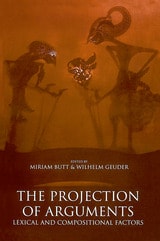
cover of The Projection of Arguments: Lexical and Compositional Factors

The Projection of Arguments

Lexical and Compositional Factors

Edited by Miriam Butt and Wilhelm Geuder

CSLI, 1998

It is becoming increasingly clear that the standard approach to argument linking in terms of "thematic roles", which are determined by the lexical meaning of verbs, has some serious shortcomings. This volume sets out to explore alternatives to a rigid model of lexical projection. It brings together a set of papers from different backgrounds that converge on the general hypothesis that the many semantic factors which influence the projection of arguments should be attributed to compositional processes rather than to the fixed contents of lexical entries. Proposals for a reassessment of the lexicon-syntax interface include flexible models of lexical meaning with productive derivation of alternants, as well as models where the structural context supplants much of the putative role of lexical entries. The topics addressed include questions of argument hierarchies and adicity of predicates, and the syntax and semantics of argument alternations in a set of very diverse languages, which include English, Dutch, Scottish Gaelic, Finnish, Hebrew, Kannada, Malay, Inuit, and Yaqui.
[more]
cover of The Semantics of Syntax: A Minimalist Approach to Grammar

The Semantics of Syntax

A Minimalist Approach to Grammar

Denis Bouchard

University of Chicago Press, 1995

During the last thirty years, most linguists and philosophers have assumed that meaning can be represented symbolically and that the mental processing of language involves the manipulation of symbols. Scholars have assembled strong evidence that there must be linguistic representations at several abstract levels—phonological, syntactic, and semantic—and that those representations are related by a describable system of rules. Because meaning is so complex, linguists often posit an equally complex relationship between semantic and other levels of grammar.

The Semantics of Syntax is an elegant and powerful analysis of the relationship between syntax and semantics. Noting that meaning is underdetermined by form even in simple cases, Denis Bouchard argues that it is impossible to build knowledge of the world into grammar and still have a describable grammar. He thus proposes simple semantic representations and simple rules to relate linguistic levels. Focusing on a class of French verbs, Bouchard shows how multiple senses can be accounted for by the assumption of a single abstract core meaning along with background information about how objects behave in the world. He demonstrates that this move simplifies the syntax at no cost to the descriptive power of the semantics. In two important final chapters, he examines the consequences of his approach for standard syntactic theories.
[more]
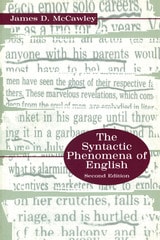
cover of The Syntactic Phenomena of English

The Syntactic Phenomena of English

James D. McCawley

University of Chicago Press, 1998

This second edition of James D. McCawley's classic textbook offers in one volume a complete course in the syntactic structure of English. New to this edition are sections on appositive constructions, parasitic gaps, contrastive negation, and comparative conditional sentences, as well as expanded coverage of cleft sentences and free relatives. The presentation is coherent, comprehensive, and systematically organized, beginning with an overview of McCawley's approach to syntactic analysis and progressing through the major constructions and processes of English grammar. No prior special knowledge of syntax is presupposed, and the number and variety of exercises after each chapter have been increased.

And now available from the author! Answers to Selected Exercises.

Instructors using James D. McCawley's The Syntactic Phenomena of English, Second Edition may request a complimentary copy of Answers to Selected Exercises in The Syntactic Phenomena of English by writing on their department's letterhead to the author, James D. McCawley, Department of Linguistics, 1010 E. 59th Street, Chicago, IL 60637. [Note: This material is available only from the author and is not available from the University of Chicago Press.]
[more]
cover of The Syntactic Phenomena of English, Volume 1

The Syntactic Phenomena of English, Volume 1

James D. McCawley

University of Chicago Press, 1988

This second edition of James D. McCawley's classic textbook offers in one volume a complete course in the syntactic structure of English. New to this edition are sections on appositive constructions, parasitic gaps, contrastive negation, and comparative conditional sentences, as well as expanded coverage of cleft sentences and free relatives. The presentation is coherent, comprehensive, and systematically organized, beginning with an overview of McCawley's approach to syntactic analysis and progressing through the major constructions and processes of English grammar. No prior special knowledge of syntax is presupposed, and the number and variety of exercises after each chapter have been increased.

And now available from the author! Answers to Selected Exercises.

Instructors using James D. McCawley's The Syntactic Phenomena of English, Second Edition may request a complimentary copy of Answers to Selected Exercises in The Syntactic Phenomena of English by writing on their department's letterhead to the author, James D. McCawley, Department of Linguistics, 1010 E. 59th Street, Chicago, IL 60637. [Note: This material is available only from the author and is not available from the University of Chicago Press.]
[more]
cover of The Syntactic Phenomena of English, Volume 2

The Syntactic Phenomena of English, Volume 2

James D. McCawley

University of Chicago Press, 1988

This second edition of James D. McCawley's classic textbook offers in one volume a complete course in the syntactic structure of English. New to this edition are sections on appositive constructions, parasitic gaps, contrastive negation, and comparative conditional sentences, as well as expanded coverage of cleft sentences and free relatives. The presentation is coherent, comprehensive, and systematically organized, beginning with an overview of McCawley's approach to syntactic analysis and progressing through the major constructions and processes of English grammar. No prior special knowledge of syntax is presupposed, and the number and variety of exercises after each chapter have been increased.

And now available from the author! Answers to Selected Exercises.

Instructors using James D. McCawley's The Syntactic Phenomena of English, Second Edition may request a complimentary copy of Answers to Selected Exercises in The Syntactic Phenomena of English by writing on their department's letterhead to the author, James D. McCawley, Department of Linguistics, 1010 E. 59th Street, Chicago, IL 60637. [Note: This material is available only from the author and is not available from the University of Chicago Press.]
[more]
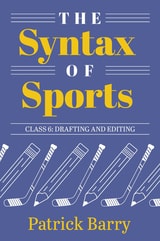
cover of The Syntax of Sports, Class 6: Drafting and Editing

The Syntax of Sports, Class 6

Drafting and Editing

Patrick Barry

Michigan Publishing Services, 2024

How do you start a piece of writing? How do you edit one? And what can be done to combat those pesky—and paralyzing—feelings of perfectionism that often derail our most important sentences and paragraphs?

This sixth volume of the Syntax of Sports series creatively uses the language of baseball, football, tennis, and many other sports to explore these questions. Based on a popular course at the University of Michigan, it captures the energy, originality, and discipline - crossing insights that make its author, Professor Patrick Barry, such a sought-after teacher and presenter.
[more]
cover of The Syntax of Subjects

The Syntax of Subjects

Koichi Tateishi

CSLI, 1994
Linguists who work on the Japanese language have disagreed about the notion of subject with resopect to Japanese; many linguists argue that there is no formal symtactic position for the subject in Japanese. Tateishi does deeper research on the surface syntax of the subject, and looks in particular at the syntax of the subject and phenomena which have been treated as S-adjunctions. These two have been identified with each other on many occasions in the history of Japanese linguistics and are of interest with respect to the debate over configurationality in the language, which has been revivedd in different forms following the emergence of the VP-Internal Subject Hypothesis, the merits of which Tateishi discusses at length. Tateishi's main claim is that despite all the non-configurational characteristics found in the language, Japanese is in a sense more configurational than the so-called configurational languages. Japanese allows more types of hierarchies to be involved in the subject-predicate relation than English allows, as Japanese does not have the same kind of restrictions on the phrase structure as the configurational languages have. Koichi Tateishi is a professor of linguistics at the Kyoto University of Foreign Studies.
[more]
cover of The Unity of Unbounded Dependency Constructions

The Unity of Unbounded Dependency Constructions

Robert D. Levine and Thomas E. Hukari

CSLI, 2006
How do languages transmit information about the properties of phrases over large structural distances? This is the difficult question raised by the phenomenon of extraction, and while extraction has driven the development of syntactic theory for decades, there is still no consensus on what form the connectivity mechanism should take. A number of recent theoretical approaches share the view that extraction is not a unitary phenomenon, but this monograph offers data that radically undercuts this view. The grammar of extraction connectivity, the authors conclude, is relatively simple, homogenous in construction type, and uniform in the position of the extractee.
[more]
cover of Think Generic!: The Meaning and Use of Generic Sentences

Think Generic!

The Meaning and Use of Generic Sentences

Ariel Cohen

CSLI, 1999

Our knowledge about the world is often expressed by generic sentences, yet their meanings are far from clear. This book provides answers to central problems concerning generics: what do they mean? Which factors affect their interpretation? How can one reason with generics? Cohen proposes that the meanings of generics are probability judgments, and shows how this view accounts for many of their puzzling properties, including lawlikeness. Generics are evaluated with respect to alternatives. Cohen argues that alternatives are induced by the kind as well as by the predicated property, and thus provides a uniform account of the varied interpretations of generics. He studies the formal properties of alternatives and provides a compositional account of their derivation by focus and presupposition. Cohen uses his semantics of generics to provide a formal characterization of adequate default reasoning, and proves some desirable results of this formalism.
[more]
cover of Time Over Matter: Diachronic Perspectives on Morphosyntax

Time Over Matter

Diachronic Perspectives on Morphosyntax

Edited by Miriam Butt and Tracy Holloway King

CSLI, 2001
[more]
cover of Tree Adjoining Grammars: Formalisms, Linguistic Analysis and Processing

Tree Adjoining Grammars

Formalisms, Linguistic Analysis and Processing

Edited by Anne Abeillé and Owen Rambow

CSLI, 2000

Past research conducted on natural language syntax has occasionally employed the well-known mathematical formalism Context-Free Grammar, defined by Noam Chomsky in 1957. But recent studies have indicated that this approach may not always be ideal in analyzing all types of natural languages. Researchers in theoretical linguistics, psycholinguistics, cognitive science, and in natural language processing have recently converged on a collective insight: formalizing the syntax of words is central to describing, understanding, and analyzing language. This insight has sparked considerable interest in Tree Adjoining Grammar (TAG). Unlike traditional approaches for analyzing natural language syntax, TAG is a lexically-oriented mathematical formalism that can precisely capture the syntactic properties of natural languages such as English, French, and Korean. Tree Adjoining Grammars is the first ever collection of works that discusses the use of the TAG framework in natural language research. The volume begins with an introductory chapter that provides an overview of TAG and key research projects that have utilized the TAG framework in the past. Contributors discuss the formalism itself, its use in analyzing linguistic phenomena, and its use in building natural language processing systems. A glossary and extensive bibliography is included, allowing the volume to be accessible to a broad audience. The selection of works in this volume were presented at the Third International Workshop in Tree Adjoining Grammars and Related Formalisms held in Paris in 1994.
[more]