Results by title
64 books match the query 'Haiti' and 15 start with t
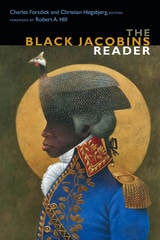
The Black Jacobins Reader
Charles Forsdick and Christian Høgsbjerg, editors
Duke University Press, 2017

The Border of Lights Reader
Bearing Witness to Genocide in the Dominican RepublicMegan Jeanette Myers
Amherst College Press, 2021
"By bringing together in one volume poetry, visual arts, literary analysis, in-depth interviews and historical analysis this volume will provide its readers with a comprehensive view of the causes and the aftermath of the massacre." —Ramón Antonio Victoriano-Martínez, University of British Columbia
Contributions by Julia Alvarez, Amanda Alcántara, DeAndra Beard, Nancy Betances, Jésula Blanc, Matías Bosch Carcuro, Cynthia Carrión, Raj Chetty, Catherine DeLaura, Magaly Colimon, Juan Colón, Robin Maria DeLugan, Lauren Derby, Rosa Iris Diendomi Álvarez, Polibio Díaz, Rana Dotson, Rita Dove, Rhina P. Espaillat, Maria Cristina Fumagalli, Saudi García, Scherezade García, Juan Carlos González Díaz, Kiran C. Jayaram, Pierre Michel Jean, Nehanda Loiseau Julot, Jake Kheel, Carlos Alomia Kollegger, Jackson Lorrain “Jhonny Rivas”, Radio Marién, Padre Regino Martínez Bretón, Sophie Maríñez, April J. Mayes, Jasminne Mendez, Komedi Mikal PGNE, Osiris Mosquea, Megan Jeanette Myers, Rebecca Osborne, Ana Ozuna, Edward Paulino, John Presimé, Laura Ramos, Amaury Rodríguez, Doña Carmen Rodríguez de Paulino, The DREAM Project, Silvio Torres-Saillant, Ilses Toribio, Deisy Toussaint, Évelyne Trouillot, Richard Turits, William Vazquez, Chiqui Vicioso, Bridget Wooding, and Óscar Zazo.
The Borders of Dominicanidad
Race, Nation, and Archives of ContradictionLorgia García Peña
Duke University Press, 2016
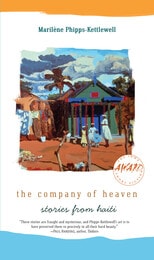
The Company of Heaven
Stories from HaitiMarilène Phipps-Kettlewell
University of Iowa Press, 2010
Marilène Phipps-Kettlewell’s award-winning stories transport you to Haiti—to a lush, lyrical, flamboyant, and spirit-filled Haiti where palm trees shine wet with moonlight and the sky paints a yellow screen over your head and the ocean sparkles with thousands of golden eyes—and keep you there forever. Her singular characters mysteriously address the deeper meanings of human existence. They also dream of escape, whether from themselves, from family, from Vodou, from financial and cultural difficulties and the politicians that create them, or from the country itself, but Haiti will forever remain part of their souls and part of the thoughts of her readers.
Some characters do achieve escape through the mind or through sea voyage—escape found by surrendering to spectacular fantasies and madness and love, bargaining with God, joining the boat people. Marie-Ange Saint-Jacques’s mother sacrifices everything to ensure her daughter’s survival on a perilous boat trip, Angelina waits to fly away to Nou Yòk, Vivi creates her own circus with dozens of rescued dogs, Gustave dies a martyr to his faith. Throughout, the “I” who moves in and out of these dream-filled stories embraces the heavenly mysteries found in “the room where all things lost are stored with grace.”
We begin our journey to Haiti with images of a little girl in a pink bedroom reading by candlelight a book about the life of Saint Bernadette, surrounded by the bewitching scents, sounds, and textures of a Caribbean night. Each story stands by itself, but some characters can be followed from one story to another through the transformations they undergo as a result of their life experiences. In this way, the collection can be read as one story, the story of a family trapped in a personal and cultural drama and the story of the people with whom the family interacts, themselves burdened by the need to survive within Haiti’s rigorously class-determined society and blessed by their relationship to the company of heaven in which they live and for which they are destined.

The Emperor
Makenzy Orcel
Seagull Books, 2024
After committing an irreparable crime, the narrator of The Emperor waits in his bedroom for the police to arrest him. His past reverberates inside of him like a drum: his youth spent in captivity as a zonbi, under the control of a charlatan Vodou leader, and many an alienating dawn delivering the daily newspaper through the cutthroat neighborhoods of Port-au-Prince, Haiti. He now has blood on his hands because of the woman on the bus—the only woman he had ever loved.
Part crime fiction, part fable gone awry, The Emperor invites readers to follow the narrator’s life as he moves from the Haitian countryside to the sprawling city, learning about the corruptible nature of power in his quest for freedom. Along the way, Makenzy Orcel blends the marvelous with the real by introducing readers to an unforgettable cast of characters including the Very Old Sheep, a deceitful Emperor, and the narrator’s so-called Enlightened Colleague. Written with Orcel’s distinctive verve, this novel offers readers a story set in contemporary Haiti that is rich in poetry and full of narrative intrigue.
The Guise of Exceptionalism
Unmasking the National Narratives of Haiti and the United StatesRobert Fatton
Rutgers University Press, 2021

The Haiti Reader
History, Culture, PoliticsLaurent Dubois, Kaiama L. Glover, Nadève Ménard, Millery Polyné, and Chantalle F. Verna, editors
Duke University Press, 2020
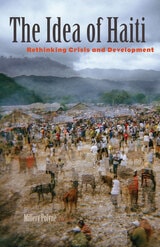
The Idea of Haiti
Rethinking Crisis and DevelopmentMillery Polyné
University of Minnesota Press, 2013
After Haiti was struck by a devastating earthquake on January 12, 2010, aid workers and offers of support poured in from around the world. Tellingly, though, news reports on the catastrophe and relief efforts frequently included a pejorative description of the country that outsiders were determined to rebuild: the troubled island nation, a nation plagued by political violence. There was much talk of inventing a “new” Haiti, which would presumably mimic Western modes of development and thus mitigate political instability and crisis.
As contributors to this wide-ranging book reveal, Haiti has long been marginalized as an embodiment of alterity, as the other, and the idea of a new Haiti is actually nothing new. An investigation of the notion of newness through the lenses of history and literature, urban planning, religion, and governance, The Idea of Haiti illuminates the politics and the narratives of Haiti’s past and present. The essays, which grow from original research and in-depth interviews, examine how race, class, and national development inform the policies that envision re-creating the country.
Together the contributors address important questions: How will the present narratives of deviance affect international relief and rebuilding efforts? What do Haitians themselves think about Haiti, old and new? What are the potential complications and weakness of aid strategies during these trying times? And what do we mean by crisis in Haiti?
Contributors: Yveline Alexis, Rutgers U; Wein Weibert Arthus, State U of Haiti; Greg Beckett, Bowdoin College; Alex Dupuy, Wesleyan U; Harley F. Etienne, U of Michigan; Robert Fatton Jr., U of Virginia; Sibylle Fischer, New York U; Elizabeth McAlister, Wesleyan U; Nick Nesbitt, Princeton U; Karen Richman, U of Notre Dame; Mark Schuller, York College (CUNY); Patrick Sylvain, Brown U; Évelyne Trouillot, State U of Haiti; Tatiana Wah, Columbia U.

The Insistent Call
Rhetorical Moments in Black Anticolonialism, 1929-1937Aric Putnam
University of Massachusetts Press, 2012
Throughout the nineteenth century, African heritage played an important role in black America, as personal memories and cultural practices continued to shape the everyday experience of people of African descent living under the shadow of slavery. Resisting efforts to de-Africanize their values, customs, and beliefs, Black Americans invoked their African roots in public arguments about their identity and place in the “new” world. At the outset of the twentieth century many still saw Africa primarily as the source of a common cultural and spiritual past. But after the 1920s, the meaning of African heritage changed as people of African descent expressed new relationships between themselves, the United States, and the African Diaspora.
In The Insistent Call, Aric Putnam studies the rhetoric of newspapers, literature, and political pamphlets that expressed this shift. He demonstrates that as people of African descent debated the United States' occupation of Haiti, the Liberian labor crisis, and the Italian invasion of Ethiopia, they formed a new collective identity, one that understood the African Diaspora in primarily political rather than cultural terms. In addition to uncovering a neglected period in the history of Black rhetoric, Putnam shows how rhetoric that articulates the interests of a population not defined by the boundaries of a state can still motivate collective action and influence policies.
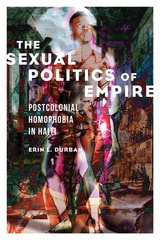
The Sexual Politics of Empire
Postcolonial Homophobia in HaitiErin L. Durban
University of Illinois Press, 2023
Evangelical Christians and members of the global LGBTQI human rights movement have vied for influence in Haiti since the 2010 earthquake. Each side accuses the other of serving foreign interests. Yet each proposes future foreign interventions on behalf of their respective causes despite the country’s traumatic past with European colonialism and American imperialism. As Erin L. Durban shows, two discourses dominate discussions of intervention. One maintains imperialist notions of a backward Haiti so riddled with cultural deficiencies that foreign supervision is necessary to overcome Haitians’ resistance to progress. The other sees Haiti as a modern but failed state that exists only through its capacity for violence, including homophobia. In the context of these competing claims, Durban explores the creative ways that same-sex desiring and gender creative Haitians contend with anti-LGBTQI violence and ongoing foreign intervention.
Compelling and thought-provoking, The Sexual Politics of Empire examines LGBTQI life in contemporary Haiti against the backdrop of American imperialism and intervention.
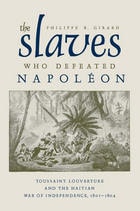
The Slaves Who Defeated Napoléon
Toussaint Louverture and the Haitian War of Independence, 1801–1804Philippe R. Girard
University of Alabama Press, 2011
A deeply researched and definitive account of the climactic battle at the end of the Haitian Revolution
Among the many rebellions against European colonial empires, the Haitian Revolution against France is among the most dramatic and complex. Having begun in 1791 as France was in the throes of its own young revolution, the conflict reached its dramatic climax when Napoleon dispatched a heavily armed expeditionary force led by his brother-in-law Charles Leclerc to re-establish slavery and the sugar economy that had so enriched France. Philippe Girard’s Slaves Who Defeated Napoleon is a deeply researched and engrossing account of this invasion and its spectacular defeat.
For this ambitious account, Philippe Girard has studied not only primary records in Haiti itself but also rare documents from nineteen public and private archives and research libraries in French, U.S., British, and Spanish collections. His more inclusive approach provides a fuller, more accurate and detailed narrative. He reveals not only key military movements, but also less-known aspects like the activities of U.S. merchants, in-fighting within Napoleon’s government, and communication between both sides and other European powers. Girard fills the work with unforgettable stories of those who led or were caught up in the war, people like poorly armed Black soldiers who ambushed Bonaparte’s columns, French child drummers, Jewish bankers in Kingston, weapon smugglers from Quaker Philadelphia, Polish artillerists, and mixed-raced people struggling to preserve their freedom against both Black and white opponents.
Transcending pat ideological and racial categories, the book brings into focus an Atlantic society at the crossroads of African and European influences, where Haitian rebels fought France while embracing its ideals.
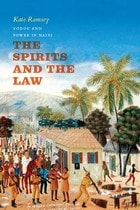
The Spirits and the Law
Vodou and Power in HaitiKate Ramsey
University of Chicago Press, 2011
Vodou has often served as a scapegoat for Haiti’s problems, from political upheavals to natural disasters. This tradition of scapegoating stretches back to the nation’s founding and forms part of a contest over the legitimacy of the religion, both beyond and within Haiti’s borders. The Spirits and the Law examines that vexed history, asking why, from 1835 to 1987, Haiti banned many popular ritual practices.
To find out, Kate Ramsey begins with the Haitian Revolution and its aftermath. Fearful of an independent black nation inspiring similar revolts, the United States, France, and the rest of Europe ostracized Haiti. Successive Haitian governments, seeking to counter the image of Haiti as primitive as well as contain popular organization and leadership, outlawed “spells” and, later, “superstitious practices.” While not often strictly enforced, these laws were at times the basis for attacks on Vodou by the Haitian state, the Catholic Church, and occupying U.S. forces. Beyond such offensives, Ramsey argues that in prohibiting practices considered essential for maintaining relations with the spirits, anti-Vodou laws reinforced the political marginalization, social stigmatization, and economic exploitation of the Haitian majority. At the same time, she examines the ways communities across Haiti evaded, subverted, redirected, and shaped enforcement of the laws. Analyzing the long genealogy of anti-Vodou rhetoric, Ramsey thoroughly dissects claims that the religion has impeded Haiti’s development.

The United States Occupation of Haiti, 1915-1934
Schmidt, Hans
Rutgers University Press, 1995
"A valuable addition to Latin American and U.S. historiography." —Library Journal
"Schmidt sees American racism, bondholders cultures, the technocratic side of Progressivism, and the National City Bank looting of Haiti as the factors motivating Wilson's 1915 invasion....As a detailed case study in an exceptional manifestation of U. S. imperial control the book will attract a readership beyond students of Caribbean history." —Kirkus
"An important and well-documented account....an interesting case study in twentieth-century imperialism. Schmidt sees the occupation of Haiti as part of a general tendency in American foreign policy...Schmidt analyses in detail the mechanics of the invasion, and discusses the actions, attitudes, and policies of the U.S. administration....A model of academic elegance." —Caribbean Studies
"All the more convincing because the author has used previously inaccessible archive materials." —Journal of American History

Toussaint Louverture
A Black Jacobin in the Age of RevolutionsCharles Forsdick and Christian Høgsbjerg
Pluto Press, 2017
These are Toussaint Louverture’s last words before being taken to prison in France. Heroic leader of the only successful slave revolt in history, Louverture is one of the greatest anti-imperialist fighters who ever lived. Born into slavery on a Caribbean plantation, he was able to break from his bondage to lead an army of freed African slaves to victory against the professional armies of France, Spain, and Britain in the Haitian Revolution of 1791-1804.
In this lively narrative biography, Louverture’s fascinating life is explored through the prism of his radical politics. Charles Forsdick and Christian Høgsbjerg champion the “black Robespierre,” whose revolutionary legacy has inspired people and movements in the two centuries since his death. For anyone interested in the roots of modern resistance movements and black political radicalism, Louverture’s extraordinary life provides the perfect groundwork.
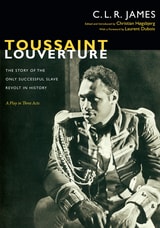
Toussaint Louverture
The Story of the Only Successful Slave Revolt in History; A Play in Three ActsC. L. R. James Edited and Introduced by Christian Høgsbjerg
Duke University Press, 2013