Results by title
8 books match the query 'Monster'
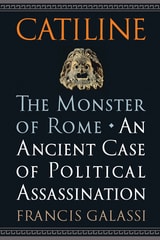
Catiline, The Monster of Rome
An Ancient Case of Political AssassinationFrancis Galassi
Westholme Publishing, 2014
Leader of a Conspiracy to Overthrow the Roman Republic, a Reform-Minded Senator Whose Reputation, Life, and Legacy Were Destroyed to Maintain the Status Quo
In 62 BC, Roman Senator Lucius Sergius Catiline lay dead on a battlefield in Tuscany. He was slain along with his soldiers after his conspiracy to overthrow the Roman Republic had been exposed by his adversary Cicero. It was an ignominious end for a man described at the time as a perverted, insane monster who had attempted to return his family to fortune and social standing. Chroniclers were not kind to Catiline, and his name over the centuries was synonymous with treachery. Recently, scholars have been reappraising the life and influence of this ancient Roman. In Catiline, The Monster of Rome: An Ancient Case of Political Assassination, economic historian Francis Galassi provides the first book-length account of Catiline in more than a generation.
Rome first achieved a status as an empire during Catiline’s lifetime. The republic was, however, constantly at war with foreign powers and occasionally its own allies, and the disparity between the wealthy and the poor threatened to destabilize society. Catiline was from an aristocratic but impoverished family and first served as an officer with Cornelius Sulla during that general’s purges against Gaius Marius, the supposed champion of the oppressed masses. Catiline’s goal was to serve Sulla and then use that as a springboard to public office where he could recover his family’s former wealth and honor. However, the senatorial elite became suspicious if not threatened by the upstart Catiline and blocked his ambitions. Catiline was dogged by trumped-up charges, including raping a Vestal virgin and murdering his brother-in-law; he was acquitted each time, but his political life was ruined. With citizens demanding land and agrarian reform, Catiline genuinely embraced their dissatisfaction, and realizing that the elite would stop his attempt to gain status through elections, he organized a conspiracy to take control of Roman government through arms. Once his actions had been made public, many of his supporters and co-conspirators left him; but honoring the course he had chosen, he and his remaining soldiers fought a Roman army to their deaths. Rather than the “monster” as portrayed by his contemporaries, the author contends that Catiline was compelled to act for the benefit of common Romans to save Rome even if it meant overthrowing the government. As Galassi notes, Catiline’s contemporary, the slave Spartacus, has been a symbol of social reform for centuries, but it was actually Catiline, not Spartacus, who attempted to change Rome.
[more]

Cindy Sherman's Office Killer
Another Kind of MonsterDahlia Schweitzer
Intellect Books, 2014
One of the twentieth century’s most significant artists, Cindy Sherman has quietly uprooted conventional understandings of portraiture and art, questioning everything from identity to feminism. Critics around the world have taken Sherman’s photographs and extensively examined what lies underneath. However, little critical ink has been spilled on Sherman’s only film, Office Killer, a piece that plays a significant role both in Sherman’s body of work and in American art in the late twentieth century. Dahlia Schweitzer breaks the silence with her trenchant analysis of Office Killer and explores the film on a variety of levels, combating head-on the art world’s reluctance to discuss the movie and arguing instead that it is only through a close reading of the film that we can begin to appreciate the messages underlying all of Sherman’s work.
The first book on this neglected piece of an esteemed artist’s oeuvre, Cindy Sherman’s “Office Killer” rescues the film from critical oblivion and situates it next to the artist’s other iconic works.
The first book on this neglected piece of an esteemed artist’s oeuvre, Cindy Sherman’s “Office Killer” rescues the film from critical oblivion and situates it next to the artist’s other iconic works.
[more]
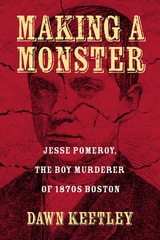
Making a Monster
Jesse Pomeroy, the Boy Murderer of 1870s BostonDawn Keetley
University of Massachusetts Press, 2017
When twelve-year-old Jesse Pomeroy tortured seven small boys in the Boston area and then went on to brutally murder two other children, one of the most striking aspects of his case was his inability ever to answer the question of why he did what he did. Whether in court or in the newspapers, many experts tried to explain his horrible acts—and distance the rest of society from them. Despite those efforts, and attempts since, the mystery remains.
In this book, Dawn Keetley details the story of Pomeroy's crimes and the intense public outcry. She explores the two reigning theories at the time—that he was shaped before birth when his pregnant mother visited a slaughterhouse and that he imitated brutal acts found in popular dime novels. Keetley then thoughtfully offers a new theory: that Pomeroy suffered a devastating reaction to a smallpox vaccination which altered his brain, creating a psychopath who revealed the human potential for brutality. The reaction to Pomeroy's acts, then and now, demonstrates the struggle to account for exactly those aspects of human nature that remain beyond our ability to understand.
In this book, Dawn Keetley details the story of Pomeroy's crimes and the intense public outcry. She explores the two reigning theories at the time—that he was shaped before birth when his pregnant mother visited a slaughterhouse and that he imitated brutal acts found in popular dime novels. Keetley then thoughtfully offers a new theory: that Pomeroy suffered a devastating reaction to a smallpox vaccination which altered his brain, creating a psychopath who revealed the human potential for brutality. The reaction to Pomeroy's acts, then and now, demonstrates the struggle to account for exactly those aspects of human nature that remain beyond our ability to understand.
[more]
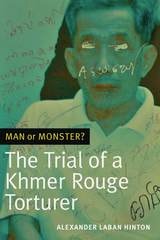
Man or Monster?
The Trial of a Khmer Rouge TorturerAlexander Laban Hinton
Duke University Press, 2016
During the Khmer Rouge's brutal reign in Cambodia during the mid-to-late 1970s, a former math teacher named Duch served as the commandant of the S-21 security center, where as many as 20,000 victims were interrogated, tortured, and executed. In 2009 Duch stood trial for these crimes against humanity. While the prosecution painted Duch as evil, his defense lawyers claimed he simply followed orders. In Man or Monster? Alexander Hinton uses creative ethnographic writing, extensive fieldwork, hundreds of interviews, and his experience attending Duch's trial to create a nuanced analysis of Duch, the tribunal, the Khmer Rouge, and the after-effects of Cambodia's genocide. Interested in how a person becomes a torturer and executioner as well as the law's ability to grapple with crimes against humanity, Hinton adapts Hannah Arendt's notion of the "banality of evil" to consider how the potential for violence is embedded in the everyday ways people articulate meaning and comprehend the world. Man or Monster? provides novel ways to consider justice, terror, genocide, memory, truth, and humanity.
[more]
The Monster I Am Today
Leontyne Price and a Life in VerseKevin Simmonds
Northwestern University Press, 2021
Leontyne Price remains one of the twentieth century’s most revered opera singers and, notably, the first African American to achieve such international acclaim. In movements encompassing poetry and prose, writer and musician Kevin Simmonds explores Price as an icon, a diva, a woman, and a patriot—and himself as a fan, a budding singer, and a gay man—through passages that move polyphonically through the contested spaces of Black identity, Black sound, Black sensibility, and Black history.
Structured operatically into overture, acts, and postlude, The Monster I Am Today guides the reader through associative shifts from arias like “weather events” and Price’s forty-two-minute final ovation to memories of Simmonds’s coming of age in New Orleans. As he melds lyric forms with the biography of one of classical music’s greatest virtuosos, Simmonds composes a duet that spotlights Price’s profound influence on him as a person and an artist: “That’s how I hear: Her.”
Structured operatically into overture, acts, and postlude, The Monster I Am Today guides the reader through associative shifts from arias like “weather events” and Price’s forty-two-minute final ovation to memories of Simmonds’s coming of age in New Orleans. As he melds lyric forms with the biography of one of classical music’s greatest virtuosos, Simmonds composes a duet that spotlights Price’s profound influence on him as a person and an artist: “That’s how I hear: Her.”
[more]
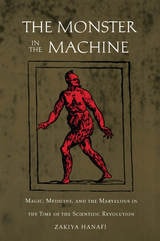
The Monster in the Machine
Magic, Medicine, and the Marvelous in the Time of the Scientific RevolutionZakiya Hanafi
Duke University Press, 2000
The Monster in the Machine tracks the ways in which human beings were defined in contrast to supernatural and demonic creatures during the time of the Scientific Revolution. Zakiya Hanafi recreates scenes of Italian life and culture from the late sixteenth to the early eighteenth centuries to show how monsters were conceptualized at this particular locale and historical juncture—a period when the sacred was being supplanted by a secular, decidedly nonmagical way of looking at the world.
Noting that the word “monster” is derived from the Latin for “omen” or “warning,” Hanafi explores the monster’s early identity as a portent or messenger from God. Although monsters have always been considered “whatever we are not,” they gradually were tranformed into mechanical devices when new discoveries in science and medicine revealed the mechanical nature of the human body. In analyzing the historical literature of monstrosity, magic, and museum collections, Hanafi uses contemporary theory and the philosophy of technology to illuminate the timeless significance of the monster theme. She elaborates the association between women and the monstrous in medical literature and sheds new light on the work of Vico—particularly his notion of the conatus—by relating it to Vico’s own health. By explicating obscure and fascinating texts from such disciplines as medicine and poetics, she invites the reader to the piazzas and pulpits of seventeenth-century Naples, where poets, courtiers, and Jesuit preachers used grotesque figures of speech to captivate audiences with their monstrous wit.
Drawing from a variety of texts from medicine, moral philosophy, and poetics, Hanafi’s guided tour through this baroque museum of ideas will interest readers in comparative literature, Italian literature, history of ideas, history of science, art history, poetics, women’s studies, and philosophy.
[more]

The Monster with a Thousand Faces
Guises of the Vampire in Myth and LiteratureBrian J. Frost
University of Wisconsin Press, 1989
Brian Frost chronicles the history of the vampire in myth and literature, providing a sumptuous repast for all devotees of the bizarre. In a wide-ranging survey, including plot summaries of hundreds of novels and short stories, the reader meets an amazing assortment of vampires from the pages of weird fiction, ranging from the 10,000-year-old femme fatale in Robert E. Howard’s Conan the Conqueror to the malevolent fetus in Eddy C. Bertin’s “Something Small, Something Hungry.” Nostalgia buffs will enjoy a discussion of the vampire yarns in the pulp magazines of the interwar years, while fans of contemporary vampire fiction will also be sated.
[more]
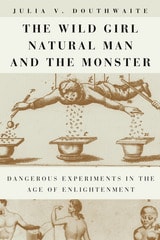
The Wild Girl, Natural Man, and the Monster
Dangerous Experiments in the Age of EnlightenmentJulia V. Douthwaite
University of Chicago Press, 2002
This study looks at the lives of the most famous "wild children" of eighteenth-century Europe, showing how they open a window onto European ideas about the potential and perfectibility of mankind. Julia V. Douthwaite recounts reports of feral children such as the wild girl of Champagne (captured in 1731 and baptized as Marie-Angélique Leblanc), offering a fascinating glimpse into beliefs about the difference between man and beast and the means once used to civilize the uncivilized.
A variety of educational experiments failed to tame these feral children by the standards of the day. After telling their stories, Douthwaite turns to literature that reflects on similar experiments to perfect human subjects. Her examples range from utopian schemes for progressive childrearing to philosophical tales of animated statues, from revolutionary theories of regenerated men to Gothic tales of scientists run amok. Encompassing thinkers such as Rousseau, Sade, Defoe, and Mary Shelley, Douthwaite shows how the Enlightenment conceived of mankind as an infinitely malleable entity, first with optimism, then with apprehension. Exposing the darker side of eighteenth-century thought, she demonstrates how advances in science gave rise to troubling ethical concerns, as parents, scientists, and politicians tried to perfect mankind with disastrous results.
A variety of educational experiments failed to tame these feral children by the standards of the day. After telling their stories, Douthwaite turns to literature that reflects on similar experiments to perfect human subjects. Her examples range from utopian schemes for progressive childrearing to philosophical tales of animated statues, from revolutionary theories of regenerated men to Gothic tales of scientists run amok. Encompassing thinkers such as Rousseau, Sade, Defoe, and Mary Shelley, Douthwaite shows how the Enlightenment conceived of mankind as an infinitely malleable entity, first with optimism, then with apprehension. Exposing the darker side of eighteenth-century thought, she demonstrates how advances in science gave rise to troubling ethical concerns, as parents, scientists, and politicians tried to perfect mankind with disastrous results.
[more]