Results by title
97 books match the query 'Historical & Comparative' and 14 start with t
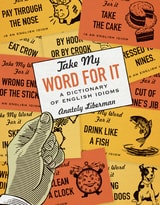
Take My Word for It
A Dictionary of English IdiomsAnatoly Liberman
University of Minnesota Press, 2022
Three centuries of English idioms—their unusual origins and unexpected interpretations
To pay through the nose. Raining cats and dogs. By hook or by crook. Curry favor. Drink like a fish. Eat crow. We hear such phrases every day, but this book is the first truly all-encompassing etymological guide to both their meanings and origins. Spanning more than three centuries, Take My Word for It is a fascinating, one-of-a-kind window into the surprisingly short history of idioms in English. Widely known for his studies of word origins, Anatoly Liberman explains more than one thousand idioms, both popular and obscure, occurring in both American and British standard English and including many regional expressions.
The origins, and even the precise meaning, of most idioms are often obscure and lost in history. Based on a critical analysis of countless conjectures, with exact, in-depth references (rare in the literature on the subject), Take My Word for It provides not only a large corpus of idiomatic phrases but also a vast bibliography. Detailed indexes and a thesaurus make the content accessible at a glance, and Liberman’s introduction and conclusion add historical dimensions. The result of decades of research by a leading authority, this book is both instructive and absorbing for scholars and general readers, who won’t find another resource as comparable in scope or based on data even remotely as exhaustive.
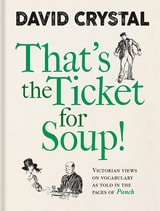
That’s the Ticket for Soup!
Victorian Views on Vocabulary as Told in the Pages of PunchDavid Crystal
Bodleian Library Publishing, 2020
The vocabulary of the past is always intriguing, especially when it is no longer used in modern English. Many of the words and phrases that were popular in Victorian England may sound foreign today, but looking to original sources and texts can yield fascinating insight, especially when we see how vocabulary was pilloried by the satirists of the day.
In That’s the Ticket for Soup!, the renowned language expert David Crystal returns to the pages of Punch magazine, England’s widely read satirical publication. Crystal has pored through the pages of Punch between its first issue in 1841 and the death of Queen Victoria in 1901 and extracted the articles and cartoons that poked fun at the jargon of the day. Here we have Victorian high and low society, with its fashionable and unfashionable slang, its class awareness on display in the vocabulary of steam engines, motor cars, and other products of the Industrial Revolution. Then, as now, people had strong feelings about the flood of new words entering English. Swearing, new street names, and the many borrowings from French provoked continual irritation and mockery, as did the Americanisms increasingly encountered in the British press. In addition to these entertaining examples, Crystal includes commentary on the context of the times and informative glossaries. This original and amusing collection reveals how many present-day feelings about words can be traced to the satire of a century ago.
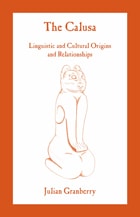
The Calusa
Linguistic and Cultural Origins and RelationshipsJulian Granberry
University of Alabama Press, 2012
Presents a full phonological and morphological analysis of the total corpus of surviving Calusa language data left by a literate Spanish captive held by the Calusa from his early youth to adulthood
The linguistic origins of Native American cultures and the connections between these cultures as traced through language in prehistory remain vexing questions for scholars across multiple disciplines and interests. Native American linguist Julian Granberry defines the Calusa language, formerly spoken in southwestern coastal Florida, and traces its connections to the Tunica language of northeast Louisiana.
Archaeologists, ethnologists, and linguists have long assumed that the Calusa language of southwest Florida was unrelated to any other Native American language. Linguistic data can offer a unique window into a culture’s organization over space and time; however, scholars believed the existing lexical data was insufficient and have not previously attempted to analyze or define Calusa from a linguistic perspective.
In The Calusa: Linguistic and Cultural Origins and Relationships, Granberry presents a full phonological and morphological analysis of the total corpus of surviving Calusa language data left by a literate Spanish captive held by the Calusa from his early youth to adulthood. In addition to further defining the Calusa language, this book presents the hypothesis of language-based cultural connections between the Calusa people and other southeastern Native American cultures, specifically the Tunica. Evidence of such intercultural connections at the linguistic level has important implications for the ongoing study of life among prehistoric people in North America. Consequently, this thoroughly original and meticulously researched volume breaks new ground and will add new perspectives to the broader scholarly knowledge of ancient North American cultures and to debates about their relationships with one another.
The Comparative Method of Language Acquisition Research
Clifton Pye
University of Chicago Press, 2017
Pye here applies the comparative method to three Mayan languages—K’iche’, Mam, and Ch’ol—showing how differences in the use of verbs are connected to differences in the subject markers and pronouns used by children and adults. His holistic approach allows him to observe how small differences between the languages lead to significant differences in the structure of the children’s lexicon and grammar, and to learn why that is so. More than this, he expects that such careful scrutiny of related languages’ variable solutions to specific problems will yield new insights into how children acquire complex grammars. Studying such an array of related languages, he argues, is a necessary condition for understanding how any particular language is used; studying languages in isolation, comparing them only to one’s native tongue, is merely collecting linguistic curiosities.
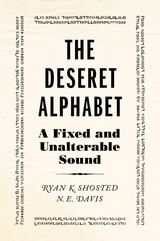
The Deseret Alphabet
A Fixed and Unalterable SoundRyan K. Shosted and N. E. Davis
University of Illinois Press, 2026
Shosted and Davis draw on a wide range of sources, including previously unpublished archival material, to trace the alphabet’s roots in Joseph Smith’s esoteric translations and its role in shaping Latter-day Saint identity. Their account brings together theology, linguistics, and culture. As they show, the Deseret Alphabet remains relevant as a living artifact of a religion wrestling with its visionary origins and the divine potential of words.
In-depth and up to date, The Deseret Alphabet traces the script’s creation, use, and legacy across Latter-day Saint history.
The History of Tense/Aspect/Mood/Voice in the Mayan Verbal Complex
By John S. Robertson
University of Texas Press, 1992
Mayan civilization, renowned for its mathematics, writing, architecture, religion, calendrics, and agriculture, fascinates scholars and a wide lay public as archaeology and glyphic decipherment reveal more of its secrets. In this pathfinding study of the Mayan language family, John S. Robertson explores major changes that have occurred in the core of Mayan grammar from the earliest, reconstructed ancestral language down through the colonial languages to the modern languages that are spoken today.
Building on groundwork already laid in phonological studies and in the study of the pronominal system, Robertson's examination of tense/ aspect/ mood/voice is the next logical step in the general linguistic study of Mayan. Robertson offers careful consideration of all the major subgroups of Mayan, from Yucatecan to Quichean, as they are spoken today. He also draws extensively on colonial documents assembled by bilingual Spanish-Mayan speaking clerics. These documents provide a check on the accuracy of both the reconstructed ancient language, Common Mayan, and the theoretical evolution of the modern languages from this ancestor. The study will also be of value to students of the Maya glyphs, since it discusses the grammatical system that most probably underlies the glyphic representations.
Beyond its obvious interest for Mayan linguistics, the study proposes a theory of language change that will be important for all students of comparative linguistics. Robertson's work sets forth the basic, universal assumptions that provide for an appropriate description of the grammatical systems of all languages. It will be a significant reference for future researchers.
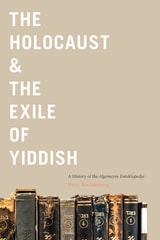
The Holocaust & the Exile of Yiddish
A History of the Algemeyne EntsiklopedyeBarry Trachtenberg
Rutgers University Press, 2022
The Holocaust & the Exile of Yiddish untangles the complicated saga of the Algemeyne entsiklopedye and its editors. The editors continued to publish volumes and revise the encyclopedia’s mission while their primary audience, Eastern European Jews, faced persecution and genocide under Nazi rule, and the challenge of reestablishing themselves in the first decades after World War II. Historian Barry Trachtenberg reveals how, over the course of the middle decades of the twentieth century, the project sparked tremendous controversy in Jewish cultural and political circles, which debated what the purpose of a Yiddish encyclopedia should be, as well as what knowledge and perspectives it should contain. Nevertheless, this is not only a story about destruction and trauma, but also one of tenacity and continuity, as the encyclopedia’s compilers strove to preserve the heritage of Yiddish culture, to document its near-total extermination in the Holocaust, and to chart its path into the future.
The Indo-European Dialects
Antoine Meillet
University of Alabama Press, 1967
The Indo‑European Dialects is a foundational work of historical linguistics that investigates how the Indo‑European language family diversified into its major regional branches. Originally delivered as lectures and first published in the early twentieth century, the book remains essential reading for understanding how phonological, morphological, and lexical evidence reveals ancient patterns of language contact, migration, and cultural development. Including Indo‑European, Indo‑Iranian, Greek, Italic (including Latin), Celtic, Germanic, Baltic, Slavic, Armenian, Albanian, Anatolian, and Tocharian, Meillet’s comparative approach situates dialect differences within a broader historical framework, making this volume a lasting contribution to Indo‑European studies and to the methods of linguistic reconstruction more generally.
The author, Antoine Meillet, was one of the most influential linguists of the twentieth century and a central figure in the development of Indo‑European comparative grammar. This edition is expertly translated by Samuel N. Rosenberg, whose careful scholarship preserves Meillet’s analytical precision while making the work accessible to modern English‑language readers. The volume is further enhanced by scholarly notes, bibliographical references, and indexes that increase its usefulness for research and teaching.
This book will be of interest to linguists, philologists, classicists, and historians of language, as well as graduate and advanced undergraduate students studying historical linguistics. It will also appeal to readers interested in how language evidence informs the study of prehistoric societies and cultural connections across Europe and Asia.
The Languages of Native America
Historical and Comparative AssessmentEdited by Lyle Campbell and Marianne Mithun
University of Texas Press, 1979
These essays were drawn from the papers presented at the Linguistic Society of America's Summer Institute at the State University of New York at Oswego in 1976. The contents are as follows:
- Lyle Campbell and Marianne Mithun, "Introduction: North American Indian Historical Linguistics in Current Perspective"
- Ives Goddard, "Comparative Algonquian"
- Marianne Mithun, "Iroquoian"
- Wallace L. Chafe, "Caddoan"
- David S. Rood, "Siouan"
- Mary R. Haas, "Southeastern Languages"
- James M. Crawford, "Timucua and Yuchi: Two Language Isolates of the Southeast"
- Ives Goddard, "The Languages of South Texas and the Lower Rio Grande"
- Irvine Davis, "The Kiowa-Tanoan, Keresan, and Zuni Languages"
- Susan Steele, "Uto-Aztecan: An Assessment for Historical and Comparative Linguistics"
- William H. Jacobsen, Jr., "Hokan lnter-Branch Comparisons"
- Margaret Langdon, "Some Thoughts on Hokan with Particular Reference to Pomoan and Yuman"
- Michael Silverstein, "Penutian: An Assessment"
- Laurence C. Thompson, "Salishan and the Northwest"
- William H. Jacobsen, Jr., "Wakashan Comparative Studies"
- William H. Jacobsen, Jr., "Chimakuan Comparative Studies"
- Michael E. Krauss, "Na-Dene and Eskimo-Aleut"
- Lyle Campbell, "Middle American Languages"
- Eric S. Hamp, "A Glance from Now On"
The Languages of Scandinavia
Seven Sisters of the NorthRuth H. Sanders
University of Chicago Press, 2017
While the two linguistic families that comprise Scandinavia’s languages ultimately have differing origins, the Seven Sisters have coexisted side by side for millennia. As Sanders reveals, a crisscrossing of names, territories, and even to some extent language genetics—intimate language contact—has created a body of shared culture, experience, and linguistic influences that is illuminated when the story of these seven languages is told as one. Exploring everything from the famed whalebone Lewis Chessmen of Norse origin to the interactions between the Black Death and the Norwegian language, The Languages of Scandinavia offers profound insight into languages with a cultural impact deep-rooted and far-reaching, from the Icelandic sagas to Swedish writer Stieg Larsson’s internationally popular Millennium trilogy. Sanders’s book is both an accessible work of linguistic scholarship and a fascinating intellectual history of language.

The Other Tongue
English Across CulturesEdited by Braj B. Kachru
University of Illinois Press, 1992
When The Other Tongue appeared in 1982, it was called "required reading for all those concerned with English teaching in non-native situations, from the classroom teacher to the policy planner", Jowhn Platt, English World-Wide) and "an extremely useful and stimulating collection" (William C. Ritchie, Language). It introduced refreshingly new perspectives for understanding the spread and functions of English around the world.
This dramatically revised volume contains eight new chapters, replacing or updating more than half of the first edition. The Other Tongue is the first attempt to integrate and address provocative issues relevant to a deeper understanding of the forms and functions of English within different sociolinguistic, cross-cultural, and cross-linguistic contexts. The volume discusses linguistic, literary, pedagogical, and attitudinal issues related to world Englishes.
The World in a Phrase
A Brief History of the Aphorism, Second EditionJames Geary
University of Chicago Press, 2025
Aphorisms are literature’s hand luggage. Light and compact, they contain everything you need to get through a rough day at the office or a dark night of the soul. Aphorisms, the oldest written art form on the planet, have been going viral for thousands of years, delivering the short, sharp shock of old forgotten truths. Today, visual artists are mixing pithy language with compelling imagery and using social media to take the form into the future. In a world of disinformation and deepfakes, aphorisms point to the power of fresh debate over tired dogma and inconvenient truths over comfortable lies.
Starting in ancient China and ending with contemporary meme-makers and street artists, The World in A Phrase tells the story of the aphorism through brief biographies of some of its greatest practitioners: sages like Lao-tzu and the Buddha, philosophers like Schopenhauer and Nietzsche, writers like George Eliot and Marie von Ebner-Eschenbach, humorists like Mark Twain and Dorothy Parker, activists like James Baldwin and Audre Lorde, poets like Langston Hughes and Kay Ryan, and artists like Jenny Holzer and David Byrne.
The World in A Phrase is for lovers of words and seekers of wisdom. This new edition of The New York Times bestseller features 26 additional aphorists and explores the aphorism in the age of social media, showing why these short sentences are the ultimate deep dives in an era when TL;DR has become a cultural catchphrase.

Tocharian and Indo-European Studies 21
Edited by Birgit Anette Olsen, Hannes Fellner, Michaël Peyrot, and Georges-Jean Pinault
Museum Tusculanum, 2022
This book offers the most diverse and comprehensive treatment of the relationships between ancient Tocharian A and B and other Indo-European languages. Studying now-extinct languages from the first millennium, early twentieth-century archaeologists discovered previously unknown Tocharian A and Tocharian B writings on Buddhist manuscripts near northwest China. Volumes in the Tocharian and Indo-European Studies series present the authoritative study of these two closely related languages, focusing both on philological and linguistic approaches toward their relationship with other Indo-European languages.

Traslados/Translations
Essays on Latin America in Honour of Jason WilsonEdited by Claire Lindsay
University of London Press, 2012