Results by title
69 books match the query 'Homosexuality and literature' and 9 start with t

Tendencies
Eve Kosofsky Sedgwick
Duke University Press, 1983
The essays range from Diderot, Oscar Wilde, and Henry James to queer kids and twelve-step programs; from "Jane Austen and the Masturbating Girl" to a performance piece on Divine written with Michael Moon; from political correctness and the poetics of spanking to the experience of breast cancer in a world ravaged and reshaped by AIDS. What unites Tendencies is a vision of a new queer politics and thought that, however demanding and dangerous, can also be intent, inclusive, writerly, physical, and sometimes giddily fun.
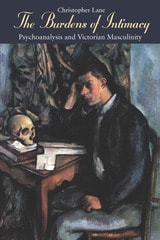
The Burdens of Intimacy
Psychoanalysis and Victorian MasculinityChristopher Lane
University of Chicago Press, 1998
Lane discredits the conservative notion that Victorian literature expresses only a demand for repression and moral restraint. But he also refutes historicist and Foucauldian approaches, arguing that they dismiss the very idea of repression and end up denouncing psychoanalysis as complicit in various kinds of oppression. These approaches, Lane argues, reduce Victorian literature to a drama about politics, power, and the ego. Striving instead to reinvigorate discussions of fantasy and the unconscious, Lane offers a clear, often startling account of writers who grapple with the genuine complexities of love, desire, and friendship.
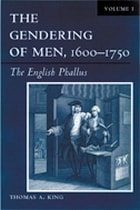
The Gendering of Men, 1600–1750
The English PhallusThomas A. King
University of Wisconsin Press, 2004
Taking on nothing less than the formation of modern genders and sexualities, Thomas A. King develops a history of the political and performative struggles that produced both normative and queer masculinities in the seventeenth and eighteenth centuries. The result is a major contribution to gender studies, gay studies, and theater and performance history.
The Gendering of Men, 1600–1750 traces the transition from a society based on alliance, which had subordinated all men, women, and boys to higher ranked males, to one founded in sexuality, through which men have embodied their claims to personal and political privacy. King proposes that the male body is a performative production marking men’s resistance to their subjection within patriarchy and sovereignty. Emphasizing that categories of gender must come under historical analysis, The Gendering of Men explores men’s particpation in an ongoing struggle for access to a universal manliness transcending other biological and social differentials.
This is volume one of two projected volumes.
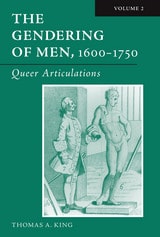
The Gendering of Men, 1600–1750
Volume 2, Queer ArticulationsThomas A. King
University of Wisconsin Press, 2008

The Masks of Mary Renault
A Literary BiographyCaroline Zilboorg
University of Missouri Press, 2001
Born Eileen Mary Challans in London in 1905, Mary Renault wrote six successful contemporary novels before turning to the historical fiction about ancient Greece for which she is best known. While Renault's novels are still highly regarded, her life and work have never been completely examined. Caroline Zilboorg seeks to remedy this in The Masks of Mary Renault by exploring Renault's identity as a gifted writer and a sexual woman in a society in which neither of these identities was clear or easy.
Although Renault's life was anything but ordinary, this fact has often been obscured by her writing. The daughter of a doctor, she grew up comfortably and attended a boarding school in Bristol. She received a degree in English from St. Hugh's College in Oxford in 1928, but she chose not to pursue an academic career. Instead, she decided to attend the Radcliffe Infirmary in Oxford, where she trained to be a nurse. With the outbreak of the Second World War, she was assigned to the Winford Emergency Hospital in Bristol and briefly worked with Dunkirk evacuees. She went on to work in the Radcliffe Infirmary's brain surgery ward and was there until 1945.
It was during her nurse's training that Renault met Julie Mullard, who became her lifelong companion. This important lesbian relationship both resolved and posed many problems for Renault, not the least of which was how she was to write about issues at once intensely personal and socially challenging. In 1939, Renault published her first novel under a pseudonym in order to mask her identity. It was a time when she was struggling not only with her vocation (nursing and writing), but also with her sexual identity in the social and moral context of English life during the war.
In 1948, Renault left England with Mullard for South Africa and never returned. It was in South Africa that she made the shift from her early contemporary novels of manners to the mature historical novels of Hellenic life. The classical settings allowed Renault to mask material too explosive to deal with directly while simultaneously giving her an "academic" freedom to write about subjects vital to her—among them war, peace, career, women's roles, female and male homosexuality, and bisexuality.
Renault's reception complicates an understanding of her achievement, for she has a special status within the academic community, where she is both widely read and little written about. Her interest in sexuality and specifically in homosexuality and bisexuality, in fluid gender roles and identities, warrants a rereading and reevaluation of her work. Eloquently written and extensively researched, The Masks of Mary Renault will be of special value to anyone interested in women's studies or English literature.
The Mourning After
Loss and Longing among Midcentury American MenJohn Ibson
University of Chicago Press, 2018

The Other Henry James
John Carlos Rowe
Duke University Press, 1998
Rowe traces a particular development in James’s work, showing how in his early writings James criticized women’s rights, same-sex relations, and other social and political trends now identified with modern culture; how he ambivalently explored these aspects of modernity in his writings of the 1880s; and, later, how he increasingly identified with such modernity in his heretofore largely ignored or marginally treated fiction of the 1890s. Building on recent scholarship that has shown James to be more anxious about gender roles, more conflicted, and more marginal a figure than previously thought, Rowe argues that James—through his treatment of women, children, and gays—indicts the values and conventions of the bourgeoisie. He shows how James confronts social changes in gender roles, sexual preferences, national affiliations, and racial and ethnic identifications in such important novels as The American, The Tragic Muse, What Maisie Knew, and In the Cage, and in such neglected short fiction as “The Last of the Valerii,” “The Death of the Lion,” and “The Middle Years.”
Positioning James’s work within an interpretive context that pits the social and political anxieties of his day against the imperatives of an aesthetic ideology, The Other Henry James will engage scholars, students, and teachers of American literature and culture, gay literature, and queer theory.
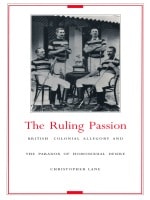
The Ruling Passion
British Colonial Allegory and the Paradox of Homosexual DesireChristopher Lane
Duke University Press, 1995
Through attentive readings of sexual and political allegory in the work of Kipling, Forster, James, Beerbohm, Firbank, and others—and deft use of psychoanalytic theory—The Ruling Passion interprets turbulent scenes of masculine identification and pleasure, power and mastery, intimacy and antagonism. By foregrounding the shattering effects of male homosexuality and interracial desire, and by insisting on the centrality of unconscious fantasy and the death drive, The Ruling Passion examines the startling recurrence of colonial failure in narratives of symbolic doubt and ontological crisis. Lane argues compellingly that Britain can progress culturally and politically only when it has relinquished its residual fantasies of global mastery.
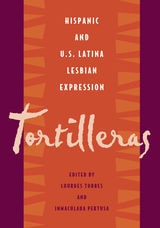
Tortilleras
Hispanic & U.S. Latina Lesbian ExpressionLourdes Torres
Temple University Press, 2003