Results by title
57 books match the query 'Hunting' and 6 start with t

Taking Flight
A History of Birds and People in the Heart of AmericaMichael Edmonds
Wisconsin Historical Society Press, 2018
Today, more than fifty million Americans traipse through wetlands at dawn, endure clouds of mosquitoes, and brave freezing autumn winds just to catch a glimpse of a bird. The human desire to connect with winged creatures defies age and generation. In the Midwest, humans and birds have lived together for more than twelve thousand years. Taking Flight explores how and why people have worshipped, feared, studied, hunted, eaten, and protected the birds that surrounded them.
Author and birder Michael Edmonds has combed archaeological reports, missionaries’ journals, travelers’ letters, early scientific treatises, the memoirs of American Indian elders, and the folklore of hunters, farmers, and formerly enslaved people throughout the Midwest to reveal how our ancestors thought about the very same birds we see today. Whether you’re a casual bird-watcher, a hard-core life-lister, or simply someone who loves the outdoors, you’ll look at birds differently after reading this book.
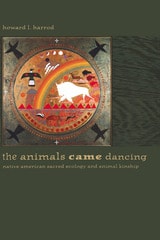
The Animals Came Dancing
Native American Sacred Ecology and Animal KinshipHoward L. Harrod
University of Arizona Press, 2000
Drawing on memories of Native Americans recorded by anthropologists, fur traders, missionaries, and other observers, Harrod examines cultural practices that flourished from the mid-eighteenth to the mid-nineteenth century. He reconstructs the complex rituals of Plains peoples, which included buffalo hunting ceremonies employing bundles or dancing, and rituals such as the Sun Dance for the renewal of animals. In a closing chapter, Harrod examines the meanings of Indian-animal relations for a contemporary society that values human dominance over the natural world—one in which domestic animals are removed from our consciousness as a source of food, wild animals are managed for humans to "experience," and hunting has become a form of recreation. His meticulous scholarship re-imagines a vanished way of life, while his keen insights give voice to a hunger among many contemporary people for the recovery of a ritual relationship between themselves and the natural sources of their lives.
The Behavioral Ecology of Efe Pygmy Men in the Ituri Forest, Zaire
Robert C. Bailey
University of Michigan Press, 1991
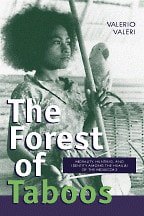
The Forest of Taboos
Morality, Hunting, and Identity among the Huaulu of the MoluccasValerio Valeri
University of Wisconsin Press, 2000
“The Forest of Taboos may be considered among the most important books ever written by an anthropologist. Valeri writes superbly, and this book makes a fundamental contribution to one of the most central lines of thought in twentieth-century anthropology. He shows that taboo is finally comprehensible.”—John Stephen Lansing, University of Michigan
“The Forest of Taboos is no conventional ethnography, more an extended meditative essay on its subject, erudite, rich in ideas and data, wide-ranging in its theoretical inspiration, and self-consciously literary in form. It is a fitting memorial to an author whose life was so tragically cut short.”—Roy Ellen, University of Kent at Canterbury
This eloquent and profound book, completed by Valerio Valeri shortly before his death in 1998, contends that the ambivalence felt by all humans about sex, death, and eating other animals can be explained by a set of coordinated principles that are expressed in taboos. In elegant prose, Valeri evokes the world of the Huaulu, forest hunters of Indonesia. The hidden attractions of the animal world, which invades the human world in perilous ways, he shows, also delineate that which the Huaulu regard as most human about themselves.

The Last of the Market Hunters
Dale Hamm with David Bakke
Southern Illinois University Press, 1996
Duck hunting has changed greatly since the days of unlimited duck kills, as the limit of fifty ducks a day established in 1902 has fallen to the present three. A legitimate hunter now, Dale Hamm learned the art of market hunting—taking waterfowl out of season and selling them to restaurants—from his father during the l920s. During the l930s and l940s, he kept his family alive by market hunting. At the peak of his career, Hamm poached every private hunting club along the Illinois River from Havana to Beardstown.
After market hunting died out, Hamm became a legendary and almost respected—albeit controversial—character on the Illinois backwaters. He was eventually invited to hunt on the same clubs from which he had once been chased at the point of a shotgun. He hunted with judges, sheriffs, and the head of undercover operations for the Illinois Department of Conservation, all of whom knew of his reputation. He passed on to these hunting partners a lifetime of outdoor knowledge gained from slogging through mud, falling through ice, hunting ducks at three o’clock in the morning, dodging game wardens, and running the world’s only floating tavern.
"I always said if anyone ever cut open one of us Hamms, all they’d find was duck or fish," Hamm once said of his family. Now in his eighties, Hamm still carries a pellet from a shotgun in his chin to remind him of a shotgun blast that ricocheted off the water and into his face. Bakke notes that it is appropriate that a man who spent his life with a shotgun in his hands should carry a bit of buckshot wherever he goes.
Everyone who ever met Dale Hamm has a story about him. His own story is that of a one-of-a-kind character who, in his later years, used his considerable outdoor savvy to conserve the natural resources he once savaged. "His time and kind are gone," Bakke notes, "and there will never be another like him."
This book will be of interest to anyone who has ever been hunting—or who enjoys reading about colorful people and times that exist no more.
The Navajo Hunter Tradition
Karl W. Luckert
University of Arizona Press, 1975