Results by title
129 books match the query 'Individual Philosophers' and 36 start with t
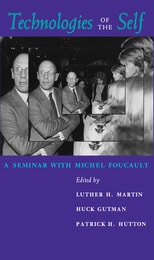
Technologies of the Self
A Seminar with Michel FoucaultLuther H. Martin
University of Massachusetts Press, 1988
Shortly before his death in 1984, Michel Foucault spoke of an idea for a new book on “technologies of the self.” He described it as “composed of different papers about the self. . . . about the role of reading and writing in constituting the self. . . . and so on.” The book Foucault envisioned was based on a faculty seminar on “Technologies of the Self,” originally presented at the University of Vermont in the fall of 1982. This volume is a partial record of that seminar.
In many ways, Foucault's project on the self was the logical conclusion to his historical inquiry over twenty-five years into insanity, deviancy, criminality, and sexuality. Because Foucault died before he completed the revisions of his seminar presentations, this volume includes a careful transcription instead...as a prolegomenon to that unfinished task.
Foucault was a French philosopher, historian of ideas, social theorist, philologist and literary critic.
This volume was edited by Luther H. Martin, Huck Gutman, and Patrick H. Hutton.
The Arachnean and Other Texts
Fernand Deligny
University of Minnesota Press, 2013
The network as a mode of being
In 1968, Fernand Deligny established a “network” for informally taking care of children with autism that was more than a mere site of living; it was a milieu created out of a reflection on the mode of being autistic. What is a space perceived outside of language? What is the form of a movement without perspective or goal? How do we engage with a world that is not our own, a world turned upside down yet truly common, where acting cohabitates with our actions and the unknown with our forms of knowledge? Such is the mythical web of the “Arachnean,” made of lines, holes, traces, enigmas, and questions without answers that demand to see that which cannot be seen. The Arachnean and Other Texts is a collection of Deligny’s writings from the second half of the 1970s. Long before the digital age of social networks, meshworks, and digital webs, Deligny speaks to us in his own autobiographical and aphoristic manner. For him, life was always experienced in the form of “the network as a mode of being.”g.”

The Bad Child
A Maria Janion ReaderMaria Janion
University of Minnesota Press, 2025
Collected writings from a visionary thinker about the perilous edge between patriotism and fascism
How do nationalism and patriotism shape our understanding of identity, and when do they drift into dangerous territory? Marta Figlerowicz gathers a selection of writings from Maria Janion, one of Eastern Europe’s most profound and original intellectuals, to explore this fine line. Between her birth in Vilnius in 1926 and her death in Warsaw in 2020, Janion witnessed some of the most consequential events of the turbulent twentieth century: the rise of authoritarian nationalism in Poland, German occupation during World War II, Soviet control, and Poland’s uneasy integration into the West. As Western countries face their own nationalist resurgences, Janion’s writing holds tools to help move through this historical condition.
The Bad Child offers sharp insights into how societies develop and assert their identities and histories—often at the cost of the people. Janion’s reflections on fascism, popular culture, and national self-fashioning presciently name and critique regional dynamics that have most recently resulted in the war between Russia and Ukraine, and they broadly expose the illusions that cultures can promote and the dangerous slide from national pride to exclusionary right-wing politics. A queer woman and survivor of World War II, a leftist who resisted Soviet orthodoxy, Janion lends a uniquely disruptive voice to contemporary discussions of fascism, and her insights resonate far beyond her Eastern European roots.
Retail e-book files for this title are screen-reader friendly with images accompanied by short alt text and/or extended descriptions.
The Barbara Johnson Collective
Edited by Devin M. Garofalo and Nathan K. Hensley
Northwestern University Press, 2027
Collaboratively reassesses Barbara Johnson’s legacy as a reader and thinker with an eye to contemporary conditions
Across an archive of essays on abortion and race, Mallarmé and Melville, feminist philosophy, rhetorical device, and pedagogical method, Barbara Johnson built a legacy of thought whose energies reverberate into the present. This collected volume gathers writers and critics from a range of North American higher educational settings to engage with this essential but still often underappreciated critic in a time of renewed and deepening crisis.
In Zoom meetings and shared essays, across a virtualized map of today’s academic and para-academic worlds, the group assessed how the rolling catastrophes of late neoliberalism continue to stage the sort of analogy Johnson herself would highlight between patriarchy, capitalism, ecocide, and other forms of structural violence. Emerging from that assemblage, this experimental collection tracks Johnson’s efforts to link literary reading with concrete matters of personhood and care at a moment when the very system of higher education that enabled Johnson’s work in the 1980s and 1990s faces existential threat. The frozen record of a live experience, the book is an impure procedure, tangled in the idiom of its own unfolding: a temporary culmination of an ongoing collaborative undertaking that will always remain unfinished.
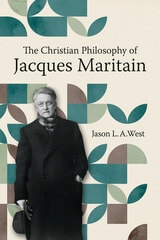
The Christian Philosophy of Jacques Maritain
Jason L.A. West
Catholic University of America Press, 2025
The Complete Works
Handbook, Discourses, and FragmentsEpictetus
University of Chicago Press, 2022
“Some things are up to us and some are not.”
Epictetus was born into slavery around the year 50 CE, and, upon being granted his freedom, he set himself up as a philosophy teacher. After being expelled from Rome, he spent the rest of his life living and teaching in Greece. He is now considered the most important exponent of Stoicism, and his surviving work comprises a series of impassioned discourses, delivered live and recorded by his student Arrian, and the Handbook, Arrian’s own take on the heart of Epictetus’s teaching.
In Discourses, Epictetus argues that happiness depends on knowing what is in our power to affect and what is not. Our internal states and our responses to events are up to us, but the events themselves are assigned to us by the benevolent deity, and we should treat them—along with our bodies, possessions, and families—as matters of indifference, simply making the best use of them we can. Together, the Discourses and Handbook constitute a practical guide to moral self-improvement, as Epictetus explains the work and exercises aspirants need to do to enrich and deepen their lives. Edited and translated by renowned scholar Robin Waterfield, this book collects the complete works of Epictetus, bringing to modern readers his insights on how to cope with death, exile, the people around us, the whims of the emperor, fear, illness, and much more.
CUSTOMER NOTE: THE HARDCOVER IS FOR LIBRARIES AND HAS NO JACKET.

The Constitution of a Historical Transcendental in Hegel's "Phenomenology of Spirit"
Graduate Thesis in Philosophy, 1949Michel Foucault
University of Chicago Press, 0
The first English translation of Foucault’s previously lost master’s thesis, itself an original contribution to the study of Hegel’s philosophy.
On June 11, 1949, a twenty-three-year-old Michel Foucault defended his master’s thesis in philosophy at the Sorbonne entitled The Constitution of a Historical Transcendental in Hegel’s “Phenomenology of Spirit.” Long considered a lost holy grail of French philosophy, the thesis was only recently rediscovered, and it is presented here in English for the first time.
In his master’s thesis, Foucault offers an original reading of Hegel that understands “absolute knowing,” the famous but enigmatic final figure of experience in the Phenomenology, as inextricably bound to time, language, and historical experience. Indeed, readers will discover how many of Foucault’s famous later concepts—the historical a priori, the episteme, and the limit-experience—are intimately rooted in his early, intense engagement with Hegel’s philosophy.
An introduction and critical apparatus provided by Hegel scholar Christophe Bouton traces previously unknown connections between the thesis and Foucault’s later masterpieces, particularly History of Madness and The Order of Things. Introducing a fundamental shift in our understanding of Foucault’s intellectual trajectory, this book is an essential text for anyone interested in Foucault, Hegel, and the dramatic evolution of twentieth-century continental philosophy.
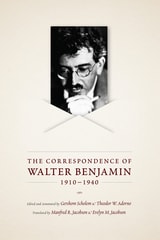
The Correspondence of Walter Benjamin, 1910-1940
Walter Benjamin
University of Chicago Press, 1994
A powerful, mesmerizing collection of letters from one of the most important intellectuals and writers of the twentieth century
The Cosmopolitan Self
George Herbert Mead and Continental PhilosophyMitchell Aboulafia
University of Illinois Press, 2001
In this incisive commentary, Mitchell Aboulafia examines the relevance of the American pragmatist philosopher George Herbert Mead to current debates on pluralism, universalism, and the fostering of a democratic temper. Addressing the relationship between Mead's notions of self and society and those of important continental thinkers, The Cosmopolitan Self demonstrates that Mead's ideas not only speak to resolving the tension between universalism and pluralism, they do so in a manner that challenges and advances the positions of these continental theoreticians.
Aboulafia examines how Mead's insights illuminate Hannah Arendt's reading of Immanual Kant's third Critique and Jürgen Habermas's understanding of the relationship among communicative action, universality, and individuation. Teasing out strands of agreement and disagreement among Mead and these theorists on topics such as impartiality and good judgment, Aboulafia develops a conception of universalism that is compatible with contemporary notions of pluralism. He also addresses the serious challenge presented to Mead's approach to pluralism by Emmanuel Levinas, who holds that true pluralism, presupposing an irreducible individualism, is fundamentally irreconcilable with universalism.
The Cosmopolitan Self offers a model of the democratically inclined individual who embodies both a capacity to establish common ground with others and a sensitivity to their uniqueness. This important volume appreciably advances the dialogue between continental thought and classical American philosophy.
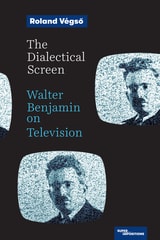
The Dialectical Screen
Walter Benjamin on TelevisionRoland Végso
Northwestern University Press, 2027
Exploring the meanings of media technologies through Walter Benjamin’s thought
Walter Benjamin’s prime years as a cultural critic coincided with the rise of televised broadcasting in Europe and North America, a unique period of rapid expansion in a new technological medium. So why would such a subtle and sensitive critic of media, known for his cultural criticism across genres, seem to have ignored or even missed the entire phenomenon of television? This book reveals how television, as a concept and a metaphor, in fact structures Benjamin’s philosophy.
Through a careful reading of Benjamin’s work across various media—literature, photography, cinema, radio, and television—Roland Végső reconstructs a powerful vision of media technologies as not merely tools of communication but as forces that shape how we imagine and construct the world as a conceptual totality. The Dialectical Screen provides a timely and provocative framework for understanding how media continue to shape our political, cultural, and existential horizons, recasting Benjamin's understanding of historical materialism in fundamentally tele-visual terms as a theoretical orientation that makes visible the perishing of the world itself.
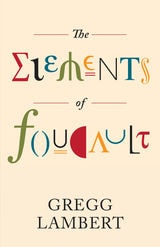
The Elements of Foucault
Gregg Lambert
University of Minnesota Press, 2020
A new conceptual diagram of Foucault’s original vision of the biopolitical order
The history around the critical reception of Michel Foucault’s published writings is troubled, according to Gregg Lambert, especially in light of the controversy surrounding his late lectures on biopolitics and neoliberal governmentality. In this book, Lambert’s unique approach distills Foucault’s thought into its most basic components in order to more fully understand its method and its own immanent rules of construction.
The Elements of Foucault presents a critical study of Foucault’s concept of method from the earlier History of Sexuality, Volume 1, to his later lectures. Lambert breaks down Foucault’s post-1975 analysis of the idea of biopower into four elements: the method, the conceptual device (i.e., dispositif), the grid of intelligibility, and the notion of “milieu.” Taken together, these elements compose the diagram of Foucault’s early analysis and the emergence of the neoliberal political economy. Lambert further delves into how Foucault’s works have been used and misused over time, challenging the periodization of Foucault’s later thought in scholarship as well as the major and most influential readings of Foucault by other contemporary philosophers—in particular Gilles Deleuze and Giorgio Agamben.
The Elements of Foucault is the first generally accessible, yet rigorous and comprehensive, discussion of lectures and major published works of Foucault’s post-1975 theory of biopower and of the major innovation of the concept of dispositif. It is also the first critical work to address the important influence of French philosopher Georges Canghuilhem on Foucault’s thought.
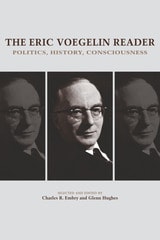
The Eric Voegelin Reader
Politics, History, ConsciousnessCharles R. Embry
University of Missouri Press, 2023
Drawing from the University of Missouri Press’s thirty-four-volume edition of The Collected Works of Eric Voegelin (1990-2009), Charles Embry and Glenn Hughes have assembled a selection of representative works of Voegelin, satisfying a longstanding need for a single volume that can serve as a general introduction to Voegelin’s philosophy. The collection includes writings that demonstrate the range and creativity of Voegelin’s thought as it developed from 1956 until his death in 1985 in his search for the history of order in human society.
The Reader begins with excerpts from Autobiographical Reflections (1973), which include an orienting mixture of biographical information, philosophical motivations, and the scope of Voegelin’s project. It reflects key periods of Voegelin’s philosophical development, pivoting on his flight from the Gestapo.
The next section focuses on Voegelin’s understanding of the contemporary need to re-ground political science in a non-positivistic, post-Weberian outlook and method. It begins with Voegelin’s historical survey of science and scientism, followed by his explanation of what political science now requires in his introduction to The New Science of Politics. Also included are two essays that exemplify the practice of this “new science.” Voegelin started his academic career as a political scientist, and these early essays indicate his wide philosophical vision.
Voegelin recognized that a fully responsible “new science of politics” would require the development of a philosophy of history. This led to the writing of his magnum opus, the five-volume Order and History (1956–1985). This section of the Reader includes his introductions to volumes 1, 2 and 4 and his most essential accounts of the theoretical requirements and historical scope of a philosophy of history adequate to present-day scholarship and historical discoveries.
In the course of his career, Voegelin came to understand that political science, political philosophy, and philosophy of history must have as their theoretical nucleus a sound philosophical anthropology based on an accurate philosophy of human consciousness. The next set of writings consists of one late lecture and four late essays that exemplify how Voegelin recovers the wisdom of classical philosophy and the Western religious tradition while criticizing modern misrepresentations of consciousness. The result is Voegelin’s contemporary accounts of the nature of reason, the challenge of truly rational discussion, and the search for divine origins and the life of the human spirit.
During his philosophical journey, Voegelin addressed the historical situatedness of human existence, explicating the historicity of human consciousness in a manner that gave full due to the challenges of acknowledging both human immersion in the story of history and the ability of consciousness to arrive at philosophically valid truths about existence that are transhistorical. The essays in this final section present the culmination of his philosophical meditation on history, consciousness, and reality.
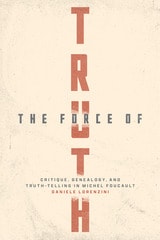
The Force of Truth
Critique, Genealogy, and Truth-Telling in Michel FoucaultDaniele Lorenzini
University of Chicago Press, 2023
Many blame Michel Foucault for our post-truth and conspiracy-laden society. In this provocative work, Daniele Lorenzini argues that such criticism fundamentally misunderstands the philosopher’s project. Foucault did not question truth itself but what Lorenzini calls “the force of truth,” or how some truth claims are given the power to govern our conduct while others are not. This interest, Lorenzini shows, drove Foucault to articulate a new ethics and politics of truth-telling precisely in order to evade the threat of relativism. The Force of Truth explores this neglected dimension of Foucault’s project by putting his writings on regimes of truth and parrhesia in conversation with early analytic philosophy and by drawing out the “possibilizing” elements of Foucault’s genealogies that remain vital for practicing critique today.
The Foundations of Arithmetic
A Logico-Mathematical Enquiry into the Concept of NumberGottlob Frege
Northwestern University Press, 1980

The Freedom of the Migrant
Objections to NationalismVilém Flusser. Translated to the German by Kenneth Kronenberg. Edited and with an Introduction by Anke K. Finger
University of Illinois Press, 2013

The Heresies of Jan Patocka
Phenomenology, History, and PoliticsJames Dodd
Northwestern University Press, 2023
Foregrounding the turbulent political and intellectual scene in Czechoslovakia following the Prague Spring in 1968, James Dodd explores the unity of philosophy, history, and politics in Jan Patočka’s life and legacy. Dodd presents Patočka as an essential philosopher of modern concepts—such as freedom, subjectivity, and history—and also as an interpreter of prominent thinkers such as Husserl and Heidegger.
Dodd outlines the phenomenology that Patočka, as a late pupil of Husserl and Heidegger, crafted in response to the classical model before turning to his philosophy of history, which was oriented around the problem of Europe and the care for the soul. Finally, Dodd examines Patočka’s role as a dissident intellectual and one of the principal voices of the Charter 77 human rights movement until his death in March 1977. By situating Patočka’s thought in relation to classical phenomenology and to the political and historical conditions of Central Europe, Dodd illuminates the enduring impact of this key thinker of the twentieth century.
The History of the Devil
Vilém Flusser
University of Minnesota Press, 2027
A fascinating exploration into the early work of the celebrated philosopher of media culture and technology, Vilém Flusser
In 1939, a young Vilém Flusser faced the Nazi invasion of his hometown of Prague. He escaped with his wife to Brazil, taking with him only two books: a small Jewish prayer book and Goethe’s Faust. Twenty-six years later, in 1965, Flusser would publish The History of the Devil, and it is the essence of those two books that haunts his own. From that time his life as a philosopher was born. While Flusser would later garner attention in Europe and elsewhere as a thinker of media culture, The History of the Devil is considered by many to be his first significant work, containing nascent forms of the main themes that would come to preoccupy him over the following decades.
In The History of the Devil, Flusser frames the human situation from a pseudo-religious point of view. The phenomenal world, or “reality” in a general sense, is identified as the “Devil,” and that which transcends phenomena, or the philosophers’ and theologians’ “reality,” is identified as “God.” Referencing Wittgenstein’s Tractatus Logico-Philosophicus in its structure, Flusser provocatively leads the reader through an existential exploration of nothingness as the bedrock of reality, where “phenomenon” and “transcendence,” “Devil” and “God” become fused and confused. So radically confused, in fact, that Flusser suggests we abandon the quotation marks from the terms “Devil” and “God.” At this moment of abysmal confusion, and of the downfall of all values, we must make the existential decisions that give direction to our lives.
The Life and Thought of Alexandre Kojève
Marco Filoni and David Broder (Trans.)
Northwestern University Press, 2025
A fresh and vivid reappraisal of one of the most influential intellects of the modern era
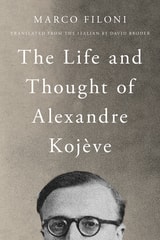
Alexandre Kojève is one of the twentieth century’s most seductive and intriguing figures. A product of the Russian merchant bourgeoisie, he became, depending on one’s point of view, either an overzealous bureaucrat or a secret agent who infiltrated the upper echelons of French state bureaucracy, spending the last twenty years of his life working in international diplomacy and high finance. Marco Filoni describes each facet of Kojève’s different lives in crystalline detail: the cultural circles of his youth, his studies, his philosophical passions, his fundamental theoretical choices, and his intellectual network, as well as the students who would become part of the intellectual elite, including Lacan, Bataille, and Merleau-Ponty. Drawing on rich archival material, unpublished texts, correspondence, and written and oral testimonies, The Life and Thought of Alexandre Kojève is a major benchmark for scholars of Kojève and of twentieth-century intellectual and political history. Filoni paints a vibrant portrait of one of the most influential intellectuals of the modern era, deftly composing Kojève’s personal, political, and philosophical lives.
The Obsolescence of the Human
Günther Anders
University of Minnesota Press, 2025
Now available in English—one of the twentieth century’s most important works on the philosophy of technology
With this first English translation of influential German philosopher Günther Anders’s 1956 masterpiece of critical theory, The Obsolescence of the Human, a new generation of readers can now engage with his prescient and haunting vision of a “world without us” dominated by technology.
Looking at technological events such as the detonation of the nuclear bomb and the arrival of televisions in our living rooms, Anders advances a warning of what humanity looks like in a world where it has surrendered all agency. He outlines the new emotional landscapes that shape our relationship to increasingly capable technology, including Promethean shame, the human sense of unease our own superior technological innovations can instill. Confronting the growing gap between what we can collectively create and what we can individually comprehend, Anders speculates on the trajectory of a developing technological world that rapidly exceeds our ability to control or even foresee its negative consequences.
The Obsolescence of the Human prefigures contemporary posthumanist discourse and is eerily predictive of current debates around automation, global warming, and artificial intelligence. Providing new ways to conceptualize the intersection of technology and emotion, it offers groundbreaking frameworks for future-oriented ethics. Radical in both its stylistic experimentation and its theoretical insights, this new translation presents a cautionary tale regarding the human capacity to usher in its own destruction.
Retail e-book files for this title are screen-reader friendly with images accompanied by short alt text and/or extended descriptions.
The Organism Is a Theory
Giuseppe Longo on Biology, Mathematics, and AIGiuseppe Longo
University of Minnesota Press, 2026
A bold reimagining of life that bridges science, philosophy, cybernetics, and the complexities of biological existence
The Organism Is a Theory is an intriguing synthesis of decades of interdisciplinary research by eminent mathematician and biological scientist Giuseppe Longo. A unique collaboration between Longo and philosopher of technology Adam Nocek, the volume confronts foundational issues in the history of mathematics, computer science, physics, and theoretical biology.
Challenging conventional approaches that apply computational and formalist models to the biological world, Longo reveals how the limitations of these models hinder the understanding of organismic complexity, development, and evolution. Through a critique of dominant scientific paradigms, he emphasizes the need for a new biological theory that accounts for the temporal and spatial intricacies of life. Enhanced by Nocek’s comprehensive introduction and a fascinating three-part interview with Longo, The Organism Is a Theory offers a bold rethinking of the biosciences, integrating the work of Alan Turing, Bernhard Riemann, Henri Poincaré, Kurt Gödel, and others into Longo’s vision of critical biology.
Bridging scientific and philosophical discourses, this book creatively applies insights from mathematics, physics, and computing into the study of the organism to present a new theoretical approach to understanding biological complexity that resists reductive mechanistic and informatic explanations.
Retail e-book files for this title are screen-reader friendly with image accompanied by short alt text and/or extended description.
The Panopticon Versus "New South Wales" and Other Writings on Australia
Tim Causer and Philip Schofield
University College London, 2021
Jeremy Bentham conceived the panopticon, in part, as an alternative to criminal transportation to Australia. This latest volume in The Collected Works of Jeremy Bentham series draws out these connections by collecting both Bentham’s fragmentary and extended comments on Australian governance and colonization. These writings include a fragment headed “New Wales” (1792) correspondence with William Wilberforce (1802), three letters to Lord Pelham (1802), a “Plea for the Constitution” (1802–3), and “Colonization Company Proposal” (1831)—the majority published here for the first time. Although Bentham’s most famous ideas emerged from his opposition to colonization, these writings demonstrate how the reformer became a vocal advocate for settler colonization near the end of his life.
The People's Princes
Machiavelli, Leadership, and LibertyJohn P. McCormick
University of Chicago Press, 2025
A new window into Machiavelli’s idea of virtuous leadership and the appropriate relationship among leaders, common citizens, and elites.
For more than a decade, John P. McCormick has been at the forefront of a new wave of scholarship that reveals the anti-elitist and democratic commitments at the center of Niccolo Machiavelli’s political thought. In The People’s Princes, McCormick turns his attention to Machiavelli’s conception of virtuous leadership and Machiavelli’s views on the appropriate relationships among individual leaders, common citizens, and elites.
While most people think of Machiavelli as a cynical advisor of tyrants—a man who counseled leaders to aggrandize themselves, by any means necessary, at the expense of their subjects and citizens—The People’s Princes fundamentally challenges this understanding. Drawing from Machiavelli’s major political works a normative standard for leadership that emphasizes the mutually reinforcing relationship of civic leadership and popular government, McCormick delineates Machiavelli’s method of “political exemplarity” by analyzing in detail the Florentine’s case studies of leaders and their interactions with populaces throughout ancient and modern history.
McCormick argues that Machiavelli suggests that civic leaders should enhance their reputations by providing for their own eventual obsolescence; specifically, they should establish institutional means through which common citizens rule themselves more directly and substantively. The People’s Princes invites readers to consider Machiavelli anew, and also reflect on insights that remain relevant in the twenty-first century amidst growing concerns that political leaders are not accountable or responsive to popular majorities.
The Philosophy of Paul Elmer More
The Ethical Basis of Life and LettersFolke Leander
University of Missouri Press, 2026
Folke Leander (1910-1981) was a prolific and internationally known Swedish philosopher. He is best known in the United States as an explicator of the New Humanism, an informal movement of literary and cultural criticism founded by Paul Elmer More (1864-1937) and Irving Babbitt (1865-1933).
Leander’s manuscript for The Philosophy of Paul Elmer More was completed in the early 1970s, but because of the academic environment at the time and the book’s special philosophical focus, Leander was unable to find a publisher. Since then, the work existed only as a typescript, a copy of which he left with Claes G. Ryn, his former student and collaborator, in the hope that one day in more favorable intellectual circumstances it might be published.
Leander is rare among the scholars of the New Humanism for his first-rate philosophical training, depth of insight, and clarity of expression. In The Philosophy of Paul Elmer More he grapples carefully and precisely with the most fundamental tenets of the New Humanism. Although very supportive of the movement, Leander provides essential critiques of its contentions—and even improves upon some of them in crucial respects. In a series of concise, limpid chapters, he explains and assesses such fundamental—but often hazily understood—Humanist concepts as the “inner check,” “naturalism,” and “the higher will.” The result is a book essential for anyone who wants to understand the New Humanism.
The Philosophy, Theology, and Rhetoric of Marius Victorinus
Stephen A. Cooper
SBL Press, 2022
Pagan rhetor, (Neo-)Platonist philosopher, Christian theologian
This collection of essays is devoted to the rhetoric, Neoplatonic philosophy, and Christian theology of Marius Victorinus, a mid-fourth-century professor of rhetoric and philosopher who converted to Christianity late in life. Scholars from eight different countries, some of whom have not previously published in English, reflect on debates about his writings and theological development. These topics include Victorinus's deployment of philosophical sources for trinitarian theology, possible connections in his work to Origen, Augustine, Plotinus, Porphyry, and Gnosticism, as well as his contributions to Latin rhetoric and dialectic. Contributors include Jan Dominik Bogataj, Michael Chase, Nello Cipriani, Stephen A. Cooper, Volker Henning Drecoll, Lenka Karfíková, Josef Lössl, Václav Němec, Thomas Riesenweber, Guadalupe Lopetegui Semperena, Miran Špelič, Chiara O. Tommasi, John D. Turner, and Florian Zacher. The chapters in this volume are of great interest to students of late antique philosophy, Christian theology, and Latin rhetoric.
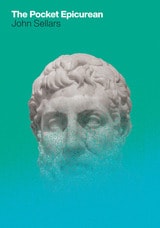
The Pocket Epicurean
John Sellars
University of Chicago Press, 2021
As long as there has been human life, we’ve searched for what it means to be happy. More than two thousand years ago, the Greek philosopher Epicurus came to his own conclusion: all we really want in life is pleasure. Though today we tend to associate the word “Epicurean” with indulgence in the form of food and wine, the philosophy of Epicurus was about a life well lived even in the hardest of times. As John Sellars shows in this concise, approachable guide, the ideal life envisioned by Epicurus and his followers was a life much more concerned with mental pleasures and the avoidance of pain. Their goal, in short, was a life of tranquility or contentment.
In The Pocket Epicurean Sellars walks us through the history of Epicureanism, starting with the private garden on the edge of ancient Athens where Epicurus and his students lived in the fourth century BC, and where women were as welcome as men. Sellars then moves on to ancient Rome, where Epicurean influence flourished thanks to the poet Lucretius and his cohort. Throughout the book, Sellars draws on the ideas of Epicurus to offer a constructive way of thinking about the pleasures of friendship and our place in the world.
The Postmodern Condition
A Report on KnowledgeJean-Francois Lyotard
University of Minnesota Press, 1984
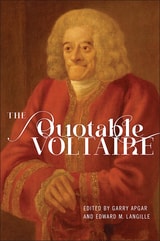
The Quotable Voltaire
Garry Apgar
Bucknell University Press, 2021
Drawing from a wide range of his publications, private letters, and remarks recorded by his contemporaries, The Quotable Voltaire includes material never before gathered in a single volume. English translations appear alongside the original French, and each quote is thoroughly indexed and referenced, with page numbers for both the first known publication edition of each entry and the most recent edition of Voltaire’s works. The book also features over 400 quotes about Voltaire, including commentary by eighteenth-century luminaries like Samuel Johnson, Catherine the Great, Casanova, and John Adams, as well as an eclectic assortment of modern-day personages ranging from Winston Churchill and Jorge Luis Borges to Mae West and Mike Tyson.
Lavishly illustrated with nearly three dozen images of Voltaire-related art, this collection opens with a scholarly essay that recounts the great man’s life and reflects on his outsized influence on Western culture. Whether you are a Voltaire scholar or a neophyte, The Quotable Voltaire is the perfect introduction to a brilliant mind.

The Romance of Individualism in Emerson and Nietzsche
David Mikics
Ohio University Press, 2027
The great American thinker Ralph Waldo Emerson and the influential German philosopher Friedrich Nietzsche, though writing in different eras and ultimately developing significantly different philosophies, both praised the individual’s wish to be transformed, to be fully created for the first time. Emerson and Nietzsche challenge us to undertake the task of identity on our own, in order to see (in Nietzsche’s phrase) “how one becomes what one is.”
David Mikics’s The Romance of Individualism in Emerson and Nietzsche examines the argument, as well as the affinity, between these two philosophers. Nietzsche was an enthusiastic reader of Emerson and inherited from him an interest in provocation as a means of instruction, an understanding of the permanent importance of moods and transitory moments in our lives, and a sense of the revolutionary character of impulse. Both were deliberately outrageous thinkers, striving to shake us out of our complacency.
Rather than choosing between Emerson and Nietzsche, Mikics attends to Nietzsche’s struggle with Emerson’s example and influence. Elegant in its delivery, The Romance of Individualism in Emerson and Nietzsche offers a significant commentary on the visions of several contemporary theorists whose interests intersect with those of Emerson and Nietzsche, especially Stanley Cavell, Jacques Lacan, Slavoj Zizek, and Harold Bloom.
The Second Alcibiades
A Platonist Dialogue on Prayer and on IgnoranceHarold Tarrant
Parmenides Publishing, 2023

The Symposium of Plato
Suzy Q. Groden
University of Massachusetts Press, 1970
This new translation of Plato’s dialogue on love avoids the cumbersome locutions of Victorian versions and presents Plato’s ancient drinking party in a vigorous contemporary idiom. The character of Socrates emerges with unexpected wit and humor, adding new dimensions to his familiar irony. A poet and philosopher have collaborated to give an English version that is fresh and clear, and accurately renders the ideas of the speakers.
A detailed internal analysis of the structure of the dialogue is given in the introduction. The afterword presents an historical interpretation of the two ways of love, eros and agapé, an a reinterpretation of eros in Plato.
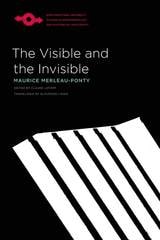
The Visible and the Invisible
Maurice Merleau-Ponty
Northwestern University Press, 1968
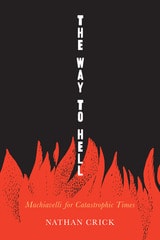
The Way to Hell
Machiavelli for Catastrophic TimesNathan Crick
University of Alabama Press, 2024
An incisive and erudite survey of Machiavelli, the catastrophes of his times and ours, and his counsel for responding to an era of constant crises.
Catastrophe looms. Political, environmental, epidemic, and military crises arrive with increasing frequency. In The Way to Hell, Nathan Crick argues that our perilous times call for the strongest medicine in the Western canon: Machiavelli. Crick reminds contemporary readers about the Florentine master’s advice—that one must learn the road to Hell precisely to avoid taking it.
Like a knowledgeable friend, Crick offers contemporary readers a guide to Machiavelli’s world, work, and warnings. He takes in the sweep of Western history, comparing Machiavelli’s work with ancient sources such as Cicero and Thucydides. And as Machiavelli has never stopped provoking comment, Crick treats readers to a feast of responses to Machiavelli’s work—caustic, learned, and humorous—in the five centuries since he lived.
Including both Machiavelli’s best-known works, The Prince and Discourses on Livy, as well as his personal correspondence and comic plays, Crick asks anew the questions that bedeviled Machiavelli’s beloved Florentine republic: When is force necessary? When are lies justified? Is cruelty defensible? When does social protest slip into violent revolution? What is the correct response to catastrophe?
Like Machiavelli himself, The Way to Hell is witty, stimulating, and challenging. In a world seemingly on the road to Hell, Machiavelli offers an alternative route. His bracing vision exhorts readers to see the dangers in their path and to take action with vigor and determination. Far from a vision of cynicism, Machiavelli offers a beacon of hope for a world that seems on the brink.
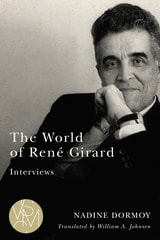
The World of René Girard
InterviewsNadine Dormoy
Michigan State University Press, 2024
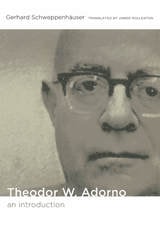
Theodor W. Adorno
An IntroductionGerhard Schweppenhäuser
Duke University Press, 2009
After providing a brief overview of Adorno’s life, Schweppenhäuser turns to the theorist’s core philosophical concepts, including post-Kantian critique, determinate negation, and the primacy of the object, as well as his view of the Enlightenment as a code for world domination, his diagnosis of modern mass culture as a program of social control, and his understanding of modernist aesthetics as a challenge to conceive an alternative politics. Along the way, Schweppenhäuser illuminates the works widely considered Adorno’s most important achievements: Minima Moralia, Dialectic of Enlightenment (co-authored with Horkheimer), and Negative Dialectics. Adorno wrote much of the first two of these during his years in California (1938–49), where he lived near Arnold Schoenberg and Thomas Mann, whom he assisted with the musical aesthetics at the center of Mann’s novel Doctor Faustus.
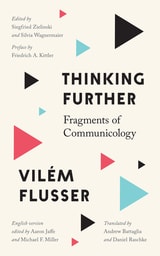
Thinking Further
Fragments of CommunicologyVilém Flusser
University of Minnesota Press, 2026
The first English-language translation of Vilém Flusser’s final series of lectures: the definitive introduction to his methods and ideas in new media theory
In summer 1991, shortly before his death, Vilém Flusser gave a series of lectures as guest professor at Ruhr University Bochum at the invitation of Friedrich Kittler. Flusser intended for these lectures to be the definitive introduction to his “communicology,” the study of human communication and the means by which acquired information is saved, processed, and passed on. In Thinking Further, Aaron Jaffe and Michael F. Miller have curated “fragments” from these lectures—first published in German in 2008—to present the most exciting and timely parts of Flusser’s foundational contributions to what is now known as media studies.
These fragments capture Flusser’s engagements with a wide range of theories, approaches, and interventions, including ecocriticism, posthumanities, game theory, cybernetics, and translinguistic exchanges. Offering sustained engagements with the ideas of Walter Benjamin, Michel Foucault, Michel Serres, and Jean Baudrillard, Thinking Further models possibilities for thinking through and clarifying the most obscure and obdurate implications of technology and modernity.
As they demonstrate Flusser’s contextual positionality and antiuniversalism, the writings presented here also underscore the pleasures and the power of his aphoristic style. Focusing less on Flusser-as-philosopher and more on his role as wry sage at the end of history, Thinking Further is a comprehensive but approachable introduction to his boundary-transcending exploration of the possibilities for communication, writing, and the human condition.
Retail e-book files for this title are screen-reader friendly.
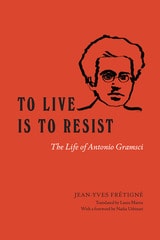
To Live Is to Resist
The Life of Antonio GramsciJean-Yves Frétigné
University of Chicago Press, 2021
One of the most influential political thinkers of the twentieth century, Antonio Gramsci (1891–1937) has left an indelible mark on philosophy and critical theory. His innovative work on history, society, power, and the state has influenced several generations of readers and political activists, and even shaped important developments in postcolonial thought. But Gramsci’s thinking is scattered across the thousands of notebook pages he wrote while he was imprisoned by Italy’s fascist government from 1926 until shortly before his death.
To guide readers through Gramsci’s life and works, historian Jean-Yves Frétigné offers To Live Is to Resist, an accessible, compelling, and deeply researched portrait of an extraordinary figure. Throughout the book, Frétigné emphasizes Gramsci’s quiet heroism and his unwavering commitment to political practice and resistance. Most powerfully, he shows how Gramsci never surrendered, even in conditions that stripped him of all power—except, of course, the power to think.