Results by title
84 books match the query 'Instruction & Study' and 25 start with t
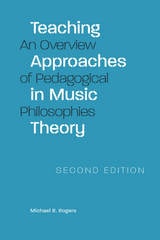
Teaching Approaches in Music Theory, Second Edition
An Overview of Pedagogical PhilosophiesMichael R. Rogers
Southern Illinois University Press, 2004
Drawing on decades of teaching experience and the collective wisdom of dozens of the most creative theorists in the country, Michael R. Rogers’s diverse survey of music theory—one of the first to comprehensively survey and evaluate the teaching styles, techniques, and materials used in theory courses—is a unique reference and research tool for teachers, theorists, secondary and postsecondary students, and for private study. This revised edition of Teaching Approaches in Music Theory: An Overview of Pedagogical Philosophies features an extensive updated bibliography encompassing the years since the volume was first published in 1984.
In a new preface to this edition, Rogers references advancements in the field over the past two decades, from the appearance of the first scholarly journal devoted entirely to aspects of music theory education to the emergence of electronic advances and devices that will provide a supporting, if not central, role in the teaching of music theory in the foreseeable future. With the updated information, the text continues to provide an excellent starting point for the study of music theory pedagogy.
Rogers has organized the book very much like a sonata. Part one, “Background,” delineates principal ideas and themes, acquaints readers with the author’s views of contemporary musical theory, and includes an orientation to an eclectic range of philosophical thinking on the subject; part two, “Thinking and Listening,” develops these ideas in the specific areas of mindtraining and analysis, including a chapter on ear training; and part three, “Achieving Teaching Success,” recapitulates main points in alternate contexts and surroundings and discusses how they can be applied to teaching and the evaluation of design and curriculum.
Teaching Approaches in Music Theory emphasizes thoughtful examination and critique of the underlying and often tacit assumptions behind textbooks, materials, and technologies. Consistently combining general methods with specific examples and both philosophical and practical reasoning, Rogers compares and contrasts pairs of concepts and teaching approaches, some mutually exclusive and some overlapping. The volume is enhanced by extensive suggested reading lists for each chapter.
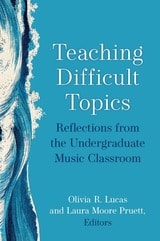
Teaching Difficult Topics
Reflections from the Undergraduate Music ClassroomOlivia R. Lucas and Laura Moore Pruett
University of Michigan Press, 2024
The teaching reflections in Teaching Difficult Topics examine difficult themes that fall into three primary categories: subjects that instructors sense to be controversial or emotionally challenging to discuss, those that derive from or intersect with real-world events that are difficult to process, and bigger-picture discussions of how music studies often focuses on dominant narratives while overlooking other perspectives. Some chapters offer practical guidance, lesson plans, and teaching materials to enable instructors to build discussions of race, gender, sexuality, and traumatic histories into their own classrooms; others take a more global view, reflecting on the importance and relevance of teaching these difficult topics and on how to respond in the music classroom when external events disrupt daily life.
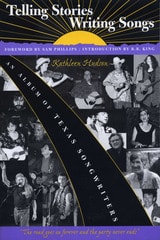
Telling Stories, Writing Songs
An Album of Texas SongwritersBy Kathleen Hudson
University of Texas Press, 2001
Willie Nelson, Joe Ely, Marcia Ball, Tish Hinojosa, Stevie Ray Vaughan, Lyle Lovett...the list of popular songwriters from Texas just goes on and on. In this collection of thirty-four interviews with these and other songwriters, Kathleen Hudson pursues the stories behind the songs, letting the singers' own words describe where their songs come from and how the diverse, eclectic cultures, landscapes, and musical traditions of Texas inspire the creative process.
Conducted in dance halls, dressing rooms, parking lots, clubs-wherever the musicians could take time to tell their stories-the interviews are refreshingly spontaneous and vivid. Hudson draws out the songwriters on such topics as the sources of their songs, the influence of other musicians on their work, the progress of their careers, and the nature of Texas music. Many common threads emerge from these stories, while the uniqueness of each songwriter becomes equally apparent. To round out the collection, Hudson interviews Larry McMurtry and Darrell Royal for their perspectives as longtime friends and fans of Texas musicians. She also includes a brief biography and discography of each songwriter.

The Analysis and Cognition of Basic Melodic Structures
Eugene Narmour
University of Chicago Press, 1990
The theoretical constants Narmour uses are context-free and, therefore, applicable to all styles of melody. He places considerable emphasis on the listener's cognitive performance (that is, fundamental melodic perception as opposed to acquired musical competence). He concentrates almost exclusively on low-level, note-to-note relations. The result is a highly generalized theory useful in researching all manner of psychological and music-theoretic problems concerned with the analysis and cognition of melody.
"In this innovative, landmark book, a distinguished music theorist draws extensively from a variety of disciplines, in particular from cognitive psychology and music theory, to develop an elegant and persuasive framework for the understanding of melody. This book should be read by all scholars with a serious interest in music."—Diana Deutsch, Editor, Music Perception
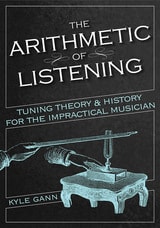
The Arithmetic of Listening
Tuning Theory and History for the Impractical MusicianKyle Gann
University of Illinois Press, 2019
A classroom essential and an invaluable reference, The Arithmetic of Listening offers beginners the grounding in music theory necessary to find their own way into microtonality and the places it may take them. Moving from ancient Greece to the present, Kyle Gann delves into the infinite tunings available to any musician who feels straitjacketed by obedience to standardized Western European tuning. He introduces the concept of the harmonic series and demonstrates its relationship to equal-tempered and well-tempered tuning. He also explores recent experimental tuning models that exploit smaller intervals between pitches to create new sounds and harmonies.
Systematic and accessible, The Arithmetic of Listening provides a much-needed primer for the wide range of tuning systems that have informed Western music.
Audio examples demonstrating the musical ideas in The Arithmetic of Listening can be found at: https://www.kylegann.com/Arithmetic.html
The Art of Accompanying and Coaching
Kurt Adler
University of Minnesota Press, 1965
The Art of Accompanying and Coaching was first published in 1965. Minnesota Archive Editions uses digital technology to make long-unavailable books once again accessible, and are published unaltered from the original University of Minnesota Press editions.
Kurt Adler, former conductor and chorus master of the Metropolitan Opera, provides a comprehensive guide to musical accompanying and coaching, based in his extensive experience, which will be helpful, if not indispensable, to music teachers, students, coaches, accompanists, orchestral and choral conductors, and performing vocal and instrumental artists.
The first part of the book gives the historical and technical background of the subject and explains in detail the mechanics of string instruments, piano, celeste, organ, harmonium, and voice. The next section offers a thorough guide to the singing diction of five languages— Italian, Latin, French, German, and English. The author continues with a discussion of the elements of musical style, describing, with the use of ample musical illustrations, tempo, rhythm, dynamics, phrasing and articulation, and ornamentation. This section closes with an analysis of the German lied style and the French art song style.
Mr. Adler goes on to synthesize the various elements of accompanying and coaching. He stresses the importance of psychological and spiritual rapport between accompanists and artist and shows ways of achieving this. He explains the differences and similarities among opera, oratorio, and song coaching. In a section on program arranging, he offers advice about planning concerts of various kinds, citing examples of programs given by outstanding artists. He writes about particular aspects of accompanying — self accompanying, the difference between piano accompanying and soloistic piano playing, and accompanying for singers, instrumentalists, and dancers. In conclusion, he describes the qualities of an ideal accompanist and the rewards derived from excellence in performance.
University and college music departments, schools of music, choral groups, voice teachers, singers, pianists, and other musicians will find the book of inestimable value, either as a text or as a reference work. It will be especially helpful to pianists who aspire to become accompanists.
The Beethoven Violin Sonatas
History, Criticism, PerformanceEdited by Lewis Lockwood and Mark Kroll
University of Illinois Press, 2004
Lewis Lockwood and Mark Kroll's volume The Beethoven Violin Sonatas is the first scholarly book in English devoted exclusively to the Beethoven sonatas, and deals with them in unprecedented depth. It presents seven critical and historical essays by some of the most important American and European Beethoven specialists of our time. The authors examine the sonatas within the history of the genre, the social and cultural context in which they were written, their significance within Beethoven's life and works, and the issues they raise regarding performance practices of the period.
The Idea of Absolute Music
Carl Dahlhaus
University of Chicago Press, 1989
"Essential reading for anyone interested in the larger intellectual framework in which Romantic music found its place, a framework that to a remarkable degree has continued to shape our image of music."—Robert P. Morgan, Yale University
Carl Dahlhaus (1928-1989) is the author of a highly influential body of works on the foundations of music history and aesthetics.
The Improviser's Classroom
Pedagogies for Cocreative WorldmakingEdited by Daniel Fischlin and Mark Lomanno
Temple University Press, 2024
Demonstrating how improvisation can inform scenes of teaching and learning, this volume also outlines how improvisatory techniques offer powerful, if not vital, tools for producing connection, creativity, accompaniment, reciprocity, meaningful revelation, and lifelong curiosity.
The Improviser's Classroom champions activist pedagogies and the public work essential for creating communities bound together by reciprocal care and equity.
Contributors: Sibongile Bhebhe, Judit Csobod, Michael Dessen, jashen edwards, Kate Galloway, Tomie Hahn, Petro Janse van Vuuren, Lauren Michelle Levesque, George Lipsitz, Rich Marsella, Tracy McMullen, Hafez Modirzadeh, Ed Sarath, Joe Sorbara, Jesse Stewart, Ellen Waterman, Carey West, and the editors
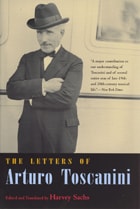
The Letters of Arturo Toscanini
Arturo Toscanini
University of Chicago Press, 2006
“This is a major contribution to our understanding of Toscanini and of several entire eras of late nineteenth- and twentieth-century musical life, especially the almost improvisatory looseness of opera in Italy, the glamour of European festivals, and the concert life of the United States. It’s also a wonderful, sometimes downright salacious read.”—New York Times
“Toscanini’s large, cranky humanity comes alive throughout his letters, as it does in his best recordings.”—New York Review of Books
“Edited with scrupulous care and wide-ranging erudition.”—Wall Street Journal
“Sachs has served the conductor well . . . by editing this generously annotated and unprecedentedly revealing collection of letters that were written, usually in haste and often in fury, over the course of seventy years.”—Washington Post
The Lucidarium of Marchetto of Padua
A Critical Edition, Translation, and CommentaryEdited by Jan W. Herlinger
University of Chicago Press, 1985
"An almost archetypal example of unpretentious and honest scholarship."—Alejandro Enrique Planchart, Journal of the American Musicological Society
The Madrigals of Michelangelo Rossi
Michelangelo Rossi
University of Chicago Press, 2002
In his extensive introduction, Mann considers in detail the biographical, cultural, and stylistic milieu in which the madrigals were written. The scholarly edition of the music, based on a thorough examination of all the known sources, includes a complete critical commentary.
Mann's work on Rossi's madrigals has already helped revive interest in them. In 1998 a CD recording of Book I appeared on the Virgin label, performed by Il Complesso Barocco under the direction of Alan Curtis, and based on this critical edition.
The Motet Books of Andrea Antico
Edited by Martin Picker
University of Chicago Press, 1987
Andrea Antico was one of the earliest and most important music publishers. Starting in Rome in 1510 and continuing in Venice, Antico produced elegant books of polyphonic music, cut with incredible skill on wood blocks. The repertory he published is central to understanding sixteenth-century music. It includes, for example, many pieces sung regularly in the Sistine Chapel. Since the best-represented composer in Antico's volumes if Jean Mouton, chapel master to the French king, these motet books provide insights into the character of music both at the Vatican and at the French court at the height of the Renaissance.
Martin Picker provides an exemplary edition of the four volumes of motets published by Antico in the early 1520s. His edition includes, in modern notation, all of the contents of these volumes not previously published in the Medici Codex (Monuments of Renaissance Music, Volumes III-V). Picker prefaces his edition with a history of Antico's publishing career and a discussion of each piece and its sources. The list of concordant sources and the discussions of important variants will be of enormous value to Renaissance scholars.
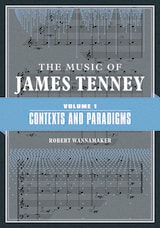
The Music of James Tenney
Volume 1: Contexts and ParadigmsRobert Wannamaker
University of Illinois Press, 2021
Robert Wannamaker's monumental two-volume study explores the influential music and ideas of American composer, theorist, writer, performer, and educator James Tenney. Delving into the whole of Tenney's far-ranging oeuvre, Wannamaker provides in-depth, aurally grounded analyses of works linked to the artist's revolutionary theories of musical form, timbre, and harmonic perception.
Volume 1, Contexts and Paradigms, chronologically surveys Tenney's creative development and output. Wannamaker begins each section with biographical, aesthetic, and technical context that illuminates a distinct period in Tenney's career. From there, he analyzes a small number of pieces that illuminate the concerns, characteristics, and techniques that emerged in Tenney's music during that time. Wannamaker supplements the text with musical examples, graphs, and diagrams while also drawing on unpublished material and newly available primary sources to flesh out each work and the ideas that shaped it.
A landmark in experimental music scholarship, The Music of James Tenney is a first-of-its-kind consideration of the experimental music titan and his work.
The Music of James Tenney
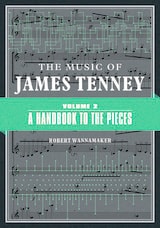
Volume 2: A Handbook to the PiecesRobert Wannamaker
University of Illinois Press, 2021
Robert Wannamaker's monumental two-volume study explores the influential music and ideas of American composer, theorist, writer, performer, and educator James Tenney. Delving into the whole of Tenney's far-ranging oeuvre, Wannamaker offers close, aurally grounded analyses of works linked to the artist's revolutionary theories of musical form, timbre, and harmonic perception.
Written as a reference work, Volume 2, A Handbook to the Pieces, presents detailed entries on Tenney's significant post-1959 experimental works (excepting pieces covered in volume 1). Wannamaker includes technical information, an analysis of intentions and goals, graphs and musical examples, historical and biographical context, and thoughts from Tenney and others on specific works. Throughout, he discusses the striking compositional ideas found in Tenney's music and, where appropriate, traces an idea's appearance from one piece to the next to reveal the evolution of the composer's art and thought.
A landmark in experimental music scholarship, The Music of James Tenney is a first-of-its-kind consideration of the experimental music titan and his work.
The Philosophy of Improvisation
Gary Peters
University of Chicago Press, 2009
Improvisation is usually either lionized as an ecstatic experience of being in the moment or disparaged as the thoughtless recycling of clichés. Eschewing both of these orthodoxies, The Philosophy of Improvisation ranges across the arts—from music to theater, dance to comedy—and considers the improvised dimension of philosophy itself in order to elaborate an innovative concept of improvisation.
Gary Peters turns to many of the major thinkers within continental philosophy—including Heidegger, Nietzsche, Adorno, Kant, Benjamin, and Deleuze—offering readings of their reflections on improvisation and exploring improvisational elements within their thinking. Peters’s wry, humorous style offers an antidote to the frequently overheated celebration of freedom and community that characterizes most writing on the subject. Expanding the field of what counts as improvisation, The Philosophy of Improvisation will be welcomed by anyone striving to comprehend the creative process.
The Race of Sound
Listening, Timbre, and Vocality in African American MusicNina Sun Eidsheim
Duke University Press, 2018
The Rhythmic Structure of Music
Grosvenor Cooper and Leonard B. Meyer
University of Chicago Press, 1963
"This is a path-breaking work, important alike to music students and teachers, but it will make profitable reading for performers, too."—New York Times Book Review
"When at some future time theories of rhythm . . . are . . . as well understood, and as much discussed as theories of harmony and counterpoint . . . they will rest in no small measure on the foundations laid by Cooper and Meyer in this provocative dissertation on the rhythmic structure of music."—Notes
". . . . a significant, courageous and, on the whole, successful attempt to deal with a very controversial and neglected subject. Certainly no one who takes the time to read it will emerge from the experience unchanged or unmoved."—Journal of Music Theory
The late GROSVENOR W. COOPER, author of Learning to Listen, was professor of music at the University of California at Santa Cruz.
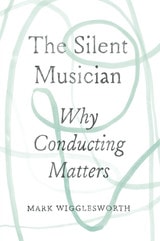
The Silent Musician
Why Conducting MattersMark Wigglesworth
University of Chicago Press, 2019
The Silent Musician deepens our understanding of what conductors do and why they matter. Neither an instruction manual for conductors, nor a history of conducting, the book instead explores the role of the conductor in noiselessly shaping the music that we hear. Writing in a clever, insightful, and often evocative style, world-renowned conductor Mark Wigglesworth deftly explores the philosophical underpinnings of conducting—from the conductor’s relationship with musicians and the music, to the public and personal responsibilities conductors face—and examines the subtler components of their silent art, which include precision, charisma, diplomacy, and passion. Ultimately, Wigglesworth shows how conductors—by simultaneously keeping time and allowing time to expand—manage to shape ensemble music into an immersive, transformative experience, without ever making a sound.
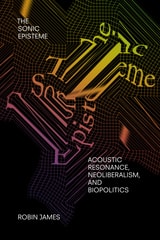
The Sonic Episteme
Acoustic Resonance, Neoliberalism, and BiopoliticsRobin James
Duke University Press, 2019
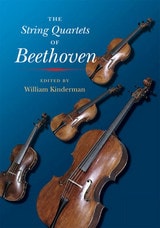
The String Quartets of Beethoven
Edited by William Kinderman
University of Illinois Press, 2020
The The Theoretical-Practical Elements of Music, Parts III and IV
Francesco Galeazzi Translated with an Introductin and Commentary by Deborah Burton and Gregory W. Harwood
University of Illinois Press, 2012
This volume offers an unprecedented English translation of the second volume of Elementi teorico-practici di musica, with annotations and commentary. The translation is introduced with a study of Galeazzi's life and milieu, the genesis and sources for the Elementi, and its reception through the present day.

The Why of Music
Dialogues in an Unexplored Region of AppreciationDonald N. Ferguson
University of Minnesota Press, 1969
The Why of Music was first published in 1969. Minnesota Archive Editions uses digital technology to make long-unavailable books once again accessible, and are published unaltered from the original University of Minnesota Press editions.
In his many tears of teaching and writing about music Professor Ferguson has given much thought to the question of the why of music — why does music affect us as it does, why are we deeply moved by some music by not by other music, what is it about music that "sends" us, and where does it send us? In this book he explores such questions in depth and provides intriguing answers. The discussions are presented in the form of dialogues between the author and several friends.
As Professor Ferguson explains, the book is intended to take the reader on a guided tour, a tour which follows, in part, the familiar roads of formal music appreciation but which leads more often into byways where, almost hidden by the brilliant Hows that line the more familiar roads, lurks the essential Why of music. He describes this Why as the fertilizing commerce between music and human experience—a portrayal, not of the tangible facts of experience, but of the concern aroused by our encounter with those facts. He explains that while avant-garde abstractionism is concerned only with music as art—a concern too specialized for the general music lover to grasp and too narrow to sustain interest—the Why of enduring music lies in its endeavor to portray experience as it lives in Everyman's mind.

Theorizing Music for Antiracist Futures
Key Terms and Critical MethodsEdited by Jade Conlee and Tatiana Koike
University of Michigan Press, 2027
Every day, musicians and teachers use terms like “pitch,” “scale,” and “meter” to describe what music is made of and how it works. But what are the stories behind our musical terminology? Theorizing Music for Antiracist Futures contends that seemingly neutral musical terms are entangled with human histories of oppression and resistance. Bringing together scholars from music theory, ethnomusicology, music history, and popular music studies, the book reads music history alongside critical philosophies of race and ethnic studies to illuminate the power structures that inform musical description and analysis across disciplines. With each chapter focusing on a single musical term, topics covered include: how ancient Greek philosophers used “harmony” to promote peaceful relationships between the ruling class and their subordinates; how sixteenth-century European colonizers perceived Indigenous groups as “dissonant;” and how nineteenth-century scholars measured “pitch” to form now-discredited scientific proof of Europe’s cognitive and musical superiority over its colonized populations. Other chapters take a global perspective, examining theorizations of meter, scale, and musical texture in Japan, Iraq, Malawi, Georgia, and Central Africa. Theorizing Music for Antiracist Futures brings these histories to light and is a crucial volume in creating antiracist futures for music studies.
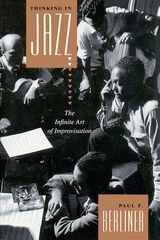
Thinking in Jazz
The Infinite Art of ImprovisationPaul F. Berliner
University of Chicago Press, 1994
The product of more than fifteen years of immersion in the jazz world, Thinking in Jazz combines participant observation with detailed musicological analysis, the author's experience as a jazz trumpeter, interpretations of published material by scholars and performers, and, above all, original data from interviews with more than fifty professional musicians: bassists George Duvivier and Rufus Reid; drummers Max Roach, Ronald Shannon Jackson, and Akira Tana; guitarist Emily Remler; pianists Tommy Flanagan and Barry Harris; saxophonists Lou Donaldson, Lee Konitz, and James Moody; trombonist Curtis Fuller; trumpeters Doc Cheatham, Art Farmer, Wynton Marsalis, and Red Rodney; vocalists Carmen Lundy and Vea Williams; and others. Together, the interviews provide insight into the production of jazz by great artists like Betty Carter, Miles Davis, Dizzy Gillespie, Coleman Hawkins, and Charlie Parker.
Thinking in Jazz overflows with musical examples from the 1920s to the present, including original transcriptions (keyed to commercial recordings) of collective improvisations by Miles Davis's and John Coltrane's groups. These transcriptions provide additional insight into the structure and creativity of jazz improvisation and represent a remarkable resource for jazz musicians as well as students and educators.
Berliner explores the alternative ways—aural, visual, kinetic, verbal, emotional, theoretical, associative—in which these performers conceptualize their music and describes the delicate interplay of soloist and ensemble in collective improvisation. Berliner's skillful integration of data concerning musical development, the rigorous practice and thought artists devote to jazz outside of performance, and the complexities of composing in the moment leads to a new understanding of jazz improvisation as a language, an aesthetic, and a tradition. This unprecedented journey to the heart of the jazz tradition will fascinate and enlighten musicians, musicologists, and jazz fans alike.