Results by title
89 books match the query 'Invention' and 31 start with t
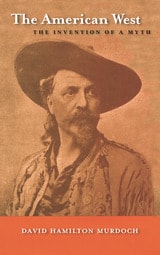
The American West
The Invention Of A MythDavid Hamilton Murdoch
University of Nevada Press, 2001
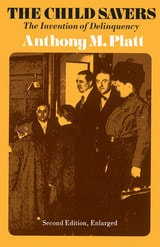
The Child Savers
The Invention of DelinquencyAnthony M. Platt
University of Chicago Press, 1977
In this second, enlarged edition of The Child Savers, the author has added a new introduction and postscript in which he critically reflects upon his original analysis, suggests new ways of thinking about the child-saving movement, and summarizes recent developments in the juvenile justice system.

The Child Savers
The Invention of DelinquencyPlatt, Anthony M
Rutgers University Press, 2009
Focusing on social reformers of the late nineteenth and early twentieth centuries, Platt's principal argument is that the "child savers" movement was not an effort to liberate and dignify youth but, instead, a punitive and intrusive attempt to control the lives of working-class urban adolescents. This expanded edition provides a renewed and distinguished contribution by placing it in historical context through insightful commentaries from cross-disciplinary academics, along with an essay by Miroslava Chávez-García examining how Platt's influential study has impacted many of the central arguments social scientists and historians face today.
The Invention and Gendering of Epicurus
Pamela Gordon
University of Michigan Press, 2012
The school of Greek philosopher Epicurus, which became known as the Garden, famously put great stock in happiness and pleasure. As a philosophical community, and a way of seeing the world, Epicureanism had a centuries-long life in Athens and Rome, as well as across the Mediterranean.
The Invention and Gendering of Epicurusstudies how the Garden's outlook on pleasure captured Greek and Roman imaginations---particularly among non-Epicureans---for generations after its legendary founding. Unsympathetic sources from disparate eras generally focus not on historic personages but on the symbolic Epicurean. And yet the traditions of this imagined Garden, with its disreputable women and unmanly men, give us intermittent glimpses of historical Epicureans and their conceptions of the Epicurean life.
Pamela Gordon suggests how a close hearing and contextualization of anti-Epicurean discourse leads us to a better understanding of the cultural history of Epicureanism. Her primary focus is on sources hostile to the Garden, but her Epicurean-friendly perspective is apparent throughout. Her engagement with ancient anti-Epicurean texts makes more palpable their impact on modern responses to the Garden.
Intended both for students and for scholars of Epicureanism and its response, the volume is organized primarily according to the themes common among Epicurus' detractors. It considers the place of women in Epicurean circles, as well as the role of Epicurean philosophy in Homer and other writers.
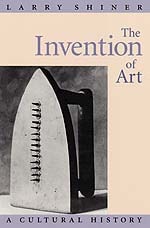
The Invention of Art
A Cultural HistoryLarry Shiner
University of Chicago Press, 2001
With The Invention of Art, Larry Shiner challenges our conventional understandings of art and asks us to reconsider its history entirely, arguing that the category of fine art is a modern invention—that the lines drawn between art and craft resulted from key social transformations in Europe during the long eighteenth century.
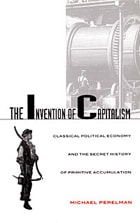
The Invention of Capitalism
Classical Political Economy and the Secret History of Primitive AccumulationMichael Perelman
Duke University Press, 2000
Clearly, they did not go willingly. As Michael Perelman shows, they were forced into the factories with the active support of the same economists who were making theoretical claims for capitalism as a self-correcting mechanism that thrived without needing government intervention. Directly contradicting the laissez-faire principles they claimed to espouse, these men advocated government policies that deprived the peasantry of the means for self-provision in order to coerce these small farmers into wage labor. To show how Adam Smith and the other classical economists appear to have deliberately obscured the nature of the control of labor and how policies attacking the economic independence of the rural peasantry were essentially conceived to foster primitive accumulation, Perelman examines diaries, letters, and the more practical writings of the classical economists. He argues that these private and practical writings reveal the real intentions and goals of classical political economy—to separate a rural peasantry from their access to land.
This rereading of the history of classical political economy sheds important light on the rise of capitalism to its present state of world dominance. Historians of political economy and Marxist thought will find that this book broadens their understanding of how capitalism took hold in the industrial age.
The Invention of Coinage and the Monetization of Ancient Greece
David M. Schaps
University of Michigan Press, 2015
The Invention of Culture
Roy Wagner
University of Chicago Press, 1981
The Invention of Culture
Roy Wagner
University of Chicago Press, 2016
Wagner breaks new ground by arguing that culture arises from the dialectic between the individual and the social world. Rooting his analysis in the relationships between invention and convention, innovation and control, and meaning and context, he builds a theory that insists on the importance of creativity, placing people-as-inventors at the heart of the process that creates culture. In an elegant twist, he shows that this very process ultimately produces the discipline of anthropology itself.
Tim Ingold’s foreword to the new edition captures the exhilaration of Wagner’s book while showing how the reader can journey through it and arrive safely—though transformed—on the other side.
The Invention of Early Christian Discourse, Volume 1
Rhetography, Rhetology, and Storyline in Wisdom, Prophetic, and Apocalyptic RhetorolectVernon K. Robbins
SBL Press, 2026
The Invention of Hebrew
Seth L. Sanders
University of Illinois Press, 2011
Seth L. Sanders connects the Bible's distinctive linguistic form--writing down a local spoken language--to a cultural desire to speak directly to people, summoning them to join a new community that the text itself helped call into being. Addressing the people of Israel through a vernacular literature, Hebrew texts reimagined their audience as a public. By comparing Biblical documents with related ancient texts in Hebrew, Ugaritic, and Babylonian, this book shows Hebrew's distinctiveness as a self-conscious political language. Illuminating the enduring stakes of Biblical writing, Sanders demonstrates how Hebrew assumed and promoted a source of power previously unknown in written literature: "the people" as the protagonist of religion and politics.

The Invention of Heterosexuality
Jonathan Ned Katz
University of Chicago Press, 2007
“Heterosexuality,” assumed to denote a universal sexual and cultural norm, has been largely exempt from critical scrutiny. In this boldly original work, Jonathan Ned Katz challenges the common notion that the distinction between heterosexuality and homosexuality has been a timeless one. Building on the history of medical terminology, he reveals that as late as 1923, the term “heterosexuality” referred to a "morbid sexual passion," and that its current usage emerged to legitimate men and women having sex for pleasure. Drawing on the works of Sigmund Freud, James Baldwin, Betty Friedan, and Michel Foucault, The Invention of Heterosexuality considers the effects of heterosexuality’s recently forged primacy on both scientific literature and popular culture.
“Lively and provocative.”—Carol Tavris, New York Times Book Review
“A valuable primer . . . misses no significant twists in sexual politics.”—Gary Indiana, Village Voice Literary Supplement
“One of the most important—if not outright subversive—works to emerge from gay and lesbian studies in years.”—Mark Thompson, The Advocate
The Invention of Infinite Growth
How Economists Came to Believe a Dangerous DelusionChristopher F. Jones
University of Chicago Press, 2025
Most economists believe that growth is the surest path to better lives. This has proven to be one of humanity’s most powerful and dangerous ideas. It shapes policy across the globe, but it fatally undermines the natural ecosystems necessary to sustain human life. How did we get here? In The Invention of Infinite Growth, environmental historian Christopher F. Jones takes us through two hundred and fifty years of economic thinking to examine the ideal of growth, its powerful influence, and the crippling burdens many decisions made in its name have placed on us all. Jones argues that the pursuit of growth has never reflected its costs, because economists downplay environmental degradation. What’s worse, skyrocketing inequality and diminishing improvements in most people’s well-being mean growth too often delivers too little for too many. Jones urges economists to engage more broadly with other ways of thinking, as well as with citizens and governments to recognize and slow infinite growth’s impact on the real world.
Both accessible and eye-opening, The Invention of Infinite Growth offers hope for the future. Humans have not always believed that economic growth could or should continue, and so it is possible for us to change course. We can still create new ideas about how to promote environmental sustainability, human welfare, and even responsible growth, without killing the planet and ourselves.
The Invention of Madness
State, Society, and the Insane in Modern ChinaEmily Baum
University of Chicago Press, 2018
Focusing on typically marginalized historical actors, including municipal functionaries and the urban poor, The Invention of Madness shifts our attention from the elite desire for modern medical care to the ways in which psychiatric discourses were implemented and redeployed in the midst of everyday life. New meanings and practices of madness, Baum argues, were not just imposed on the Beijing public but continuously invented by a range of people in ways that reflected their own needs and interests. Exhaustively researched and theoretically informed, The Invention of Madness is an innovative contribution to medical history, urban studies, and the social history of twentieth-century China.
The Invention of Order
On the Coloniality of SpaceDon Thomas Deere
Duke University Press, 2025

The Invention of Religion in Japan
Jason Ananda Josephson Storm
University of Chicago Press, 2012
The Invention of Sodomy in Christian Theology
Mark D. Jordan
University of Chicago Press, 1997
"A crucial contribution to our understanding of the tortured and tortuous relationship between men who love men, and the Christian religion—indeed, between our kind and Western society as a whole. . . . The true power of Jordan's study is that it gives back to gay and lesbian people our place in history and that it places before modern theologians and church leaders a detailed history of fear, inconsistency, hatred and oppression that must be faced both intellectually and pastorally."—Michael B. Kelly, Screaming Hyena
"[A] detailed and disturbing tour through the back roads of medieval Christian thought."—Dennis O'Brien, Commonweal
"Being gay and being Catholic are not necessarily incompatible modes of life, Jordan argues. . . . Compelling and deeply learned."—Virginia Quarterly Review

The Invention of World Religions
Or, How European Universalism Was Preserved in the Language of PluralismTomoko Masuzawa
University of Chicago Press, 2005
In this ambitious study, Tomoko Masuzawa examines the emergence of "world religions" in modern European thought. Devoting particular attention to the relation between the comparative study of language and the nascent science of religion, she demonstrates how new classifications of language and race caused Buddhism and Islam to gain special significance, as these religions came to be seen in opposing terms-Aryan on one hand and Semitic on the other. Masuzawa also explores the complex relation of "world religions" to Protestant theology, from the hierarchical ordering of religions typical of the Christian supremacists of the nineteenth century to the aspirations of early twentieth-century theologian Ernst Troeltsch, who embraced the pluralist logic of "world religions" and by so doing sought to reclaim the universalist destiny of European modernity.
The Invention of the Brazilian Northeast
Durval Muniz de Albuquerque Jr.
Duke University Press, 2014
The Invention of the Colonial Americas
Data, Architecture, and the Archive of the Indies, 1781–1844Byron Ellsworth Hamann
J. Paul Getty Trust, The, 2022
The Invention of the Colonial Americas is an architectural history and media-archaeological study of changing theories and practices of government archives in Enlightenment Spain. It centers on an archive created in Seville for storing Spain’s pre-1760 documents about the New World. To fill this new archive, older archives elsewhere in Spain—spaces in which records about American history were stored together with records about European history—were dismembered. The Archive of the Indies thus constructed a scholarly apparatus that made it easier to imagine the history of the Americas as independent from the history of Europe, and vice versa.
In this meticulously researched book, Byron Ellsworth Hamann explores how building layouts, systems of storage, and the arrangement of documents were designed to foster the creation of new knowledge. He draws on a rich collection of eighteenth-century architectural plans, descriptions, models, document catalogs, and surviving buildings to present a literal, materially precise account of archives as assemblages of spaces, humans, and data—assemblages that were understood circa 1800 as capable of actively generating scholarly innovation.
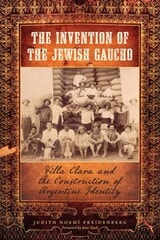
The Invention of the Jewish Gaucho
Villa Clara and the Construction of Argentine IdentityBy Judith Noemí Freidenberg
University of Texas Press, 2009
By the mid-twentieth century, Eastern European Jews had become one of Argentina's largest minorities. Some represented a wave of immigration begun two generations before; many settled in the province of Entre Ríos and founded an agricultural colony. Taking its title from the resulting hybrid of acculturation, The Invention of the Jewish Gaucho examines the lives of these settlers, who represented a merger between native cowboy identities and homeland memories.
The arrival of these immigrants in what would be the village of Villa Clara coincided with the nation's new sense of liberated nationhood. In a meticulous rendition of Villa Clara's social history, Judith Freidenberg interweaves ethnographic and historical information to understand the saga of European immigrants drawn by Argentine open-door policies in the nineteenth century and its impact on the current transformation of immigration into multicultural discourses in the twenty-first century. Using Villa Clara as a case study, Freidenberg demonstrates the broad power of political processes in the construction of ethnic, class, and national identities. The Invention of the Jewish Gaucho draws on life histories, archives, material culture, and performances of heritage to enhance our understanding of a singular population—and to transform our approach to social memory itself.
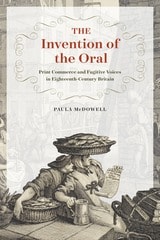
The Invention of the Oral
Print Commerce and Fugitive Voices in Eighteenth-Century BritainPaula McDowell
University of Chicago Press, 2017
Drawing on an impressive array of sources including travel narratives, elocution manuals, theological writings, ballad collections, and legal records, McDowell re-creates a world in which everyone from fishwives to philosophers, clergymen to street hucksters, competed for space and audiences in taverns, marketplaces, and the street. She argues that the earliest positive efforts to theorize "oral tradition," and to depict popular oral culture as a culture (rather than a lack of culture), were prompted less by any protodemocratic impulse than by a profound discomfort with new cultures of reading, writing, and even speaking shaped by print.
Challenging traditional models of oral versus literate societies and key assumptions about culture’s ties to the spoken and the written word, this landmark study reorients critical conversations across eighteenth-century studies, media and communications studies, the history of the book, and beyond.
The Logic of Invention
Roy Wagner
HAU, 2018
Wagner explores what he calls “the reciprocity of perspectives” through a journey between Euro-American bodies of knowledge and his in-depth knowledge of Melanesian modes of thought. This logic grounds variants of the subject/object transformation, as Wagner works through examples such as the figure-ground reversal in Gestalt psychology, Lacan’s theory of the mirror-stage formation of the Ego, and even the self-recursive structure of the aphorism and the joke. Juxtaposing Wittgenstein’s and Leibniz’s philosophy with Melanesian social logic, Wagner explores the cosmological dimensions of the ways in which different societies develop models of self and the subject/object distinction. The result is a philosophical tour de force by one of anthropology’s greatest mavericks.
The Methodical Memory
Invention in Current-Traditional RhetoricSharon Crowley
Southern Illinois University Press, 1990
In this first sustained critique of current-traditional rhetorical theory, Sharon Crowley uses a postmodern, deconstructive reading to reexamine the historical development of current-traditional rhetoric. She identifies it (as well as the British new rhetoric from which it developed) as a philosophy of language use that posits universal principles of mind and discourse. Crowley argues that these philosophies are not appropriate bases for the construction of rhetorical theories, much less guides for the teaching of composition. She explains that current-traditional rhetoric is not a rhetorical theory, and she argues that its use as such has led to a misrepresentation of invention.
Crowley contends that current-traditional rhetoric continues to prosper because a considerable number of college composition teachers—graduate students, part-time instructors, and teachers of literature—are not involved in the development of the curricula they are asked to teach. As a result, their voices, necessary to create any true representation of the composition teaching experience, are denied access to the scholarly conversations evaluating the soundness of the institutionalized teaching methods derived from the current-traditional approach.
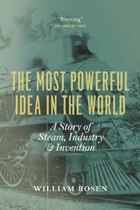
The Most Powerful Idea in the World
A Story of Steam, Industry, and InventionWilliam Rosen
University of Chicago Press, 2012
This bracing history uses the earth-shaking development of the steam engine to show how the very idea of intellectual property was essential to the entire Industrial Revolution.
Hardly a week passes without some high-profile court case that features intellectual property at its center. But how did the belief that one could own an idea come about? And how did that belief change the way humankind lives and works?
William Rosen, author of Justinian's Flea, seeks to answer these questions and more with The Most Powerful Idea in the World. A lively and passionate study of the engineering and scientific breakthroughs that led to the steam engine, this book argues that the very notion of intellectual property drove not only the invention of the steam engine but also the entire Industrial Revolution: history’s first sustained era of economic improvement. To do so, Rosen conjures up an eccentric cast of characters, including the legal philosophers who enabled most the inventive society in millennia, and the scientists and inventors—Thomas Newcomen, Robert Boyle, and James Watt—who helped to create and perfect the steam engine over the centuries. With wit and wide-ranging curiosity, Rosen explores the power of creativity, capital, and collaboration in the brilliant engineering of the steam engine and how this power source, which fueled factories, ships, and railroads, changed human history.
Deeply informative and never dull, Rosen's account of one of the most important inventions made by humans is a rollicking ride through history, with careful scholarship and fast-paced prose in equal measure.
The Rhetorical Turn
Invention and Persuasion in the Conduct of InquiryEdited by Herbert W. Simons
University of Chicago Press, 1990
The Rhetorical Turn moves from biology to politics via excursions into the rhetorics of psychoanalysis, decision science, and conversational analysis. Topics explored include how rhetorical invention guides scientific invention, how rhetoric assists political judgment, and how it integrates varying approaches to meta-theory. Concluding with four philosophical essays, this volume of case studies demonstrates how the inventive and persuasive dimensions of scholarly discourse point the way to forms of argument appropriate to our postmodern age.

The Unlikely Futurist
Pushkin and the Invention of Originality in Russian ModernismJames Rann
University of Wisconsin Press, 2020
Through systematic and detailed readings of Futurist texts, James Rann offers the first book-length study of the tensions between the outspoken literary group and the great national poet. He observes how those in the movement engaged with and invented a new Pushkin, who by turns became a founding father to rebel against, a source of inspiration to draw from, a prophet foreseeing the future, and a monument to revive.
Rann's analysis contributes to the understanding of both the Futurists and Pushkin's complex legacy. The Unlikely Futurist will appeal broadly to scholars of Slavic studies, especially those interested in literature and modernism.

The Unteachables
Disability Rights and the Invention of Black Special EducationKeith A. Mayes
University of Minnesota Press, 2023
How special education used disability labels to marginalize Black students in public schools
The Unteachables examines the overrepresentation of Black students in special education over the course of the twentieth century. As African American children integrated predominantly white schools, many were disproportionately labeled educable mentally retarded (EMR), learning disabled (LD), and emotionally behavioral disordered (EBD). Keith A. Mayes charts the evolution of disability categories and how these labels kept Black learners segregated in American classrooms.
The civil rights and the educational disability rights movements, Mayes shows, have both collaborated and worked at cross-purposes since the beginning of school desegregation. Disability rights advocates built upon the opportunity provided by the civil rights movement to make claims about student invisibility at the level of intellectual and cognitive disabilities. Although special education ostensibly included children from all racial groups, educational disability rights advocates focused on the needs of white disabled students, while school systems used disability discourses to malign and marginalize Black students.
From the 1940s to the present, social science researchers, policymakers, school administrators, and teachers have each contributed to the overrepresentation of Black students in special education. Excavating the deep-seated racism embedded in both the public school system and public policy, The Unteachables explores the discriminatory labeling of Black students, and how it indelibly contributed to special education disproportionality, to student discipline and push-out practices, and to the school-to-prison pipeline effect.

The Wildest Place on Earth
Italian Gardens and the Invention of WildernessJohn Hanson Mitchell
University Press of New England, 2015
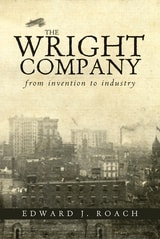
The Wright Company
From Invention to IndustryEdward J. Roach
Ohio University Press, 2014
Fresh from successful flights before royalty in Europe, and soon after thrilling hundreds of thousands of people by flying around the Statue of Liberty, in the fall of 1909 Wilbur and Orville Wright decided the time was right to begin manufacturing their airplanes for sale. Backed by Wall Street tycoons, including August Belmont, Cornelius Vanderbilt III, and Andrew Freedman, the brothers formed the Wright Company. The Wright Company trained hundreds of early aviators at its flight schools, including Roy Brown, the Canadian pilot credited with shooting down Manfred von Richtofen—the “Red Baron”—during the First World War; and Hap Arnold, the commander of the U.S. Army Air Forces during the Second World War. Pilots with the company’s exhibition department thrilled crowds at events from Winnipeg to Boston, Corpus Christi to Colorado Springs. Cal Rodgers flew a Wright Company airplane in pursuit of the $50,000 Hearst Aviation Prize in 1911.
But all was not well in Dayton, a city that hummed with industry, producing cash registers, railroad cars, and many other products. The brothers found it hard to transition from running their own bicycle business to being corporate executives responsible for other people’s money. Their dogged pursuit of enforcement of their 1906 patent—especially against Glenn Curtiss and his company—helped hold back the development of the U.S. aviation industry. When Orville Wright sold the company in 1915, more than three years after his brother’s death, he was a comfortable man—but his company had built only 120 airplanes at its Dayton factory and Wright Company products were not in the U.S. arsenal as war continued in Europe.
Edward Roach provides a fascinating window into the legendary Wright Company, its place in Dayton, its management struggles, and its effects on early U.S. aviation.

The Wright Company
From Invention to IndustryEdward J. Roach
Ohio University Press, 0
But all was not well in Dayton, a city that hummed with industry, producing cash registers, railroad cars, and many other products. The brothers found it hard to transition from running their own bicycle business to being corporate executives responsible for other people’s money. Their dogged pursuit of enforcement of their 1906 patent — especially against Glenn Curtiss and his company — helped hold back the development of the U.S. aviation industry. When Orville Wright sold the company in 1915, more than three years after his brother’s death, he was a comfortable man — but his company had built only 120 airplanes at its Dayton factory and Wright Company products were not in the U.S. arsenal as war continued in Europe.
Edward Roach provides a fascinating window into the legendary Wright Company, its place in Dayton, its management struggles, and its effects on early U.S. aviation.