59 books match the query 'Jewish women' and 13 start with t
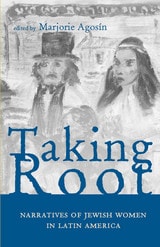
cover of Taking Root: Narratives of Jewish Women in Latin America

Taking Root

Narratives of Jewish Women in Latin America

Marjorie Agosín

Ohio University Press, 2002

In Taking Root, Latin American women of Jewish descent, from Mexico to Uruguay, recall their coming of age with Sabbath candles and Hebrew prayers, Ladino songs and merengue music, Queen Esther and the Virgin of Guadalupe. Rich and poor, Sephardi and Ashkenazi, Jewish immigrant families searched for a new home and identity in predominantly Catholic societies. The essays included here examine the religious, economic, social, and political choices these families have made and continue to make as they forge Jewish identities in the New World.

Marjorie Agosín has gathered narratives and testimonies that reveal the immense diversity of Latin American Jewish experience. These essays, based on first- and second-generation immigrant experience, describe differing points of view and levels of involvement in Jewish tradition. In Taking Root, Agosín presents us with a contemporary and vivid account of the Jewish experience in Latin America.

Taking Root documents the sadness of exile and loss but also a fierce determination to maintain Jewish traditions. This is Jewish history but it is also part of the untold history of Brazil, Argentina, El Salvador, Ecuador, Chile, Peru, and all of Latin America.
[more]
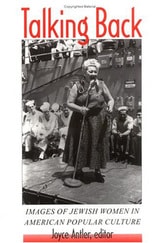
cover of Talking Back: Images of Jewish Women in American Popular Culture

Talking Back

Images of Jewish Women in American Popular Culture

Edited by Joyce Antler

Brandeis University Press, 1998
Fourteen provocative essays challenge traditional notions of Jewish female identity presented in mass media images, films, narrative, and stories by portraying the American Jewish woman not only as subject but as shaper of American popular culture. Sometimes internalizing negative presentations but more often "talking back" to them, Jewish women created alternative images that became tools of rebellion, subverting and dismantling such stereotypes as the "Yiddishe Mama," the Jewish Mother, and the Jewish American Princess. Over the course of the century -- and particularly as a consequence of feminism -- Jewish female novelists, screenwriters, dramatists, entertainers, and grass-roots feminists were able to create new possibilities for the expression of Jewish women's voices.
[more]
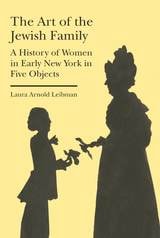
cover of The Art of the Jewish Family: A History of Women in Early New York in Five Objects

The Art of the Jewish Family

A History of Women in Early New York in Five Objects

Laura Arnold Leibman

Bard Graduate Center, 2020

In The Art of the Jewish Family, Laura Arnold Leibman examines five objects owned by a diverse group of Jewish women who all lived in New York in the years between 1750 and 1850: a letter from impoverished Hannah Louzada seeking assistance; a set of silver cups owned by Reyna Levy Moses; an ivory miniature owned by Sarah Brandon Moses, who was born enslaved and became one of the wealthiest Jewish women in New York; a book created by Sarah Ann Hays Mordecai; and a family silhouette owned by Rebbetzin Jane Symons Isaacs. These objects offer intimate and tangible views into the lives of Jewish American women from a range of statuses, beliefs, and lifestyles—both rich and poor, Sephardi and Ashkenazi, slaves and slaveowners.

Each chapter creates a biography of a single woman through an object, offering a new methodology that looks past texts alone to material culture in order to further understand early Jewish American women’s lives and restore their agency as creators of Jewish identity. While much of the available history was written by men, the objects that Leibman studies were made for and by Jewish women. Speaking to American Jewish life, women’s studies, and American history, The Art of the Jewish Family sheds new light on the lives and values of these women, while also revealing the social and religious structures that led to Jewish women being erased from historical archives.

The Art of the Jewish Family was the winner of three 2020 National Jewish Book Awards: the Celebrate 350 Award for American Jewish Studies, the Gerrard and Ella Berman Memorial Award for History, and the Barbara Dobkin Award for Women's Studies. 
 
[more]
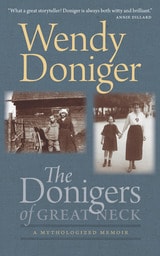
cover of The Donigers of Great Neck: A Mythologized Memoir

The Donigers of Great Neck

A Mythologized Memoir

Wendy Doniger

Brandeis University Press, 2019
“Many memories, many myths”—this is how Wendy Doniger begins the story of her parents’ origins in Europe and sharply bifurcated life in America. Recalling their contrasting attitudes toward Judaism and religion in general—and acknowledging the mythologized narratives that keep bubbling up in those recollections—Doniger tells the story of their childhoods, their unusual marriage, their life in the post–World War II Jewish enclave of Great Neck, New York, and her own complex relationship with each of them.
[more]
cover of The End of Free Love

The End of Free Love

Susan Steinberg

University of Alabama Press, 2003
The End of Free Love evokes the schizophrenia of our times, a community of voices at the zero point. Like the voices that splinter from Marguerite Duras's work, these characters are neurotic, taking refuge in comics, food, music, sex, 'locking' and lies. Violence is everywhere: within, without, in every emotion, in every word. But often hidden emotions rise to the surface, where self-consciousness, shame, and rage, to name a few, are permitted, voiced, and, eventually, set free. Throughout The End of Free Love Steinberg creates a hybrid text, blending poetry and fiction in writing as much about its form as its content. This is fiction that offers itself up for our delight, while remaining as elusive and unpredictable as language itself.
[more]
cover of The Jewish Women of Ravensbrück Concentration Camp

The Jewish Women of Ravensbrück Concentration Camp

Rochelle G. Saidel

University of Wisconsin Press, 2006

    Ravensbrück was the only major Nazi concentration camp for women. Located about fifty miles north of Berlin, the camp was the site of murder by slave labor, torture, starvation, shooting, lethal injection, "medical" experimentation, and gassing.
    While this camp was designed to hold 5,000 women, the actual figure was six times this number. Between 1939 and 1945, 132,000 women from twenty-three countries were imprisoned in Ravensbrück, including political prisoners, Jehovah's Witnesses, "asocials" (including Gypsies, prostitutes, and lesbians), criminals, and Jewish women (who made up about 20 percent of the population). Only 15,000 survived.
    Drawing upon more than sixty narratives and interviews of survivors in the United States, Israel, and Europe as well as unpublished testimonies, documents, and photographs from private archives, Rochelle Saidel provides a vivid collective and individual portrait of Ravensbrück’s Jewish women prisoners. She worked for over twenty years to track down these women whose poignant testimonies deserve to be shared with a wider audience and future generations. Their memoirs provide new perspectives and information about satellite camps (there were about 70 slave labor sub-camps). Here is the story of real daily camp life with the women’s thoughts about food, friendships, fear of rape and sexual abuse, hygiene issues, punishment, work, and resistance. Saidel includes accounts of the women's treatment, their daily struggles to survive, their hopes and fears, their friendships, their survival strategies, and the aftermath.
    On April 30, 1945, the Soviet Army liberated Ravensbrück. They found only 3,000 extremely ill women in the camp, because the Nazis had sent other remaining women on a death march. The Jewish Women of Ravensbrück Concentration Camp reclaims the lost voices of the victims and restores the personal accounts of the survivors.
[more]
cover of The Long Journey of Gracia Mendes

The Long Journey of Gracia Mendes

Marianna D. Birnbaum

Central European University Press, 2003
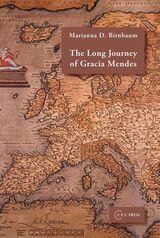
The historical biography of a true Jewish heroine in her day, Gracia Mendes. Born in 1510 in Portugal, the book details this woman's extraordinary personality until her death in 1569 in Constantinople (today's Istanbul). Her life exemplified a perseverance by the Jewish culture to survive and triumph even in the worst of conditions. As a young girl, Gracia secretly married successful Jewish spice trader, Francisco Mendes. But at age 27 she became a widow, yet she went on to raise her children and run the family business all on her own. Her travels led her through Antwerp, Venice, Ferrara, Ragusa, and finally to Constantinople, from where the Ottoman Empire dominated former Byzantium territories and offered shelter for battered Conversos (converted Jews). The text recounting the last fifteen years of Gracia's life at the center of the Empire is particularly revealing. Birnbaum's biography has the unique distinction of being the first among many studies to pay tribute to a woman during this period. It is also one of the first titles to pay equal attention to the lives of the Conversos in Christian West Europe and in the Muslim East.
[more]
cover of The Marital Knot: Agunot in the Ashkenazi Realm, 1648–1850

The Marital Knot

Agunot in the Ashkenazi Realm, 1648–1850

Noa Shashar

Brandeis University Press, 2024

A long overdue study of agunot based on exhaustive research in rabbinic sources, memoirs, and communal records.
 
Noa Shashar sheds light on Jewish family life in the early modern era and on the activity of rabbis whose Jewish legal rulings determined the fate of agunot, literally “chained women,” who were often considered a marginal group. Who were these men and women? How did Jewish society deal with the danger of a woman’s becoming an agunah? What kind of reality was imposed on women who found themselves agunot, and what could they do to extricate themselves from their plight? How did rabbinic decisors discharge their task during this period, and what were the outcomes given the fact that the agunot were dependent on the male rabbinic establishment?
 
This study describes the lives of agunot, and by reexamining the halakhic activity concerning agunot in this period, proposes a new assessment of the attitude that decisors displayed toward the freeing of agunot.
[more]
cover of The Miriam Tradition: Teaching Embodied Torah

The Miriam Tradition

Teaching Embodied Torah

Cia Sautter

University of Illinois Press, 2010
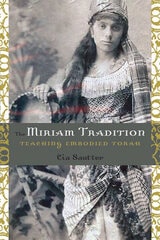
The Miriam Tradition works from the premise that religious values form in and through movement, with ritual and dance developing patterns for enacting those values. Cia Sautter considers the case of Sephardic Jewish women who, following in the tradition of Miriam the prophet, performed dance and music for Jewish celebrations and special occasions. She uses rabbinic and feminist understandings of the Torah to argue that these women, called tanyaderas, "taught" Jewish values by leading appropriate behavior for major life events.
 
Sautter considers the religious values that are in music and dance performed by tanyaderas and examines them in conjunction with written and visual records and evidence from dance and music traditions. Explaining the symbolic gestures and motions encoded in dances, Sautter shows how rituals display deeply held values that are best expressed through the body. The book argues that the activities of women in other religions might also be examined for their embodiment and display of important values, bringing forgotten groups of women back into the historical record as important community leaders
[more]
cover of The Mortal Storm

The Mortal Storm

Phyllis Bottome

Northwestern University Press, 1998
A highly acclaimed anti-fascist novel, The Mortal Storm was Phyllis Bottome's dramatic warning against the warmongering, antisemitism, and misogyny of the Nazis. The story pits the developing political and feminist consciousness of Freya Roth against the Nazi machine that will destroy the fabric of her family and nation. In its combination of adventure and love story, political analysis and history, The Mortal Storm remains a powerful reminder of the greatest crisis of the twentieth century, as well as a riveting personal saga.
[more]
cover of The Song Is Over: A Jewish Girl in Dresden

The Song Is Over

A Jewish Girl in Dresden

Henny Brenner

University of Alabama Press, 2010
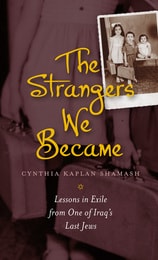
 
A moving story of German Jews saved by the firebombing of Dresden.
February, 1945. After heavy bombing by Allied air forces, Dresden was on fire and in ruins. Ironically, for the few Dresden Jews who had not yet been deported and murdered by the Nazis, the destruction meant rescue. With the Gestapo order for the family to report for deportation still in hand, Henny Wolf Brenner and her parents ran for their lives. They went into hiding and waited for the end of the war. Despite the family’s fears, the Gestapo did not succeed in tracking down the city’s last few Jews, and the family survived.
At the end of the war the Red Army liberated Dresden. But instead of the desired release from terror into a resumption of a peaceful, productive life, different forms of repression awaited Brenner and her parents. In the new communist-run East Germany, she was refused advanced schooling because she was not a Party member. Under the communist regime, it was clear the Jewish population was not welcome, and consequently normal life was impossible. With heavy hearts, the family decided to abandon their beloved home and risk the dangers of flight from East Berlin to West Berlin. With the help of good friends, they were successful in their venture.
[more]
cover of The Strangers We Became: Lessons in Exile from One of Iraq's Last Jews

The Strangers We Became

Lessons in Exile from One of Iraq's Last Jews

Cynthia Kaplan Shamash

Brandeis University Press, 2015
This riveting and utterly unique memoir chronicles the coming of age of Cynthia Shamash, an Iraqi Jew born in Baghdad in 1963. When she was eight, her family tried to escape Iraq over the Iranian border, but they were captured and jailed for five weeks. Upon release, they were returned to their home in Baghdad, where most of their belongings had been confiscated and the door of their home sealed with wax. They moved in with friends and applied for passports to spend a ten-day vacation in Istanbul, although they never intended to return. From Turkey, the family fled to Tel Aviv and then to Amsterdam, where Cynthia’s father soon died of a heart attack. At the age of twelve, Sanuti (as her mother called her) was sent to London for schooling, where she lived in an Orthodox Jewish enclave with the chief rabbi and his family. At the end of the school year, she returned to Holland to navigate her teen years in a culture that was much more sexually liberal than the one she had been born into, or indeed the one she was experiencing among Orthodox Jews in London. Shortly after finishing her schooling as a dentist, Cynthia moved to the United States in an attempt to start over. This vivid, beautiful, and very funny memoir will appeal to readers intrigued by spirituality, tolerance, the personal ramifications of statelessness and exile, the clashes of cultures, and the future of Iraq and its Jews.
[more]
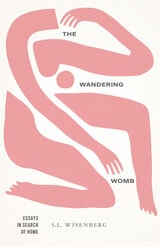
cover of The Wandering Womb: Essays in Search of Home

The Wandering Womb

Essays in Search of Home

S. L. Wisenberg

University of Massachusetts Press, 2023

Even as a fourth-generation Jewish Texan, S. L. Wisenberg has always felt the ghost of Europe dogging her steps, making her feel uneasy in her body and in the world. At age six, she’s sure that she hears Nazis at her bedroom window and knows that after they take her away, she’ll die without her asthma meds. In her late twenties, she infiltrates sorority rush at her alma mater, curious about whether she’ll get a bid now. Later in life, she makes her first and only trip to the mikvah while healing from a breast biopsy (benign this time), prompting an exploration of misogyny, shame, and woman-fear in rabbinical tradition.

With wit, verve, blood, scars, and a solid dose of self-deprecation, Wisenberg wanders across the expanse of continents and combs through history books and family records in her search for home and meaning. Her travels take her from Selma, Alabama, where her Eastern European Jewish ancestors once settled, to Vienna, where she tours Freud’s home and figures out what women really want, and she visits Auschwitz, which—disappointingly—leaves no emotional mark.

[more]