50 books match the query 'Justice, Administration of' and 12 start with t
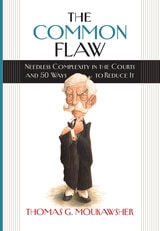
cover of The Common Flaw: Needless Complexity in the Courts and 50 Ways to Reduce It

The Common Flaw

Needless Complexity in the Courts and 50 Ways to Reduce It

Thomas Moukawsher

Brandeis University Press, 2023

A sitting judge makes the compelling argument that we should simplify lawsuits to create a more humane and accessible legal system.
 
Americans are losing faith in their courts. After long delays, judges often get rid of cases for technical reasons, or force litigants to settle rather than issue a decision. When they do decide cases, we can't understand why.
 
The Common Flaw seeks to rid the American lawsuit of this needless complexity. The book proposes fifty changes from the filing of a complaint in court to the drafting of appellate decisions to replace the legal system’s formalism with a kind of humanism. Thomas G. Moukawsher calls for courts that decide cases promptly based more on the facts than the law, that prioritize the parties involved over lawyers, that consider the consequences for the people and the public, and that use words we can all understand. Sure to spark an important conversation about court reform, The Common Flaw makes the case for a more effective and credible legal system with warmth and humor, incorporating cartoons alongside insightful reflection.
[more]
cover of The Death of the American Trial

The Death of the American Trial

Robert P. Burns

University of Chicago Press, 2009

In The Death of the American Trial, distinguished legal scholar Robert P. Burns makes an impassioned case for reversing the rapid decline of the trial before we lose one of our public culture’s greatest achievements. As a practice that is adapted for modern times yet rooted in ancient wisdom, the trial is uniquely suited to balance the tensions—between idealism and realism, experts and citizens, contextual judgment and reliance on rules—that define American culture. Arguing that many observers make a grave mistake by taking a complacent or even positive view of the trial’s demise, Burns concludes by laying out the catastrophic consequences of losing an institution that so perfectly embodies democratic governance.
[more]
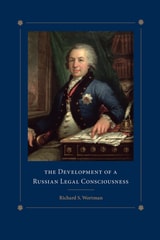
cover of The Development of a Russian Legal Consciousness

The Development of a Russian Legal Consciousness

Richard S. Wortman

University of Chicago Press, 1976
Until the nineteenth century, the Russian legal system was subject to an administrative hierarchy headed by the tsar, and the courts were expected to enforce, not interpret the law. Richard S. Wortman here traces the first professional class of legal experts who emerged during the reign of Nicholas I (1826 – 56) and who began to view the law as a uniquely modern and independent source of authority. Discussing how new legal institutions fit into the traditional system of tsarist rule, Wortman analyzes how conflict arose from the same intellectual processes that produced legal reform. He ultimately demonstrates how the stage was set for later events, as the autocracy and judiciary pursued contradictory—and mutually destructive—goals.
[more]
cover of The History of Indiana Law

The History of Indiana Law

David J. Bodenhamer

Ohio University Press, 2006

Long regarded as a center for middle-American values, Indiana is also a cultural crossroads that has produced a rich and complex legal and constitutional heritage. The History of Indiana Law traces this history through a series of expert articles by identifying the themes that mark the state’s legal development and establish its place within the broader context of the Midwest and nation.

The History of Indiana Law explores the ways in which the state’s legal culture responded to—and at times resisted—the influence of national legal developments, including the tortured history of race relations in Indiana. Legal issues addressed by the contributors include the Indiana constitutional tradition, civil liberties, race, women’s rights, family law, welfare and the poor, education, crime and punishment, juvenile justice, the role of courts and judiciary, and landmark cases. The essays describe how Indiana law has adapted to the needs of an increasingly complex society.

The History of Indiana Law is an indispensable reference and invaluable first source to learn about law and society in Indiana during almost two centuries of statehood.

[more]
cover of The Impossible Machine: A Genealogy of South Africa's Truth and Reconciliation Commission

The Impossible Machine

A Genealogy of South Africa's Truth and Reconciliation Commission

Adam Sitze

University of Michigan Press, 2016

Adam Sitze meticulously traces the origins of South Africa’s Truth and Reconciliation Commission back to two well-established instruments of colonial and imperial governance: the jurisprudence of indemnity and the commission of inquiry. This genealogy provides a fresh, though counterintuitive, understanding of the TRC’s legal, political, and cultural importance. The TRC’s genius, Sitze contends, is not the substitution of “forgiving” restorative justice for “strict” legal justice but rather the innovative adaptation of colonial law, sovereignty, and government. However, this approach also contains a potential liability: if the TRC’s origins are forgotten, the very enterprise intended to overturn the jurisprudence of colonial rule may perpetuate it. In sum, Sitze proposes a provocative new means by which South Africa’s Truth and Reconciliation Commission should be understood and evaluated.
[more]
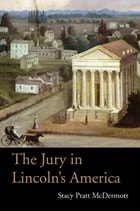
cover of The Jury in Lincoln’s America

The Jury in Lincoln’s America

Stacy Pratt McDermott

Ohio University Press, 2012

In the antebellum Midwest, Americans looked to the law, and specifically to the jury, to navigate the uncertain terrain of a rapidly changing society. During this formative era of American law, the jury served as the most visible connector between law and society. Through an analysis of the composition of grand and trial juries and an examination of their courtroom experiences, Stacy Pratt McDermott demonstrates how central the law was for people who lived in Abraham Lincoln’s America.

McDermott focuses on the status of the jury as a democratic institution as well as on the status of those who served as jurors. According to the 1860 census, the juries in Springfield and Sangamon County, Illinois, comprised an ethnically and racially diverse population of settlers from northern and southern states, representing both urban and rural mid-nineteenth-century America. It was in these counties that Lincoln developed his law practice, handling more than 5,200 cases in a legal career that spanned nearly twenty-five years.

Drawing from a rich collection of legal records, docket books, county histories, and surviving newspapers, McDermott reveals the enormous power jurors wielded over the litigants and the character of their communities.
[more]
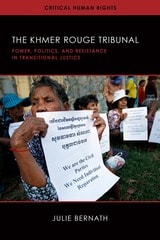
cover of The Khmer Rouge Tribunal: Power, Politics, and Resistance in Transitional Justice

The Khmer Rouge Tribunal

Power, Politics, and Resistance in Transitional Justice

Julie Bernath

University of Wisconsin Press, 2023

From 1975 to 1979, while Cambodia was ruled by the brutal Communist Party of Kampuchea (Khmer Rouge) regime, torture, starvation, rape, and forced labor contributed to the death of at least a fifth of the country’s population. Despite the severity of these abuses, civil war and international interference prevented investigation until 2004, when protracted negotiations between the Cambodian government and the United Nations resulted in the establishment of the Extraordinary Chambers in the Courts of Cambodia (ECCC), or Khmer Rouge tribunal. The resulting trials have been well scrutinized, with many scholars seeking to weigh the results of the tribunal against the extent of the offenses. 

Here, Julie Bernath takes a different tack, deliberately decentering the trials in an effort to understand the ECCC in its particular context—and, by extension, the degree to which notions of transitional justice generally must be understood in particular social, cultural, and political contexts. She focuses on “sites of resistance” to the ECCC, including not only members of the elite political class but also citizens who do not, for a variety of tangled reasons, participate in the tribunal—and even resistance from victims of the regime and participants in the trials. Bernath demonstrates that the ECCC both shapes and is shaped by long-term contestation over Cambodia’s social, economic, and political transformations, and thereby argues that transitional justice must be understood locally rather than as a homogenous good that can be implanted by international actors.
[more]
cover of Total Justice

Total Justice

Lawrence M. Friedman

Russell Sage Foundation, 1985
It is a widely held belief today that there are too many lawsuits, too many lawyers, too much law. As readers of this engaging and provocative essay will discover, the evidence for a "litigation explosion" is actually quite ambiguous. But the American legal profession has become extremely large, and it seems clear that the scope and reach of legal process have indeed increased greatly. How can we best understand these changes? Lawrence Friedman focuses on transformations in American legal culture—that is, people's beliefs and expectations with regard to law. In the early nineteenth century, people were accustomed to facing sudden disasters (disease, accidents, joblessness) without the protection of social and private insurance. The uncertainty of life and the unavailability of compensation for loss were mirrored in a culture of low legal expectations. Medical, technical, and social developments during our own century have created a very different set of expectations about life, again reflected in our legal culture. Friedman argues that we are moving toward a general expectation of total justice, of recompense for all injuries and losses that are not the victim's fault. And the expansion of legal rights and protections in turn creates fresh expectations, a cycle of demand and response. This timely and important book articulates clearly, and in nontechnical language, the recent changes that many have sensed in the American legal system but that few have discussed in so powerful and sensible a way. Total Justice is the third of five special volumes commissioned by the Russell Sage Foundation to mark its seventy-fifth anniversary.
[more]
cover of Transformative Justice: Israeli Identity on Trial

Transformative Justice

Israeli Identity on Trial

Leora Bilsky

University of Michigan Press, 2004
Transformative Justice, Leora Bilsky's landmark study of Israeli political trials, poses this deceptively simple question. The four trials that she analyzes focus on identity, the nature of pluralism, human rights, and the rule of law-issues whose importance extends far beyond Israel's borders. Drawing on the latest work in philosophy, law, history, and rhetoric, Bilsky exposes the many narratives that compete in a political trial and demonstrates how Israel's history of social and ideological conflicts in the courtroom offers us a rare opportunity to understand the meaning of political trials. The result is a bold new perspective on the politics of justice and its complex relationship to the values of liberalism.
[more]
cover of Transitions: Legal Change, Legal Meanings

Transitions

Legal Change, Legal Meanings

Austin Sarat

University of Alabama Press, 2012

Transitions: Legal Change, Legal Meanings illustrates the various intersections, crises, and shifts that continually occur within the law, and how these moments of change interact with and comment on contemporary society.

Together the essays in this volume investigate the transformation of US law during moments of political change and explore what we can learn about law by examining its role and its use in times of transition. Whether by an abrupt shift in regime or an orderly progression from one government to the next, political change often calls into question the stability and versatility of the law, making it appear temporarily absent or in suspension.  What challenges to the law arise at these times? To what extent do transitional periods foster ingenuity and resourcefulness, and how might they precipitate crises in legal authority? What do moments of legal change mean for law itself and how legal institutions bring about and respond to times of transition in legal arrangements? Transitions begins the scholarly exploration of these questions that have largely been neglected.
 
Contributors
Akhil Reed Amar / William L. Andreen /
Jack M. Beermann / Heather Elliott / Joshua
Alexander Geltzer / David Gray / Paul
Horwitz / Daniel H. Joyner / Nina
Mendelson / Meredith Render / Austin
Sarat / Ruti Teitel / Lindsey Ohlsson Worth
[more]
cover of Trial Courts as Organizations

Trial Courts as Organizations

Brian J Ostrom, Charles W Ostrom, Jr., Roger A Hanson and Matthew Kleiman

Temple University Press, 2007

Court administrators and judges have long acknowledged that culture plays an important role in the function of trial courts. Trial Courts as Organizations provides a comprehensive framework for understanding this organizational culture, along with a set of steps and tools to assess and measure the current and preferred culture.

The authors examine how courts operate, what characteristics they may display, and how they function as a unit to preserve judicial independence, strengthen organizational leadership, and influence court performance. They identify four different types of institutional cultures using a systematic analysis of alternative values on how work is done. Each culture is shown to have its own strengths and weaknesses in achieving values, such as timely case resolution, access to court services, and procedural justice. Accordingly, the authors find judges and administrators prefer a definite pattern of different cultures, called a "mosaic," to guide how their courts operate in the future.
[more]
cover of Trust in the Law: Encouraging Public Cooperation with the Police and Courts

Trust in the Law

Encouraging Public Cooperation with the Police and Courts

Tom R. Tyler

Russell Sage Foundation, 2002

Public opinion polls suggest that American's trust in the police and courts is declining. The same polls also reveal a disturbing racial divide, with minorities expressing greater levels of distrust than whites. Practices such as racial profiling, zero-tolerance and three-strikes laws, the use of excessive force, and harsh punishments for minor drug crimes all contribute to perceptions of injustice. In Trust in the Law, psychologists Tom R. Tyler and Yuen J. Huo present a compelling argument that effective law enforcement requires the active engagement and participation of the communities it serves, and argue for a cooperative approach to law enforcement that appeals to people's sense of fair play, even if the outcomes are not always those with which they agree. Based on a wide-ranging survey of citizens who had recent contact with the police or courts in Oakland and Los Angeles, Trust in the Law examines the sources of people's favorable and unfavorable reactions to their encounters with legal authorities. Tyler and Huo address the issue from a variety of angles: the psychology of decision acceptance, the importance of individual personal experiences, and the role of ethnic group identification. They find that people react primarily to whether or not they are treated with dignity and respect, and the degree to which they feel they have been treated fairly helps to shape their acceptance of the legal process. Their findings show significantly less willingness on the part of minority group members who feel they have been treated unfairly to trust the motives to subsequent legal decisions of law enforcement authorities. Since most people in the study generalize from their personal experiences with individual police officers and judges, Tyler and Huo suggest that gaining maximum cooperation and consent of the public depends upon fair and transparent decision-making and treatment on the part of law enforcement officers. Tyler and Huo conclude that the best way to encourage compliance with the law is for legal authorities to implement programs that foster a sense of personal involvement and responsibility. For example, community policing programs, in which the local population is actively engaged in monitoring its own neighborhood, have been shown to be an effective tool in improving police-community relationships. Cooperation between legal authorities and community members is a much discussed but often elusive goal. Trust in the Law shows that legal authorities can behave in ways that encourage the voluntary acceptance of their directives, while also building trust and confidence in the overall legitimacy of the police and courts. A Volume in the Russell Sage Foundation Series on Trust
[more]