Results by title
169 books match the query 'Juvenile Nonfiction' and 23 start with t
Tales of the Wild Horse Desert
By Betty Bailey Colley and Jane Clements Monday
University of Texas Press, 2001
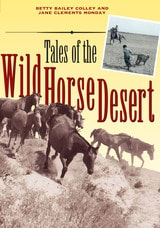
Highly skilled, hard-working, and loyal to each other and to the ranches that employ them, the Mexican and Mexican American vaqueros who work on the famous King and Kenedy Ranches of South Texas' Wild Horse Desert are some of America's best cowboys. Many of them come from families who have lived and worked on the ranches for over a hundred years. They preserve the memories of ranch life handed down by their grandparents and great-grandparents, even as they use modern technologies to keep the ranches running smoothly in the twenty-first century.
This book tells the stories of the vaqueros of the Wild Horse Desert for fourth- through eighth-grade students. It begins with a brief history of the vaqueros and the King and Kenedy Ranches. Then, using in the words of today's vaqueros and their families, it describes many aspects of past and present life on the ranches. Young readers will learn what it's like to grow up on the ranches and how vaqueros learn their work. They'll also discover how much goes into being a vaquero, from using all the different ropes and equipment, to working a round-up, to showing prize-winning cattle and horses. Teachers and parents will appreciate all the supplemental material in the appendix, including a glossary, lists of related books and websites, hands-on learning activities, and even range and camp house recipes.
Teaching Kids To Love The Earth
Marina Lachecki
University of Minnesota Press, 2002
Teaching Kids to Love the Earth is a collection of 186 earth-caring activities designed for use with children of all ages to help them experience and appreciate the earth. This book leads you through the authors’ Sense of Wonder Circle: curiosity, exploration, discovery, sharing, and passion. Each chapter contains a story, instructions for a main activity, suggestions for related activities, and a lsit of additional resources. Teaching Kids to Love the Earth will enable you and the children you work with to experience a “sense of wonder” about the world we share.
Tents, Tigers and the Ringling Brothers
Jerry Apps
Wisconsin Historical Society Press, 2007
The ABCs of Wisconsin Cheese
Susan Apps-Bodilly
Wisconsin Historical Society Press, 2026
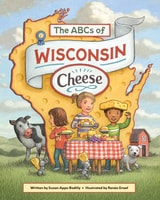
A fun A-to-Z journey through the delicious world of Wisconsin cheese! In The ABCs of Wisconsin Cheese, explore the wonderful world of cheese and the stories and makers behind the food that has made Wisconsin famous—one letter at a time! From the milk that comes from family-owned farms to the award-winning varieties produced across the state, this charming picture book introduces children to the state’s cheese-making traditions in a fun and accessible way.
Written by retired elementary and middle school teacher Susan Apps-Bodilly and beautifully illustrated by Renée Graef, an award-winning artist best known for her work on American Girl books and the My First Little House series, this book pairs playful, engaging artwork with an alphabet of cheese-related facts that educate and entertain. Learn how cheese is made, why curds squeak, and what makes Wisconsin cheeses so special.
Designed for readers ages 5–9 (grades K–3), The ABCs of Wisconsin Cheese is a perfect blend of education and entertainment that will delight children, families, and anyone curious about the state’s cheese-making heritage. The book is a tasty celebration of a beloved food tradition and the Dairy State’s most famous product—cheese!
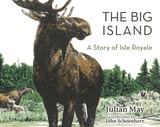
The Big Island
A Story of Isle RoyaleJulian May
University of Minnesota Press, 2021
First published in 1968, this engrossing and beautiful picture book about wildlife on Isle Royale is available again
Isle Royale, “the big island” of this book, is a wilderness national park in Lake Superior and home to a unique and fascinating ecosystem of animals, most notably the iconic wolf and majestic moose. Here is author Julian May’s story about the island’s beginning, the kinds of animals that came to populate it, and their effects on the pristine landscape. Among them were the moose, who swam to the island from the distant shore to fend off starvation. The moose found conditions on Isle Royale so favorable that they reproduced quickly—but then faced another food shortage. The wolves arrived by floating to the island on an ice floe in winter and soon became important to the island’s ecology as successful predators of the moose.
Complementing this fascinating text, John Schoenherr’s magnificent illustrations convey the strength of these animals and the beauty of the island that is their home.
First published in 1968, and reprinted here with a new note by renowned wolf expert L. David Mech, The Big Island is an enchanting introduction to the wilderness and wildlife of Isle Royale.
The Big Picture
A Guide to Finding Your Purpose in LifeChristine B. Whelan
Templeton Press, 2016
“If young adults could be guided in the right direction for a life journey of meaning and purpose, we would be grooming the leaders of tomorrow for a better world. This book is the perfect guide.” —Deepak Chopra, MD, FACP, founder of the Chopra Center for Wellbeing
What am I going to do for the rest of my life?
This question is familiar for young people at a turning point—whether it’s facing the end of high school, college, graduate school, or just a dead-end job. Maybe they have the degree they want but don’t know where to start their job search. Perhaps they’re still choosing a major and, given the range—from “Biochemistry” to “Adventure Education”—are lost in the options. Maybe they’re facing a mountain of debt but don’t want to get locked into a job they hate.
While other books might advise writing resumes or preparing for interviews, they only go so far. Young people want more than just another job—they want a life, and a meaningful one at that.
Enter The Big Picture. Created by the leading authority on self-help research and reviewed by over six hundred college students, Dr. Christine B. Whelan’s The Big Picture offers a guide to discovering one’s talents, dreams, and desires that can lead one to a fulfilling career but fulfilling life. It guides young people to take a step back and look at the “big picture” of who they are, what they want, and why they’re here.
Through quizzes and questionnaires which college students have vetted, Whelan guides the reader through “big picture” questions like,
- What are my talents—and how can I use those to help others and create meaning?
- How have my life experiences shaped who I am and what I can give?
- What do I value—and how can I be happy while being true to those values?
Although there are endless books on finding a job, this is the first book that presents research-based and tested material to help young people answer the question, What will I do with my life? The Big Picture provides the resources needed to find—and live—a purposeful life. An excellent gift for a graduate or a guide for yourself.
The Carter Journals
Time Travels in Early U.S. HistoryShane Phipps
Indiana Historical Society Press, 2014
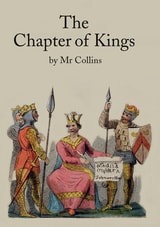
The Chapter of Kings
Mr. Collins
Bodleian Library Publishing, 2005
Poor Edward the Fifth was young killed in his bed
By his uncle, Richard, who was knocked on the head
By Henry the Seventh, who in fame grew big
And Henry the Eighth, who was fat as a pig!
By the time "Mr. Collins" had written this verse, George III, the King of England, had been noticeably missing for seven years—having spent much of the time in his final period of illness at Windsor Castle—and the country had forever lost its American colonies. For many English citizens this dismal period was considered to be the beginning of the end for the British monarchy. The Chapter of Kings, offered here in a facsimile edition, provides a good deal of illustration to that effect.
For the first time since 1818, these charming verses, which were written for children but remain a biting satire ofthe British monarchy, are available for our edification and amusement, each accompanied by hand-drawn "portraits" of England's kings, from Caesar through George, the prince and future king.
Written and illustrated with a keen sense of irony, The Chapter of Kings is a fascinating peek, both for children and parents, into nineteenth-century attitudes toward the royals.
The Death of Socrates
Jean Paul Mongin and Yann Le Bras
Diaphanes, 2015
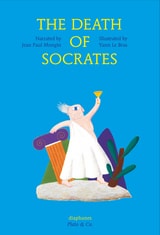
“Tell us, Delphic Oracle, who is the wisest man in all of Greece?” So begins The Death of Socrates. No mortal man is wiser than Socrates, who, on his daily walks through Athens, talks to all the people he meets. When the person he talks to takes himself to be very wise, Socrates asks so many questions that the person ends up admitting he knows nothing. When he runs into people who know little, Socrates sets them on the way to wisdom. But not everyone shares Socrates’s love for the truth. When the people of Athens become angry with him for his ceaseless questioning, how will he find the courage to continue to speak the truth?
Plato & Co.’s clear approach and charming illustrations make this series the perfect addition to any little library.
The Fishermen, the Horse, and the Sea
Barbara Joosse
Wisconsin Historical Society Press, 2021
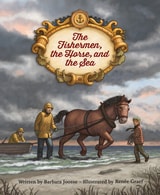
This beautifully illustrated children’s book based on a true story recounts a dramatic rescue on Lake Michigan and introduces young readers to Lester Smith and his family, who founded Port Washington’s long-running and beloved Smith Bros. Fish Shanty. Educational materials including definitions, an illustrated map of Lake Michigan, and short biographies of the story’s featured characters supplement this engaging story for elementary-age readers.
The Ghost of Karl Marx
Ronan de Calan and Donatien Mary
Diaphanes, 2015
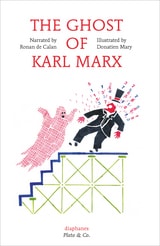
In The Ghost of Karl Marx, the philosopher is saddened when the town weavers must sell their cloth cheaply to compete with machines. The farmers too cannot sell their crops and have no money to buy new seeds. Forced to leave their work, the townspeople form an angry crowd in front of the factories, but what is to be done when there are so many hungry people and so few jobs to pay for food to eat? Concealed in one of the weavers’ sheets, the philosopher makes a solemn vow to give this story a happy ending by finding the Market, that infernal magician, and ridding the town of him once and for all.
Plato & Co.’s clear approach and charming illustrations make this series the perfect addition to any little library.
The Great Peshtigo Fire
Stories and Science from America’s Deadliest FireScott Knickelbine
Wisconsin Historical Society Press, 2012
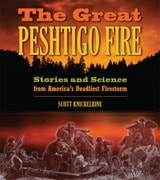
On the night of October 8, 1871, a whirlwind of fire swept through northeastern Wisconsin, destroying the bustling frontier town of Peshtigo. Trees, buildings, and people burst into flames. Metal melted. Sand turned into glass. People thought the end of the world had come. When the “tornado of fire” was over, 2,500 people were dead, and Peshtigo was nothing but a smoking ruin. It was the deadliest wildfire in U.S. history.
The Great Peshtigo Fire: Stories and Science from America’s Deadliest Firestorm explores the history, science, and legacy of the 1871 Peshtigo Fire at a fourth-grade reading level. Readers will learn about the history of settlement, agriculture, and forestry in 19th-century Wisconsin. This illuminating text covers a diverse range of topics that will enrich the reader’s understanding of the Peshtigo Fire, including the building and land-use practices of the time that made the area ripe for such a fire, the weather patterns that fostered widespread fires throughout the upper Midwest in the summer and fall of 1871, and exciting first-person accounts that vividly bring the `victims’ stories to life. Connections made between the Peshtigo Fire and the history of fire prevention in the United States encourage critical thinking about issues that remain controversial to this day, such as planned burns and housing development restrictions near forested areas. The Great Peshtigo Fire: Stories and Science from America’s Deadliest Firestorm will inform and captivate its readers as it journeys through the horrifying history of the Peshtigo Fire.
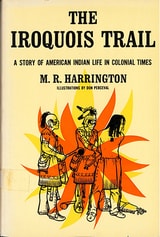
The Iroquois Trail
Dickon among the Onondagas and SenecasM. R. Harrington
Rutgers University Press, 1965
As Dickon and his companions travel the Iroquois Trail in search of his Lenape brother, Little-Bear, they learn the ways of the Onondagas, Senecas, Mohawks, Oneidas, and Cayugas. Dickon tells his own story, describing the day-to-day activities in the villages along the trail—their ways of making clothing, weapons, household articles, and ornaments, and how they hunt, cook, travel, and worship. He meets Hiawatha, Deganawide, Jigonsasay, and other Indian leaders. His tale is accompanied by line drawings that vividly portray the art of making baskets, moccasins, bows and arrows, clothing, and other everday articles. These illustrations are done by Don Perceval, a renowned artist and specialist on Indians.
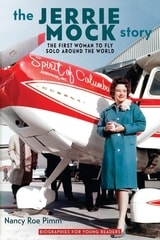
The Jerrie Mock Story
The First Woman to Fly Solo around the WorldNancy Roe Pimm
Ohio University Press, 2016
A Junior Library Guild selection
Society of Children’s Book Writers and Illustrators Official 2016 Summer Reading List
In this biography for middle-grade readers, Nancy Roe Pimm tells the story of Geraldine “Jerrie” Mock, the first woman to fly solo around the world. In her trusty Cessna, The Spirit of Columbus—also known as Charlie—she traveled from Columbus, Ohio, on an eastward route that totaled nearly twenty-three thousand miles and took almost a month. Overcoming wind, ice, mechanical problems, and maybe even sabotage, Mock persevered.
Mock caught the aviation bug at seven years old, when she rode in a Ford Trimotor plane with her parents. In high school, she displayed a talent for math and science, and she was the only woman in her aeronautical engineering classes at Ohio State University. Although she then settled into domestic life, she never lost her interest in flying. What began as a joking suggestion from her husband to fly around the world prompted her to pursue her childhood dream. But the dream became a race, as another woman, Joan Merriam Smith, also sought to be the first to circle the globe.
Even though Mock beat Smith and accomplished what her heroine Amelia Earhart had died trying to do, her feat was overshadowed by the Vietnam War and other world events. Now, Pimm introduces Mock to a new generation of adventurers.
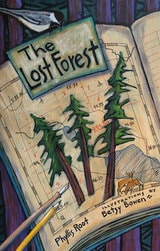
The Lost Forest
Phyllis Root
University of Minnesota Press, 2019
The story of a forest “lost” by a surveying error—and all the flora and fauna to be found there
A forest, of course, doesn’t need a map to know where to grow. But people need a map to find it. And in 1882 when surveyors set out to map a part of Minnesota, they got confused, or tired and cold (it was November), and somehow mapped a great swath of ancient trees as a lake. For more than seventy-five years, the mistake stayed on the map, and the forest remained safe from logging—no lumber baron expects to find timber in a lake, after all.
The Lost Forest tells the story of this lucky error and of the 144 acres of old-growth red and white pine it preserved. With gentle humor, Phyllis Root introduces readers to the men at their daunting task, trekking across Minnesota, measuring and marking the vast land into townships and sections and quarters. She takes us deep into a stand of virgin pine, one of the last and largest in the state, where U.S. history and natural history meet. With the help of Betsy Bowen’s finely observed and beautiful illustrations, she shows us all the life that can be found in the Lost Forest.
Accompanying the story is a wealth of information about the Cadastral Survey and about the plants and animals that inhabit forests—making the book a valuable guide for readers who might want to look even deeper into the history of Minnesota, the flora and fauna of old-growth forests, and the apportioning of land in America.
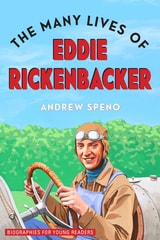
The Many Lives of Eddie Rickenbacker
Andrew Speno
Ohio University Press, 2020
The life story of a daredevil who became a war hero will fascinate adventurous young readers with its tales of survival.
At age thirteen, following the death of his father, young Eddie dropped out of school and joined the workforce. Through a combination of smarts, hard work, and perseverance, Rickenbacker would grow up to become an automobile mechanic, a race car driver, a fighter pilot, an entrepreneur, a war hero, a business executive, and a staunch advocate for hard work and personal responsibility.
Along the way he lived on the line between recklessness and courage. He survived dozens of accidents, coming close to death more than once. During the earliest years of American automobile racing, Rickenbacker was “the most daring and withal the most cautious driver” on the circuit. How could he have been both daring and cautious? This book invites young readers to decide for themselves as they follow Rickenbacker on his many hair-raising adventures.
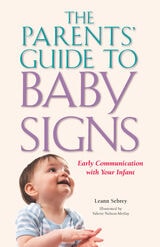
The Parents’ Guide to Baby Signs
Early Communication with Your InfantLeann Sebrey
Gallaudet University Press, 2009
Experienced ASL instructor Leann Sebrey champions two-way sign communication between parents and their infants who are just months old as a way to bond more closely and reduce frustration, while also maximizing the children’s intelligence and emotional quotients.
Sebrey’s book The Parents’ Guide to Baby Signs: Early Communication with Your Infant lays out an easy, step-by-step process that will instill confidence in parents who have never signed before. She begins by explaining why ASL is best for all children, both deaf and hearing. Sebrey also recognizes the different ways young children learn, encouraging parents and caregivers to sign with infants at all times as a natural part of their interaction. She reveals the first indications of when a baby is ready to communicate, and includes a list of signs to provide parents with a good starting point. Sebrey discusses the moments when infants are most receptive to learn signs and outlines numerous practical techniques with plenty of helpful hints to speed the process. She describes the pleasure of seeing a baby’s first sign, and tells parents how to interpret baby signs, including what to do when a baby uses the wrong signs. Full of easy-to-grasp illustrations of child and family-oriented signs, The Parents’ Guide to Baby Signs is the best how-to book for parents, caregivers, and educators to teach early communication to infants.

The Quiet Hero
A Life of Ryan WhiteNelson Price
Indiana Historical Society Press, 2015
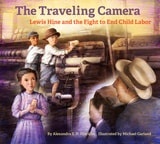
The The Traveling Camera
Lewis Hine and the Fight to End Child LaborAlexandra S. D. Hinrichs
J. Paul Getty Trust, The, 2021
Stunning visuals and poetic text combine to tell the inspiring story of Lewis Hine (1874–1940), a teacher and photographer who employed his art as a tool for social reform. Working for the National Child Labor Committee, Hine traveled the United States, taking pictures of children as young as five toiling under dangerous conditions in cotton mills, seafood canneries, farms, and coal mines. He often wore disguises to sneak into factories, impersonating a machinery inspector or traveling salesman. He said, “If I could tell this story in words, I wouldn’t need to lug a camera.” His poignant pictures attracted national attention and were instrumental in the passage of child labor laws. The Traveling Camera contains extensive back matter, including a time line, original photos, and a bibliography.
Ages six to nine.
Theatre for Youth
Twelve Plays with Mature ThemesEdited by Coleman A. Jennings and Gretta Berghammer
University of Texas Press, 1986
Since the beginning of the theatre-for-youth movement in the United States, the majority of plays written for children have been fairy tales. By the 1960s, however, encouraged by changes in social attitudes toward children, playwrights began to respond to a growing tendency on the parts of both parents and teachers to have children face, rather than avoid, the more difficult truths of existence. Thus children's dramatic literature was opened to new subjects, themes and characters previously considered unsuitable for the young audience.
Theatre for Youth seeks to identify and illustrate this trend by examining twelve plays that deal with mature themes: aging, death and dying, conformity, sexuality, divorce, moral culpability. The plays have been chosen not only for their mature content, but also for their professional integrity, the delicacy with which they handle their subject matter, and their respect for their intended audience.
A foreword by Jed H. Davis, an introduction and summary paragraphs for each play by Jennings and Berghammer, and a lengthy annotated list of suggested plays for further reading or viewing make this volume extremely useful both for directors of children's theatre and for teachers.
They Came to Wisconsin
Julia Pferdehirt
Wisconsin Historical Society Press, 2002
They Came to Wisconsin presents three themes of the state’s immigrant history: leaving the homeland, making the journey, and enduring the first year of settlement. Journal and diary entries and letters from European groups and oral histories from African American, Latino, Hmong, and Amish sources make this book dynamic and wholly inclusive. They Came to Wisconsin breaks fresh ground in presenting document-centered Wisconsin history to a young audience. More important, these firsthand stories add a real human dimension to history, helping students to compare the experiences of the varied groups who came to Wisconsin in the last two hundred years.
Distributed for the Wisconsin Historical Society Press.

Thomas H. Begay and the Navajo Code Talkers
Alysa Landry
Ohio University Press, 2023
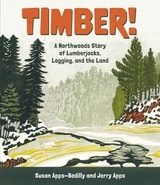
Timber!
A Northwoods Story of Lumberjacks, Logging, and the LandSusan Apps-Bodilly
Wisconsin Historical Society Press, 2024
How did the logging boom begin? What was it like to work in the woods? What happened to the land after the trees were cut down? The latest book for young readers from father-daughter duo Jerry Apps and Susan Apps-Bodilly explores the origin story of Wisconsin’s logging boom, the devastation it caused to the land, and the extraordinary efforts to restore the cutover land and log sustainably.
Timber! helps young readers examine a complex and pivotal chapter in our state and nation’s history, covering a wide range of topics, including:
• how Native people used, shared, and relied on natural resources for thousands of years
• the forced removal of Native people from forested lands
• how the lumber industry made possible the westward expansion of the United States
• what it was like to work in a logging camp, on a log drive, and inside a sawmill
• the roles on a logging team, from sawyer to cook
• the destructive legacy of early logging practices and early efforts to restore the land
• the emergence of sustainable forestry practices
This comprehensive yet easy-to-read history includes letters, postcards, and other primary sources paired with discussion questions designed to engage young readers’ creativity and critical-thinking skills. Timber! also features more than 100 images, a glossary, suggested activities, and an extensive list of related resources, including books, websites, teaching materials, museums, and outdoor places to visit. Timber! will inspire readers of all ages to explore, protect, and learn about trees and forests in their own communities.