Results by title
99 books match the query 'Knowledge, Theory of' and 16 start with t
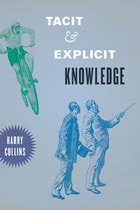
Tacit and Explicit Knowledge
Harry Collins
University of Chicago Press, 2010
Much of what humans know we cannot say. And much of what we do we cannot describe. For example, how do we know how to ride a bike when we can’t explain how we do it? Abilities like this were called “tacit knowledge” by physical chemist and philosopher Michael Polanyi, but here Harry Collins analyzes the term, and the behavior, in much greater detail, often departing from Polanyi’s treatment.
In Tacit and Explicit Knowledge, Collins develops a common conceptual language to bridge the concept’s disparate domains by explaining explicit knowledge and classifying tacit knowledge. Collins then teases apart the three very different meanings, which, until now, all fell under the umbrella of Polanyi’s term: relational tacit knowledge (things we could describe in principle if someone put effort into describing them), somatic tacit knowledge (things our bodies can do but we cannot describe how, like balancing on a bike), and collective tacit knowledge (knowledge we draw that is the property of society, such as the rules for language). Thus, bicycle riding consists of some somatic tacit knowledge and some collective tacit knowledge, such as the knowledge that allows us to navigate in traffic. The intermixing of the three kinds of tacit knowledge has led to confusion in the past; Collins’s book will at last unravel the complexities of the idea.
Tacit knowledge drives everything from language, science, education, and management to sport, bicycle riding, art, and our interaction with technology. In Collins’s able hands, it also functions at last as a framework for understanding human behavior in a range of disciplines.
The Art of Conjecture
Nicholas of Cusa on KnowledgeClyde Lee Miller
Catholic University of America Press, 2021
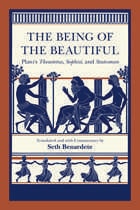
The Being of the Beautiful
Plato's Theaetetus, Sophist, and StatesmanPlato
University of Chicago Press, 1984
“The translations are masterpieces of literalness. . . . They are honest, accurate, and give the reader a wonderful sense of the Greek.”—Drew A. Hyland, Review of Metaphysics
The Company of Words
Hegel, Language, and Systematic PhilosophyJohn McCumber
Northwestern University Press, 1993
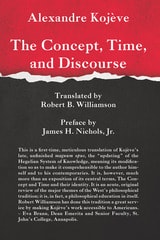
The Concept, Time, and Discourse
Alexandre Kojève
St. Augustine's Press, 2019
Alexandre Kojève (1902–1968) is most widely known in America for his provocative assertion that history is at its end, that is, its completion. In the “practical” sense, this means that the process of historical development can at last be seen (if from a distance) as the realization of the Marxist “universal and homogeneous state.” However, Kojève claimed as well that the history of philosophical thinking had also reached its goal in the transformation of philosophy, as the “love of wisdom” (or the unsatisfied quest for comprehensive knowledge), into that very Wisdom itself and had done so in the most essential respects in the philosophy of Hegel.
The Concept, Time, and Discourse is the first volume of Kojève’s magnum opus, which was to have given an exposition of the (Hegelian) System of Knowledge and of which five volumes were written before his death. It contains, along with a preliminary discussion of the need for an updating of the Hegelian system, the first two of three introductions to the exposition of that system: a First Introduction of the Concept (the integrated totality of what is comprehensible, which is the final object of philosophic inquiry) and a Second Introduction concerning Time, both introductions leading to the (Hegelian) identification of the Concept with Time, an identification which alone takes adequate account of the fact that Philosophy is necessarily discursive (that it must actualize the requirements and essential structure of Discourse).
The present volume offers Kojève’s fullest statement of his Ontology. It includes a critical discussion of the traditional oppositions of the “general” to the “particular” and of the “abstract” to the “concrete” and an analysis of the act of “generalizing abstraction,” which detaches Essence from the Existence of Things. Kojève then discusses the three great figures in the three-stage development of philosophy into wisdom: Parmenides, Plato, and Hegel. Parmenides’ monadic account of Being (= Eternity) rendered it ineffable, thereby reducing philosophy to (non-philosophic) silence; Plato’s dyadic account of Being (as eternal) was intended to make Being a possible subject of discourse but failed to reflect adequately the triadic (and temporally developing) structure which Plato himself discerned in Discourse. Finally, Hegel’s triadic account of Being as itself “dialectical” achieved the final identification of the Concept with Time.
This is a first-time, meticulous translation of Kojève’s late, unfinished magnum opus, the “updating” of the Hegelian System of Knowledge, meaning its modification so as to make it comprehensible to the author himself and to his contemporaries. It is, however, much more than an exposition of its central terms, The Concept and Time and their identity. It is an acute, original review of the major themes of the West’s philosophical tradition; it is, in fact, a philosophical education in itself. Robert Williamson has done this tradition a great service by making Kojève’s work accessible to Americans. – Eva Brann, Dean Emerita and Senior Faculty, St. John’s College, Annapolis, Maryland
We now recognize Alexandre Kojève as one of the central figures of 20th century European philosophy. A translation of his The Concept, Time, and Discourse will enable English speaking readers to have a fuller understanding of his remarkably ambitious intellectual project. – Michael S. Roth, President, Wesleyan University, Middletown, Connecticut.
Robert B. Williamson is Tutor Emeritus at St. John’s College in Annapolis, Maryland, where he continues to teach. He is co-author, with Alfred Mollin, of An Introduction to Ancient Greek (University Press of America) and the author of articles on Plato’s philosophy and Einstein’s early work on relativity theory.
James H. Nichols, Jr. is Professor of Government and Dr. Jules L. Whitehill Professor of Humanism and Ethics at Claremont McKenna College, where he teaches political philosophy. Among his publications are Epicurean Political Philosophy: The De rerum natura of Lucretius, translations with interpretations of Plato’s Gorgias and Phaedrus, and most recently Alexandre Kojève: Wisdom at the End of History.
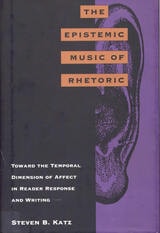
The Epistemic Music of Rhetoric
Toward the Temporal Dimension of Affect in Reader Response and WritingSteven B. Katz
Southern Illinois University Press, 1996
Arguing for an oral theory of Reader Response Criticism, Steven B. Katz conducts a philosophical investigation into the possibility and desirability of teaching reading and writing as rhetorical music.
In the course of this investigation, Katz deals with New Physics, the sophists, Cicero, orality, epistemology, voice, writing, temporality, and sound. He demonstrates that Reader Response Criticism—as part of a new sophistic that has entered the mainstream of pedagogy and practice in our culture—parallels the philosophy of science engendered by the Copenhagen school of New Physics, which theoretically holds that knowledge of subatomic phenomena is probable, relative, contingent, and uncertain, thus requiring more nonformalistic, nonrationalistic methods in understanding and reconstructing it; Katz shows how the same methods are required in the study of affect in reading and writing. Katz also demonstrates that, like New Physics, Reader Response Criticism, in its commitment to interpretation as the primary function and goal of writing about literature, must remain somewhat committed to the formalistic, rationalistic epistemology it seeks to redress.
Basing his oral theory of Reader Response Criticism on notions of language as physical, sensuous, and musical and understanding reception as participatory performance rather that interpretation, Katz suggests a way to reconceptualize Reader Response Criticism. He accounts for "voice," "felt sense," "dissonance," and aesthetic response generally as it is created by the temporal, musical patterns of language, noting that the physical, musical dimension of language has been relatively neglected in contemporary movements in rhetoric, composition, and literature.
Thus, set against the relationship between literature and science, especially between Reader Response Criticism and the philosophy of science engendered by New Physics, Katz examines the sophistic and Ciceronian conceptions of rhetoric. He reinterprets Cicero’s rhetorical theory in light of recent revisionist scholarship on the sophists and reevaluates his assigned position in rhetorical history as neo-Aristotelian by focusing on his oral notions of style as epistemic music. In so doing, Katz offers a new interpretation of Cicero within the sophistic tradition.
Discussing the relationship between sophistic and Ciceronian conceptions of style as an oral, physical, nonrational, indirect form of knowledge and viewing philosophical conceptions of language as sensuous, temporal gestalten or "shapes" in consciousness, Katz suggests that response to and performance of the epistemic music of language can supplement analysis and interpretation in the teaching of reading and writing and can provide less formalistic, less rationalistic foundation for a reader response criticism as a new sophistic.
The Fittingness of the Incarnation
Essays in Analytic Thomistic Philosophy and TheologyDavid Braine, David
Catholic University of America Press, 2025
The Foundations of Knowing
Roderick M. Chisholm
University of Minnesota Press, 1982
The Foundations of Knowing was first published in 1982. Minnesota Archive Editions uses digital technology to make long-unavailable books once again accessible, and are published unaltered from the original University of Minnesota Press editions.
This collection of essays on the foundations of empirical knowledge brings together ten of Roderick M. Chisholm's most important papers in epistemology, three of them published for the first time, the others significantly revised and expanded for this edition. The essays in Part I constitute a thoroughgoing defense of foundationalism—the doctrine that our justification for believing always rests upon a self-evident basis. In Part II, Chisholm applies foundationalist principles to various areas within the theory of knowledge, and in part III he presents a history of twentieth-century American epistemology.
"Roderick M. Chisholm's work has been most influential both in the development of epistemology and in the widespread application of his analytic method. I am sure this publication featuring the unification of his views will be of great value to those working on the central issues of philosophy." Hector-Neri Castañeda, Indiana University
Roderick Chisholm is Andrew W. Mellon Professor of the Humanities in the department of philosophy at Brown University. Among his books are Perceiving: A Philosophical Study, Theory of Knowledge, Person and Object,and The First Person (Minnesota, 1981).
The Individual and the Cosmos in Renaissance Philosophy
Ernst Cassirer
University of Chicago Press, 2010
This provocative volume, one of the most important interpretive works on the philosophical thought of the Renaissance, has long been regarded as a classic in its field. Ernst Cassirer here examines the changes brewing in the early stages of the Renaissance, tracing the interdependence of philosophy, language, art, and science; the newfound recognition of individual consciousness; and the great thinkers of the period—from da Vinci and Galileo to Pico della Mirandola and Giordano Bruno. The Individual and the Cosmos in Renaissance Philosophy discusses the importance of fifteenth-century philosopher Nicholas Cusanus, the concepts of freedom and necessity, and the subject-object problem in Renaissance thought.
“This fluent translation of a scholarly and penetrating original leaves little impression of an attempt to show that a ‘spirit of the age’ or ‘spiritual essence of the time’ unifies and expresses itself in all aspects of society or culture.”—Philosophy
The Nature of Scientific Explanation
Jude P. Dougherty
Catholic University of America Press, 2013
The Pedagogy of Wisdom
An Interpretation of Plato's TheaetetusGregory Kirk
Northwestern University Press, 2015
In this interpretive commentary on Theaetetus, Gregory Kirk makes a major contribution to scholarship on Plato by emphasizing the relevance of the interpersonal dynamics between the interlocutors for the interpretation of the dialogue’s central arguments about knowledge. Kirk attends closely to the personalities of the participants in the dialogue, focusing especially on the unique demands faced by a student—in this case, Theaetetus—and the ways in which one can embrace or deflect the responsibilities of learning. Kirk’s approach gives equal consideration to the dual demands of dramatic interpretation and philosophical argument that constitute the unique character of the Platonic text, and he develops an original interpretation of the Theaetetus, concluding that the uncertainty that characterizes wisdom supersedes the certainty of knowledge.
The Politics of Decolonial Investigations
Walter D. Mignolo
Duke University Press, 2021
The Postmodern Condition
A Report on KnowledgeJean-Francois Lyotard
University of Minnesota Press, 1984
The Tacit Dimension
Michael Polanyi
University of Chicago Press, 2009
A classic work in the philosophy of science that changed how we think about knowledge itself
“I shall reconsider human knowledge by starting from the fact that we can know more than we can tell,” writes Michael Polanyi, whose work paved the way for the likes of Thomas Kuhn and Karl Popper. The Tacit Dimension argues that tacit knowledge—tradition, inherited practices, implied values, and prejudgments—is a crucial part of scientific knowledge. As relevant today as it was when it was first published, this volume challenges the assumption that skepticism, rather than established belief, lies at the heart of scientific discovery.
"The reissuing of this remarkable book give us a new opportunity to see how far-reaching—and foundational—Michael Polanyi's ideas are, on some of the age-old questions in philosophy."—Amartya Sen, from the Foreword
Toward a Phenomenological Rhetoric
Writing, Profession, and AltruismBarbara Couture
Southern Illinois University Press, 1998
Current rhetorical and critical theory for the most part separates writing from consciousness and presumes relative truth to be the only possible expressive goal for rhetoric. These presumptions are reflected in our tradition of persuasive rhetoric, which values writing that successfully argues one person’s belief at the expense of another’s. Barbara Couture presents a case for a phenomenological rhetoric, one that values and respects consciousness and selfhood and that restores to rhetoric the possibility of seeking an all-embracing truth through pacific and cooperative interaction.
Couture discusses the premises on which current interpretive theory has supported relative truth as the philosophical grounding for rhetoric, premises, she argues, that have led to constraints on our notion of truth that divorce it from human experience. She then shows how phenomenological philosophy might guide the theory and practice of rhetoric, reanimating its role in the human enterprise of seeking a shared truth. She proposes profession and altruism as two guiding metaphors for the phenomenological activity of "truth-seeking through interaction."
Among the contemporary rhetoricians and philosophers who influence Couture are Pierre Teilhard de Chardin, Martin Buber, Charles Altieri, Charles Taylor, Alasdair Maclntyre, and Jürgen Habermas.
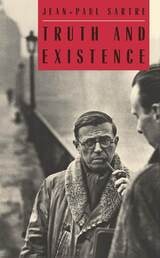
Truth and Existence
Jean-Paul Sartre
University of Chicago Press, 1992
Truth and Existence is introduced by an extended biographical, historical, and analytical essay by Ronald Aronson.
"Truth and Existence is another important element in the recently published links between Sartre's existentialist ontology and his later ethical, political, and literary concerns. . . . The excellent introduction by Aronson will help readers not experienced in reading Sartre."—Choice
"Accompanied by an excellent introduction, this dense, lucidly translated treatise reveals Sartre as a characteristically 20th-century figure."—Publishers Weekly
Jean-Paul Sartre (1906-1980) was offered, but declined, the Nobel Prize for literature in 1964. His many works of fiction, drama, and philosophy include the monumental study of Flaubert, The Family Idiot, and The Freud Scenario, both published in translation by the University of Chicago Press.