Results by title
70 books match the query 'Language Arts' and 7 start with t
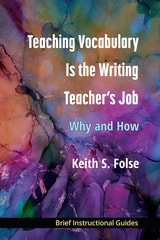
Teaching Vocabulary Is the Writing Teacher's Job
Why and HowKeith S. Folse
University of Michigan Press, 2020
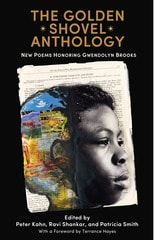
The Golden Shovel Anthology
New Poems Honoring Gwendolyn BrooksPeter Kahn
University of Arkansas Press, 2019
—Claudia Rankine in the New York Times
The Golden Shovel Anthology celebrates the life and work of poet and civil rights icon Gwendolyn Brooks through a dynamic new poetic form, the Golden Shovel, created by National Book Award–winner Terrance Hayes.
An array of writers—including winners of the Pulitzer Prize, the T. S. Eliot Prize, and the National Book Award, as well as a couple of National Poets Laureate—have written poems for this exciting new anthology: Rita Dove, Billy Collins, Danez Smith, Nikki Giovanni, Sharon Olds, Tracy K. Smith, Mark Doty, Sharon Draper, Richard Powers, and Julia Glass are just a few of the contributing poets.
This second edition includes Golden Shovel poems by two winners and six runners-up from an international student poetry competition judged by Nora Brooks Blakely, Gwendolyn Brooks’s daughter. The poems by these eight talented high school students add to Ms. Brooks’s legacy and contribute to the depth and breadth of this anthology.
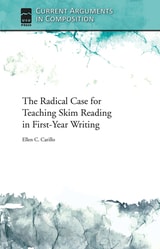
The Radical Case for Teaching Skim Reading in First-Year Writing
Ellen C. Carillo
Utah State University Press, 2025
Data from studies of the lived experiences of undergraduates indicate that students do not need deep reading practices in the majority of their classes across the disciplines and, moreover, that students succeed in their classes by skim reading. Rather than imagining an idealized set of circumstances that allow for sustained deep reading, as does a great deal of the scholarship on reading in writing studies, The Radical Case for Teaching Skim Reading in First-Year Writing argues for teaching students reading practices that will support their success in their college writing assignments rather than those strategies the field believes should support their success.
In our information landscape and our fragile democracy, encouraging skimming as opposed to deep reading may seem like a gamble—this very tendency toward the quick rather than the critical has undoubtedly contributed to the current crisis of mass misinformation. However, teaching students to use skim reading as a strategic tool for purposeful engagement and efficient yet thoughtful information filtering better equips them to navigate the rapidly changing information landscape and manage the fast-paced flow of content from diverse media sources.
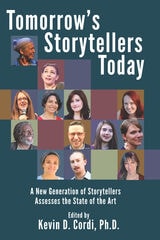
Tomorrow's Storytellers Today
A New Generation of Storytellers Assesses the State of the ArtEdited by Kevin D. Cordi, Ph.D.
Parkhurst Brothers, Inc., 2021
• Charles Parrott on truth claims in storytelling today
• Danielle Bellone on the blending of old forms and new audience concerns
• Alison Bergblom Johnson on the storyteller’s relationship to the story
• Cooper Braun on what works and what doesn’t when telling hard or “dark” stories
• Marie Lupine-Durocher and Petronella van Dijk on what wonder tales teach the next generation of storytellers
• Carolina Quiroga-Stultz on storytelling that starts conversations about frontiers and borders
• And eleven more chapters of stories and examination of the art of storytelling in the current era.
The contributors come from many different storytelling traditions as well as many modern subcultures. Their concerns will be of interest to educators, storytellers, art watchers, and cultural thinkers. There is no other book like Tomorrow’s Storytellers Today.
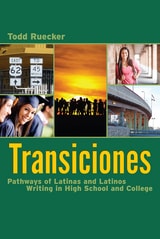
Transiciones
Pathways of Latinas and Latinos Writing in High School and CollegeTodd Ruecker
Utah State University Press, 2015
Transiciones is a thorough ethnography of seven Latino students in transition between high school and community college or university. Data gathered over two years of interviews with the students, their high school English teachers, and their writing teachers and administrators at postsecondary institutions reveal a rich picture of the conflicted experience of these students as they attempted to balance the demands of schooling with a variety of personal responsibilities.
Todd Ruecker explores the disconnect between students’ writing experiences in high school and higher education and examines the integral role that writing plays in college. Considering the almost universal requirement that students take a writing class in their critical first year of college, he contends that it is essential for composition researchers and teachers to gain a fuller understanding of the role they play in supporting and hindering Latina and Latino students’ transition to college.
Arguing for situating writing programs in larger discussions of high school/college alignment, student engagement, and retention, Transiciones raises the profile of what writing programs can do while calling composition teachers, administrators, and scholars to engage in more collaboration across the institution, across institutions, and across disciplines to make the transition from high school to college writing more successful for this important group of students.
Transnational Writing Program Administration
David S. Martins
Utah State University Press, 2014
While local conditions remain at the forefront of writing program administration, transnational activities are slowly and thoroughly shifting the questions we ask about writing curricula, the space and place in which writing happens, and the cultural and linguistic issues at the heart of the relationships forged in literacy work. Transnational Writing Program Administration challenges taken-for-granted assumptions regarding program identity, curriculum and pedagogical effectiveness, logistics and quality assurance, faculty and student demographics, innovative partnerships and research, and the infrastructure needed to support writing instruction in higher education.
Well-known scholars and new voices in the field extend the theoretical underpinnings of writing program administration to consider programs, activities, and institutions involving students and faculty from two or more countries working together and highlight the situated practices of such efforts. The collection brings translingual graduate students at the forefront of writing studies together with established administrators, teachers, and researchers and intends to enrich the efforts of WPAs by examining the practices and theories that impact our ability to conceive of writing program administration as transnational.
This collection will enable writing program administrators to take the emerging locations of writing instruction seriously, to address the role of language difference in writing, and to engage critically with the key notions and approaches to writing program administration that reveal its transnationality.
Twenty-One Genres and How to Write Them
Brock Dethier
Utah State University Press, 2013
In the first section, Dethier efficiently presents each genre, providing models; a description of the genres’ purpose, context, and discourse; and suggestions for writing activities or “moves” that writers can use to get words on the page and accomplish their writing tasks. The second section explains these moves, over two hundred of them, in chapters ranging from “Solve Your Process Problems” and “Discover” to “Revise” and “Present.” Applicable to any writing task or genre, these moves help students overcome writing blocks and develop a piece of writing from the first glimmers of an idea to its presentation.
This approach to managing the complexity and challenge of writing in college strives to be useful, flexible, eclectic, and brief—a valuable resource for students learning to negotiate unfamiliar writing situations.