124 books match the query 'Learning' and 13 start with t
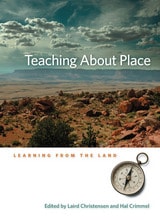
cover of Teaching About Place: Learning From The Land

Teaching About Place

Learning From The Land

Laird Christensen

University of Nevada Press, 2008
The sixteen essays in this anthology describe the practice of teaching about place, with the goal of inspiring educators as well as other readers to discover the value of close investigation of their own places. The contributors discuss places from the desert river canyons of the American West, to the bayous of Texas, to wildlife refuges on the Atlantic Coast, to New England’s forests and river, and back to the wildland-urban interface in suburban Southern California.  These essays reveal broader lessons about the possibilities and limitations that come with teaching about place and inhabiting our own places outside the classroom. Contributors include: Ann Zwinger, Bradley John Monsma, SueEllen Campbell, Terrell Dixon, and John Elder.
[more]
cover of Teaching and Learning in Bilingual Classrooms: New Scholarship

Teaching and Learning in Bilingual Classrooms

New Scholarship

Kristin J. Mulrooney

Gallaudet University Press, 2014

A new initiative known as the Scholarship of Teaching and Learning (SoTL) strives to improve education today by methodically examining and assessing the vital component of classroom interaction. This collection presents research by five professors who adopted SoTL methodology to study their own classrooms at Gallaudet University, a uniquely diverse bilingual institution that employs both American Sign Language (ASL) and written English. The Gallaudet study, called the GSTLI, intended to create an engaged learning community that investigated, reflected upon, and documented strategies that most effectively enhance learning for linguistically diverse, visually oriented populations.

     After extensive SoTL training, the GSTLI professors reviewed interaction in their respective classrooms. Through meticulous study of class videos and written assignments in three General Studies Requirements courses for first-year students, the teachers learned how to ensure connecting with students who have a variety of language differences and communication methods.

     The other professors assessed bottlenecks in classes on the linguistic structure of ASL, and on criminal justice. The linguistics professor identified the bottleneck as the students’ inability to conceptualize the interrelationship between definitions and examples, a fundamental skill to scientific thinking. In the criminal justice class, the professor saw the need to guide students through linguistic bottlenecks by providing materials in both ASL and English. The successes of the GSTLI presented in this unique volume can benefit other teachers by better preparing them to meet the needs of bilingual diverse learners in more effective ways.
[more]
cover of Teaching and Learning in Jewish Day Schools

Teaching and Learning in Jewish Day Schools

Edited by Jonathan B. Krasner, Jon A. Levisohn, and Sharon Avni

Brandeis University Press, 2025

Examines how day schools are educating diverse Jewish youth in a variety of content areas.
 
Teaching and Learning in Jewish Day Schools offers an important analysis of Jewish day school classrooms today. In light of difficulties initiating, evaluating, and sustaining educational innovation, this volume takes stock of what is happening among students and teachers in contemporary Jewish day school classrooms. The authors of this volume confront and question several bedrock principles of Jewish education to address how day schools intersect with broader societal issues including race and gender. They point to themes and topics that scholars and practitioners are grappling with to explore new potential pathways to evaluating student learning and learning outcomes: assessing core subject areas; understanding the ways social and environmental factors contribute to learning; and studying how race, ethnicity, class, and gender shape student learning and school culture. The chapters address topics relevant to educators working in contemporary Jewish day schools including Zionism, the outcomes of Israel education, Jewish engagement, the experience of Latinx students, community building, and more.
[more]
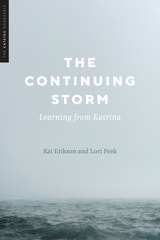
cover of The Continuing Storm: Learning from Katrina

The Continuing Storm

Learning from Katrina

Kai Erikson and Lori Peek

University of Texas Press, 2022

2023 Finalist, Colorado Book Awards, History/Biography Category

This final volume in the award-winning Katrina Bookshelf series reflects upon the lessons of Hurricane Katrina and what they reveal about our society and current cultural climate.

More than fifteen years later, Hurricane Katrina maintains a strong grip on the American imagination. The reason is not simply that Katrina was an event of enormous scale, although it certainly was by any measure one of the most damaging storms in American history. But, quite apart from its lethality and destructiveness, Katrina retains a place in living memory because it is one of the most telling disasters in our recent national experience, revealing important truths about our society and ourselves.

The final volume in the award-winning Katrina Bookshelf series The Continuing Storm reflects upon what we have learned about Katrina and about America. Kai Erikson and Lori Peek expand our view of the disaster by assessing its ongoing impact on individual lives and across the wide-ranging geographies where displaced New Orleanians landed after the storm. Such an expanded view, the authors argue, is critical for understanding the human costs of catastrophe across time and space. Concluding with a broader examination of disasters in the years since Katrina—including COVID-19—The Continuing Storm is a sobering meditation on the duration of a catastrophe that continues to exact steep costs in human suffering.

[more]
cover of The Grounded Instruction Librarian: Participating in The Scholarship of Teaching and Learning

The Grounded Instruction Librarian

Participating in The Scholarship of Teaching and Learning

Melissa Mallon

Assoc of College & Research Libraries, 2019
[more]
cover of The Intellectual Properties of Learning: A Prehistory from Saint Jerome to John Locke

The Intellectual Properties of Learning

A Prehistory from Saint Jerome to John Locke

John Willinsky

University of Chicago Press, 2017

Providing a sweeping millennium-plus history of the learned book in the West, John Willinsky puts current debates over intellectual property into context, asking what it is about learning that helped to create the concept even as it gave the products of knowledge a different legal and economic standing than other sorts of property.
 
Willinsky begins with Saint Jerome in the fifth century, then traces the evolution of reading, writing, and editing practices in monasteries, schools, universities, and among independent scholars through the medieval period and into the Renaissance. He delves into the influx of Islamic learning and the rediscovery of classical texts, the dissolution of the monasteries, and the founding of the Bodleian Library before finally arriving at John Locke, whose influential lobbying helped bring about the first copyright law, the Statute of Anne of 1710. Willinsky’s bravura tour through this history shows that learning gave rise to our idea of intellectual property while remaining distinct from, if not wholly uncompromised by, the commercial economy that this concept inspired, making it clear that today’s push for marketable intellectual property threatens the very nature of the quest for learning on which it rests.

 
[more]
cover of The International Relations of Middle-earth: Learning from The Lord of the Rings

The International Relations of Middle-earth

Learning from The Lord of the Rings

Abigail E. Ruane and Patrick James

University of Michigan Press, 2012

Based on their successful undergraduate course at the University of Southern California, Abigail E. Ruane and Patrick James provide an introduction to International Relations using J. R. R. Tolkien's fantastically popular trilogy The Lord of the Rings. Because Tolkien's major themes---such as good versus evil and human agency versus determinism---are perennially relevant to International Relations, The Lord of the Rings is well suited for application to the study of politics in our own world. This innovative combination of social science and humanities approaches to illustrate key concepts engages students and stimulates critical thinking in new and exciting ways.

[more]
cover of The Lived Experience of Improvisation: In Music, Learning and Life

The Lived Experience of Improvisation

In Music, Learning and Life

Simon Rose

Intellect Books, 2017

Improvisation is crucial to a wide range of artistic activities—most prominently, perhaps, in music, but extending to other fields of experience such as literature and pedagogy. Yet it gets short shrift in both appreciation and analysis of art within education. This is in no small part due to our tendency to view the world in fixed categories and structures that belie our ability to generate creative, groundbreaking responses within and between those structures.
            The Lived Experience of Improvisation draws on an analysis of interviews with highly regarded improvisers, including Roscoe Mitchell, Pauline Oliveros, and George Lewis. Simon Rose also exploits his own experience as a musician and teacher, making a compelling case for bringing back improvisation from the margins. He argues that improvisation is a pervasive aspect of being human and that it should be at the heart of our teaching and understanding of the world.
 
[more]
cover of The Pedagogical Contract: The Economies of Teaching and Learning in the Ancient World

The Pedagogical Contract

The Economies of Teaching and Learning in the Ancient World

Yun Lee Too

University of Michigan Press, 2000
The Pedagogical Contract explores the relationship between teacher and student and argues for ways of reconceiving pedagogy. It discloses this relationship as one that since antiquity has been regarded as a scene of give-and-take, where the teacher exchanges knowledge for some sort of payment by the student and where pedagogy always runs the risk of becoming a broken contract. The book seeks to liberate teaching and learning from this historical scene and the anxieties that it engenders, arguing that there are alternative ways of conceiving the economy underlying pedagogical activities.
Reading ancient material together with contemporary representations of teaching and learning, Yun Lee Too shows that apart from being conceived as a scene of self-interest in which a professional teacher, or sophist, is the charlatan who cheats his pupil, pedagogy might also purport to be a disinterested process of socialization or a scene in which lack and neediness are redeemed through the realization that they are required precisely to stimulate the desire to learn. The author also argues that pedagogy ideally ignores the imperative of the conventional marketplace for relevance, utility, and productivity, inasmuch as teaching and learning most enrich a community when they disregard the immediate material concerns of the community.
The book will appeal to all those who understand scholarship as having an important social and/or political role to play; it will also be of interest to literary scholars, literary and cultural theorists, philosophers, historians, legal theorists, feminists, scholars of education, sociologists, and political theorists.
Yun Lee Too is Assistant Professor of Classics, Columbia University. She is the author of Rethinking Sexual Harassment;The Rhetoric of Identity in Socrates: Text, Power, Pedagogy; and The Idea of Ancient Literary Criticism, forthcoming; and coeditor, with Niall Livingstone, of Pedagogy and Power: Rhetorics of Classical Learning.
[more]
cover of The Spark of Learning: Energizing the College Classroom with the Science of Emotion

The Spark of Learning

Energizing the College Classroom with the Science of Emotion

Sarah Rose Cavanagh

West Virginia University Press, 2016
Historically we have constructed our classrooms with the assumption that learning is a dry, staid affair best conducted in quiet tones and ruled by an unemotional consideration of the facts. The field of education, however, is beginning to awaken to the potential power of emotions to fuel learning, informed by contributions from psychology and neuroscience. In friendly, readable prose, Sarah Rose Cavanagh argues that if you as an educator want to capture your students' attention, harness their working memory, bolster their long-term retention, and enhance their motivation, you should consider the emotional impact of your teaching style and course design. To make this argument, she brings to bear a wide range of evidence from the study of education, psychology, and neuroscience, and she provides practical examples of successful classroom activities from a variety of disciplines in secondary and higher education.
 
[more]
cover of The Spiritual Formation of Seminarians: Learning to Live in Intimate and Unceasing Union with God

The Spiritual Formation of Seminarians

Learning to Live in Intimate and Unceasing Union with God

James Keating

Catholic University of America Press, 2025

In this book, Deacon James Keating provides an opportunity for one spiritual director to introduce his mind to the minds of other directors with the hope that his ideas may season their own already developed method of direction. The book does not attend to all the possible realities a director may encounter within his or her training or within the daily execution of this ministry. The author wishes to share his approach to directing seminarians by reflecting upon themes and experiences which regularly appear within direction sessions. Spiritual direction certainly has some universal components to it. All directors want their directees to internalize a habit of prayer, to choose a life of remaining with God, to suffer the vulnerability necessary to know divine love and to then embody that love as heralds of the Gospel. But each director approaches his or her directees from within their own skin, from within a personality that is unique, and by way of a formation that reflects the unique attractions of each director and his or her own sufferings, failures, and fidelities. These unique embodiments no one writer can know or capture in a book. And so, this book simply begins a conversation that the author invites other directors to enter and add to according to their own insights. The spiritual life of those in seminary occupies the integrating center of a projected life of priestly ministry. Time needed to secure an interior life of prayer is one of the key reasons the Church demands years of formation before the celibate state is entered. Such a state in life is entered as a testimony to the reality that God lives and loves. In light of such love a man enters seminary to discern if he desires to surrender his whole life in response to God sharing His own. To live as a cleric without a vital interior life leaves a man in a state of meaninglessness. Instilling the virtue of prayer during priestly formation can help assure that celibate priesthood retains its inspiration and meaning throughout the life of a priest. Spiritual directors minister to assist a future priest to secure a lifetime habit of prayer so as to secure his commitment to communicate with the living God.
[more]
cover of The Two Ends of the Log: Learning and Teaching in Today’s College

The Two Ends of the Log

Learning and Teaching in Today’s College

Russell Cooper

University of Minnesota Press, 1958

The Two Ends of the Log was first published in 1958. Minnesota Archive Editions uses digital technology to make long-unavailable books once again accessible, and are published unaltered from the original University of Minnesota Press editions.Distinguished professors and administrators from a number of colleges, universities, and related organizations pool their thinking in this volume for an appraisal of college teaching as it stands today and a synthesis of ideals for the improvement of teaching and learning in higher education. The book is based on a series of papers presented at a conference on college teaching held at the University of Minnesota under the sponsorship of the Association of Minnesota Colleges. There are 27 chapters by 24 contributors.The chapters in the first section consider various aspects of the learning process. The subjects discussed include an analysis of learning, the motivation of students’ interest, the gifted student, the use of examinations, student-teacher relations, the stimulation of creativity, and the development of critical thinking and judgment.The second section, which deals with teaching, includes chapters on such subjects as a historical survey of teaching, the role of teaching in relation to technological progress, and artistry in teaching.The final section is devoted to individual methods of teaching, both traditional and new. Among chapter topics are the use of television and other audio-visual methods, student personnel services, and the role of the community in college teaching.In addition to presenting the material based on the major conference addresses, the book also includes the reports of analysts who participated in the conference programs. There is a foreword by James Lewis Morrill, former president of the University of Minnesota.
[more]
cover of The War Against The Beavers: Learning to Be Wild in the North Woods

The War Against The Beavers

Learning to Be Wild in the North Woods

Verena Andermatt Conley

University of Minnesota Press, 2005

A lifelong city dweller, Verena Andermatt Conley had long harbored romantic ideals about the natural world and dreamed of a wilderness retreat for herself and her husband, Tom. When a sizable tract of land along the Vermillion River on the edge of Minnesota's Boundary Waters - complete with two primitive log cabins - became available, they jumped at the chance to own a piece of paradise.The War against the Beavers is a wry and funny account of two people's ten-year apprenticeship in backwoods living, from their arrival as literal babes in the woods to their education in the ways of nature as they face plagues of insects, fungus, storms, and droughts, and embark on a lengthy campaign to eradicate a colony of beavers that threatens the peace and beauty of their forest refuge. It is only the coming of a mechanized and much more menacing threat - bulldozers and other heavy machinery clear-cutting the woods - that restores perspective to the obsessed cabin dwellers.
[more]