Results by title
94 books match the query 'Lessons' and 14 start with t
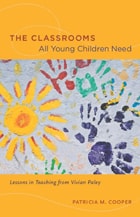
The Classrooms All Young Children Need
Lessons in Teaching from Vivian PaleyPatricia M. Cooper
University of Chicago Press, 2009
Teacher and author Vivian Paley is highly regarded by parents, educators, and other professionals for her original insights into such seemingly everyday issues as play, story, gender, and how young children think. In The Classrooms All Young Children Need, Patricia M. Cooper takes a synoptic view of Paley’s many books and articles, charting the evolution of Paley’s thinking while revealing the seminal characteristics of her teaching philosophy. This careful analysis leads Cooper to identify a pedagogical model organized around two complementary principles: a curriculum that promotes play and imagination, and the idea of classrooms as fair places where young children of every color, ability, and disposition are welcome.
With timely attention paid to debates about the reduction in time for play in the early childhood classroom, the role of race in education, and No Child Left Behind, The Classrooms All Young Children Need will be embraced by anyone tasked with teaching our youngest pupils.
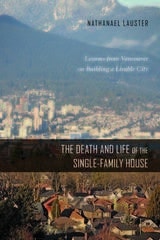
The Death and Life of the Single-Family House
Lessons from Vancouver on Building a Livable CityNathanael Lauster
Temple University Press, 2016
Vancouver today is recognized as one of the most livable cities in the world as well as an international model for sustainability and urbanism. Single-family homes in this city are “a dying breed.” Most people live in the various low-rise and high-rise urban alternatives throughout the metropolitan area.
The Death and Life of the Single-Family House explains how residents in Vancouver attempt to make themselves at home without a house. Local sociologist Nathanael Lauster has painstakingly studied the city’s dramatic transformation to curb sprawl. He tracks the history of housing and interviews residents about the cultural importance of the house as well as the urban problems it once appeared to solve.
Although Vancouver’s built environment is unique, Lauster argues that it was never predestined by geography or demography. Instead, regulatory transformations enabled the city to renovate, build over, and build around the house. Moreover, he insists, there are lessons here for the rest of North America. We can start building our cities differently, and without sacrificing their livability.
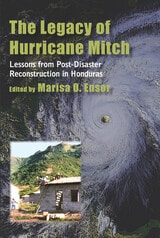
The Legacy of Hurricane Mitch
Lessons from Post-Disaster Reconstruction in HondurasMarisa O. Ensor
University of Arizona Press, 2009
As it swept across the Honduran landscape, the exceptional size, power and duration of Hurricane Mitch abruptly and brutally altered the already diminished economic, social, and environmental conditions of the population. In the aftermath of the disaster a group of seven socio-environmental scientists set out to investigate the root causes of the heightened vulnerability that characterized pre-Mitch Honduras, the impact of the catastrophe on the local society, and the subsequent recovery efforts. Edited by Marisa O. Ensor, this volume presents the findings of their investigation.
The Legacy of Hurricane Mitch offers a comprehensive analysis of the immediate and long-term consequences of Hurricane Mitch in Honduras. Based on longitudinal ethnographic fieldwork and environmental assessments, this volume illustrates the importance of adopting an approach to disaster research and practice that places “natural” trigger events within their political, cultural, and socio-economic contexts. The contributors make a compelling case against post-disaster recovery efforts that limit themselves to alleviating the symptoms, rather than confronting the root causes of the vulnerability that prefigured the disaster.
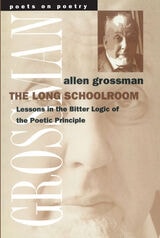
The Long Schoolroom
Lessons in the Bitter Logic of the Poetic PrincipleAllen Grossman
University of Michigan Press, 1997
The jist of what he learned--of what his "lessons" taught him--was (in the sentence of Oliver Wendell Holmes): "Where most men have died, there is the greatest interest." According to Grossman, violence arises not merely from the "barbarian" outside of the culture the poet serves, but from the inner logic of that culture; not, as he would now say, from the defeat of cultural membership but from the terms of cultural membership itself.
Grossman analyzes the "bitter logic of the poetic principle" as it is articulated in exemplary texts and figures, including Bede's Caedmon and Milton. But the heart of The Long Schoolroom is American, ranging from essays on Whitman and Lincoln to an in-depth review of the work of Hart Crane. His final essays probe the example of postmodern Jewish and Christian poetry in this country, most notably the work of Robert Lowell and Allen Ginsburg, as it searches for an understanding of "holiness" in the production and control of violence.
Allen Grossman is author of The Ether Dome and Other Poems: New and Selected, The Sighted Singer: Two Works on Poetry for Readers and Writers (with Mark Halliday), and most recently, The Philosopher's Window. He is Mellon Professor in the Humanities at The Johns Hopkins University.
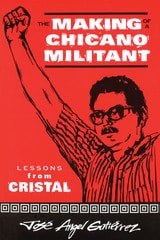
The Making of a Chicano Militant
Lessons from CristalJose Angel Gutierrez
University of Wisconsin Press, 1999
Texas, for years, was a one-party state controlled by white democrats. In 1962, a young eighteen-year-old heard the first rumblings of Chicano community organization in the barrios of Cristal. The rumor in the town was that five Mexican Americans were going to run for all five seats on the city council. But first, poor citizens had to find a way to pay the $1.75 poll tax. Money had to be raised—through bake sales of tamales, cake walks, and dances. So began the political activism of José Angel Gutiérrez.
Gutiérrez's autobiography, The Making of a Chicano Militant, is the first insider's view of the important political and social events within the Mexican American communities in South Texas during the 1960s and 1970s. A controversial and dynamic political figure during the height of the Chicano movement, Gutiérrez offers an absorbing personal account of his life at the forefront of the Mexican-American civil rights movement—first as a Chicano and then as a militant.
Gutiérrez traces the racial, ethnic, economic, and social prejudices facing Chicanos with powerful scenes from his own life: his first summer job as a tortilla maker at the age of eleven, his racially motivated kidnapping as a teenager, and his coming of age in the face of discrimination as a radical organizer in college and graduate school. When Gutiérrez finally returned to Cristal, he helped form the Mexican American Youth Organization and, subsequently the Raza Unida Party to confront issues of ethnic intolerance in his community. His story is soon to be a classic in the developing literature of Mexican American leaders.
The New Chicago Way
Lessons from Other Big CitiesEd Bachrach and Austin Berg
Southern Illinois University Press, 2019
Rather than simply lament the situation, criticize specific leaders, or justify an ideology, Bachrach and Berg compare the decisions about Chicago’s governance and finances with choices made in fourteen other large U.S. cities. The problems that seem unique to Chicago have been encountered elsewhere, and Chicagoans, the authors posit, can learn from the successful solutions other cities have embraced.
Chicago government and its citizens must let go of the past to prepare for the future, argue Bachrach and Berg. A future filled with demographic, technological, and economic change requires a government capable of responding and adapting. Reforms can transform the city. The prescriptions for change provided in this book point toward a hopeful future: the New Chicago Way.
The Politics of Health Care Reform
Lessons from the Past, Prospects for the FutureJames A. Morone and Gary S. Belkin, eds.
Duke University Press, 1994
The Politics of Health Care Reform explains how successful reforms occur in the United States and shows what is unique about health care issues. Theoretically informed, politically astute, historically nuanced, this volume takes an inventory of our health policy infrastructure. Here is an account of the institutions, ideas, and interests that shape health policy in the 1990s: Congress, the federal courts, interest groups, state governments, the public bureaucracy, business (large and small), the insurance industry, the medical profession. The volume offers a fresh look at such critical matters as public opinion, the politics of race and gender, and the lessons we can draw from other nations.
The Politics of Health Care Reform is the definitive collection of political science essays about health care. Expanded from two special issues of the Journal of Health Politics, Policy and Law, the most prominent scholarly journal in the field it helped create, this collection will enliven the present debate over health reform and instruct everyone who is concerned about the future of American health care.
Contributors. Lawrence Brown, Robert Evans, William Glaser, Colleen Grogan, Robert Hackey, Lawrence Jacobs, Nancy Jecker, Taeku Lee, Joan Lehman, David McBride, Ted Marmor, Cathie Jo Martin, James A. Morone, Mark Peterson, David Rochefort, Rand Rosenblatt, David Rothman, Joan Ruttenberg, Mark Schlesinger, Theda Skocpol, Michael Sparer, Deborah Stone, Kenneth Thorpe
The Space Age Generation
Lives and Lessons from the Golden Age of Solar System ExplorationWilliam Sheehan and Klaus Brasch
University of Arizona Press, 2024
At the heart of this momentous time were the men and women working behind the scenes. Scientists, historians, and astronomers share their memories and contributions from this unparalleled era in essays told in their own words. They are the remarkable generation who witnessed and contributed to some of space science’s most stunning achievements. Here they have recorded their memories—their childhood inspirations, their challenges, failures, and triumphs—for future generations.
A unique and authoritative record of a momentous period in human history, The Space Age Generation highlights the golden age of space exploration and the people who made it happen.
Contributors
Leo Aerts
Alexander Basilevsky
Klaus Brasch
Clark R. Chapman
Dale P. Cruikshank
William K. Hartmann
William Leatherbarrow
Baerbel Koesters Lucchitta
Yvonne Pendleton
Peter H. Schultz
William Sheehan
Paolo Tanga
Charles A. Wood
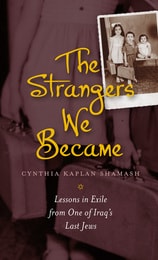
The Strangers We Became
Lessons in Exile from One of Iraq's Last JewsCynthia Kaplan Shamash
Brandeis University Press, 2015
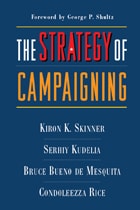
The Strategy of Campaigning
Lessons from Ronald Reagan and Boris YeltsinKiron K. Skinner, Serhiy Kudelia, Bruce Bueno de Mesquita, and Condoleezza Rice
University of Michigan Press, 2010
The Strategy of Campaigning explores the political careers of Ronald Reagan and Boris Yeltsin, two of the most galvanizing and often controversial political figures of our time. Both men overcame defeat early in their political careers and rose to the highest elected offices in their respective countries.
The authors demonstrate how and why Reagan and Yeltsin succeeded in their political aspirations, despite—or perhaps because of—their apparent “policy extremism”: that is, their advocacy of policy positions far from the mainstream. The book analyzes the viability of policy extremism as a political strategy that enables candidates to forge new coalitions and outflank conventional political allegiances.
Bruce Bueno de Mesquita is Julius Silver Professor and Director of the Alexander Hamilton Center for Political Economy at New York University and a Senior Fellow at the Hoover Institution.
Condoleezza Rice is on a leave of absence from Stanford University, where she was a Professor of Political Science and a Senior Fellow at the Hoover Institution. She is currently serving as U.S. Secretary of State.
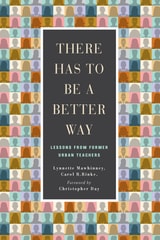
There Has to Be a Better Way
Lessons from Former Urban TeachersMawhinney, Lynnette
Rutgers University Press, 2019
Teacher attrition has long been a significant challenge within the field of education. It is a commonly-cited statistic that almost fifty percent of beginning teachers leave the field within their first five years, to the detriment of schools, students, and their own career development. There Has to be a Better Way offers an essential voice in understanding the dynamics of teacher attrition from the perspective of the teachers themselves. Drawing upon in-depth qualitative research with former teachers from urban schools in multiple regions of the United States, Lynnette Mawhinney and Carol R. Rinke identify several themes that uncover the rarely-spoken reasons why teachers so often willingly leave the classroom. The authors go further to provide concrete recommendations for how school administrators can better support their practicing teachers, as well as how teacher educators might enhance preparation for the next generation of educators. Complete with suggested readings and discussion questions, this book serves as an indispensable resource in understanding and building an effective and productive educational workforce for our nation’s students.

Thunder Tree
Lessons from an Urban WildlandRobert Michael Pyle
Oregon State University Press, 2011
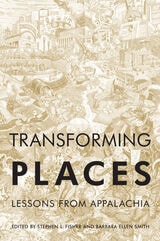
Transforming Places
Lessons from AppalachiaEdited by Stephen L. Fisher and Barbara Ellen Smith
University of Illinois Press, 2012
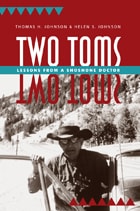
Two Toms
Lessons from a Shoshone DoctorThomas H. Johnson
University of Utah Press, 2011
In 1969, Tom Wesaw was an 83-year-old Shoshone doctor and religious leader on the Wind River Reservation in Wyoming. He could no longer drive, which posed problems in making house calls. The arrival of young anthropologist Tom Johnson changed that. Johnson would drive Wesaw, and cook, pump water, and build fires for sweat lodges. In exchange, the elder Tom would show the younger Tom his work. The two were together so often that the people of Wind River began to refer to them affectionately by one name: Two Toms. By the light of the lamp Wesaw gave him, Johnson would write down what he learned. The Shoshone doctor wanted his student to share everything he saw and heard. Now, in Two Toms: Lessons from a Shoshone Doctor, he has.