Results by title
56 books match the query 'Life Stages' and 13 start with t
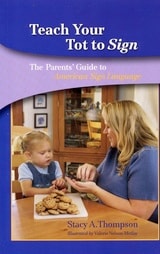
Teach Your Tot to Sign
The Parents' Guide to American Sign LanguageStacy A. Thompson
Gallaudet University Press, 2005
Research has shown that very young children can learn sign language before they learn to speak. Teach Your Tot to Sign: The Parents’ Guide to American Sign Language provides parents and teachers the opportunity to teach more than 500 basic American Sign Language (ASL) signs to their infants, toddlers, and young children. Hearing children, deaf children, and children with special needs can benefit from learning the elementary signs chosen for this handy pocket-size book. Young children who can communicate using simple signs become less frustrated and also bond in a special way with their parents. In teaching ASL to parents of toddlers and preschool teachers, author Stacy A. Thompson recognized the need for a book that could be used at home and in the classroom. Her book features fundamental signs of great appeal to young children and concise instructions on how to sign, including the critical importance of facial expression.
Teach Your Tot to Sign anticipates all of the common desires and interests of young children — food, pets, planes, trains, cars, and boats, games, holidays, vegetables, family — in short, nearly everything. Reflecting children’s endless curiosity, the vocabulary chosen ranges from signs for “baby,” “broken,” “clown,” “dinosaur,” “firefighter,” “gentle,” “hot,” “hurt,” “ketchup,” “pacifier,” “rooster,” “sad,” “spaghetti,” “wagon,” “water,” “wet,” to “you’re welcome,” and even “McDonalds.” This lively assortment of signs will help every child convey earlier in their development their thoughts, feelings, and desires to their parents and teachers.
The Changing Borders of Juvenile Justice
Transfer of Adolescents to the Criminal CourtEdited by Jeffrey Fagan and Franklin E. Zimring
University of Chicago Press, 2000
Research in this area has not kept pace with these legislative developments. There has never been a detailed, sociolegal analytic book devoted to this topic. In this important collection, researchers discuss policy, substantive procedural and empirical dimensions of waivers, and where the boundaries of the courts lie. Part 1 provides an overview of the origins and development of law and contemporary policy on the jurisdiction of adolescents. Part 2 examines the effects of jurisdictional shifts. Part 3 offers valuable insight into the developmental and psychological aspects of current and future reforms.
Contributors: Donna Bishop, Richard Bonnie, M. A. Bortner, Elizabeth Cauffman, Linda Frost Clausel, Robert O. Dawson, Jeffrey Fagan, Barry Feld, Charles Frazier, Thomas Grisso, Darnell Hawkins, James C. Howell, Akiva Liberman, Richard Redding, Simon Singer, Laurence Steinberg, David Tanenhaus, Marjorie Zatz, and Franklin E. Zimring
The Child
An Encyclopedic CompanionRichard A. Shweder, Editor in Chief
University of Chicago Press, 2009
The Child: An Encyclopedic Companion offers both parents and professionals access to the best scholarship from all areas of child studies in a remarkable one-volume reference.
Bringing together contemporary research on children and childhood from pediatrics, child psychology, childhood studies, education, sociology, history, law, anthropology, and other related areas, The Child contains more than 500 articles—all written by experts in their fields and overseen by a panel of distinguished editors led by anthropologist Richard A. Shweder. Each entry provides a concise and accessible synopsis of the topic at hand. For example, the entry “Adoption” begins with a general definition, followed by a detailed look at adoption in different cultures and at different times, a summary of the associated mental and developmental issues that can arise, and an overview of applicable legal and public policy.
While presenting certain universal facts about children’s development from birth through adolescence, the entries also address the many worlds of childhood both within the United States and around the globe. They consider the ways that in which race, ethnicity, gender, socioeconomic status, and cultural traditions of child rearing can affect children’s experiences of physical and mental health, education, and family. Alongside the topical entries, The Child includes more than forty “Imagining Each Other” essays, which focus on the particular experiences of children in different cultures. In “Work before Play for Yucatec Maya Children,” for example, readers learn of the work responsibilities of some modern-day Mexican children, while in “A Hindu Brahman Boy Is Born Again,” they witness a coming-of-age ritual in contemporary India.
Compiled by some of the most distinguished child development researchers in the world, The Child will broaden the current scope of knowledge on children and childhood. It is an unparalleled resource for parents, social workers, researchers, educators, and others who work with children.
The Company We Keep
Interracial Friendships and Romantic Relationships from Adolescence to AdulthoodGrace Kao
Russell Sage Foundation, 2019
While research on interracial social ties has often focused on whites and blacks, Hispanics are the largest minority group and Asian Americans are the fastest growing racial group in the United States. The Company We Keep examines friendships and romantic relationships among blacks, whites, Hispanics, and Asian Americans to better understand the full spectrum of contemporary race relations. Using data from the National Longitudinal Study of Adolescent to Adult Health, the authors explore the social ties of more than 15,000 individuals from their first survey responses as middle and high school students in the mid-1990s through young adulthood nearly fifteen years later. They find that while approval for interracial marriages has increased and is nearly universal among young people, interracial friendships and romantic relationships remain relatively rare, especially for whites and blacks. Black women are particularly disadvantaged in forming interracial romantic relationships, while Asian men are disadvantaged in the formation of any romantic relationships, both as adolescents and as young adults. They also find that people in same-sex romantic relationships are more likely to have partners from a different racial group than are people in different-sex relationships. The authors pay close attention to how the formation of interracial friendships and romantic relationships depends on opportunities for interracial contact. They find that the number of students choosing different-race friends and romantic partners is greater in schools that are more racially diverse, indicating that school segregation has a profound impact on young people’s social ties.
Kao, Joyner, and Balistreri analyze the ways school diversity and adolescent interracial contact intersect to lay the groundwork for interracial relationships in young adulthood. The Company We Keep provides compelling insights and hope for the future of living and loving across racial divides.
The Crisis of School Violence
A New PerspectiveMarianna King
Michigan State University Press, 2020
The Essential Eldercare Handbook for Nevada
Kim Boyer
University of Nevada Press, 2014
Boyer and Shapiro provide Nevada-specific information\--medical, legal, and financial\--on the wide range of problems that arise during the elder years. Case studies show how a typical family copes with troubles such as failing health or financial cares and what options they have. This guide will help any Nevada resident plan for their own senior years and take care of aging parents, spouses, and other loved ones.
The Five Life Decisions
How Economic Principles and 18 Million Millennials Can Guide Your ThinkingRobert T. Michael
University of Chicago Press, 2016
Economist Robert T. Michael won’t tell you what to choose. Instead, he’ll show you how to make smarter choices. Michael focuses on five critical decisions we all face about college, career, partners, health, and parenting. He uses these to demonstrate how the science of scarcity and choice—concepts used to guide major business decisions and shape national legislation—can offer a solid foundation for our own lives. Employing comparative advantage can have a big payoff when picking a job. Knowing how to work the marketplace can minimize uncertainty when choosing a partner. And understanding externalities—the ripple of results from our actions—can clarify the if and when of having children.
Michael also brings in data from the National Longitudinal Survey of Youth, a scientific sample of 18 million millennials in the United States that tracks more than a decade of young adult choices and consequences. As the survey’s longtime principal investigator and project director, Michael shows that the aggregate decisions can help us understand what might lie ahead along many possible paths—offering readers insights about how their own choices may turn out.
There’s no singular formula for always making the right choice. But the adaptable framework and rich data at the heart of The Five Life Decisions will help you feel confident in whatever you decide.
The Last of His Mind
A Year in the Shadow of Alzheimer’sJohn Thorndike
Ohio University Press, 2011
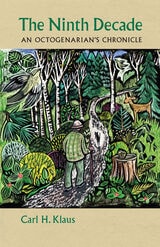
The Ninth Decade
An Octogenarian’s ChronicleKlaus, Carl H.
University of Iowa Press, 2021
The multi-year scope of his chronicle reveals the numerous physical and mental problems that arise during octogenarian life and how eighty-year-olds have dealt with those challenges. The Ninth Decade is a unique, first-hand source of information for anyone in their sixties, seventies, or eighties, as well as for persons devoted to care of the aged. Though the challenges of octogenarian life often require specialized care, The Ninth Decade also shows the pleasures of it to be so special as to have inspired Lillian Hellman’s paradoxical description of “longer life” as “the happy problem of our time.”
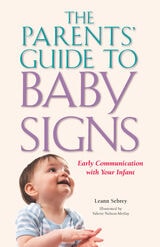
The Parents’ Guide to Baby Signs
Early Communication with Your InfantLeann Sebrey
Gallaudet University Press, 2009
Experienced ASL instructor Leann Sebrey champions two-way sign communication between parents and their infants who are just months old as a way to bond more closely and reduce frustration, while also maximizing the children’s intelligence and emotional quotients.
Sebrey’s book The Parents’ Guide to Baby Signs: Early Communication with Your Infant lays out an easy, step-by-step process that will instill confidence in parents who have never signed before. She begins by explaining why ASL is best for all children, both deaf and hearing. Sebrey also recognizes the different ways young children learn, encouraging parents and caregivers to sign with infants at all times as a natural part of their interaction. She reveals the first indications of when a baby is ready to communicate, and includes a list of signs to provide parents with a good starting point. Sebrey discusses the moments when infants are most receptive to learn signs and outlines numerous practical techniques with plenty of helpful hints to speed the process. She describes the pleasure of seeing a baby’s first sign, and tells parents how to interpret baby signs, including what to do when a baby uses the wrong signs. Full of easy-to-grasp illustrations of child and family-oriented signs, The Parents’ Guide to Baby Signs is the best how-to book for parents, caregivers, and educators to teach early communication to infants.
The Third and Only Way
Reflections on Staying AliveHelen Bevington
Duke University Press, 1996
The unique Bevington way of autobiography recreates lessons and insights of other lives, historical figures, and compelling incidents, and combines them in a narrative that follows the emotional currents of her life. Evoking a wide range of historical and literary figures, including Chekhov, Marcus Aurelius, Flannery O’Connor, Simone de Beauvoir, Thoreau, Beatrix Potter, Sappho, Yeats, Alexander the Great, Montaigne, Saint Cecilia, Virginia Woolf, Liv Ullmann, and many others, Bevington finds in these lives a path that has guided her search away from solitude. Through her reflections on the ten years that followed her son’s death, we become aware of how far she has traveled, how the search has brightened, how she has eloquently evolved into old age. In the end she is sitting, like the Buddha, under her own fig tree, waiting not for death but for further illumination.
An original contemplation of the universal dilemmas and tragedies of existence, The Third and Only Way is at once warm, funny, and inspiring—full of learning and wisdom.
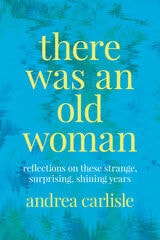
There Was an Old Woman
Reflections on These Strange, Surprising, Shining YearsAndrea Carlisle
Oregon State University Press, 2023
In these personal essays, Carlisle looks for new ways to bring herself more fully to this time of life, such as daily walks with other women and connecting to the natural world that surrounds her houseboat on an Oregon river at the foot of a forest. She writes about experiences shared with many, if not most, older women: wondering at her body’s transformation, discovering new talents, caregiving, facing loss, tuning in to life patterns and drawing strength through understanding them, letting go (or not) of pieces of the past, and facing other changes large and small. Those curious about, approaching, or living in old age will find wisdom and insight in her unique perspective.
In a voice that rings with clarity, humor, humility, Carlisle shows us that Old Age is not another country where we can expect to find The Old Woman grimly waiting, but is instead an expansion of the borders in the country we’re most familiar with: ourselves.
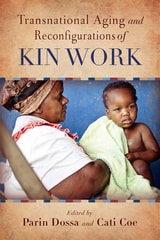
Transnational Aging and Reconfigurations of Kin Work
Dossa, Parin
Rutgers University Press, 2017