Results by title
97 books match the query 'Literature, Modern' and 24 start with t
Textual Silence
Unreadability and the HolocaustLang, Jessica
Rutgers University Press, 2017
Holocaust texts, which encompass works as diverse as memoirs, novels, poems, and diaries, are traditionally characterized by silences the authors place throughout the text, both deliberately and unconsciously. While a reader may have the desire and will to comprehend the Holocaust, the presence of “textual silence” is a force that removes the experience of genocide from the reader’s analysis and imaginative recourse. Lang defines silences as omissions that take many forms, including the use of italics and quotation marks, ellipses and blank pages in poetry, and the presence of unreliable narrators in fiction. While this limits the reader’s ability to read in any conventional sense, these silences are not flaws. They are instead a critical presence that forces readers to acknowledge how words and meaning can diverge in the face of events as unimaginable as those of the Holocaust.
The Big Question
David Lehman
University of Michigan Press, 1995
The Big Question leads off with a major essay explaining and exploring the concept of postmodernism. The next sections include pieces about poetry and fiction, lives and letters, and criticism and controversy.
Other "big questions" addressed include political correctness, the genre of literary biography, academic life and deconstruction. There is a humorous piece on poetry "slams" and the whole "downtown" poetry scene, a feisty op-ed column (on the deconstruction of the Gettysburg Address), a pair of wickedly satirical poems, as well as a group of exceptional book reviews.
The subjects covered range from Philip Larkin to Philip Roth- from the greatest poetry hoax of the twentieth century (which took place in Australia during World War II) to Charles Dickens's unfinished last novel- and from nineteenthth-century American poetry to the political career of Martin Heidegger.
David Lehman is a poet and author of Signs of the Times: Deconstruction and the Fall of Paul de Man. He is series editor of the celebrated Best American Poetry anthology.

The Culture of Violence
Essays on Tragedy and HistoryFrancis Barker
University of Chicago Press, 1993
Central to his argument is the contention that, contrary to post-Enlightenment humanist, liberal and conservative thought, 'culture' does not necessarily stand in opposition to political inequality and social injustice, but may be complicit with the oppressive exercise of power.
The book focuses on Shakespearean tragedy and on the historicism and culturalism of much present-day cultural theory. Barker's analysis moves dialectically backwards and forwards between these two moments in order to illuminate aspects of early modern culture, and to critique the ways in which the complicity between culture and violence has been occluded. Rejecting the tendency of both modernism and post-modernism to homogenise historical time, Barker argues for a genuinely new, 'diacritical' understanding of the violence of history.
The Dismemberment of Orpheus
Toward a Postmodern LiteratureIhab Hassan
University of Wisconsin Press, 1982
In this book, the first edition of which was published in 1971 by Oxford University Press, Ihab Hassan takes Orphic dismemberment and regeneration as his metaphor for a radical crisis in art and language, culture and consciousness, which prefigures postmodern literature. The modern Orpheus, he writes, “sings on a lyre without strings.” Thus, his sensitive critique traces a hypothetical line from Sade through four modern authors—Hemingway, Kafka, Genet, and Beckett—to a literature still to come. But the line also breaks into two Interludes, one concerning ’Pataphysics, Dada, and Surrealism, and the other concerning Existentialism and Aliterature.
Combining literary history, brief biography, and critical analysis, Hassan surrounds these authors with a complement of avant-garde writers whose works also foreshadow the postmodern temper. These include Jarry, Apollinaire, Tzara, Breton, Sartre, Camus, Nathalie Sarraute, Robbe-Grillet, and in America, Cage, Salinger, Ginsberg, Barth, and Burroughs. Hassan takes account also of related contemporary developments in art, music, and philosophy, and of many works of literary theory and criticism.
For this new edition, Hassan has added a new preface and postface on the developing character of postmodernism, a concept which has gained currency since the first edition of this work, and which he himself has done much to theorize.
The Essential Guide to Werewolf Literature
Brian J. Frost
University of Wisconsin Press, 2003
Frost’s analysis encompasses fanciful medieval beliefs, popular works by Victorian authors, scholarly treatises and medical papers, and short stories from pulp magazines of the 1930s and 1940s. Revealing the complex nature of the werewolf phenomenon and its tremendous and continuing influence, The Essential Guide to Werewolf Literature is destined to become a standard reference on the subject.
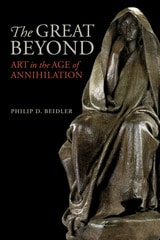
The Great Beyond
Art in the Age of AnnihilationPhilip D. Beidler
University of Alabama Press, 2022
Essays mapping how modern art confronts mortality in an age of war and annihilation.
While much about modernism remains up for debate, there can be no dispute about the connection between modernist art and death. The long modern moment was and is an age of war, genocide, and annihilation. Two world wars killed perhaps as many as 100 million people, through combat, famine, holocaust, and ghastly attacks on civilians. The ongoing COVID-19 pandemic is the fifth global pandemic since 1918, with more than a half-million American deaths and counting.
It can hardly come as a surprise, then, that many of the touchstones of modernism reflect on death and devastation. In Philip D. Beidler’s exploration of the modernist canon, he illuminates how these singular voices looked extinction in the eye and tried to reckon with our finitude—and their own. The Great Beyond: Art in the Age of Annihilation catalogs through lively prose an eclectic selection of artists, writers, and thinkers. In 16 essays, Beidler takes nuanced and surprising approaches to well-studied figures—the haunting sculpture by Saint-Gaudens commissioned by Henry Adams for his late wife; Luchino Visconti’s adaptation of Mann’s Death in Venice; and the author’s own long fascination with Beckett’s Waiting for Godot.
The threads and recurring motifs that emerge through Beidler’s analysis bridge the different media, genres, and timeframes of the works under consideration. Protomodernists Crane and Twain connect with near-contemporary voices like Sebald and Morrison. Robert MacFarlane’s 21st-century nonfiction about what lies underneath the earth echoes the Furerbunker and the poetry of Gertrud Kolmar. Learned but lively, somber but not grim, The Great Beyond is not a comfortable read, but it is in a way comforting. In tracing how his subjects confronted nothingness, be it personal or global, Beidler draws a brilliant map of how we see the end of the road.
The Greening Of Literary Scholarship
Literature, Theory, and he EnvironmentSteven Rosendale
University of Iowa Press, 2002
Each essay in this impressive collection challenges the notion that the study of environmental literature is separate from traditional concerns of criticism, and each applies ecocritical scholarship to literature not commonly explored in this context. New historicism, postcolonialism, deconstructionism, and feminist and Marxist theories are all utilized to evaluate and gain new insights into environmental literature; at the same time, Percy Bysshe Shelley, Upton Sinclair, Leslie Marmon Silko, and Susan Howe are studied from an ecocritical perspective.
The Humble Story of Don Quixote
Reflections on the Birth of the Modern NovelCesáreo Bandera
Catholic University of America Press, 2006
The Idea of Spatial Form
Frank, Joseph
Rutgers University Press, 1991
The Idea of Spatial Form contains the classic essay that introduced the concept of "spatial form" into literary discussion in 1945, and has since been accepted as one of the foundations for a theory of modern literature. It is here reprinted along with two later reconsiderations, one of which answers its major critics, while the second places the theory in relation to Russian Formalism and French Structuralism. Originally conceived to clarify the formal experiments of avant-garde literature, the idea of spatial form, when placed in this wider context, also contributes importantly to the foundations of a general poetics of the literary text. Also included are related discussions of André Malraux, Heinrich Wölfflin, Herbert Read, and E. H. Gombrich.
New material has been added to the essays in the form of footnotes and postscripts to two of them. These either illustrate the continuing relevance of the questions raised, or offer Frank's more recent opinions on the topic.
The Limits of Ferocity
Sexual Aggression and Modern Literary RebellionDaniel Fuchs
Duke University Press, 2011
The Living Moment
Modernism in a Broken WorldJeffrey Hart
Northwestern University Press, 2012
In the spirit of Lionel Trilling, Edmund Wilson, and Susan Sontag, the renowned literary critic Jeffrey Hart writes The Living Moment, a close reading of literature as it intersects with the political. Hart’s book is an even-handed guide for anyone toddling into the mists of the modernist moment, effortlessly moving between such modernist monuments as Eliot’s “The Waste Land,” Hemingway’s A Farewell to Arms, Mann’s Doctor Faustus, and Fitzgerald’s The Great Gatsby. Hart’s most stunning achievement is his brilliant inclusion of Marilynne Robinson’s Gilead as a modernist text, for the way the novel teaches us to see more, to hear more, to feel more. Hart’s dazzling study is an examination of important works of literature as they explore the experience of living in a broken world with thought and sometimes with examples of resolve that possess permanent validity. The Living Moment is for anyone who is wearied by so much of today’s trendy, narrow, and ideologically driven criticism.
The Metanarrative of Blindness
A Re-reading of Twentieth-Century Anglophone WritingDavid Bolt
University of Michigan Press, 2013
Although the theme of blindness occurs frequently in literature, literary criticism has rarely engaged the experiential knowledge of people with visual impairments. The Metanarrative of Blindness counters this trend by bringing to readings of twentieth-century works in English a perspective appreciative of impairment and disability. Author David Bolt examines representations of blindness in more than forty literary works, including writing by Kipling, Joyce, Synge, Orwell, H. G. Wells, Susan Sontag, and Stephen King, shedding light on the deficiencies of these representations and sometimes revealing an uncomfortable resonance with the Anglo-American science of eugenics.
What connects these seemingly disparate works is what Bolt calls “the metanarrative of blindness,” a narrative steeped in mythology and with deep roots in Western culture. Bolt examines literary representations of blindness using the analytical tools of disability studies in both the humanities and social sciences. His readings are also broadly appreciative of personal, social, and cultural aspects of disability, with the aim of bringing literary scholars to the growing discipline of disability studies, and vice versa. This interdisciplinary monograph is relevant to people working in literary studies, disability studies, psychology, sociology, applied linguistics, life writing, and cultural studies, as well as those with a general interest in education and representations of blindness.
The Modern Movement
A TLS CompanionEdited by John Gross
University of Chicago Press, 1993
In The Modern Movement, John Gross has assembled an entertaining selection of 155 articles and reviews about and by the great figures of literary modernism. The focus is on twelve key modernist writers: W. B. Yeats, Ezra Pound, D. H. Lawrence, James Joyce, T. S. Eliot, Wyndham Lewis, Virginia Wolf, W. H. Auden, Marcel Proust, Thomas Mann, Rainer Maria Rilke, and Franz Kafka. Another section gathers ten reviews and articles by Eliot and Woolf on then current writers and writing. In addition, there are more general articles on literary trends and issues by such prominent writers and critics as Anthony Burgess, Wallace Stevens, Anthony Powell, and Erich Heller.
This fascinating array reveals early opinions on what have come to be the classics of modernist literature. Readers will be treated to astute and often surprising opinions of their favorite writers on the most important literature of this century.

The Moral Imagination
Essays On Literature EthicsChristopher Clausen
University of Iowa Press, 1986
The Philosopher and the Storyteller
Eric Voegelin and Twentieth-Century LiteratureCharles R. Embry
University of Missouri Press, 2018
Throughout his philosophical career, Eric Voegelin had much to say about literature in both his published work and his private letters. Many of his most trenchant comments regarding the analysis of literature appear in his correspondence with critic Robert Heilman, and, through his familiarity with that exchange, Charles Embry has gained extraordinary insight into Voegelin’s literary views.
The Philosopher and the Storyteller is the first book-length study of the literary dimensions of Voegelin’s philosophy—and the first to use his philosophy to read specific novels. Bringing to bear a thorough familiarity with both Voegelin and great literature, Embry shows that novels—like myths, philosophy, and religious texts—participate in the human search for the truth of existence, and that reading literature within a Voegelinian framework exposes the existential and philosophical dimensions of those works.
Embry focuses on two key elements of Voegelin’s philosophy as important for reading literature: metaxy, the in-between of human consciousness, and metalepsis, human participation in the community of being. He shows how Voegelin’s philosophy in general is rooted in literary-symbolic interpretation and, therefore, provides a foundation for the interpretation of literature. And finally he explores Voegelin’s insistence that the soundness of literary criticism lies in the consciousness of the reader.
Embry then offers Voegelinian readings that vividly illustrate the principles of this approach. First he considers Graham Swift’s Waterland as an example of the human search for meaning in the modern world, then he explores the deformation and recovery of reality in Heimito von Doderer’s long and complex novel The Demons, and finally he examines how Flannery O’Connor’s The Violent Bear It Away mythically expresses the flux of divine presence in what Voegelin calls the Time of the Tale.
The Philosopher and the Storyteller unites fiction and philosophy in the common quest to understand our nature, our world, and our cosmos. A groundbreaking exploration of the connection between Voegelin and twentieth-century literature, this book opens a new window on the philosopher’s thought and will motivate readers to study other novels in light of this approach.
The Practical Past
Hayden White
Northwestern University Press, 2014
Hayden White borrows the title for The Practical Past from philosopher Michael Oakeshott, who used the term to describe the accessible material and literary-artistic artifacts that individuals and institutions draw on for guidance in quotidian affairs. The Practical Past, then, forms both a summa of White’s work to be drawn upon and a new direction in his thinking about the writing of history.
White’s monumental Metahistory: The Historical Imagination in Nineteenth-Century Europe (1973) challenged many of the commonplaces of professional historical writing and wider assumptions about the ontology of history itself. It formed the basis of his argument that we can never recover “what actually happened”in the past and cannot really access even material culture in context. Forty years on, White sees “professional history" as falling prey to narrow specialization, and he calls upon historians to take seriously the practical past of explicitly “artistic” works, such as novels and dramas, and literary theorists likewise to engage historians.
The Primitive, the Aesthetic, and the Savage
An Enlightenment ProblematicTony C. Brown
University of Minnesota Press, 2012
Tony C. Brown examines “the inescapable yet infinitely troubling figure of the not-quite-nothing” in Enlightenment attempts to think about the aesthetic and the savage. The various texts Brown considers—including the writings of Addison, Rousseau, Kant, and Defoe—turn to exotic figures in order to delimit the aesthetic, and to aesthetics in order to comprehend the savage.
In his intriguing exploration Brown discovers that the primitive introduces into the aesthetic and the savage an element that proves necessary yet difficult to conceive. At its most profound, Brown explains, this element engenders a loss of confidence in one’s ability to understand the human’s relation to itself and to the world. That loss of confidence—what Brown refers to as a breach in anthropological security—traces to an inability to maintain a sense of self in the face of the New World. Demonstrating the impact of the primitive on the aesthetic and the savage, he shows how the eighteenth-century writers he focuses on struggle to define the human’s place in the world. As Brown explains, these authors go back again and again to “exotic” examples from the New World—such as Indian burial mounds and Maori tattooing practice—making them so ubiquitous that they come to underwrite, even produce, philosophy and aesthetics.
The Storytellers
Reading the Masterpieces of Nineteenth-Century Short FictionMichael Gorra
University of Chicago Press, 2026
Tracing the origins of the modern short story, Michael Gorra provides the first fully realized picture of a century’s worth of great tales.
The Storytellers offers a far-reaching account of the rich tradition of short narratives that flourished in nineteenth-century Europe and America, one that both prepared for and eventually gave way to the modern short story. Tracing unexpected resemblances across languages and decades, Michael Gorra restores a wide-angle view of the form in which works usually treated as stand-alone classics reveal themselves as parts of a single, lively conversation.
What unites these tales, Gorra argues, is their blend of novelty and unity. The book’s heart lies in a series of accessible readings of great tales by Herman Melville, Nikolai Gogol, Ivan Turgenev, E. T. A. Hoffmann, Guy de Maupassant, Nathaniel Hawthorne, Arthur Conan Doyle, Sarah Orne Jewett, Charles Chesnutt, and many more. Beyond its consideration of individual works, The Storytellers examines the formal and thematic concerns that bind the century together: the use of frame tales, accounts of social marginality, and an abundance of ghosts and uncanny coincidences. Over time, Gorra shows, these qualities yielded to a cooler realism, with Anton Chekhov as the key transitional figure. His compressed studies of ordinary lives inspired the modern short story and consigned the gothic flourishes of earlier tales to genre fiction.
What do we want from a story? What makes a tale worth telling? The nineteenth-century tale sought not the grand “meaning of life” promised by the novel, Gorra shows, but sudden revelations from singular events. The Storytellers gives readers an incomparable guide to a vast body of tales that still has the power to thrill and entertain.
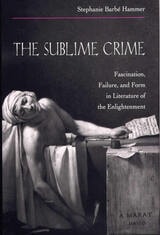
The Sublime Crime
Fascination, Failure, and Form in Literature of the EnlightenmentStephanie Barbe Hammer
Southern Illinois University Press, 1993
In this hermeneutic analysis of seven literary texts, Stephanie Barbé Hammer studies the roles of criminal protagonists in the dramas of George Lillo (The London Merchant) and Friedrich Schiller (The Robbers) and in the narratives of Abbé de Prévost (Manon Lescaut), Henry Fielding (Jonathan Wild), Marquis de Sade (Justine), William Godwin (Caleb Williams), and Heinrich von Kleist (Michael Kohlhaas).
Hammer reflects the current interest in cultural critique by utilizing the social theories of Michel Foucault and the feminist approaches of Hélène Cixous and Eve Sedgwick to redefine the Enlightenment as a movement of thought rather than as a strictly defined period synonymous with the eighteenth century. In addition, through the examination of the works of three post–World War II authors (Jean Genet, Anthony Burgess, and Peter Handke), Hammer suggests that the Enlightenment’s artistic representations of criminality are unparalleled by subsequent modern literature.
Hammer explains that the seven works she focuses on have been dismissed as failures by readers who have misunderstood the texts’ aesthetic elements. While claiming that the form of these works breaks down under the pressure of their criminal protagonists, she asserts that this formal failure actually contributes to the success of the works as art. The works "fail" because, like the criminal characters themselves, they break laws. The criminal protagonist effectively sabotages the official story that the text seeks to tell by deflecting the plot, style, and formal requirements in question, subverting its message—be it moral, sentimental, or libertine— through a kind of structural undermining, forcing the text beyond its own formal boundaries. For example, Hammer maintains that the presence of the criminal figure, Millwood, in Lillo’s bourgeois tragedy actually makes the play covertly antibourgeois.
Hammer insists that the criminal’s subversive presence in these seven works inaugurates new insight, and her analysis thereby challenges late twentieth-century readers to continue the investigation that the works themselves have begun.
This book will prove indispensable to scholars of comparative literature, especially eighteenth-century specialists, as well as to all individuals interested in cultural critique.
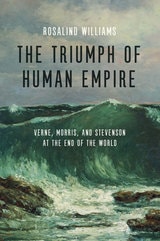
The Triumph of Human Empire
Verne, Morris, and Stevenson at the End of the WorldRosalind Williams
University of Chicago Press, 2013
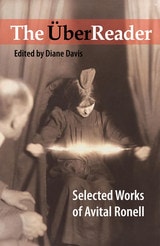
The UberReader
SELECTED WORKS OF AVITAL RONELLEdited by Diane Davis
University of Illinois Press, 2007
For twenty years Avital Ronell has stood at the forefront of the confrontation between literary study and European philosophy. She has tirelessly investigated the impact of technology on thinking and writing, with groundbreaking work on Heidegger, dependency and drug rhetoric, intelligence and artificial intelligence, and the obsession with testing. Admired for her insights and breadth of field, she has attracted a wide readership by writing with guts, candor, and wit.
Coyly alluding to Nietzsche’s “gay science,” The ÜberReader presents a solid introduction to Avital Ronell’s later oeuvre. It includes at least one selection from each of her books, two classic selections from a collection of her early essays (Finitude’s Score), previously uncollected interviews and essays, and some of her most powerful published and unpublished talks. An introduction by Diane Davis surveys Ronell’s career and the critical response to it thus far.
With its combination of brevity and power, this Ronell “primer” will be immensely useful to scholars, students, and teachers throughout the humanities, but particularly to graduate and undergraduate courses in contemporary theory.
Third-Generation Holocaust Representation
Trauma, History, and MemoryVictoria Aarons and Alan L. Berger
Northwestern University Press, 2017
Translating Modernism
Fitzgerald and HemingwayRonald Berman
University of Alabama Press, 2009
Trauma Culture
The Politics of Terror and Loss in Media and LiteratureKaplan, E. Ann
Rutgers University Press, 2005
In Trauma Culture, E. Ann Kaplan explores the relationship between the impact of trauma on individuals and on entire cultures and nations. Arguing that humans possess a compelling need to draw meaning from personal experience and to communicate what happens to others, she examines the artistic, literary, and cinematic forms that are often used to bridge the individual and collective experience. A number of case studies, including Sigmund Freud's Moses and Monotheism, Marguerite Duras' La Douleur, Sarah Kofman's Rue Ordener, Rue Labat, Alfred Hitchcock's Spellbound, and Tracey Moffatt's Night Cries, reveal how empathy can be fostered without the sensationalistic element that typifies the media.
From World War II to 9/11, this passionate study eloquently navigates the contentious debates surrounding trauma theory and persuasively advocates the responsible sharing and translating of catastrophe.