Results by title
74 books match the query 'Mathematical models' and 6 start with t
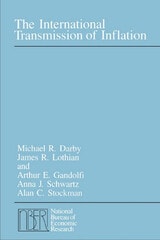
The International Transmission of Inflation
Michael R. Darby, James R. Lothian, Arthur E. Gandolfi, Anna J. Schwartz, and Al
University of Chicago Press, 1984
Inflation became the dominant economic, social, and political problem of the industrialized West during the 1970s. This book is about how the inflation came to pass and what can be done about it. Certain to provoke controversy, it is a major source of new empirical information and theoretical conclusions concerning the causes of international inflation.
The authors construct a consistent data base of information for eight countries and design a theoretically sound model to test and evaluate competing hypotheses incorporating the most recent theoretical developments. Additional chapters address an impressive variety of issues that complement and corroborate the core of the study. They answer such questions as these: Can countries conduct an independent monetary policy under fixed exchange rates? How closely tied are product prices across countries? How are disturbances transmitted across countries?
The International Transmission of Inflation is an important contribution to international monetary economics in furnishing an invaluable empirical foundation for future investigation and discussion.
[more]

The Maze of Urban Housing Markets
Theory, Evidence, and PolicyJerome Rothenberg, George C. Galster, Richard V. Butler, and John R. Pitkin
University of Chicago Press, 1991
This powerful new theoretical approach to analyzing urban housing problems and the policies designed to rectify them will be a vital resource for urban planners, developers, policymakers, and economists. The search for the roots of serious urban housing problems such as homelessness, abandonment, rent burdens, slums, and gentrification has traditionally focused on the poorest sector of the housing market. The findings set forth in this volume show that the roots of such problems lie in the relationships among different parts of the market—not solely within the lower-quality portion—though that is where problems are most dramatically manifested and housing reforms are myopically focused.
The authors propose a new understanding of the market structure characterized by a closely interrelated array of quality submarkets. Their comprehensive models ground a unified theory that accounts for demand by both renters and owner occupants, supply by owners of existing dwellings, changes in the stock of housing due to conversions and new construction, and interactions across submarkets.
The authors propose a new understanding of the market structure characterized by a closely interrelated array of quality submarkets. Their comprehensive models ground a unified theory that accounts for demand by both renters and owner occupants, supply by owners of existing dwellings, changes in the stock of housing due to conversions and new construction, and interactions across submarkets.
[more]

The Scourge of War
New Extensions on an Old ProblemPaul F. Diehl, Editor
University of Michigan Press, 2004
J. David Singer's legendary Correlates of War project represented the first comprehensive effort by political scientists to gather and analyze empirical data about the causes of war. In doing so, Singer and his colleagues transformed the face of twentieth-century political science. Their work provoked some of the most important debates in modern international relations -- about the rules governing territory, international intervention, and the so-called "democratic peace."
Editor Paul F. Diehl has now convened some of the world's foremost international conflict analysis specialists to reassess COW's contribution to our understanding of global conflict. Each chapter takes one of COW's pathbreaking ideas and reevaluates it in light of subsequent world events and developments in the field. The result is a critical retrospective that will reintroduce Singer's important and still-provocative findings to a new generation of students and specialists.
Paul F. Diehl is Professor of Political Science and University Distinguished Scholar at the University of Illinois, Urbana-Champaign.
[more]
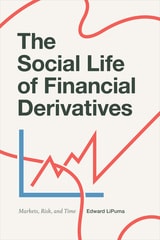
The Social Life of Financial Derivatives
Markets, Risk, and TimeEdward LiPuma
Duke University Press, 2017
In The Social Life of Financial Derivatives Edward LiPuma theorizes the profound social dimensions of derivatives markets and the processes, rituals, and belief systems that drive them. In response to the 2008 financial crisis and drawing on his experience trading derivatives, LiPuma outlines how they function as complex devices that organize speculative capital as well as the ways derivative-driven capitalism not only produces the conditions for its own existence, but also penetrates the fabric of everyday life. Framing finance as a form of social life and highlighting the intrinsically social character of financial derivatives, LiPuma deepens our understanding of derivatives so that we may someday use them to serve the public well-being.
[more]

Theory of Nonuniform Waveguides
The cross-section methodB.Z. Katsenelenbaum
The Institution of Engineering and Technology, 1998
The cross-section method is an analytical tool used in the design of components required for low-loss, highly efficient transmission of electromagnetic waves in nonuniform waveguides. When the waveguide dimensions are large compared with the wavelength, a fully three-dimensional analysis employing modern numerical methods based on finite element, finite difference, finite integration or transmission line matrix formalisms is practically impossible and the cross-section method is the only feasible analysis technique.
[more]

Time, Ignorance, and Uncertainty in Economic Models
Donald W. Katzner
University of Michigan Press, 1998
Emerging from the tradition of Marshall, Knight, Keynes, and Shackle, Time, Ignorance, and Uncertainty in Economic Models is concerned with the character of formal economic analysis when the notions of logical or mechanical time and probabilistic uncertainty and the relatively complete knowledge basis it requires, are replaced, respectively, by historical time, and nonprobabilistic uncertainty and ignorance. Examining that analytical character by constructing and exploring particular models, this book emphasizes doing actual economic analysis in a framework of historical time, nonprobabilistic uncertainty, and ignorance.
Donald W. Katzner begins with an extensive investigation of the distinction between potential surprise and probability. He presents a modified version of Shackle's model of decision-making in ignorance and examines in considerable detail its "comparative statics" and operationality properties. The meaning of aggregation and simultaneity under these conditions is also explored, and Shackle's model is applied to the construction of models of the consumer, the firm, microeconomics, and macroeconomics. Katzner concludes with discussions of the roles of history, hysteresis, and empirical investigation in economic inquiry.
Time, Ignorance, and Uncertainty in Economic Models will be of interest to economists and others engaged in the study of uncertainty, probability, aggregation, and simultaneity. Those interested in the microeconomics of consumer and firm behavior, general equilibrium, and macroeconomics will also benefit from this book.
Donald W. Katzner is Professor of Economics, University of Massachusetts.
[more]