Results by title
58 books match the query 'Media & Internet' and 16 start with t
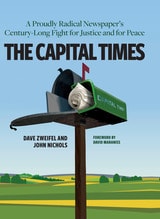
The Capital Times
A Proudly Radical Newspaper’s Century Long Fight for Justice and for PeaceJohn Nichols
Wisconsin Historical Society Press, 2017
As Madison’s Capital Times marks its 100th anniversary in 2017, editors Dave Zweifel and John Nichols recall the remarkable history of a newspaper that served as the tribune of Robert M. La Follette and the progressive movement, earned the praise of Franklin Delano Roosevelt for its stalwart opposition to fascism, battled Joe McCarthy during the "Red Scare," championed civil rights, women’s rights, and LGBTQ rights, opposed the Vietnam War and the invasion of Iraq, and stood with Russ Feingold when he cast the only US Senate vote against the Patriot Act. The Capital Times did not do this from New York or Washington but from the middle of America, with a readership of farmers, factory workers, teachers, and shopkeepers who stood by The Cap Times when the newspaper was boycotted, investigated, and attacked for its determination.
At a point when journalism is under assault, when newspapers struggle to survive, and "old media" struggles to find its way in a digital age, The Capital Times remains unbowed—still living up to the description Lord Francis Williams, the British newspaper editor, wrote 50 years ago: "The vast majority of American papers are as dull as weed-covered ditch-water; vast Saharas of cheap advertising with occasional oases of editorial matter written to bring happiness to the Chamber of Commerce and pain and irritation to none; the bland leading the bland.… Just here and there are a few relics of the old fighting muckraking tradition of American journalism, like The Capital Times of Madison."
The Indecent Screen
Regulating Television in the Twenty-First CenturyChris, Cynthia
Rutgers University Press, 2019
The Left and Digital Politics
Political Parties from Platform Neoliberalism to Platform SocialismMarco Guglielmo
University of Westminster Press, 2025

The Obama Effect
How the 2008 Campaign Changed White Racial AttitudesSeth K. Goldman
Russell Sage Foundation, 2014
The Online Advertising Tax as the Foundation of a Public Service Internet
a CAMRI extended policy reportChristian Fuchs
University of Westminster Press, 2018
Online advertising will soon form the largest share of global advertisement revenues. Google and Facebook netted profits of US $29 billion in 2016. While these two giants control more than 66% of all online advertising revenues complex legal company structures have minimised their tax liabilities. This extended policy report considers where they should be taxed and where the value of their activities is actually created. It argues that tax paid by those platforms should be levied in the country where platform users are located when they click on or view an advertisement. Furthermore, the report examines the practical steps needed to ensure transparent accounting of taxed transactions in order to avoid long term negative effects for media and democracy.
Considering counter-arguments the author makes the case for an online advertising tax alongside a public service Internet strategy that could support other viable platforms and counter the dangers of duopoly or oligopoly and the high risks of financial bubbles in a world where advertising is the Internet's dominant business model.
The Other Air Force
U.S. Efforts to Reshape Middle Eastern Media Since 9/11Sienkiewicz, Matt
Rutgers University Press, 2016
As it seeks to win the hearts and minds of citizens in the Muslim world, the United States has poured millions of dollars into local television and radio programming, hoping to generate pro-American currents on Middle Eastern airwaves. However, as this fascinating new book shows, the Middle Eastern media producers who rely on these funds are hardly puppets on an American string, but instead contribute their own political and creative agendas while working within U.S. restrictions.
The Paradox of Democracy
Free Speech, Open Media, and Perilous PersuasionZac Gershberg and Sean Illing
University of Chicago Press, 2022
At the heart of democracy lies a contradiction that cannot be resolved, one that has affected free societies since their advent: Though freedom of speech and media has always been a necessary condition of democracy, that very freedom is also its greatest threat. When new forms of communication arrive, they often bolster the practices of democratic politics. But the more accessible the media of a society, the more susceptible that society is to demagoguery, distraction, and spectacle. Tracing the history of media disruption and the various responses to it over time, Zac Gershberg and Sean Illing reveal how these changes have challenged democracy—often with unsettling effects.
The Paradox of Democracy captures the deep connection between communication and political culture, from the ancient art of rhetoric and the revolutionary role of newspapers to liberal broadcast media and the toxic misinformation of the digital public sphere. With clear-eyed analysis, Gershberg and Illing show that our contemporary debates over media, populism, and cancel culture are not too different from the democratic cultural experiences of the past. As we grapple with a fast-changing, hyper-digital world, they prove democracy is always perched precipitously on a razor’s edge, now as ever before.
The Participatory Condition in the Digital Age
Darin Barney
University of Minnesota Press, 2016
Just what is the “participatory condition”? It is the situation in which taking part in something with others has become both environmental and normative. The fact that we have always participated does not mean we have always lived under the participatory condition. What is distinctive about the present is the extent to which the everyday social, economic, cultural, and political activities that comprise simply being in the world have been thematized and organized around the priority of participation.
Structured along four axes investigating the relations between participation and politics, surveillance, openness, and aesthetics, The Participatory Condition in the Digital Age comprises fifteen essays that explore the promises, possibilities, and failures of contemporary participatory media practices as related to power, Occupy Wall Street, the Arab Spring uprisings, worker-owned cooperatives for the post-Internet age; paradoxes of participation, media activism, open source projects; participatory civic life; commercial surveillance; contemporary art and design; and education.
This book represents the most comprehensive and transdisciplinary endeavor to date to examine the nature, place, and value of participation in the digital age. Just as in 1979, when Jean-François Lyotard proposed that “the postmodern condition” was characterized by the questioning of historical grand narratives, The Participatory Condition in the Digital Age investigates how participation has become a central preoccupation of our time.
Contributors: Mark Andrejevic, Pomona College; Bart Cammaerts, London School of Economics and Political Science (LSE); Nico Carpentier, Vrije Universiteit Brussel (VUB – Free University of Brussels) and Charles University in Prague; Julie E. Cohen, Georgetown University; Kate Crawford, MIT; Alessandro Delfanti, University of Toronto; Christina Dunbar-Hester, University of Southern California; Rudolf Frieling, California College of Arts and the San Francisco Art Institute; Salvatore Iaconesi, La Sapienza University of Rome and ISIA Design Florence; Jason Edward Lewis, Concordia University; Rafael Lozano-Hemmer; Graham Pullin, University of Dundee; Trebor Scholz, The New School in New York City; Cayley Sorochan, McGill University; Bernard Stiegler, Institute for Research and Innovation in Paris; Krzysztof Wodiczko, Harvard Graduate School of Design; Jillian C. York.
The Propaganda Model Today
Filtering Perception and AwarenessJoan Pedro-Carañana, Daniel Broudy and Jeffery Klaehn
University of Westminster Press, 2018
While the individual elements of the propaganda system (or filters) identified by the Propaganda Model (PM) – ownership, advertising, sources, flak and anti-communism – have previously been the focus of much scholarly attention, their systematisation in a model, empirical corroboration and historicisation have made the PM a useful tool for media analysis across cultural and geographical boundaries.
Despite the wealth of scholarly research Herman and Chomsky’s work has set into motion over the past decades, the PM has been subjected to marginalisation, poorly informed critiques and misrepresentations. Interestingly, while the PM enables researchers to form discerning predictions as regards corporate media performance, Herman and Chomsky had further predicted that the PM itself would meet with such marginalisation and contempt.
In current theoretical and empirical studies of mass media performance, uses of the PM continue, nonetheless, to yield important insights into the workings of political and economic power in society, due in large measure to the model’s considerable explanatory power.
The Public Service Media and Public Service Internet Manifesto
Christian Fuchs and Klaus Unterberger
University of Westminster Press, 2021
This book presents the collectively authored Public Service Media and Public Service Internet Manifesto and accompanying materials.The Internet and the media landscape are broken. The dominant commercial Internet platforms endanger democracy. They have created a communications landscape overwhelmed by surveillance, advertising, fake news, hate speech, conspiracy theories, and algorithmic politics. Commercial Internet platforms have harmed citizens, users, everyday life, and society. Democracy and digital democracy require Public Service Media. A democracy-enhancing Internet requires Public Service Media becoming Public Service Internet platforms – an Internet of the public, by the public, and for the public; an Internet that advances instead of threatens democracy and the public sphere. The Public Service Internet is based on Internet platforms operated by a variety of Public Service Media, taking the public service remit into the digital age. The Public Service Internet provides opportunities for public debate, participation, and the advancement of social cohesion.
Accompanying the Manifesto are materials that informed its creation: Christian Fuchs’ report of the results of the Public Service Media/Internet Survey, the written version of Graham Murdock’s online talk on public service media today, and a summary of an ecomitee.com discussion of the Manifesto’s foundations.
The Manifesto can be signed by visiting http://bit.ly/signPSManifesto
The Social Citizen
Peer Networks and Political BehaviorBetsy Sinclair
University of Chicago Press, 2012
The Struggle for Hegemony in Pakistan
Fear, Desire and Revolutionary HorizonsAasim Sajjad-Akhtar
Pluto Press, 2022
The collapse of neoliberal hegemony in the western world following the financial crash of 2007-8 and subsequent rise of right-wing authoritarian personalities has been described as a crisis of 'the political' in western societies. But the crisis must be seen as global, rather than focusing on the west alone.
Pakistan is experiencing rapid financialization and rapacious capture of natural resources, overseen by the country's military establishment and state bureaucracy. Under their watch, trading and manufacturing interests, property developers and a plethora of mafias have monopolized the provision of basic needs like housing, water and food, whilst also feeding conspicuous consumption by a captive middle-class.
Aasim Sajjad-Akhtar explores neoliberal Pakistan, looking at digital technology in enhancing mass surveillance, commodification and atomization, as well as resistance to the state and capital. Presenting a new interpretation of our global political-economic moment, he argues for an emancipatory political horizon embodied by the 'classless' subject.
The U.S.–China Trade War
Global News Framing and Public Opinion in the Digital AgeLouisa Ha
Michigan State University Press, 2022

Thinker, Faker, Spinner, Spy
Corporate PR and the Assault on DemocracyEdited by David Miller and William Dinan
Pluto Press, 2007
Written by leading activists and writers, this book reveals the secrets of the PR trade including deception, the use of fake 'institutes', spying and dirty tricks. The impact can be devastating -- when the public is denied access to the truth, the results are rising inequality and environmental catastrophe.
Exposing the misdeeds of famous companies including Coca Cola, British Aerospace, Exxon and Monsanto, and revealing information about the covert funding of various apparently independent thinks tanks and institutes, the authors offer a guide to campaigns that can help us roll back corporate power and resist deceptive PR.
Through the Grapevine
Socially Transmitted Information and Distorted DemocracyTaylor N. Carlson
University of Chicago Press, 2024
An enlightening examination of what it means when Americans rely on family and friends to stay on top of politics.
Accurate information is at the heart of democratic functioning. For decades, researchers interested in how information is disseminated have focused on mass media, but the reality is that many Americans today do not learn about politics from direct engagement with the news. Rather, about one-third of Americans learn chiefly from information shared by their peers in conversation or on social media. How does this socially transmitted information differ from that communicated by traditional media? What are the consequences for political attitudes and behavior?
Drawing on evidence from experiments, surveys, and social media, Taylor N. Carlson finds that, as information flows first from the media then person to person, it becomes sparse, more biased, less accurate, and more mobilizing. The result is what Carlson calls distorted democracy. Although socially transmitted information does not necessarily render democracy dysfunctional, Through the Grapevine shows how it contributes to a public that is at once underinformed, polarized, and engaged.
Turning the Page
Storytelling as Activism in Queer Film and MediaCoon, David R
Rutgers University Press, 2018
Surprisingly, Hollywood is still clumsily grappling with its representation of sexual minorities, and LGBTQ filmmakers struggle to find a place in the mainstream movie industry. However, organizations outside the mainstream are making a difference, helping to produce and distribute authentic stories that are both by and for LGBTQ people.
Turning the Page introduces readers to three nonprofit organizations that, in very different ways, have each positively transformed the queer media landscape. David R. Coon takes readers inside In the Life Media, whose groundbreaking documentaries on the LGBTQ experience aired for over twenty years on public television stations nationwide. Coon reveals the successes of POWER UP, a nonprofit production company dedicated to mentoring filmmakers who can turn queer stories into fully realized features and short films. Finally, he turns to Three Dollar Bill Cinema, an organization whose film festivals help queer media find an audience and whose filmmaking camps for LGBTQ youth are nurturing the next generation of queer cinema.
Combining a close analysis of specific films and video programs with extensive interviews of industry professionals, Turning the Page demonstrates how queer storytelling in visual media has the potential to empower individuals, strengthen communities, and motivate social justice activism.