128 books match the query 'Men' and 27 start with t
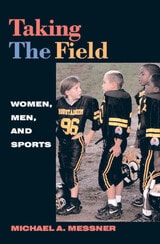
cover of Taking The Field: Women, Men, and Sports

Taking The Field

Women, Men, and Sports

Michael A. Messner

University of Minnesota Press, 2002
 In the past, when sport simply excluded girls, the equation of males with active athletic power and of females with weakness and passivity seemed to come easily, almost naturally. Now, however, with girls’ and women’s dramatic movement into sport, the process of exclusion has become a bit subtler, a bit more complicated-and yet, as Michael Messner shows us in this provocative book, no less effective. In Taking the Field, Messner argues that despite profound changes, the world of sport largely retains and continues its longtime conservative role in gender relations.
To explore the current paradoxes of gender in sport, Messner identifies and investigates three levels at which the "center" of sport is constructed: the day-to-day practices of sport participants, the structured rules and hierarchies of sport institutions, and the dominant symbols and belief systems transmitted by the major sports media. Using these insights, he analyzes a moment of gender construction in the lives of four- and five-year-old children at a soccer opening ceremony, the way men’s violence is expressed through sport, the interplay of financial interests and dominant men’s investment in maintaining the status quo in the face of recent challenges, and the cultural imagery at the core of sport, particularly televised sports. Through these examinations Messner lays bare the practices and ideas that buttress-as well as those that seek to disrupt-the masculine center of sport. 
Taking the Field exposes the subtle and not-so-subtle ways in which men and women collectively construct gender through their interactions-interactions contextualized in the institutions and symbols of sport.
[more]
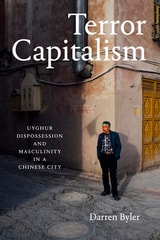
cover of Terror Capitalism: Uyghur Dispossession and Masculinity in a Chinese City

Terror Capitalism

Uyghur Dispossession and Masculinity in a Chinese City

Darren Byler

Duke University Press, 2021
In Terror Capitalism anthropologist Darren Byler theorizes the contemporary Chinese colonization of the Uyghur Muslim minority group in the northwest autonomous region of Xinjiang. He shows that the mass detention of over one million Uyghurs in “reeducation camps” is part of processes of resource extraction in Uyghur lands that have led to what he calls terror capitalism—a configuration of ethnoracialization, surveillance, and mass detention that in this case promotes settler colonialism. Drawing on ethnographic fieldwork in the regional capital Ürümchi, Byler shows how media infrastructures, the state’s enforcement of “Chinese” cultural values, and the influx of Han Chinese settlers contribute to Uyghur dispossession and their expulsion from the city. He particularly attends to the experiences of young Uyghur men—who are the primary target of state violence—and how they develop masculinities and homosocial friendships to protect themselves against gendered, ethnoracial, and economic violence. By tracing the political and economic stakes of Uyghur colonization, Byler demonstrates that state-directed capitalist dispossession is coconstructed with a colonial relation of domination.
[more]
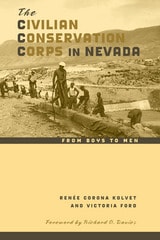
cover of The Civilian Conservation Corps in Nevada: From Boys to Men

The Civilian Conservation Corps in Nevada

From Boys to Men

Renée Corona Kolvet

University of Nevada Press, 2015

The Great Depression of the 1930s had a devastating impact on sparsely populated Nevada and its two major industries, mining and agriculture. Luckily, thanks to Nevada’s powerful Senate delegation, Roosevelt’s New Deal funding flowed abundantly into the state. Among the programs thus supported was the Civilian Conservation Corps, a federal program intended to provide jobs for unemployed young men and a pool of labor for essential public lands rehabilitation projects. In all, nearly thirty-one thousand men were employed in fifty-nine CCC camps across Nevada, most of them from outside the state. These “boys,” as they were called, went to work improving the state’s forests, parks, wildlife habitats, roads, fences, irrigation systems, flood-control systems, and rangelands, while learning valuable skills on the job. Rural communities near CCC camps reaped additional benefits when local men were hired as foremen and when the camps purchased supplies from local merchants.
 
The Civilian Conservation Corps in Nevada is the first comprehensive history of the Nevada CCC, a program designed to help the nation get back on its feet, and of the “boys” who did so much to restore Nevada’s lands and resources. The book is based on extensive research in private manuscript collections, unpublished memoirs, CCC inspectors’ reports, and other records. The book also includes period photographs depicting the Nevada CCC and its activities.
[more]
cover of The Complementarity of Women and Men: Philosophy, Theology, Psychology, and Art

The Complementarity of Women and Men

Philosophy, Theology, Psychology, and Art

Paul C. Vitz

Catholic University of America Press, 2021
The Complementarity of Women and Men provides a Catholic Christian case that men and women are in certain respects quite different but also have a positive, synergistic complementary relationship. Although differences and their mutually supporting relationships are focused on throughout the volume, men and women are assumed to have equal dignity and value. This underlying interpretation comes from the familiar, basic theological position in Genesis that both sexes were made in the image of God. After a cogent philosophical introduction to complementary differences by J. Budziszewski, this position is developed from theological, philosophical, and historical perspectives by Sr. Prudence Allen. Next Deborah Savage, building upon the writings of St. John Paul II, gives a strong theological basis for complementarity. This is followed by Elizabeth Lev’s chapter presenting new and surprising art history evidence from the paintings of Michelangelo in the Sistine Chapel supporting the complementarity interpretation. A final chapter by Paul Vitz documents and summarizes the scientific evidence supporting sexual difference and complementarity in the disciplines of psychology and neuroscience. As a consequence of both the individual chapters and the integrated understanding they present The Complementarity of Women and Men is a significant contribution to the important, complex, contemporary debate about men, women, sex, and gender.
[more]
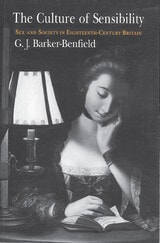
cover of The Culture of Sensibility: Sex and Society in Eighteenth-Century Britain

The Culture of Sensibility

Sex and Society in Eighteenth-Century Britain

G. J. Barker-Benfield

University of Chicago Press, 1992
G. J. Barker-Benfield documents the emergence of the culture of sensibility that transformed British society of the eighteenth century. His account focuses on the rise of new moral and spiritual values and the struggle to redefine the group identities of men and women. Drawing on the full spectrum of eighteenth-century thought from Adam Smith to John Locke, from the Earl of Shaftesberry to Dr. George Cheyne, and especially Mary Wollstonecraft, Barker-Benfield offers an innovative and compelling way to understand how Britain entered the modern age.
[more]
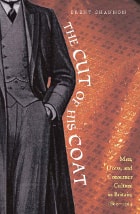
cover of The Cut of His Coat: Men, Dress, and Consumer Culture in Britain, 1860–1914

The Cut of His Coat

Men, Dress, and Consumer Culture in Britain, 1860–1914

Brent Shannon

Ohio University Press, 2006

The English middle class in the late nineteenth century enjoyed an increase in the availability and variety of material goods. With that, the visual markers of class membership and manly behavior underwent a radical change. In The Cut of His Coat: Men, Dress, and Consumer Culture in Britain, 1860–1914, Brent Shannon examines familiar novels by authors such as George Eliot, Anthony Trollope, Thomas Hughes, and H. G. Wells, as well as previously unexamined etiquette manuals, period advertisements, and fashion monthlies, to trace how new ideologies emerged as mass-produced clothes, sartorial markers, and consumer culture began to change.

While Victorian literature traditionally portrayed women as having sole control of class representations through dress and manners, Shannon argues that middle-class men participated vigorously in fashion. Public displays of their newly acquired mannerisms, hairstyles, clothing, and consumer goods redefined masculinity and class status for the Victorian era and beyond.

The Cut of His Coat probes the Victorian disavowal of men’s interest in fashion and shopping to recover men’s significant role in the representation of class through self-presentation and consumer practices.
[more]
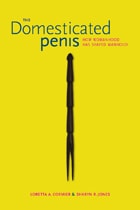
cover of The Domesticated Penis: How Womanhood Has Shaped Manhood

The Domesticated Penis

How Womanhood Has Shaped Manhood

Loretta A. Cormier

University of Alabama Press, 2015

Demonstrates that not only natural selection but also female choice has played a key role in shaping male anatomy

The Domesticated Penis challenges long-held assumptions that, in the development of Homo sapiens, form follows function alone. In this fascinating exploration, Loretta A. Cormier and Sharyn R. Jones explain the critical contribution that conscious female selection has made to the attributes of the modern male phallus.

Synthesizing a wealth of robust scholarship from the fields of archaeology, cultural anthropology, evolutionary theory, and primatology, the authors successfully dismantle the orthodox view that each part of the human anatomy has followed a vector of development along which only changes and mutations that increased functional utility were retained and extended. Their research animates our understanding of human morphology with insights about how choices early females made shaped the male reproductive anatomy.

In crisp and droll prose, Cormier’s and Jones’s rigorous scholarship incorporates engaging examples and lore about the human phallus in a variety of foraging, agrarian, and contemporary cultures. By detailing how female selection in mating led directly to a matrix of anatomical attributes in the male, their findings illuminate how the penis also acquired a matrix of attributes of the imagination and mythical powers—powers to be assuaged, channeled, or deployed for building productive societies.

These analyses offer a highly persuasive alternative to moribund biological and behavioral assumptions about prehistoric alpha males as well as the distortions such assumptions give rise to in contemporary popular culture. In this anthropological tour de force, Cormier and Jones transcend reductive gender stereotypes and bring to our concepts of evolutional biomechanics an invigorating new balance and nuance.
 
[more]
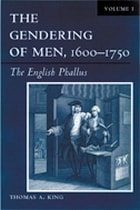
cover of The Gendering of Men, 1600–1750: The English Phallus

The Gendering of Men, 1600–1750

The English Phallus

Thomas A. King

University of Wisconsin Press, 2004

    Taking on nothing less than the formation of modern genders and sexualities, Thomas A. King develops a history of the political and performative struggles that produced both normative and queer masculinities in the seventeenth and eighteenth centuries. The result is a major contribution to gender studies, gay studies, and theater and performance history.
    The Gendering of Men, 1600–1750 traces the transition from a society based on alliance, which had subordinated all men, women, and boys to higher ranked males, to one founded in sexuality, through which men have embodied their claims to personal and political privacy. King proposes that the male body is a performative production marking men’s resistance to their subjection within patriarchy and sovereignty. Emphasizing that categories of gender must come under historical analysis, The Gendering of Men explores men’s particpation in an ongoing struggle for access to a universal manliness transcending other biological and social differentials.

This is volume one of two projected volumes.
[more]
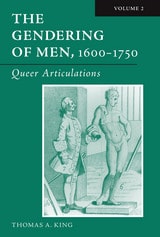
cover of The Gendering of Men, 1600–1750: Volume 2, Queer Articulations

The Gendering of Men, 1600–1750

Volume 2, Queer Articulations

Thomas A. King

University of Wisconsin Press, 2008
The queer man’s mode of embodiment—his gestural and vocal style, his posture and gait, his occupation of space—remembers a political history. To gesture with the elbow held close to the body, to affect a courtly lisp, or to set an arm akimbo with the hand turned back on the hip is to cite a history in which the sovereign body became the effeminate and sodomitical and, finally, the homosexual body. In Queer Articulations, Thomas A. King argues that the Anglo-American queer body publicizes a history of resistance to the gendered terms whereby liberal subjectivities were secured in early modern England.
Arguing that queer agency preceded and enabled the formulation of queer subjectivities, Queer Articulations investigates theatricality and sodomy as performance practices foreclosed in the formation of gendered privacy and consequently available for resistant uses by male-bodied persons who have been positioned, or who have located themselves, outside the universalized public sphere of citizen-subjects. By defining queerness as the lack or failure of private pleasures, rather than an alternative pleasure or substance in its own right, eighteenth-century discourses reconfigured publicness as the mark of difference from the naturalized, private bodies of liberal subjects.
Inviting a performance-centered, interdisciplinary approach to queer/male identities, King develops a model of queerness as processual activity, situated in time and place but irreducible to the individual subject's identifications, desires, and motivations.
[more]
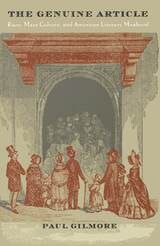
cover of The Genuine Article: Race, Mass Culture, and American Literary Manhood

The Genuine Article

Race, Mass Culture, and American Literary Manhood

Paul Gilmore

Duke University Press, 2001

In The Genuine Article Paul Gilmore examines the interdependence of literary and mass culture at a crucial moment in US history. Demonstrating from a new perspective the centrality of race to the construction of white manhood across class lines, Gilmore argues that in the years before the Civil War, as literature increasingly became another commodity in the capitalist cultural marketplace, American authors appropriated middle-brow and racially loaded cultural forms to bolster their masculinity.

From characters in Indian melodramas and minstrel shows to exhibits in popular museums and daguerrotype galleries, primitive racialized figures circulated as “the genuine article” of manliness in the antebellum United States. Gilmore argues that these figures were manipulated, translated, and adopted not only by canonical authors such as Hawthorne, Thoreau, Cooper, and Melville but also by African American and Native American writers like William Wells Brown and Okah Tubbee. By examining how these cultural notions of race played out in literary texts and helped to construct authorship as a masculine profession, Gilmore makes a unique contribution to theories of class formation in nineteenth-century America.

The Genuine Article will enrich students and scholars of American studies, gender studies, literature, history, sociology, anthropology, popular culture, and race.
[more]
cover of The Impotence Epidemic: Men's Medicine and Sexual Desire in Contemporary China

The Impotence Epidemic

Men's Medicine and Sexual Desire in Contemporary China

Everett Yuehong Zhang

Duke University Press, 2015
Since the 1990s China has seen a dramatic increase in the number of men seeking treatment for impotence. Everett Yuehong Zhang argues in The Impotence Epidemic that this trend represents changing public attitudes about sexuality in an increasingly globalized China. In this ethnography he shifts discussions of impotence as a purely neurovascular phenomenon to a social one. Zhang contextualizes impotence within the social changes brought by recent economic reform and through the production of various desires in post-Maoist China. Based on interviews with 350 men and their partners from Beijing and Chengdu, and concerned with de-mystifying and de-stigmatizing impotence, Zhang suggests that the impotence epidemic represents not just trauma and suffering, but also a contagion of individualized desire and an affirmation for living a full life. For Zhang, studying male impotence in China is one way to comprehend the unique experience of Chinese modernity.
[more]
cover of The Masculine Self in Late Medieval England

The Masculine Self in Late Medieval England

Derek G. Neal

University of Chicago Press, 2008

What did it mean to be a man in medieval England? Most would answer this question by alluding to the power and status men enjoyed in a patriarchal society, or they might refer to iconic images of chivalrous knights. While these popular ideas do have their roots in the history of the aristocracy, the experience of ordinary men was far more complicated.
            Marshalling a wide array of colorful evidence—including legal records, letters, medical sources, and the literature of the period—Derek G. Neal here plumbs the social and cultural significance of masculinity during the generations born between the Black Death and the Protestant Reformation. He discovers that social relations between men, founded on the ideals of honesty and self-restraint, were at least as important as their domination and control of women in defining their identities. By carefully exploring the social, physical, and psychological aspects of masculinity, The Masculine Self in Late Medieval England offers a uniquely comprehensive account of the exterior and interior lives of medieval men.
[more]
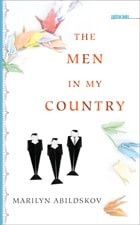
cover of The Men in My Country

The Men in My Country

Marilyn Abildskov

University of Iowa Press, 2004

In the early 1990s, at the watershed age of thirty, Marilyn Abildskov decided she needed to start over. She accepted an offer to move from Utah to Matsumoto, Japan, to teach English to junior high school students. “All I knew is that I had to get away and when I stared at my name on the Japanese contract, the squiggles of katakana, my name typed in English sturdily beneath, I liked how it looked. As if it—as if I—were translated, transformed, emerging now as someone new.”

The Men in My Country is the story of an American woman living and loving in Japan. Satisfied at first to observe her exotic surroundings, the woman falls in love with the place, with the light, with the curve of a river, with the smell of bonfires during obon, with blue and white porcelain dishes, with pencil boxes, and with small origami birds. Later, struggling for a deeper connection—“I wanted the country under my skin”—Abildskov meets the three men who will be part of her transformation and the one man with whom she will fall deeply in love.

A travel memoir offering an artful depiction of a very real place, The Men in My Country also covers the terrain of a complex emotional journey, tracing a geography of the heart, showing how we move to be moved, how in losing ourselves in a foreign place we can become dangerously—and gloriously—undone.
[more]
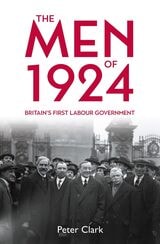
cover of The Men of 1924: Britain’s First Labour Government

The Men of 1924

Britain’s First Labour Government

Peter Clark

Haus Publishing, 2023

An in-depth look at the diverse group of men who comprised Britain’s first Labour Party in 1924.

In January of 1924, the cabinet of the first Labour government consisted of twenty white, middle-aged men, as it had for generations. But the election also represented a radical departure from government by the ruling class. Most members of the administration had left school by the age of fifteen. Five of them had started work by the time they were twelve years old. Three were working down the mines before they entered their teens. Two were illegitimate, one was abandoned at birth, and three were of Irish immigrant descent. For the first time in Britain’s history, the cabinet could truly be said to represent all of Britain’s social classes. This unheralded revolution in representation is the subject of Peter Clark’s fascinating new book, The Men of 1924. Who were these men? Clark’s vivid portrayal is full of evocative portraits of a new breed of politician, the forerunners of all those who, later in the last century and this one, overcame a system from which they had been excluded for too long.
 
[more]
cover of The Men of Cajamarca: A Social and Biographical Study of the First Conquerors of Peru

The Men of Cajamarca

A Social and Biographical Study of the First Conquerors of Peru

By James Lockhart

University of Texas Press, 1972

In November 1532, a group of 168 Spaniards seized the Inca emperor Atahuallpa in the town of Cajamarca, in the northern Peruvian highlands. Their act, quickly taken as a symbol of the conquest of a vast empire, brought them unprecedented rewards in gold and silver; it made them celebrities, gave them first choice of positions of honor and power in the new Peru of the Spaniards, and opened up the possibility of a splendid life at home in Spain, if they so desired. Thus they became men of consequence, at the epicenter of a swift and irrevocable transformation of the Andean region. Yet before that memorable day in Cajamarca they had been quite unexceptional, a reasonable sampling of Spaniards on expeditions all over the Indies at the time of the great conquests.

The Men of Cajamarca is perhaps the fullest treatment yet published of any group of early Spaniards in America. Part I examines general types, characteristics, and processes visible in the group as representative Spanish immigrants, central to the establishment of a Spanish presence in the New World’s richest land. The intention is to contribute to a changing image of the Spanish conqueror, a man motivated more by pragmatic self-interest than by any love of adventure, capable and versatile as often as illiterate and rough. Aiming at permanence more than new landfalls, these men created the governmental units and settlement distribution of much of Spanish America and set lasting patterns for a new society.

Part II contains the men’s individual biographies, ranging from a few lines for the most obscure to many pages of analysis for the best-documented figures. The author traces the lives of the men to their beginnings in Spain and follows their careers after the episode in Cajamarca.
[more]
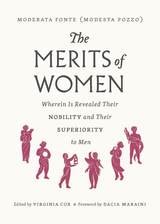
cover of The Merits of Women: Wherein Is Revealed Their Nobility and Their Superiority to Men

The Merits of Women

Wherein Is Revealed Their Nobility and Their Superiority to Men

Moderata Fonte

University of Chicago Press, 2018

You would as well look for blood in a corpse as for the least shred of decency in a man . . .
 
Without help from their wives, men are just like unlit lamps . . .
 
Just think of them as an unreliable clock that tells you it’s ten o’clock when it’s in fact barely two . . .
 
A man without a woman is like a fly without a head . . .
 
These are but a small selection of the quips bandied about at this lively gathering of women. The broad topic at hand is the relative pros and cons of men, and the cases in point range from pick-up artists to locker-room talk, and from double standards to fragile masculinity.

Yet this dialogue unfolds not among ironically misandrist millenials venting at their local dive bar, but rather among sixteenth-century women—variously married, widowed, single, and betrothed—attending a respectable Venice garden party. Written in the early 1590s by Moderata Fonte, pseudonym of the Renaissance poet and writer Modesta Pozzo, this literary dialogue interrogates men and men’s treatment of women, and explores by contrast the virtues of singledom and female friendship. As the women diverge from their theme—discussing everything from astrology to the curative powers of plants and minerals—a remarkable group portrait of wisdom, wit, and erudition emerges.

A new introduction by translator Virginia Cox and foreword by Dacia Maraini situate The Merits of Women in its historical context, written as it was on the cusp of Shakespeare’s heyday, and straddling the centuries between the feminist works of Christine de Pizan and Mary Wollstonecraft. Elegantly presented for a general audience, this is a must-read for baby feminists and “nasty women” alike, not to mention the perfect subtle gift for any mansplaining friend who needs a refresher on the merits of women . . . and their superiority to men.
 
[more]
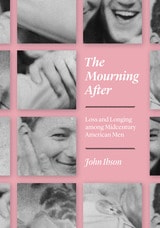
cover of The Mourning After: Loss and Longing among Midcentury American Men

The Mourning After

Loss and Longing among Midcentury American Men

John Ibson

University of Chicago Press, 2018
On the battlefields of World War II, with their fellow soldiers as the only shield between life and death, a generation of American men found themselves connecting with each other in new and profound ways. Back home after the war, however, these intimacies faced both scorn and vicious homophobia. The Mourning After makes sense of this cruel irony, telling the story of the unmeasured toll exacted upon generations of male friendships. John Ibson draws evidence from the contrasting views of male closeness depicted in WWII-era fiction by Gore Vidal and John Horne Burns, as well as from such wide-ranging sources as psychiatry texts, child development books, the memoirs of veterans’ children, and a slew of vernacular snapshots of happy male couples. In this sweeping reinterpretation of the postwar years, Ibson argues that a prolonged mourning for tenderness lost lay at the core of midcentury American masculinity, leaving far too many men with an unspoken ache that continued long after the fighting stopped, forever damaging their relationships with their wives, their children, and each other.
[more]
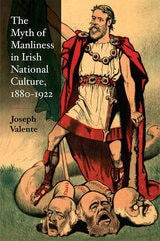
cover of The Myth of Manliness in Irish National Culture, 1880-1922

The Myth of Manliness in Irish National Culture, 1880-1922

Joseph Valente

University of Illinois Press, 2011

This study aims to supply the first contextually precise account of the male gender anxieties and ambivalences haunting the culture of Irish nationalism in the period between the Act of Union and the founding of the Irish Free State. To this end, Joseph Valente focuses upon the Victorian ethos of manliness or manhood, the specific moral and political logic of which proved crucial to both the translation of British rule into British hegemony and the expression of Irish rebellion as Irish psychomachia. The influential operation of this ideological construct is traced through a wide variety of contexts, including the career of Ireland's dominant Parliamentary leader, Charles Stewart Parnell; the institutions of Irish Revivalism--cultural, educational, journalistic, and literary; the writings of both canonical authors (Yeats, Synge, Gregory, and Joyce) and subcanonical authors (James Stephens, Patrick Pearse, Lennox Robinson); and major political movements of the time, including suffragism, Sinn Fein, Na Fianna E Éireann, and the Volunteers.
 
The construct of manliness remains very much alive today, underpinning the neo-imperialist marriage of ruthless aggression and the sanctities of duty, honor, and sacrifice. Mapping its earlier colonial and postcolonial formations can help us to understand its continuing geopolitical appeal and danger.
[more]
cover of The New Presidential Elite: Men and Women in National Politics

The New Presidential Elite

Men and Women in National Politics

Jeane J. Kirkpatrick

Russell Sage Foundation, 1976
Explores the idea that a "new breed" of men and women are actively involved in the majority American political party, and that their motives, goals, ideals, and patterns of organizational behavior are different from those of the people who have dominated U.S. politics in the past. This book is based on interviews with 1,300 delegates to the 1972 Democratic and Republican National Conventions, and mail questionnaires completed by some 55 percent of the delegates. The author identifies women as one part of the new "presidential elite," and analyzes their social, cultural, psychological, and political characteristics. This study was funded jointly by Russell Sage Foundation and The Twentieth Century Fund.
[more]
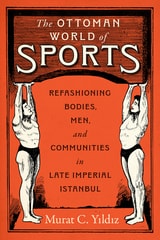
cover of The Ottoman World of Sports: Refashioning Bodies, Men, and Communities in Late Imperial Istanbul

The Ottoman World of Sports

Refashioning Bodies, Men, and Communities in Late Imperial Istanbul

Murat C. Yildiz

University of Texas Press, 2025

2026 co-winner of the Ottoman and Turkish Studies Association Book Prize
A revision of the history of modern sports in late Ottoman Istanbul, showing how Muslims, Christians, and Jews created a shared sports culture that was simultaneously global, imperial, and local.

The history of sports in Turkey is deeply contested. Over the decades, journalists, pundits, non-professional historians, sports scholars, and everyday people have offered competing narratives about the origins of modern sports in the late Ottoman Empire.

The Ottoman World of Sports tells the story of how Istanbul’s Muslims, Christians, and Jews—gymnastics teachers, football coaches, weightlifters, journalists, athletes, and fans—created a gendered and class-stratified civic project that promoted athletics as a source of fun, beauty, and moral education. Influenced by the emerging global vogue for organized sports, all boys from the expanding middle class of the late nineteenth- and early twentieth-century imperial capital were expected to exercise and compete on the playing field in order to develop into moral men. Yet even as the embrace of modern athletics transcended ethnoreligious divisions, it did not erase them. Drawing on a wide range of archival research in multiple languages, historian Murat Cihan Yıldız shows that sportsmen created new communal boundaries in team affiliations, fandom, and sports media. Adeptly reconstructing Istanbul’s imperial culture as it was experienced more than a century ago, The Ottoman World of Sports recovers a lived imperial culture whose defining features were shaped by its multiethnic, multireligious, and multilingual sportsmen.
[more]
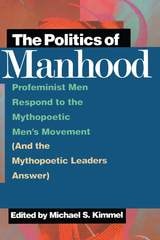
cover of The Politics of Manhood: Profeminist Men Respond to the Mythopoetic Men's Movement (And the Mythopoetic Leaders Answer)

The Politics of Manhood

Profeminist Men Respond to the Mythopoetic Men's Movement (And the Mythopoetic Leaders Answer)

edited by Michael S. Kimmel

Temple University Press, 1995
The concept and reality of revolution continue to pose some of the most challenging and important questions in the world today. What causes revolution? Why do some people participate in revolutionary events while others do not? What is the role of religion and ideology in causing and sustaining revolution? Why do some revolutions succeed and some fail? These questions have preoccupied philosophers and social scientists for centuries. In Revolution, Michael S. Kimmel examines why the study of revolution has attained such importance and he provides a systematic historical analysis of key ideas and theories. The book surveys the classical perspectives on revolution offered by nineteenth- and early twentieth-century theorists, such as Marx, Weber, Durkheim, Tocqueville, and Freud. Kimmel argues that their perspectives on revolution were affected by the reality of living through the revolutions of 1848 and 1917, a reality that raised crucial issues of class, state, bureaucracy, and motivation. The author then turns to the interpretations of revolution offered by social scientists in the post-World War II period, especially modernization theory and social psychological theories. Here, he contends that the relative quiescence of the 1950s cast revolutions in a different light, which was poorly suited to explain the revolutionary upheavals that have marked the 1960s, 1970s, and 1980s. With reference to the work of Barrington Moore, Theda Skocpol, Immanuel Wallerstein, and Charles Tilly, among others, Kimmel develops the criteria for a structural theory of revolution. This lucid, accessible account includes contemporary analyses of the Nicaraguan, Iranian, and Angolan revolutions.
[more]
cover of The Trials of Masculinity: Policing Sexual Boundaries, 1870-1930

The Trials of Masculinity

Policing Sexual Boundaries, 1870-1930

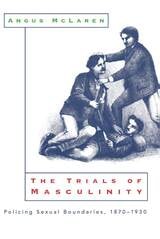
Angus McLaren

University of Chicago Press, 1997
In this path-breaking history of manhood and masculinity, Angus McLaren examines how nineteenth- and twentieth-century western society created what we now take to be the traditional model of the heterosexual male.
[more]
cover of The Trouble with Men: Reflections on Sex, Love, Marriage, Porn, and Power

The Trouble with Men

Reflections on Sex, Love, Marriage, Porn, and Power

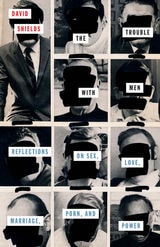
David Shields

The Ohio State University Press, 2019
David Shields’s The Trouble with Men: Reflections on Sex, Love, Marriage, Porn, and Power is an immersion into the perils, limits, and possibilities of human intimacy. All at once a love letter to his wife, a nervy reckoning with his own fallibility, a meditation on the impact of porn on American culture, and an attempt to understand marriage (one marriage, the idea of marriage, all marriages), The Trouble with Men is exquisitely balanced between the personal and the anthropological, nakedness and restraint. While unashamedly intellectual, it’s also irresistibly readable and extremely moving. Over five increasingly intimate chapters, Shields probes the contours of his own psyche and marriage, marshalling a chorus of other voices that leaven, deepen, and universalize his experience; his goal is nothing less than a deconstruction of eros and conventional masculinity. Masterfully woven throughout is an unmistakable and surprisingly tender cri de coeur to his wife. The risk and vulnerability on display are in the service of radical candor, acerbic wit, real emotion, and profound insight—exactly what we’ve come to expect from Shields, who, in an open invitation to the reader, leaves everything on the page.
[more]
cover of The Worth of Women: Wherein Is Clearly Revealed Their Nobility and Their Superiority to Men

The Worth of Women

Wherein Is Clearly Revealed Their Nobility and Their Superiority to Men

Moderata Fonte

University of Chicago Press, 1997

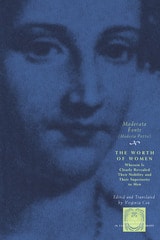
Gender equality and the responsibility of husbands and fathers: issues that loom large today had currency in Renaissance Venice as well, as evidenced by the publication in 1600 of The Worth of Women by Moderata Fonte.

Moderata Fonte was the pseudonym of Modesta Pozzo (1555–92), a Venetian woman who was something of an anomaly. Neither cloistered in a convent nor as liberated from prevailing codes of decorum as a courtesan might be, Pozzo was a respectable, married mother who produced literature in genres that were commonly considered "masculine"—the chivalric romance and the literary dialogue. This work takes the form of the latter, with Fonte creating a conversation among seven Venetian noblewomen. The dialogue explores nearly every aspect of women's experience in both theoretical and practical terms. These women, who differ in age and experience, take as their broad theme men's curious hostility toward women and possible cures for it.

Through this witty and ambitious work, Fonte seeks to elevate women's status to that of men, arguing that women have the same innate abilities as men and, when similarly educated, prove their equals. Through this dialogue, Fonte provides a picture of the private and public lives of Renaissance women, ruminating on their roles in the home, in society, and in the arts.

A fine example of Renaissance vernacular literature, this book is also a testament to the enduring issues that women face, including the attempt to reconcile femininity with ambition.
[more]
cover of To Be a Man Is Not a One-Day Job: Masculinity, Money, and Intimacy in Nigeria

To Be a Man Is Not a One-Day Job

Masculinity, Money, and Intimacy in Nigeria

Daniel Jordan Smith

University of Chicago Press, 2017

Refrains about financial hardship are ubiquitous in contemporary Nigeria, frequently expressed through the idiom “to be a man is not a one-day job.” But while men talk constantly about money, underlying their economic worries are broader concerns about the shifting meanings of masculinity, amid changing expectations and practices of intimacy.
 
Drawing on twenty-five years of experience in southeastern Nigeria, Daniel Jordan Smith takes readers through the principal phases and arenas of men’s lives: the transition to adulthood; searching for work and making a living; courtship, marriage, and fatherhood; fraternal and political relationships; and finally, the attainment of elder status and death. He relates men’s struggles both to fulfill their own aspirations and to meet society’s expectations. He also considers men who behave badly, mistreat their wives and children, or resort to crime and violence. All of these men face similar challenges as they navigate the complex geometry of money and intimacy. Unraveling these connections, Smith argues, provides us with a deeper understanding of both masculinity and society in Nigeria. 
[more]
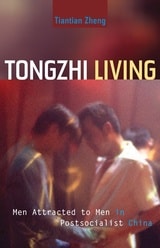
cover of Tongzhi Living: Men Attracted to Men in Postsocialist China

Tongzhi Living

Men Attracted to Men in Postsocialist China

Tiantian Zheng

University of Minnesota Press, 2015

Tongzhi, which translates into English as “same purpose” or “same will,” was once widely used to mean “comrade.” Since the 1990s, the word has been appropriated by the LGBT community in China and now refers to a broad range of people who do not espouse heteronormativity.

Tongzhi Living, the first study of its kind, offers insights into the community of same-sex-attracted men in the metropolitan city of Dalian in northeast China. Based on ethnographic fieldwork by Tiantian Zheng, the book reveals an array of coping mechanisms developed by tongzhi men in response to rapid social, cultural, and political transformations in postsocialist China. According to Zheng, unlike gay men in the West over the past three decades, tongzhi men in China have adopted the prevailing moral ideal of heterosexuality and pursued membership in the dominant culture at the same time they have endeavored to establish a tongzhi culture. They are, therefore, caught in a constant tension of embracing and contesting normality as they try to create a new and legitimate space for themselves.

Tongzhi men’s attempts to practice both conformity and rebellion paradoxically undercut the goals they aspire to reach, Zheng shows, perpetuating social prejudice against them and thwarting the activism they believe they are advocating.

[more]
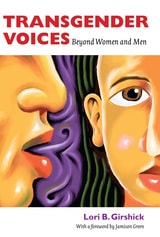
cover of Transgender Voices: Beyond Women and Men

Transgender Voices

Beyond Women and Men

Lori B. Girshick

University Press of New England, 2009

In this extraordinary book, based on 150 in-depth interviews, Lori B. Girshick, a sociologist and social justice activist, brings together the voices of sex- and gender-diverse people who speak with absolute candor about their lives. Girshick presents transpeople speaking in their own voices about identity, coming out, passing, sexual orientation, relationship negotiations and the dynamics of attraction, homophobia (including internalized fears), and bullying. She exposes the guilt and the shame that “gender police” use in their attempts to exert control and points out the many ways transpeople are discriminated against in daily life, from filling out identification documents to gender-segregated bathrooms. By showing us a variety of descriptions of diverse real lives and providing a thorough exploration of the embodied experiences of gender variant people, Girshick demonstrates that there is nothing inherently binary about gender, and that the way each of us experiences our own gender is, in fact, normal and natural.
[more]