60 books match the query 'Middle Eastern Studies' and 7 start with t

cover of Terracene: A Crude Aesthetics

Terracene

A Crude Aesthetics

Salar Mameni

Duke University Press, 2023
In Terracene Salar Mameni historicizes the popularization of the scientific notion of the Anthropocene alongside the emergence of the global war on terror. Mameni theorizes the Terracene as an epoch marked by a convergence of racialized militarism and environmental destruction. Both the Anthropocene and the war on terror centered the antagonist figures of the Anthropos and the terrorist as responsible for epochal changes in the new geological and geopolitical world orders. In response, Mameni shows how the Terracene requires radically new engagements with terra (the earth), whose intelligence resides in matters such as oil and phenomena like earthquakes and fires. Drawing on the work of artists whose practices interrogate histories of settler-colonial and imperial interests in land and resources in Iran, Iraq, Yemen, Kuwait, Syria, Palestine, and other regions most affected by the war on terror, Mameni offers speculative paths into the aesthetics of the Terracene.
[more]
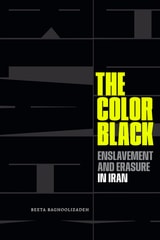
cover of The Color Black: Enslavement and Erasure in Iran

The Color Black

Enslavement and Erasure in Iran

Beeta Baghoolizadeh

Duke University Press, 2024
In The Color Black, Beeta Baghoolizadeh traces the twin processes of enslavement and erasure of Black people in Iran during the nineteenth and twentieth centuries. She illustrates how geopolitical changes and technological advancements in the nineteenth century made enslaved East Africans uniquely visible in their servitude in wealthy and elite Iranian households. During this time, Blackness, Africanness, and enslavement became intertwined—and interchangeable—in Iranian imaginations. After the end of slavery in 1929, the implementation of abolition involved an active process of erasure on a national scale, such that a collective amnesia regarding slavery and racism persists today. The erasure of enslavement resulted in the erasure of Black Iranians as well. Baghoolizadeh draws on photographs, architecture, theater, circus acts, newspapers, films, and more to document how the politics of visibility framed discussions around enslavement and abolition during the nineteenth and twentieth centuries. In this way, Baghoolizadeh makes visible the people and histories that were erased from Iran and its diaspora.
[more]
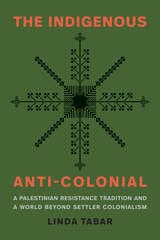
cover of The Indigenous Anti-Colonial: A Palestinian Resistance Tradition and a World Beyond Settler Colonialism

The Indigenous Anti-Colonial

A Palestinian Resistance Tradition and a World Beyond Settler Colonialism

Linda Tabar

Duke University Press, 2026
In The Indigenous Anti-Colonial, Linda Tabar explores the radical tradition in which Palestinians remain defiant and undeterred as they hold onto their world and resist settler colonialism. Using a living archive of memory and oral knowledges to trace this long tradition, Tabar outlines the way Palestinians refuse and counter Zionist efforts to erase Palestinian presence and history from the land with an unyielding resistance that is distinctly Indigenous, shaped by Palestinians’ bonds with the land and the world that they built with it. This Indigenous anticolonial radical tradition produces its own imaginaries of liberation that seek a world beyond settler colonialism, white supremacy, and capitalism, constructing alternative conditions for freedom. As Israeli settler colonialism accelerates its attempts to eradicate the Palestinian people and the horrors of its genocide in Gaza are broadcast to the world, Tabar puts Palestinian conceptions of liberation at the center of conversations around settler colonialism.
[more]
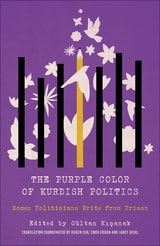
cover of The Purple Color of Kurdish Politics: Women Politicians Write from Prison

The Purple Color of Kurdish Politics

Women Politicians Write from Prison

Gultan Kisanak

Pluto Press, 2022

Prison writings from twenty-two Kurdish women who were elected to office in Turkey and then imprisoned by the state on political grounds.

Gültan Kışanak, a Kurdish journalist and former MP, was elected co-mayor of Diyarbakır in 2014. Two years later, the Turkish state arrested and imprisoned her. Her story is remarkable, but not unique. While behind bars, she wrote about her own experiences and collected similar accounts from other Kurdish women, all co-chairs, co-mayors, and MPs in Turkey; all incarcerated on political grounds.

The Purple Colour of Kurdish Politics is a one-of-a-kind collection of prison writings from twenty-two Kurdish women politicians. Here they reflect on their personal and collective struggles against patriarchy and anti-Kurdish repression in Turkey; on the radical feminist principles and practices through which they transformed the political structures and state offices in which they operated. They discuss what worked and what didn’t, and the ways in which Turkey’s anti-capitalist and socialist movements closely informed their political stances and practices.

Demonstrating Kurdish women’s ceaseless political determination and refusal to be silenced – even when behind bars – the book ultimately hopes to inspire women living under even the most unjust conditions to engage in collective resistance.
[more]
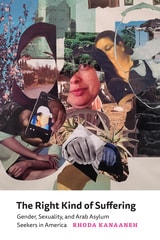
cover of The Right Kind of Suffering: Gender, Sexuality, and Arab Asylum Seekers in America

The Right Kind of Suffering

Gender, Sexuality, and Arab Asylum Seekers in America

Rhoda Kanaaneh

University of Texas Press, 2023

2024 Evelyn Shakir Non-Fiction Academic Award, The Arab American National Museum

An examination of Arab asylum seekers who feel compelled to package their tales of disenfranchisement and suffering to satisfy a deeply reluctant immigration system.

From the overloaded courts with their constantly changing dates and appointments to the need to prove oneself the “right” kind of victim, the asylum system in the United States is an exacting and drawn-out immigration process that itself results in suffering. When anthropologist Rhoda Kanaaneh became a volunteer interpreter for Arab asylum seekers, she learned how applicants were pushed to craft specific narratives to satisfy the system’s requirements.

Kanaaneh tells the stories of four Arab asylum seekers who sought protection in the United States on the basis of their gender or sexuality: Saud, who relived painful memories of her circumcision and police harassment in Sudan and then learned to number and sequence these recollections; Fatima, who visited doctors and therapists in order to document years of spousal abuse without over-emphasizing her resulting mental illness; Fadi, who highlighted the homophobic motivations that provoked his arrest and torture in Jordan, all the while sidelining connected issues of class and racism; and Marwa, who showcased her private hardships as a lesbian in a Shiite family in Lebanon and downplayed her environmental activism. The Right Kind of Suffering is a compelling portrait of Arab asylum seekers whose success stories stand in contrast with those whom the system failed.
[more]
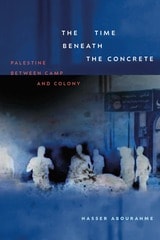
cover of The Time beneath the Concrete: Palestine between Camp and Colony

The Time beneath the Concrete

Palestine between Camp and Colony

Nasser Abourahme

Duke University Press, 2025
In The Time beneath the Concrete, Nasser Abourahme argues that settler colonialism is always as much an attempt to conquer time as it is to conquer land. Taking as his primary object  Palestinian refugee camps, created in the fallout of the eliminatory violence of Israel’s founding, Abourahme shows how these camps become the primary place where settler colonial attempts to dominate space and time encounter Indigenous refusal. Seen from the camps, Israel becomes a settler colonial project defined by its inability to move past the past—a project stuck at its foundational moment of conquest. At the same time, the Palestinian insistence on return is a refusal to abide by the closure of the past into settler futurity. Palestinian struggle does not just happen in the open time of dispossession; it happens over this time. That struggle, Abourahme demonstrates, is a form of anticolonial refusal that draws its power not from any decisive finality, but precisely from irresolution and keeping time open.
[more]
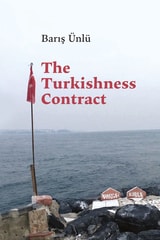
cover of The Turkishness Contract

The Turkishness Contract

Baris Ünlü

Temple University Press, 2025

The Turkishness Contract places Critical Race Theory in conversation with literature on Turkey and nation-state making via a historical study enriched by in-depth interviews. In this new English-language edition, Barış Ünlü makes a number of comprehensive changes to his widely read and much discussed 2018 Turkish book, including a new preface and a new sweeping and theoretical introduction.

Ünlü uses Critical Race Theory to present a historical–sociological model to examine not only the historical constitution and contemporary functioning of the Turkish nation-state, but also the affective and bodily modalities of being Turkish. He also develops a framework for rethinking the complex relations between the socio-genesis of the Turkish nation and state and the psycho-genesis of the Turkish people, their cognitive habits and emotional orientations, and the structural privileges and unconsciousness strategies of Turkishness.

The Turkishness Contract addresses broader theoretical concerns including histories of colonialism, ethnic/racial social contracts, privilege, Armenian Genocide and the Kurdish question, as well as the unraveling of Turkey’s social contract at a moment of contemporary right-wing authoritarianism. 

In the series Critical Race, Indigeneity, and Relationality
[more]