Results by title
491 books match the query 'Moral and ethical aspects' and 98 start with t
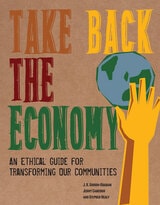
Take Back the Economy
An Ethical Guide for Transforming Our CommunitiesJ. K. Gibson-Graham
University of Minnesota Press, 2013
In the wake of economic crisis on a global scale, more and more people are reconsidering their role in the economy and wondering what they can do to make it work better for humanity and the planet. In this innovative book, J. K. Gibson-Graham, Jenny Cameron, and Stephen Healy contribute complex understandings of economics in practical terms: what can we do right now, in our own communities, to make a difference?
Full of exercises, thinking tools, and inspiring examples from around the world, Take Back the Economy shows how people can implement small-scale changes in their own lives to create ethical economies. There is no manifesto here, no one prescribed model; rather, readers are encouraged and taught how to take back the economy in ways appropriate for their own communities and context, using what they already have at hand.
Take Back the Economy dismantles the idea that the economy is separate from us and best comprehended by experts. Instead, the authors demonstrate that the economy is the outcome of the decisions and efforts we make every day. The economy is thus reframed as a space of ethical action—something we can shape and alter according to what is best for the well-being of people and the planet. The book explores what people are already doing to build ethical economies, presenting these deeds as mutual concerns: What is necessary for survival, and what do we do with the surplus produced beyond what will fulfill basic needs? What do we consume, and how do we preserve and replenish the commons—those resources that can be shared to maintain all? And finally, how can we invest in a future worth living in?
Suitable for activists and students alike, Take Back the Economy will be of interest to anyone seeking a more just, sustainable, and equitable world.

Technological Turf Wars
A Case Study of the Computer Antivirus IndustryJessica Johnston
Temple University Press, 2008
In Technological Turf Wars, Jessica Johnston analyzes the tensions and political dilemmas that coexist in the interrelationship among science, technology and society. Illustrating how computer security is as concerned with social relationships as it is with technology, Johnston provides an illuminating ethnography that considers corporate culture and the workplace environment of the antivirus industry.
Using a qualitative, interdisciplinary approach, which combines organizational and security studies with critical and social analysis of science and technology, Johnston questions the motivations, contradictions and negotiations of antivirus professionals. She examines the tensions between the service ethics and profit motives—does the industry release viruses to generate demand for antivirus software?—and considers the dynamics within companies by looking at facets such as gender bias and power politics. Technological Turf Wars is an informed, enlightened and entertaining view of how the production of computer security technology is fraught with social issues.
Technology and Religion
Remaining Human Co-created WorldNoreen Herzfeld
Templeton Press, 2009
Technology is changing all the time, but does it also have the ability to change us and the way we approach religion and spirituality? In Technology and Religion: Remaining Human in a Co-created World, Noreen Herzfeld examines this and other provocative questions as she provides an accessible and fascinating overview of the relationship between religion and the ever-broadening world of technology.
The result is a multifaceted look at the ongoing dialogue between these two subjects that are not commonly associated with one another. This volume is the third title published in the new Templeton Science and Religion Series.

Terrorism, Ticking Time-Bombs, and Torture
A Philosophical AnalysisFritz Allhoff
University of Chicago Press, 2012
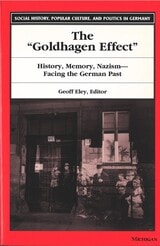
The "Goldhagen Effect"
History, Memory, Nazism--Facing the German PastGeoff Eley, Editor
University of Michigan Press, 2000
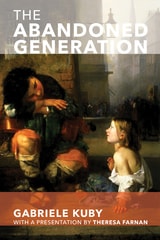
The Abandoned Generation
Gabriele Kuby
St. Augustine's Press, 2021
Reading Kuby’s analysis of cultural, sociological and biological data, the danger is clear and present. Yet Kuby asserts that, generally, our plight goes unnoticed and is veiled from our eyes. We need to see children for who and what they really are to us, to the family, and society at large. In the words of Fulton Sheen, “Children play a redeemer role in the family. The represent the victory of love over the insatiable ego. They symbolize the defeat of selfishness and the triumph of giving love.” Tragically, children are increasingly less a part of Western culture. This leaves the family, in the best case scenario, an artifact, and in the worst case, a casualty.
The topics addressed by Kuby cover towering influences in postmodern family life: Gender politics, the abortion mentality, daycare (“Socialism 2.0”), premature stress, rights of children, digital distractions, pornography, and divorce. A native German, Kuby’s work is, heartbreakingly, as relevant to American society as her own. This European perspective drives home the urgent need to recognize our situation as global and embedded, and one that requires more than political mobilization of mainstream efforts and responses. What really is good and normal, and how to we realize it? Listen to the heartstrings that yearn for true knowledge of oneself, Kuby implores, of God, and how in the surprise of God’s mercy we are guided through life. Kuby backs up this invitation to personal conversion and betterment with hard data.
The Afterlife of Data
What Happens to Your Information When You Die and Why You Should CareCarl Öhman
University of Chicago Press, 2024
A short, thought-provoking book about what happens to our online identities after we die.
These days, so much of our lives takes place online—but what about our afterlives? Thanks to the digital trails that we leave behind, our identities can now be reconstructed after our death. In fact, AI technology is already enabling us to “interact” with the departed. Sooner than we think, the dead will outnumber the living on Facebook. In this thought-provoking book, Carl Öhman explores the increasingly urgent question of what we should do with all this data and whether our digital afterlives are really our own—and if not, who should have the right to decide what happens to our data.
The stakes could hardly be higher. In the next thirty years alone, about two billion people will die. Those of us who remain will inherit the digital remains of an entire generation of humanity—the first digital citizens. Whoever ends up controlling these archives will also effectively control future access to our collective digital past, and this power will have vast political consequences. The fate of our digital remains should be of concern to everyone—past, present, and future. Rising to these challenges, Öhman explains, will require a collective reshaping of our economic and technical systems to reflect more than just the monetary value of digital remains.
As we stand before a period of deep civilizational change, The Afterlife of Data will be an essential guide to understanding why and how we as a human race must gain control of our collective digital past—before it is too late.
The Aims of Higher Education
Problems of Morality and JusticeEdited by Harry Brighouse and Michael McPherson
University of Chicago Press, 2015
The contributors tackle the biggest questions in higher education: What are the proper aims of the university? What role do the liberal arts play in fulfilling those aims? What is the justification for the humanities? How should we conceive of critical reflection, and how should we teach it to our students? How should professors approach their intellectual relationship with students, both in social interaction and through curriculum? What obligations do elite institutions have to correct for their historical role in racial and social inequality? And, perhaps most important of all: How can the university serve as a model of justice? The result is a refreshingly thoughtful approach to higher education and what it can, and should, be doing.
The Ambivalence of Scarcity and Other Essays
Paul Dumouchel
Michigan State University Press, 2014
The Animal Claim
Sensibility and the Creaturely VoiceTobias Menely
University of Chicago Press, 2015
In the Restoration and eighteenth century, philosophers emphasized the role of sympathy in collective life and began regarding the passionate expression humans share with animals, rather than the spoken or written word, as the elemental medium of community. Menely shows how poetry came to represent this creaturely voice and, by virtue of this advocacy, facilitated the development of a viable discourse of animal rights in the emerging public sphere. Placing sensibility in dialogue with classical and early-modern antecedents as well as contemporary animal studies, The Animal Claim uncovers crucial connections between eighteenth-century poetry; theories of communication; and post-absolutist, rights-based politics.
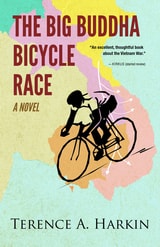
The Big Buddha Bicycle Race
A NovelTerence A. Harkin
Ohio University Press, 2017
Silver Medalist in Literary Fiction, 2020 Military Writers Society of America Awards
Brendan Leary, assigned to an Air Force photo squadron an hour from L.A., thinks he has it made. But when the U.S. invades Cambodia and he joins his buddies who march in protest, he is shipped off to an obscure air base in upcountry Thailand. There, he finds himself flying at night over the Ho Chi Minh Trail in a secret war that turns the mountains of Laos into a napalm-scorched moonscape. As the emotional vise tightens, his moral fiber crumbles and he sinks ever deeper into a netherworld of drugs, sex, and booze.
When a visit by Nixon looms, Brendan dreams up an all-squadron bicycle race to build morale, win hearts and minds in rural Thailand, and make him and his underpaid buddies a pile of money. The Big Buddha Bicycle Race is a last gasp of hope that turns into a unifying adventure—until the stakes turn out to be far higher than anyone imagined.
The Big Buddha Bicycle Race is a new take on the Vietnam War. A caper on the surface, it is also a tribute to the complex culture and history of Southeast Asia and a sober remembrance of those groups who have been erased from American history—the brash active-duty soldiers who risked prison by taking part in the GI antiwar movement, the gutsy air commandos who risked death night after night flying over the Ho Chi Minh Trail, and the people of Laos, whose lives and land were devastated in ways that have yet to be fully acknowledged in Western accounts of the war.
The Big Data Agenda
Data Ethics and Critical Data StudiesAnnika Richterich
University of Westminster Press, 2018
This book highlights that the capacity for gathering, analysing, and utilising vast amounts of digital (user) data raises significant ethical issues. Annika Richterich provides a systematic contemporary overview of the field of critical data studies that reflects on practices of digital data collection and analysis. The book assesses in detail one big data research area: biomedical studies, focused on epidemiological surveillance. Specific case studies explore how big data have been used in academic work.
The Big Data Agenda concludes that the use of big data in research urgently needs to be considered from the vantage point of ethics and social justice. Drawing upon discourse ethics and critical data studies, Richterich argues that entanglements between big data research and technology/ internet corporations have emerged. In consequence, more opportunities for discussing and negotiating emerging research practices and their implications for societal values are needed.
An electronic version of this book is freely available, thanks to the support of libraries working with Knowledge Unlatched. KU is a collaborative initiative designed to make high quality books Open Access for the public good. More information about the initiative and details about KU's Open Access programme can be found at www.knowledgeunlatched.org.

The Boiler Room and Other Telephone Sales Scams
Robert J. Stevenson
University of Illinois Press, 1998
The Boiler Room and Other Telephone Sales Scams is grounded in the nine years Robert Stevenson spent working covertly as a "participant-observer" in telephone rooms (the ethical implications of which he discusses in an epilogue). As Stevenson details boiler room hierarchy, you'll learn why all boilers are telephone salesmen but not all telephone salesmen are boilers. You'll read about the "heat" rising in rooms where experienced pitchmen use tried-and-true manipulative techniques to overcome objections to sales. And you'll marvel at Stevenson's insider knowledge of product houses, service shops, and other aspects of a major industry in which both employees and customers are in daily peril—the former of losing their jobs and the latter of losing their money.
The Boiler Room and Other Telephone Sales Scams is required reading for anyone who's ever picked up a telephone and been asked to buy a product or a service. It's also an invaluable study of a widespread form of deviance and occupational crime, essential reading for students of criminology and the sociology of occupations.
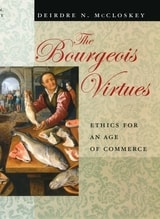
The Bourgeois Virtues
Ethics for an Age of CommerceDeirdre Nansen McCloskey
University of Chicago Press, 2006
McCloskey’s sweeping, charming, and even humorous survey of ethical thought and economic realities—from Plato to Barbara Ehrenreich—overturns every assumption we have about being bourgeois. Can you be virtuous and bourgeois? Do markets improve ethics? Has capitalism made us better as well as richer? Yes, yes, and yes, argues McCloskey, who takes on centuries of capitalism’s critics with her erudition and sheer scope of knowledge. Applying a new tradition of “virtue ethics” to our lives in modern economies, she affirms American capitalism without ignoring its faults and celebrates the bourgeois lives we actually live, without supposing that they must be lives without ethical foundations.
High Noon, Kant, Bill Murray, the modern novel, van Gogh, and of course economics and the economy all come into play in a book that can only be described as a monumental project and a life’s work. The Bourgeois Virtues is nothing less than a dazzling reinterpretation of Western intellectual history, a dead-serious reply to the critics of capitalism—and a surprising page-turner.

The Cancer Stage of Capitalism
From Crisis to CureJohn McMurtry
Pluto Press, 2013
The Cancer Stage of Capitalism is a modern classic of critical philosophy and political economy, renowned for its depth and comprehensive research. It provides a step by step diagnosis of the continuing economic collapse in the US and Europe and has had an enormous influence on new visions of economic alternatives.
John McMurtry argues that our world disorder of unending crises is the predictable result of a cancerous economic system multiplying out of all control and destroying ecological, social and organic life - a process he describes as 'global ecogenocide'. In this updated edition he explains the ‘social immune response’ required to fight the ‘macro cancer’, something which has already been shown in developments such as the Occupy movement and the democratic social transformation of Latin America.
In an official global culture increasingly destructive of life, this book shows the necessity and possibility of building a sustainable society based on a universal commitment to life and nature.
The Center Cannot Hold
Decolonial Possibility in the Collapse of a Tanzanian NGOJenna N. Hanchey
Duke University Press, 2023
The Common Cause
Postcolonial Ethics and the Practice of Democracy, 1900-1955Leela Gandhi
University of Chicago Press, 2014
Reframing the way we think about some of the most consequential political events of the era, Gandhi presents moral imperfectionism as the lost tradition of global democratic thought and offers it to us as a key to democracy’s future. In doing so, she defends democracy as a shared art of living on the other side of perfection and mounts a postcolonial appeal for an ethics of becoming common.
The Consciousness of the Litigator
Duffy Graham
University of Michigan Press, 2005
---Kimberly Kirkland, Franklin Pierce Law Center
The Consciousness of the Litigator investigates the role of the lawyer in modern American political and social life and in the judicial process, and plumbs lawyers' perceptions of themselves, their work, and, especially, their sense of right and wrong.
In so doing, the book sheds light on the unique and little-examined subject of the moral mind of the litigator, whose work extends to all corners of society and whose primary expertise---making legal arguments---is the fundamental skill of all lawyers.
The Consciousness of the Litigator stands with Michael Kelly's Lives of Lawyers as a must-read for the many law students, scholars, and practicing litigators who struggle to balance ethical questions with the dictates of their highly commercialized profession.
The Contested Crown
Repatriation Politics between Europe and MexicoKhadija von Zinnenburg Carroll
University of Chicago Press, 2022
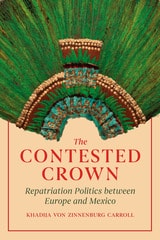
In The Contested Crown, Khadija von Zinnenburg Carroll meditates on the case of a spectacular feather headdress believed to have belonged to Montezuma, emperor of the Aztecs. This crown has long been the center of political and cultural power struggles, and it is one of the most contested museum claims between Europe and the Americas. Taken to Europe during the conquest of Mexico, it was placed at Ambras Castle, the Habsburg residence of the author’s ancestors, and is now in Vienna’s Welt Museum. Mexico has long requested to have it back, but the Welt Museum uses science to insist it is too fragile to travel.
Both the biography of a cultural object and a history of collecting and colonizing, this book offers an artist’s perspective on the creative potentials of repatriation. Carroll compares Holocaust and colonial ethical claims, and she considers relationships between indigenous people, international law and the museums that amass global treasures, the significance of copies, and how conservation science shapes collections. Illustrated with diagrams and rare archival material, this book brings together global history, European history, and material culture around this fascinating object and the debates about repatriation.
The Corporation That Changed the World
How the East India Company Shaped the Modern MultinationalNick Robins
Pluto Press, 2012
"Elegantly written and sharply argued, Nick Robins' gripping account of the rise and fall of the English East India Company brings to life a crucial episode in the history of globalization."—Sankar Muthu, University of Chicago
The English East India Company was the mother of the modern multinational. Its trading empire encircled the globe, importing Asian luxuries such as spices, textiles, and teas. But it also conquered much of India with its private army and broke open China's markets with opium. The Company's practices shocked its contemporaries and still reverberate today, offering lessons about unfettered capitalism, corporate responsibility, and the legacy of colonialism.
The Corporation That Changed the World is the first book to reveal the Company's enduring legacy as a corporation. This expanded edition explores how the four forces of scale, technology, finance, and regulation drove its spectacular rise and fall. For decades, the Company was simply too big to fail, and stock market bubbles, famines, drug-running, and even duels between rival executives are to be found in this new account.
Table of Contents:
Introduction
Chronology
1 The Hidden Wound
2 The Imperious Company
3 Out of the Shadows
4 The Bengal Revolution
5 The Great East Indian Crash
6 Regulating the Company
7 Justice Will Be Done
8 The Toxic Exchange
10 The Unfettered Business
Epilogue
For Robins, the Company's story provides vital lessons on both the role of corporations in world history and the steps required to make global business accountable today.

The Cow with Ear Tag #1389
Kathryn Gillespie
University of Chicago Press, 2018
The Creativity Complex
Art, Tech, and the Seduction of an IdeaShannon Steen
University of Michigan Press, 2023
“Creativity” is a word that excites and dazzles us. It promises brilliance and achievement, a shield against conformity, a channel for innovation across the arts, sciences, technology, and education, and a mechanism for economic revival and personal success. But it has not always evoked these ideas. The Creativity Complex traces the history of how creativity has come to mean the things it now does, and explores the ethical implications of how we use this term today for both the arts and for the social world more broadly. Richly researched, the book explores how creativity has been invoked in arenas as varied as Enlightenment debates over the nature of cognition, Victorian-era intelligence research, the Cold War technology race, contemporary K-12 education, and even modern electoral politics. Ultimately, The Creativity Complex asks how our ideas about creativity are bound up with those of self-fulfillment, responsibility, and the individual, and how these might seduce us into joining a worldview and even a set of social imperatives that we might otherwise find troubling.

The Cross of War
Christian Nationalism and U.S. Expansion in the Spanish-American WarMatthew McCullough
University of Wisconsin Press, 2014

The Culture of Merit
Nobility, Royal Service, and the Making of Absolute Monarchy in France, 1600-1789Jay M. Smith
University of Michigan Press, 1996
Jay M. Smith argues that the early modern nobility instinctively drew a correlation between the meaning of merit and an image of the "sovereign's gaze." In the early seventeenth century, merit meant the qualities traditionally associated with aristocratic values: generosity, fidelity, and honor. Nobles sought to display those qualities before the appreciative gaze of the king himself. But the expansion of the monarchy forced the routinization of the sovereign's gaze, and Louis XIV began to affirm and reward new qualities--talent and application--besides those thought innately noble.
The contradictions implicit within the absolute monarchy's culture of merit are demonstrated by the eighteenth-century French army, which was dominated by the nobility, but also committed to efficiency and expertise. Smith shows that the army's continuous efforts to encourage and reward "merit" led to a clash of principles. The ever-growing emphasis on talent and discipline led reformers--the great majority of them noble--to attack the most egregious examples of privilege and favoritism in the army. Smith's analysis of the long-term evolution in conceptions of royal service suggests a new explanation for the shift in values signified by the French Revolution. The transition away from the "personal" gaze of the king toward the "public" gaze of the monarchy and nation foretold the triumph of a new culture of merit in which noble birth would have no meaning.
The Culture of Merit will interest historians and other social scientists concerned with issues of aristocratic identity, state formation, professionalization, and the changing political culture of pre-Revolutionary France.
Jay M. Smith is Assistant Professor of History, University of North Carolina, Chapel Hill.
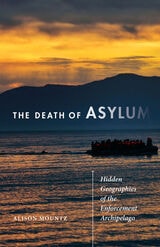
The Death of Asylum
Hidden Geographies of the Enforcement ArchipelagoAlison Mountz
University of Minnesota Press, 2020
Investigating the global system of detention centers that imprison asylum seekers and conceal persistent human rights violations
Remote detention centers confine tens of thousands of refugees, asylum seekers, and undocumented immigrants around the world, operating in a legal gray area that hides terrible human rights abuses from the international community. Built to temporarily house eight hundred migrants in transit, the immigrant “reception center” on the Italian island of Lampedusa has held thousands of North African refugees under inhumane conditions for weeks on end. Australia’s use of Christmas Island as a detention center for asylum seekers has enabled successive governments to imprison migrants from Asia and Africa, including the Sudanese human rights activist Abdul Aziz Muhamat, held there for five years.
In The Death of Asylum, Alison Mountz traces the global chain of remote sites used by states of the Global North to confine migrants fleeing violence and poverty, using cruel measures that, if unchecked, will lead to the death of asylum as an ethical ideal. Through unprecedented access to offshore detention centers and immigrant-processing facilities, Mountz illustrates how authorities in the United States, the European Union, and Australia have created a new and shadowy geopolitical formation allowing them to externalize their borders to distant islands where harsh treatment and deadly force deprive migrants of basic human rights.
Mountz details how states use the geographic inaccessibility of places like Christmas Island, almost a thousand miles off the Australian mainland, to isolate asylum seekers far from the scrutiny of humanitarian NGOs, human rights groups, journalists, and their own citizens. By focusing on borderlands and spaces of transit between regions, The Death of Asylum shows how remote detention centers effectively curtail the basic human right to seek asylum, forcing refugees to take more dangerous risks to escape war, famine, and oppression.
The Degradation of American History
David Harlan
University of Chicago Press, 1997
Part One, "The Legacy of the Sixties," describes the impact of literary theory in the 1970s and beyond, the rise of women's history, the various forms of ideological analysis developed by historians on the left, and the crippling obsession with professionalism in the 1980s. Part Two, "The Renewal of American Historical Writing," focuses on the contributions of John Patrick Diggins, Hayden White, Richard Rorty, Elaine Showalter, Henry Louis Gates Jr., and others. Harlan argues that at the end of the twentieth century American historical writing is perfectly poised to become what it once was: not one of the social sciences in historical costume, but a form of moral reflection that speaks to all Americans.
"[A] wholly admirable work. This book will be talked about for years."—Library Journal
The Dignity of Commerce
Markets and the Moral Foundations of Contract LawNathan B. Oman
University of Chicago Press, 2016
With The Dignity of Commerce, Nathan B. Oman argues persuasively that well-functioning markets are morally desirable in and of themselves and thus a fit object of protection through contract law. Markets, Oman shows, are about more than simple economic efficiency. To do business with others, we must demonstrate understanding of and satisfy their needs. This ability to see the world from another’s point of view inculcates key virtues that support a liberal society. Markets also provide a context in which people can peacefully cooperate in the absence of political, religious, or ideological agreement. Finally, the material prosperity generated by commerce has an ameliorative effect on a host of social ills, from racial discrimination to environmental destruction.
The first book to place the moral status of the market at the center of the justification for contract law, The Dignity of Commerce is sure to elicit serious discussion about this central area of legal studies.
The Economics and the Ethics of Constitutional Order
James M. Buchanan
University of Michigan Press, 1991
The Ecosystem Approach in Anthropology serves as a foundational methodology guide for modern ecological and environmental anthropology. The book advocates for a rigorous, integrative approach to studying human societies by framing them as deeply interconnected components of larger biological ecosystems. Moran gathers a diverse cohort of leading researchers to demonstrate how abstract ecosystem concepts can be translated into concrete, empirical field practices across varying environments, ranging from tropical rainforests to arid landscapes. By bridging the gap between cultural anthropology and natural sciences like ecology, soil science, and demography, the volume offers critical frameworks for quantifying energy flows, resource consumption, and human-environmental feedback loops, making it an indispensable resource for analyzing complex social-ecological systems and anthropogenic environmental changes.
The Economics of Transformative AI
Edited by Ajay Agrawal, Erik Brynjolfsson, and Anton Korinek
University of Chicago Press, 2026
A thought-provoking examination of how AI might either spur or harm human economic progress.
What happens to an economy when machines can think as well as, or even better than, humans? The Economics of Transformative AI tackles this issue, which is one of the most consequential economic questions of our time. This book brings together sixteen research studies from top economists that look closely at how transformative AI reshapes everything from innovation and market structure to employment, inequality, and human purpose. They explore both opportunities, such as personalized algorithmic assistance, accelerated scientific discovery, and new forms of organization, and profound challenges, including potential labor displacement, rising concentration of power, changes in the information ecosystem, and even possible existential risks to humanity.
The studies in this volume develop economic frameworks for understanding the conditions under which AI might enhance or undermine human flourishing. They offer policymakers, researchers, and business leaders the analytical tools needed to prepare for the potential economic transformations ahead.
The Ethical Case against Animal Experiments
Andrew Linzey, Clair Linzey
University of Illinois Press, 2018
The Ethical Case against Animal Experiments begins with the Oxford Centre for Animal Ethics's groundbreaking and comprehensive ethical critique of the practice of animal experiments. A second section offers original writings that engage with, and elaborate on, aspects of the Oxford Centre report. The essayists explore historical, philosophical, and personal perspectives that range from animal experiments in classical times to the place of necessity in animal research to one researcher's painful journey from researcher to opponent.
A devastating look at a contemporary moral crisis, The Ethical Case against Animal Experiments melds logic and compassion to mount a powerful challenge to human cruelty.
The Ethics and Politics of Speech
Communication and Rhetoric in the Twentieth CenturyPat J. Gehrke
Southern Illinois University Press, 2009
In The Ethics and Politics of Speech, Pat J. Gehrke provides an accessible yet intensive history of the speech communication discipline during the twentieth century. Drawing on several previously unpublished or unexamined sources—including essays, conference proceedings, and archival documents—Gehrke traces the evolution of communication studies and the dilemmas that often have faced academics in this field. In his examination, Gehrke not only provides fresh perspectives on old models of thinking; he reveals new methods for approaching future studies of ethical and political communication.
Gehrke begins his history with the first half of the twentieth century, discussing the development of a social psychology of speech and an ethics based on scientific principles, and showing the importance of democracy to teaching and scholarship at this time. He then investigates the shift toward philosophical—especially existential—ways of thinking about communication and ethics starting in the 1950s and continuing through the mid-1970s, a period associated with the rise of rhetoric in the discipline. In the chapters covering the last decades of the twentieth century, Gehrke demonstrates how the ethics and politics of communication were directed back onto the practices of scholarship within the discipline, examining the increased use of postmodern and poststructuralist theories, as well as the new trend toward writing original theory, rather than reinterpreting the past. In offering a thorough history of rhetoric studies, Gehrke sets the stage for new questions and arguments, ultimately emphasizing the deeply moral and political implications that by nature embed themselves in the field of communication.
More than simply a history of the discipline's major developments, The Ethics and Politics of Speech is an account of the philosophical and moral struggles that have faced communication scholars throughout the last century. As Gehrke explores the themes and movements within rhetoric and speech studies of the past, he also provides a better understanding of the powerful forces behind the forging of the field. In doing so, he reveals history’s potential to act as a vehicle for further academic innovation in the future.
The Ethics of Care
A Feminist Approach to Human SecurityFiona Robinson
Temple University Press, 2011
In The Ethics of Care, Fiona Robinson demonstrates how the responsibilities of sustaining life are central to the struggle for basic human security. She takes a unique approach, using a feminist lens to challenge gender biases in rights-based, individualist approaches.Robinson's thorough and impassioned consideration of care in both ethical and practical terms provides a starting point for understanding and addressing the material, emotional and psychological conditions that create insecurity for people. The Ethics of Careexamines “care ethics” and “security” at the theoretical level and explores the practical implications of care relations for security in a variety of contexts: women's labor in the global economy, humanitarian intervention and peace building, healthcare, and childcare.
Theoretically-innovative and policy-relevant, this critical analysis demonstrates the need to understand the obstacles and inequalities that obstruct the equitable and adequate delivery of care around the world.

The Ethics of Earth Art
Amanda Boetzkes
University of Minnesota Press, 2010
The Ethics of History
John McCumber
Northwestern University Press, 2004
The Ethics of Oneness
Emerson, Whitman, and the Bhagavad GitaJeremy David Engels
University of Chicago Press, 2021
In The Ethics of Oneness, Jeremy David Engels reads the Bhagavad Gita alongside the works of American thinkers Ralph Waldo Emerson and Walt Whitman. Drawing on this rich combination of traditions, Engels presents the notion that individuals are fundamentally interconnected in their shared divinity. In other words, everything is one. If the lessons of oneness are taken to heart, particularly as they were expressed and celebrated by Whitman, and the ethical challenges of oneness considered seriously, Engels thinks it is possible to counter the pervasive and problematic American ideals of hierarchy, exclusion, violence, and domination.
The Ethics of Organ Transplantation
Steven J. Jensen
Catholic University of America Press, 2011
The Ethos of Drama
Rhetorical Theory and Dramatic WorthRobert L. King
Catholic University of America Press, 2010
The Everest Effect
Nature, Culture, IdeologyElizabeth Mazzolini
University of Alabama Press, 2015
The Everest Effect is an accessibly written cultural history of how nature, technology, and culture have worked together to turn Mount Everest into a powerful and ubiquitous physical measure of Western values.
In The Everest Effect Elizabeth Mazzolini traces a series of ideological shifts in the status of Mount Everest in Western culture over the past century to the present day and links these shifts to technologies used in climbs. By highlighting the intersections of technology and cultural ideologies at this site of environmental extremity, she shows both how nature is shaped—physically and symbolically—by cultural values and how extreme natural phenomena shape culture.
Nostalgia, myth, and legend are intrinsic features of the conversations that surround discussions of historic and contemporary climbs of Everest, and those conversations themselves reflect changing relations between nature, technology, and ideology. Each of the book’s chapters links a particular value with a particular technology to show how technology is implicated in Mount Everest’s cultural standing and commodification: authenticity is linked with supplemental oxygen; utility with portable foodstuffs; individuality with communication technology; extremity with visual technology; and ability with money. These technologies, Mazzolini argues, are persuasive—and increasingly so as they work more quickly and with more intimacy on our bodies and in our daily lives.
As Mazzolini argues, the ideologies that situate Mount Everest in Western culture today are not debased and descended from a more noble time; rather, the material of the mountain and its surroundings and the technologies deployed to encounter it all work more immediately with the bodies and minds of actual and “armchair” mountaineers than ever before. By moving the analysis of a natural site and phenomenon away from the traditional labor of production and toward the symbolic labor of affective attachment, The Everest Effect shows that the body and nature have helped constitute the capitalization that is usually characterized as taking over Everest.

The Fair Trade Scandal
Marketing Poverty to Benefit the RichNdongo Sylla
Ohio University Press, 2014
This critical account of the fair trade movement explores the vast gap between the rhetoric of fair trade and its practical results for poor countries, particularly those of Africa. In the Global North, fair trade often is described as a revolutionary tool for transforming the lives of millions across the globe. The growth in sales for fair trade products has been dramatic in recent years, but most of the benefit has accrued to the already wealthy merchandisers at the top of the value chain rather than to the poor producers at the bottom.
Ndongo Sylla has worked for Fairtrade International and offers an insider’s view of how fair trade improves—or doesn’t—the lot of the world’s poorest. His methodological framework first describes the hypotheses on which the fair trade movement is grounded before going on to examine critically the claims made by its proponents. By distinguishing local impact from global impact, Sylla exposes the inequity built into the system and the resulting misallocation of the fair trade premium paid by consumers. The Fair Trade Scandal is an empirically based critique of both fair trade and traditional free trade; it is the more important for exploring the problems of both from the perspective of the peoples of the Global South, the ostensible beneficiaries of the fair trade system.
The Fatal Conceit
The Errors of SocialismF. A. Hayek
University of Chicago Press, 1988
"The achievement of The Fatal Conceit is that it freshly shows why socialism must be refuted rather than merely dismissed—then refutes it again."—David R. Henderson, Fortune.
"Fascinating. . . . The energy and precision with which Mr. Hayek sweeps away his opposition is impressive."—Edward H. Crane, Wall Street Journal
F. A. Hayek is considered a pioneer in monetary theory, the preeminent proponent of the libertarian philosophy, and the ideological mentor of the Reagan and Thatcher "revolutions."
The Freudian Robot
Digital Media and the Future of the UnconsciousLydia H. Liu
University of Chicago Press, 2011
The identity and role of writing has evolved in the age of digital media. But how did writing itself make digital media possible in the first place? Lydia H. Liu offers here the first rigorous study of the political history of digital writing and its fateful entanglement with the Freudian unconscious.
Liu’s innovative analysis brings the work of theorists and writers back into conversation with one another to document significant meetings of minds and disciplines. She shows how the earlier avant-garde literary experiments with alphabetical writing and the word-association games of psychoanalysis contributed to the mathematical making of digital media. Such intellectual convergence, she argues, completed the transformation of alphabetical writing into the postphonetic, ideographic system of digital media, which not only altered the threshold of sense and nonsense in communication processes but also compelled a new understanding of human-machine interplay at the level of the unconscious.
Ranging across information theory, cybernetics, modernism, literary theory, neurotic machines, and psychoanalysis, The Freudian Robot rewrites the history of digital media and the literary theory of the twentieth century.
The German Patient
Crisis and Recovery in Postwar CultureJennifer M. Kapczynski
University of Michigan Press, 2010
The German Patient takes an original look at fascist constructions of health and illness, arguing that the idea of a healthy "national body"---propagated by the Nazis as justification for the brutal elimination of various unwanted populations---continued to shape post-1945 discussions about the state of national culture. Through an examination of literature, film, and popular media of the era, Jennifer M. Kapczynski demonstrates the ways in which postwar German thinkers inverted the illness metaphor, portraying fascism as a national malady and the nation as a body struggling to recover. Yet, in working to heal the German wounds of war and restore national vigor through the excising of "sick" elements, artists and writers often betrayed a troubling affinity for the very biopolitical rhetoric they were struggling against. Through its exploration of the discourse of collective illness, The German Patient tells a larger story about ideological continuities in pre- and post-1945 German culture.
Jennifer M. Kapczynski is Assistant Professor of Germanic Languages and Literatures at Washington University in St. Louis. She is the coeditor of the anthology A New History of German Cinema.
Cover art: From The Murderers Are Among Us (1946). Reprinted courtesy of the Deutsche Kinemathek.
"A highly evocative work of meticulous scholarship, Kapczynski's deftly argued German Patient advances the current revaluation of Germany's postwar reconstruction in wholly original and even exciting ways: its insights into discussions of collective sickness and health resonate well beyond postwar Germany."
---Jaimey Fischer, University of California, Davis
"The German Patient provides an important historical backdrop and a richly specific cultural context for thinking about German guilt and responsibility after Hitler. An eminently readable and engaging text."
---Johannes von Moltke, University of Michigan
"This is a polished, eloquently written, and highly informative study speaking to the most pressing debates in contemporary Germany. The German Patient will be essential reading for anyone interested in mass death, genocide, and memory."
---Paul Lerner, University of Southern California
The Good Life in the Scientific Revolution
Descartes, Pascal, Leibniz, and the Cultivation of VirtueMatthew L. Jones
University of Chicago Press, 2006
Amid the unrest, dislocation, and uncertainty of seventeenth-century Europe, readers seeking consolation and assurance turned to philosophical and scientific books that offered ways of conquering fears and training the mind—guidance for living a good life.
The Good Life in the Scientific Revolution presents a triptych showing how three key early modern scientists, René Descartes, Blaise Pascal, and Gottfried Leibniz, envisioned their new work as useful for cultivating virtue and for pursuing a good life. Their scientific and philosophical innovations stemmed in part from their understanding of mathematics and science as cognitive and spiritual exercises that could create a truer mental and spiritual nobility. In portraying the rich contexts surrounding Descartes’ geometry, Pascal’s arithmetical triangle, and Leibniz’s calculus, Matthew L. Jones argues that this drive for moral therapeutics guided important developments of early modern philosophy and the Scientific Revolution.

The High School
Sports, Spirit, and Citizens, 1903-2024Michael A. Messner
Rutgers University Press, 2025
In The High School, acclaimed sociologist Michael A. Messner reads through 120 years of El Gabilan, the yearbook from his own alma mater, Salinas High School in California, where his father taught and coached. Treating the yearbooks as a historical archive, Messner makes surprising discoveries about the school he thought he knew so well. For example, over fifty years before Title IX, the earliest yearbooks gave equal spotlights to boys’ and girls’ athletics, while the cheerleaders were all boys.
Tracing American life and culture from 1903 to 2024, Messner illuminates shifts in social practices at his high school that reflect broader changes in American culture across the twentieth century. The High School spotlights how the meanings and iconography of certain activities have changed radically over the decades, even as the “sports spirit complex”—involving athletes, cheerleaders, band members, and community boosters—has remained a central part of the high school experience. By exploring evolving sports cultures, socioeconomic conditions, racial demographics, and gender norms, Messner offers a fresh perspective on a defining feature of American teenage life.
The Holocaust
Theoretical ReadingsLevi, Neil
Rutgers University Press, 2003
This agenda-setting reader brings together both classic and new writings to demonstrate how concerns arising from the Nazi genocide shaped contemporary literary and cultural theory. Wide in its thematic scope, it covers such vital questions as:
- Authenticity and experience
- Memory and trauma
- Historiography and the philosophy of history
- Fascism and Nazi anti-Semitism
- Representation and identity formation
- Race, gender, and genocide
- Implications of the Holocaust for theories of the unconscious, ethics, politics, and aesthetics
The readings, which are fully contextualized by a general introduction, section introductions, and bibliographical notes, represent the work of many influential writers and theorists, including Theodor Adorno, Giorgio Agamben, Hannah Arendt, Jean Baudrillard, Zygmunt Bauman, Walter Benjamin, Cathy Caruth, Jacques Derrida, Shoshana Felman, Saul Friedlander, Paul Gilroy, Lawrence Langer, Emmanuel Levinas, Primo Levi, Jean-François Lyotard, Hayden White, and James E. Young. This multidisciplinary anthology will be welcomed by students and scholars of the Holocaust.

The Humane Economy
Populism, Capitalism, and DemocracyPollack, Norman
Rutgers University Press, 1990
The Imperative of Responsibility
In Search of an Ethics for the Technological AgeHans Jonas
University of Chicago Press, 1984
Hans Jonas here rethinks the foundations of ethics in light of the awesome transformations wrought by modern technology: the threat of nuclear war, ecological ravage, genetic engineering, and the like. Though informed by a deep reverence for human life, Jonas's ethics is grounded not in religion but in metaphysics, in a secular doctrine that makes explicit man's duties toward himself, his posterity, and the environment. Jonas offers an assessment of practical goals under present circumstances, ending with a critique of modern utopianism.
The Land Is Our Community
Aldo Leopold’s Environmental Ethic for the New MillenniumRoberta L. Millstein
University of Chicago Press, 2024
Informed by his experiences as a hunter, forester, wildlife manager, ecologist, conservationist, and professor, Aldo Leopold developed a view he called the land ethic. In a classic essay, published posthumously in A Sand County Almanac, Leopold advocated for an expansion of our ethical obligations beyond the purely human to include what he variously termed the “land community” or the “biotic community”—communities of interdependent humans, nonhuman animals, plants, soils, and waters, understood collectively. This philosophy has been extremely influential in environmental ethics as well as conservation biology and related fields.
Using an approach grounded in environmental ethics and the history and philosophy of science, Roberta L. Millstein reexamines Leopold’s land ethic in light of contemporary ecology. Despite the enormous influence of the land ethic, it has sometimes been dismissed as either empirically out of date or ethically flawed. Millstein argues that these dismissals are based on problematic readings of Leopold’s ideas. In this book, she provides new interpretations of the central concepts underlying the land ethic: interdependence, land community, and land health. She also offers a fresh take on of his argument for extending our ethics to include land communities as well as Leopold-inspired guidelines for how the land ethic can steer conservation and restoration policy.

The Last Walk
Reflections on Our Pets at the End of Their LivesJessica Pierce
University of Chicago Press, 2012
The product of a lifetime of loving pets, studying philosophy, and collaborating with scientists at the forefront of the study of animal behavior and cognition, The Last Walk asks—and answers—the toughest questions pet owners face. The result is informative, moving, and consoling in equal parts; no pet lover should miss it.
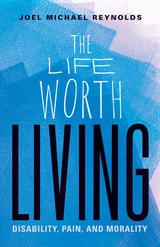
The Life Worth Living
Disability, Pain, and MoralityJoel Michael Reynolds
University of Minnesota Press, 2022
A philosophical challenge to the ableist conflation of disability and pain
More than 2,000 years ago, Aristotle said: “let there be a law that no deformed child shall live.” This idea is alive and well today. During the past century, Supreme Court Justice Oliver Wendell Holmes Jr. argued that the United States can forcibly sterilize intellectually disabled women and philosopher Peter Singer argued for the right of parents to euthanize certain cognitively disabled infants. The Life Worth Living explores how and why such arguments persist by investigating the exclusion of and discrimination against disabled people across the history of Western moral philosophy.
Joel Michael Reynolds argues that this history demonstrates a fundamental mischaracterization of the meaning of disability, thanks to the conflation of lived experiences of disability with those of pain and suffering. Building on decades of activism and scholarship in the field, Reynolds shows how longstanding views of disability are misguided and unjust, and he lays out a vision of what an anti-ableist moral future requires.
The Life Worth Living is the first sustained examination of disability through the lens of the history of moral philosophy and phenomenology, and it demonstrates how lived experiences of disability demand a far richer account of human flourishing, embodiment, community, and politics in philosophical inquiry and beyond.
Accessibility features: Retail e-book files for this title are screen-reader friendly with images accompanied by short alt text and/or extended descriptions.