Results by title
76 books match the query 'Narrative' and 18 start with t
Tell Me a Story
Narrative and IntelligenceRoger C. Schank
Northwestern University Press, 1995
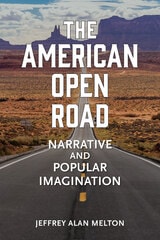
The American Open Road
Narrative and Popular ImaginationJeffrey Alan Melton
University of Alabama Press, 2025
WINNER OF THE ELIZABETH AGEE PRIZE IN AMERICAN LITERATURE
The rearview mirror perspective of a road trip across the American “open road.”
The American Open Road: Narrative and Popular Imagination offers a rich exploration of how the mythos of the open road has shaped, and been shaped by, American culture. Beginning with the post–World War II boom that solidified car culture as central to American life, Melton reflects on how roads, automobiles, and landscapes have been represented in literature, film, and other cultural texts, highlighting the interplay between mobility and narrative.
Drawing on a wide range of cultural texts, from traditional classic road novels and cinematic presentations, to advertisements, poetry, and prose, Melton examines how the open road functions as a symbol of autonomy, reinvention, and resistance. He highlights how road narratives have also exposed deeper tensions in American life—especially around race, gender, and power—and how historically marginalized voices have used the road to reclaim space and tell new stories.
From the romanticism of Route 66 to the political edge of modern road films, The American Open Road offers a thoughtful, engaging analysis of the narratives that continue to define American identity and longing. For readers interested in cultural history, travel literature, or the enduring pull of the highway, this book offers a compelling view from the passenger seat of America’s most iconic journeys.
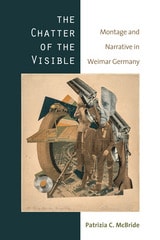
The Chatter of the Visible
Montage and Narrative in Weimar GermanyPatrizia C. McBride
University of Michigan Press, 2016
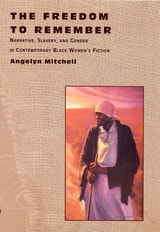
The Freedom to Remember
Narrative, Slavery, and Gender in Contemporary Black Women's FictionMitchell, Angelyn
Rutgers University Press, 2002
The Freedom to Remember examines contemporary literary revisions of slavery in the United States by black women writers. The narratives at the center of this book include: Octavia E. Butler’s Kindred, Sherley Anne Williams’s Dessa Rose, Toni Morrison’s Beloved, J. California Cooper’s Family, and Lorene Cary’s The Price of a Child.
Recent studies have investigated these works only from the standpoint of victimization. Angelyn Mitchell changes the conceptualization of these narratives, focusing on the theme of freedom, not slavery, defining these works as “liberatory narratives.” These works create a space to problematize the slavery/freedom dichotomy from which contemporary black women writers have the “safe” vantage point to reveal aspects of enslavement that their ancestors could not examine. The nineteenth-century female emancipatory narrative, by contrast, was written to aid the cause of abolition by revealing the unspeakable realitiesof slavery. Mitchell shows how the liberatory narrative functions to emancipate its readers from the legacies of slavery in American society: by facilitating a deeper discussion of the issues and by making them new through illumination and interrogation.
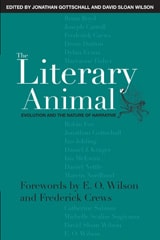
The Literary Animal
Evolution and the Nature of NarrativeJonathan Gottschall and David Sloan Wilson
Northwestern University Press, 2005
The goal of this book is to overcome some of the widespread misunderstandings about the meaning of a Darwinian approach to the human mind generally, and literature specifically. The volume brings together scholars from the forefront of the new field of evolutionary literary analysis-both literary analysts who have made evolution their explanatory framework and evolutionist scientists who have taken a serious interest in literature-to show how the human propensity for literature and art can be properly framed as a true evolutionary problem. Their work is an important step toward the long-prophesied synthesis of the humanities and what Steven Pinker calls "the new sciences of human nature."
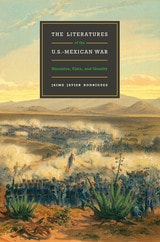
The Literatures of the U.S.-Mexican War
Narrative, Time, and IdentityBy Jaime Javier Rodríguez
University of Texas Press, 2010
The literary archive of the U.S.-Mexican War (1846–1848) opens to view the conflicts and relationships across one of the most contested borders in the Americas. Most studies of this literature focus on the war's nineteenth-century moment of national expansion. In The Literatures of the U.S.-Mexican War, Jaime Javier Rodríguez brings the discussion forward to our own moment by charting a new path into the legacies of a military conflict embedded in the cultural cores of both nations.
Rodríguez's groundbreaking study moves beyond the terms of Manifest Destiny to ask a fundamental question: How do the war's literary expressions shape contemporary tensions and exchanges among Anglo Americans, Mexicans, and Mexican Americans. By probing the war's traumas, anxieties, and consequences with a fresh attention to narrative, Rodríguez shows us the relevance of the U.S.-Mexican War to our own era of demographic and cultural change. Reading across dime novels, frontline battle accounts, Mexican American writings and a wide range of other popular discourse about the war, Rodríguez reveals how historical awareness itself lies at the center of contemporary cultural fears of a Mexican "invasion," and how the displacements caused by the war set key terms for the ways Mexican Americans in subsequent generations would come to understand their own identities. Further, this is also the first major comparative study that analyzes key Mexican war texts and their impact on Mexico's national identity.
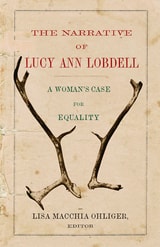
The Narrative of Lucy Ann Lobdell
A Woman's Case for EqualityLisa Macchia Ohliger
Westholme Publishing, 2024
Lucy Ann Lobdell’s (1829–1912) extraordinary life was shaped by personal strife and the hardships of survival in upstate New York. Struggling with an abusive, alcoholic husband, a young child, ailing parents, and financial strain, Lucy did what was necessary to support her family. In a rural world defined by hunting, farming, and lumbering, she dressed, labored, and lived in a traditional masculine manner. Her prowess as a rifle shot and fiddle player were known locally, but because of her unconventional, androgynous lifestyle, she became a target of public gossip and ridicule. Educated and eloquent, Lucy penned and published, Lucy Ann Lobdell, the Female Hunter of Delaware and Sullivan Counties, N.Y., in 1855. The narrative provides a unique look at the persecution of a woman whose only “offense” was disregard for contemporary societal norms.
After her husband was killed during the Civil War, she received a widow’s pension. Ostracized and eventually hospitalized in 1880—gender laws of the time imprisoned indigent men, but sent women to mental hospitals—she underwent torturous experimental treatment until she confessed to a self-serving doctor that she was “a man in all that the name implies.” Whether Lucy was a lesbian, cross dresser, or transgender, we don’t know from the historical record, but as Lisa Macchia Ohliger demonstrates in The Narrative of Lucy Ann Lobdell: A Woman’s Case for Equality, Lucy did embody the nascent women’s rights movement. At the same time, and not far from where Lucy lived and went to school, Amelia Bloomer was advocating the right for women to wear pants and was publishing the feminist newspaper, The Lily, while Susan B. Anthony was pushing for land rights and equal pay for women. All of these issues are found in Lucy’s autobiographical account, fully reproduced in this volume. Lucy’s life is an illustration of the historical significance and destructive power of gender in society, and her narrative bears painful witness to the clash between taboo and survival.

The Place of Narrative
Mural Decoration in Italian Churches, 431-1600Marilyn Aronberg Lavin
University of Chicago Press, 1990
"Like many masterpieces, Lavin's book builds upon a simple idea . . . it is possible to do a computer analysis of . . . visual narratives. . . . This is the first computer-based study of the visual arts of which I am aware that illustrates how those technologies can utterly transform the study of old master art. An extremely important book, one likely to become the most influential recent study of art of this period, The Place of Narrative is also a beautiful artifact."—David Carrier, Leonardo
"Covering over a millennium and dealing with the whole of Italy, Lavin makes pioneering use of new methodology employing a computer database . . . [and] novel terminology to describe the disposition of scenes of church and chapel walls. . . . We should recognize this as a book of high seriousness which reaches out into new areas and which will fruitfully stimulate much thought on a neglected subject of very considerable significance."—Julian Gardner, Burlington Magazine
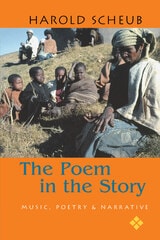
The Poem in the Story
Music, Poetry, and NarrativeHarold Scheub
University of Wisconsin Press, 2002
Fact and fiction meet at the boundaries, the betwixt and between where transformations occur. This is the area of ambiguity where fiction and fact become endowed with meaning, and this is the area—where ambiguity, irony, and metaphor join forces—that Harold Scheub exposes in all its nuanced and evocative complexity in The Poem in the Story.
In a career devoted to exploring the art of the African storyteller, Scheub has conducted some of the most interesting and provocative investigations into nonverbal aspects of storytelling, the complex relationship between artist and audience, and, most dramatically, the role played by poetry in storytelling. This book is his most daring effort yet, an unconventional work that searches out what makes a story artistically engaging and emotionally evocative, the metaphorical center that Scheub calls "the poem in the story." Drawing on extensive fieldwork in southern Africa and decades of experience as a researcher and teacher, Scheub develops an original approach—a blend of field notes, diary entries, photographs, and texts of stories and poems—that guides readers into a new way of viewing, even experiencing, meaning in a story. Though this work is largely focused on African storytelling, its universal applications emerge when Scheub brings the work of storytellers as different as Shakespeare and Faulkner into the discussion.
The Shape of Inca History
Narrative and Architecture in an Andean EmpireSusan A. Niles
University of Iowa Press, 1999
Theorizing Myth
Narrative, Ideology, and ScholarshipBruce Lincoln
University of Chicago Press, 2000
He begins by showing that mythos yielded to logos not as part of a (mythic) "Greek miracle," but as part of struggles over political, linguistic, and epistemological authority occasioned by expanded use of writing and the practice of Athenian democracy. Lincoln then turns his attention to the period when myth was recuperated as a privileged type of narrative, a process he locates in the political and cultural ferment of the eighteenth and nineteenth centuries. Here, he connects renewed enthusiasm for myth to the nexus of Romanticism, nationalism, and Aryan triumphalism, particularly the quest for a language and set of stories on which nation-states could be founded.
In the final section of this wide-ranging book, Lincoln advocates a fresh approach to the study of myth, providing varied case studies to support his view of myth—and scholarship on myth—as ideology in narrative form.

Theory and History of Narrative, Volume 24
Meir Sternberg
Duke University Press, 0
Time and Narrative, Volume 1
Paul Ricoeur
University of Chicago Press, 1990
Ricoeur finds a "healthy circle" between time and narrative: time is humanized to the extent that it portrays temporal experience. Ricoeur proposes a theoretical model of this circle using Augustine's theory of time and Aristotle's theory of plot and, further, develops an original thesis of the mimetic function of narrative. He concludes with a comprehensive survey and critique of modern discussions of historical knowledge, understanding, and writing from Aron and Mandelbaum in the late 1930s to the work of the Annales school and that of Anglophone philosophers of history of the 1960s and 1970s.
"This work, in my view, puts the whole problem of narrative, not to mention philosophy of history, on a new and higher plane of discussion."—Hayden White, History and Theory
"Superb. . . . A fine point of entrance into the work of one of the eminent thinkers of the present intellectual age."—Joseph R. Gusfield, Contemporary Sociology
Time and Narrative, Volume 2
Paul Ricoeur
University of Chicago Press, 1990
Ricoeur treats the question of just how far the Aristotelian concept of "plot" in narrative fiction can be expanded and whether there is a point at which narrative fiction as a literary form not only blurs at the edges but ceases to exist at all. Though some semiotic theorists have proposed all fiction can be reduced to an atemporal structure, Ricoeur argues that fiction depends on the reader's understanding of narrative traditions, which do evolve but necessarily include a temporal dimension. He looks at how time is actually expressed in narrative fiction, particularly through use of tenses, point of view, and voice. He applies this approach to three books that are, in a sense, tales about time: Virgina Woolf's Mrs. Dalloway; Thomas Mann's Magic Mountain; and Marcel Proust's Remembrance of Things Past.
"Ricoeur writes the best kind of philosophy—critical, economical, and clear."—Eugen Weber, New York Times Book Review
"A major work of literary theory and criticism under the aegis of philosophical hermenutics. I believe that . . . it will come to have an impact greater than that of Gadamer's Truth and Method—a work it both supplements and transcends in its contribution to our understanding of the meaning of texts and their relationship to the world."—Robert Detweiler, Religion and Literature
"One cannot fail to be impressed by Ricoeur's encyclopedic knowledge of the subject under consideration. . . . To students of rhetoric, the importance of Time and Narrative . . . is all too evident to require extensive elaboration."—Dilip Parameshwar Gaonkar, Quarterly Journal of Speech
Time and Narrative, Volume 3
Paul Ricoeur
University of Chicago Press, 1990
Ricoeur's aim here is to explicate as fully as possible the hypothesis that has governed his inquiry, namely, that the effort of thinking at work in every narrative configuration is completed in a refiguration of temporal experience. To this end, he sets himself the central task of determing how far a poetics of narrative can be said to resolve the "aporias"—the doubtful or problematic elements—of time. Chief among these aporias are the conflicts between the phenomenological sense of time (that experienced or lived by the individual) and the cosmological sense (that described by history and physics) on the one hand and the oneness or unitary nature of time on the other. In conclusion, Ricoeur reflects upon the inscrutability of time itself and attempts to discern the limits of his own examination of narrative discourse.
"As in his previous works, Ricoeur labors as an imcomparable mediator of often estranged philosophical approaches, always in a manner that compromises neither rigor nor creativity."—Mark Kline Taylor, Christian Century
"In the midst of two opposing contemporary options—either to flee into ever more precious readings . . . or to retreat into ever more safe readings . . . —Ricoeur's work offers an alternative option that is critical, wide-ranging, and conducive to new applications."—Mary Gerhart, Journal of Religion
Tragic Rites
Narrative and Ritual in Sophoclean DramaAdriana E. Brook
University of Wisconsin Press, 2018
Employing both modern ritual theory and Aristotle's Poetics, Brook exposes the deep structural analogies between ritual and narrative, the parallels between mistakes in ritual and deviations from the expected in the plot, and the relationship between ritual content and dramatic closure.
Trail to Heaven
Knowledge and Narrative in a Northern Native CommunityRobin Ridington
University of Iowa Press, 1992
Two Years in the Pontifical Zouaves
A Narrative of Travel, Residence, and Experience in the Roman StatesJoseph Powell
Catholic University of America Press, 2026