Results by title
58 books match the query 'Navajo Indians' and 8 start with t

The Main Stalk
A Synthesis of Navajo PhilosophyJohn R. Farella
University of Arizona Press, 1984
"This is a stimulating book. Essentially, it criticizes previous discussions of Navajo religion and philosophy for greatly underestimating their complexity and sophistication. . . . What the author discovers in Navajo thought is that the key concepts are interrelated in a grand, moral, ethical, philosophic, and cosmic unity." —American Anthropologist
"Discredits dualists, both non-Indian and Indian, who see simplistic oppositions of Good and Evil in Navajo culture and philosophy. The concept of walking in beauty, as related to the proper growth of the corn plant, unifies the book, and Farella does some impressive cross-cultural linguistic analysis to derive practical and ceremonial applications of these central Navajo metaphors. . . . This is one of the better books on Indian religion." —Choice
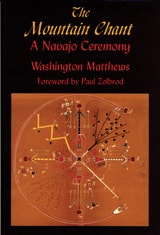
The Mountain Chant
A Navajo CeremonyMatthews, Washington
University of Utah Press, 1997
The Mountain Chant is a nine-day Navajo healing ceremony, one of several major rites undertaken only in winter. Aside from curing disease, it brings rain and invokes the unseen powers for general benefit. Though perhaps practiced less often now than better-known ceremonies such as the Night Chant, it is by no means forgotten.
Fully faithful to the original book published by Washington Matthews over a century ago, this edition contains the story of the wandering hero upon whose exploits the Mountain Chant is based, a description of each of the nine ceremonial days, and original song text and translations.
"Each Navajo ceremony builds on a specific story, which in turn contributes to a network of interlocking narratives as poetically rich as the Homeric epics or the Arthurian cycle. Non-Navajos are only now beginning to fathom the extent of that poetic richness as we learn more about the nature of ceremonial Navajo, with its formulaic virtuosity, its rhythmic cadences, its deep allusiveness to enduring human values, and the spellbinding thrust of its stories."
- Paul Zolbrod, from the foreword
The Mountainway of the Navajo
Leland C. Wyman; with a myth of the Female Branch recorded and translated by Father Berard Haile, OFM
University of Arizona Press, 1975
The Navajo Hunter Tradition
Karl W. Luckert
University of Arizona Press, 1975
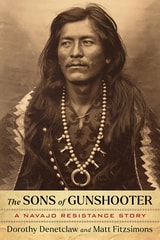
The Sons of Gunshooter
A Navajo Resistance StoryDorothy Denetclaw and Matt Fitzsimons
University of Arizona Press, 2026
In 1919, the brother of one of the West’s most famous Indian traders was shot to death in a remote corner of the Navajo Nation.
Part history, part true crime, The Sons of Gunshooter reexamines the killing and subsequent murder trial, while simultaneously embedding the story in a much larger saga of colonization and resistance. The result is a book that’s sweeping in its scope and surgical in its approach. Rewinding the clock to 1868, the authors follow the intertwining paths of two families to offer a riveting, deeply personal account that has been hailed as “a new way of doing historiography.”
One of the authors is a descendant of participants in the case; the other is an investigative journalist. By merging Diné oral traditions with archival evidence, they succeed in upending one false narrative after another.
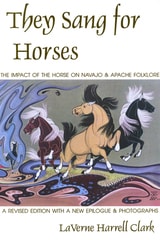
They Sang for Horses
The Impact of the Horse on Navajo and Apache FolkloreLaVerne Harrell Clark
University Press of Colorado, 2001
No Native American groups placed more emphasis on the horse in their lives than did the Navajo and Apache of the Southwest. They Sang for Horses, first published in 1966 and now considered a classic, remains the only comprehensive treatment of the profound mystical influence that the horse has exerted for more than 300 years.
In this completely redesigned and expanded edition, LaVerne Harrell Clark examines how storytellers, singers, medicine men, and painters created the animal's evolving symbolic significance by adapting existing folklore and cultural symbols. Exploring the horse's importance in ceremonies, songs, prayers, customs, and beliefs, she investigates the period of the horse's most pronounced cultural impact on the Navajo and the Apache, starting from the time of its acquisition from the Spanish in the seventeenth century and continuing to the mid-1960s, when the pickup truck began to replace it as the favored means of transportation. In addition, she presents a look at how Navajos and Apaches today continue to redefine the horse's important role in their spiritual as well as material lives.
This classic work is a must for historians, readers interested in Native American folklore and mythology, and anyone who has ever been captivated by the magic and romance of the horse.

Thomas H. Begay and the Navajo Code Talkers
Alysa Landry
Ohio University Press, 2023
Transforming Diné Education
Innovations in Pedagogy and PracticeEdited by Pedro Vallejo and Vincent Werito
University of Arizona Press, 2022
Bringing together decades of teaching experience, contributors offer perspectives from school- and community-based programs, as well as the tribal, district, and university level. They address special education, language revitalization, wellness, self-determination and sovereignty, and university-tribal-community partnerships. These contributions foreground Diné ways of knowing both as an educational philosophy and as an active practice applied in the innovative programs the book highlights. The contributors deepen our understanding of the state of Navajo education by sharing their perspectives about effective teaching practices and the development of programs that advance educational opportunities for Navajo youth.
This work provides stories of Diné resilience, resistance, and survival. It articulates a Diné-centered pedagogy that will benefit educators and learners for generations to come. Transforming Diné Education fills a need in the larger literature of curricular and programmatic development and provides tools for academic success for all American Indian students.
Contributors
Berlinda Begay
Lorenda Belone
Michael “Mikki” Carroll
Quintina “Tina” Deschenie
Henry Fowler
Richard Fulton
Davis E. Henderson
Kelsey Dayle John
Lyla June Johnston
Tracia Keri Jojola
Tiffany S. Lee
Shawn Secatero
Michael Thompson
Pedro “Pete” Vallejo
Christine B. Vining
Vincent Werito
Duane “Chili” Yazzie