Results by title
226 books match the query 'New Jersey' and 45 start with t
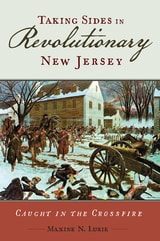
Taking Sides in Revolutionary New Jersey
Caught in the CrossfireMaxine N. Lurie
Rutgers University Press, 2022
Supplemental Instructor Resources for Taking Sides in Revolutionary New Jersey:
Questions (https://d3tto5i5w9ogdd.cloudfront.net/wp-content/uploads/2022/07/19144155/Taking-Sides-Supplementary-Instructor-Resources-Questions.pdf)
Bibliography (https://d3tto5i5w9ogdd.cloudfront.net/wp-content/uploads/2022/07/19144154/Taking-Sides-Supplementary-Instructor-Resources-Bibliography.pdf)
Tales and Towns of Northern New Jersey
Beck, Henry
Rutgers University Press, 1967
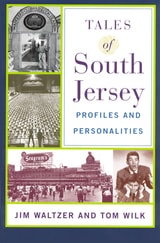
Tales of South Jersey
Profiles and PersonalitiesWaltzer, Jim
Rutgers University Press, 2001
There's much more to southern New Jersey than the Pine Barrens and the Jersey Devil, and this collection by journalists Jim Waltzer and Tom Wilk tells readers all about it. Oceanside and bayside towns offer a box seat from which to observe the regions rich history and the summery lore of the wonders of nature. Landlocked towns boast their own homespun and hell-raising traditions and idiosyncrasies.
Waltzer and Wilk have compiled almost fifty stories about the state's southernmost counties. Although the focus is on Atlantic City and its remarkable people, outsize structures, and quirky events, the storytelling ranges across the wider region to provide an insiders look at history as it was being made. You'll encounter gangsters and gamblers, baseball hitters and hurricanes, famous piers and hotels, landmark theaters and eateries, splashy events and unheralded oddities ¾ in sum, a cross-section of the regions character and characters.
The authors divide their book into six sections: entertainment, famous and infamous events, innovations and innovators, leisure and recreation, room and board, and sports legends. Within each section are the rich and varied stories Waltzer and Wilk have collected for New Jerseyans reading pleasure.

Teenage Wasteland
Suburbia's Dead End KidsDonna Gaines
University of Chicago Press, 1998
"A powerful book."—Samuel G. Freedman, New York Times Book Review
"[Gaines] sheds light on a poorly understood world and raises compelling questions about what society might do to help this alienated group of young people."—Ann Grimes, Washington Post Book World
"There is no comparable study of teenage suburban culture . . . and very few ethnographic inquiries written with anything like Gaines's native gusto or her luminous eye for detail."—Andrew Ross, Transition
"An outstanding case study. . . . Gaines shows how teens engage in cultural production and how such social agency is affected by economic transformations and institutional interventions."—Richard Lachman, Contemporary Sociology
"The best book on contemporary youth culture."—Rolling Stone
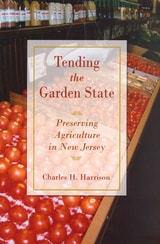
Tending the Garden State
Preserving Agriculture in New JerseyHarrison, Charles
Rutgers University Press, 2006
Early in the nineteenth century, an army colonel stood before a crowd at the Salem County Courthouse and ate buckets of tomatoes to prove that they were not poisonous. Ever since, the red vegetable of summer has played a starring role in New Jersey’s history. Although today visitors to the state are more likely to see smoke-spewing factories than acres of farmland or grazing cattle, the state’s legacy of agriculture and farming continues, and extends far beyond the popular Jersey tomato.
In Tending the Garden State, Charles Harrison tells the story of the state’s rich agricultural history from the time when Leni-Lenape Indians scratched the earth with primitive tools up through today. He recalls New Jersey’s rural past, traces the evolution of farming over the course of the twentieth century, and explains innovative approaches to protecting the industry.
Drawing on interviews with farmers, as well as researchers, professional planners, designers, and architects, Harrison discovers that despite the discouraging spread of suburban sprawl, the Garden State’s farming legacy is not as endangered as it may seem. Many residents care deeply about preserving New Jersey’s agricultural industry and are making great strides to keep the tradition alive for future generations. Some of these protective measures include new laws that encourage the conservation of land and research devoted to helping farmers make the most of their limited acreage. Innovative techniques such as high-tunnel farming, together with the growth of some very profitable farm specializations, such as turf grass, aquaculture, horticulture, and wine making, will enable farmers to remain active and successful in the state’s oldest industry.
Anyone interested in New Jersey’s history or, more broadly, in the history of American agriculture, will be delighted by Harrison’s engaging and readable account of farming in the Garden State.
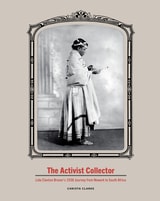
The Activist Collector
Lida Clanton Broner’s 1938 Journey from Newark to South AfricaChrista Clarke
Rutgers University Press, 2023
Published by the Newark Museum. Distributed worldwide by Rutgers University Press.
“After twenty-eight years of desire and determination, I have visited Africa, the land of my forefathers.” So wrote Lida Clanton Broner (1895–1982), an African American housekeeper and hairstylist from Newark, New Jersey, upon her return from an extraordinary nine-month journey to South Africa in 1938. This epic trip was motivated not only by Broner’s sense of ancestral heritage, but also a grassroots resolve to connect the socio-political concerns of African Americans with those of black South Africans under the segregationist policies of the time. During her travels, this woman of modest means circulated among South Africa’s Black intellectual elite, including many leaders of South Africa’s freedom struggle. Her lectures at Black schools on “race consciousness and race pride” had a decidedly political bent, even as she was presented as an “American beauty specialist.”
How did Broner—a working class mother—come to be a globally connected activist? What were her experiences as an African American woman in segregated South Africa and how did she further her work after her return? Broner’s remarkable story is the subject of this book, which draws upon a deep visual and documentary record now held in the collection of the Newark Museum of Art. This extraordinary archive includes more than one hundred and fifty objects, ranging from beadwork and pottery to mission school crafts, acquired by Broner in South Africa, along with her diary, correspondence, scrapbooks, and hundreds of photographs with handwritten notations.
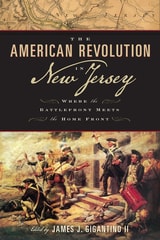
The American Revolution in New Jersey
Where the Battlefront Meets the Home FrontJames J. Gigantino II
Rutgers University Press, 2015
Battles were fought in many colonies during the American Revolution, but New Jersey was home to more sustained and intense fighting over a longer period of time. The nine essays in The American Revolution in New Jersey, depict the many challenges New Jersey residents faced at the intersection of the front lines and the home front.
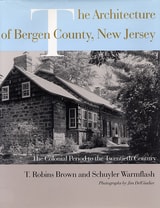
The Architecture of Bergen County, New Jersey
The Colonial Period to the Twentieth CenturyBrown, T. Robins
Rutgers University Press, 2000
Winner of the 2001 New Jersey Historic Preservation Award | Commendation Award from the Bergen County Historic Preservation Advisory Board
Walk or drive through any of Bergen County's seventy communities and you will find telling reminders of a wonderfully rich and diverse architectural history--the legacy of three hundred years of settlement, growth, and change.
The Architecture of Bergen County, New Jersey presents an accessible overview of the county's architectural heritage and its historic structures. The volume explores the styles, trends, and events that influenced the design and setting of the region's buildings. More than 150 photos document Bergen County's architectural treasures, generating awareness and appreciation for these structures and their history.
The book is arranged chronologically, beginning with the arrival of European settlers in the seventeenth century and ending in the late twentieth century. Each chapter opens with a brief historical background and follows with a description and analysis of building types common to Bergen County for the period. Some structures, such as the Hermitage in Ho-Ho-Kus, the Vreeland House in Leonia, and the Bergen County Courthouse in Hackensack, are of regional, even national, significance.
The book also highlights delightful surprises. Examples include a large number of picturesque houses that were built from the designs published in mid-nineteenth century architectural pattern books, the home of an early African American newspaper publisher, and two homes in Paramus and Washington Township whose exterior walls are made of mud.
The Architecture of Bergen County, New Jersey demonstrates the close association between architectural development at the national and local levels, and shows how social, technological, and political changes occurring within the county have been reflected in the building types and styles of the area.
The Black Student Protest Movement at Rutgers
Richard P. McCormick
Rutgers University Press, 1990
Richard P. McCormick has chronicled the black student protest movement at Rutgers University, from the 1960s to today. He examines the forces that produced the protest movement, the tactics that were employed, and the qualified gains that were achieved. He tells us about demonstrations, building occupations, committee hearings, and countless meetings, but he also paints portraits of the many student leaders who mobilized protest. This is the story of a lot of pain, some blunders, and some successes.
In the mid-sixties, the University established committees to recruit black students and to add more blacks to the faculty. These efforts produced only modest results. By 1968, there were still not enough black students on campus, but there were enough to create a political presence for the first time. They were committed to acting against the racism they perceived within the University. To respond to their protests, in March 1969 the Board of Governors passed a dramatically new and controversial policy to encourage disadvantaged students who lived in Camden, Newark, and New Brunswick to apply to Rutgers, where they would take college-preparatory classes as unmatriculated students, and then enter Rutgers as matriculated students. This program, never very successful, lasted only two years.
Unrest did not end with the sixties. During the seventies, black students sporadically voiced protests against what they perceived to be an unsupportive environment. During the eighties, black enrollment actually declined, as did the black graduation rate. In conclusion, McCormick points to the effort that has been made but even more to the effort that still needs to be made and the social cost of ignoring the problem.
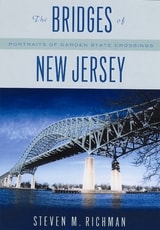
The Bridges of New Jersey
Portraits of Garden State CrossingsSteven M. Richman
Rutgers University Press, 2005
In The Bridges of New Jersey, Steven M. Richman provides a rare photographic and poetic journey across sixty of the state's bridges, ranging from impressive suspension spans such as the Ben Franklin and George Washington Bridges, to the small wrought iron and stone bridges that are cherished by local citizens. The book provides a rich diversity of stories that place the bridges in the context of New Jersey history and culture. Richman also explores the contribution New Jersey bridges have made to engineering-some of the most prominent engineers of the nineteenth and twentieth centuries either lived or established businesses in the Garden State or designed its bridges.
Lavishly illustrated with over seventy photographs, this book is much more than a documentary survey. It is a visual portrait that beautifully captures the metaphoric significance and aesthetic pleasures of New Jersey's bridges, and indeed all bridges. Perhaps more than any other structure built by humans, bridges typify progress and they give us a sense of connectedness. The Bridges of New Jersey provides a compelling visual demonstration of these symbolic functions, as well as their practical purposes and engineering accomplishments.
The Brodsky Center at Rutgers University
Three Decades, 1986-2017Ferris Olin
Rutgers University Press, 2024
Published in partnership with the Zimmerli Museum.
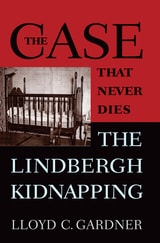
The Case That Never Dies
The Lindbergh KidnappingLloyd C. Gardner
Rutgers University Press, 2004
The Case That NeverDies places the Lindbergh kidnapping, investigation, and trial in the context of the Depression, when many feared the country was on the edge of anarchy. Gardner delves deeply into the aspects of the case that remain confusing to this day, including Lindbergh’s dealings with crime baron Owney Madden, Al Capone’s New York counterpart, as well as the inexplicable exploits of John Condon, a retired schoolteacher who became the prosecution’s best witness. The initial investigation was hampered by Colonel Lindbergh, who insisted that the police not attempt to find the perpetrator because he feared the investigation would endanger his son’s life. He relented only when the child was found dead.
After two years of fruitless searching, Bruno Richard Hauptmann, a German immigrant, was discovered to have some of the ransom money in his possession. Hauptmann was arrested, tried, and sentenced to death. Throughout the book, Gardner pays special attention to the evidence of the case and how it was used and misused in the trial. Whether Hauptmann was guilty or not, Gardner concludes that there was insufficient evidence to convict him of first-degree murder.
Set in historical context, the book offers not only a compelling read, but a powerful vantage point from which to observe the United States in the 1930s as well as contemporary arguments over capital punishment.
The Common Place of Law
Stories from Everyday LifePatricia Ewick and Susan S. Silbey
University of Chicago Press, 1998
One narrative is based on an idea of the law as magisterial and remote. Another views the law as a game with rules that can be manipulated to one's advantage. A third narrative describes the law as an arbitrary power that is actively resisted. Drawing on these extensive case studies, Ewick and Silbey present individual experiences interwoven with an analysis that charts a coherent and compelling theory of legality. A groundbreaking study of law and narrative, The Common Place of Law depicts the institution as it is lived: strange and familiar, imperfect and ordinary, and at the center of daily life.
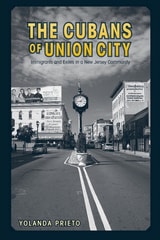
The Cubans of Union City
Immigrants and Exiles in a New Jersey CommunityYolanda Prieto
Temple University Press, 2009
As a result of the conflicts between Cuba and the United States, especially after 1959, Cubans immigrated in great numbers. Most stayed in Miami, but many headed north to Union City, making it second only to Miami in its concentration of Cubans. In The Cubans of Union City, Yolanda Prieto discusses why Cubans were drawn to this particular city and how the local economy and organizations developed. Central aspects of this story are the roles of women, religion, political culture, and the fact of exile itself.
As a member of this community and a participant in many of its activities, Prieto speaks with special authority about its demographic uniqueness. Far from being a snapshot of the community, The Cubans of Union City conveys an ongoing research agenda extending over more than twenty years, from 1959 to the 1980s. As a long-term observer who was also a resident, Prieto offers a unique and insightful view of the dynamics of this community’s evolution.
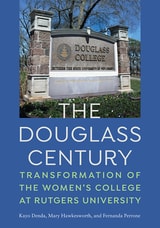
The Douglass Century
Transformation of the Women’s College at Rutgers UniversityDenda, Kayo
Rutgers University Press, 2018
The Douglass Century celebrates the college’s longevity and diversity as distinctive accomplishments, and analyzes the contributions of Douglass administrators, alumnae, and students to its survival, while also investigating multiple challenges that threatened its existence. This book demonstrates how changing historical circumstances altered the possibilities for women and the content of higher education, comparing the Jazz Age, American the Great Depression, the Second World War, the post-war Civil Rights era, and the resurgence of feminism in the 1970s and 1980s. Concluding in the present day, the authors highlight the college’s ongoing commitment to Mabel Smith Douglass’ founding vision, “to bring about an intellectual quickening, a cultural broadening in connection with specific training so that women may go out into the world fitted…for leadership…in the economic, political, and intellectual life of this nation.” In addition to providing a comprehensive history of the college, the book brings its subjects to life with eighty full-color images from the Special Collections and University Archives, Rutgers University Libraries.
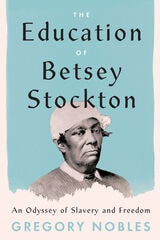
The Education of Betsey Stockton
An Odyssey of Slavery and FreedomGregory Nobles
University of Chicago Press, 2022
The life of Betsey Stockton (ca. 1798–1865) is a remarkable story of a Black woman’s journey from slavery to emancipation, from antebellum New Jersey to the Hawai‘ian Islands, and from her own self-education to a lifetime of teaching others—all told against the backdrop of the early United States’ pervasive racism. It’s a compelling chronicle of a critical time in American history and a testament to the courage and commitment of a woman whose persistence grew into a potent form of resistance.
When Betsey Stockton was a child, she was “given, as a slave” to the household of Rev. Ashbel Green, a prominent pastor and later the president of what is now Princeton University. Although she never went to school, she devoured the books in Green’s library. After being emancipated, she used that education to benefit other people of color, first in Hawai‘i as a missionary, then Philadelphia, and, for the last three decades of her life, Princeton—a college town with a genteel veneer that never fully hid its racial hostility. Betsey Stockton became a revered figure in Princeton’s sizeable Black population, a founder of religious and educational institutions, and a leader engaged in the day-to-day business of building communities.
In this first book-length telling of Betsey Stockton’s story, Gregory Nobles illuminates both a woman and her world, following her around the globe, and showing how a determined individual could challenge her society’s racial obstacles from the ground up. It’s at once a revealing lesson on the struggles of Stockton’s times and a fresh inspiration for our own.
The Fixers
Devolution, Development, and Civil Society in Newark, 1960-1990Julia Rabig
University of Chicago Press, 2016
Rabig argues that fixers play dual roles. They support resistance, but also mediation; they fight for reform, but also more radical and far-reaching alternatives; they rally others to a collective cause, but sometimes they broker factions. Fixers reflect longer traditions of organizing while responding to the demands of their times. In so doing, they end up fixing (like a fixative) a new and enduring pattern of activist strategies, reforms, and institutional expectations—a pattern we continue to see today.

The Folklore and Folklife of New Jersey
David Steven Cohen
Rutgers University Press, 1983
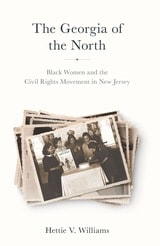
The Georgia of the North
Black Women and the Civil Rights Movement in New JerseyHettie V. Williams
Rutgers University Press, 2024
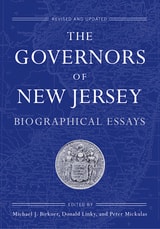
The Governors of New Jersey
Biographical EssaysBirkner, Michael J
Rutgers University Press, 2014
Rogues, aristocrats, and a future U.S. president. These and other governors are portrayed in this revised and updated edition of the classic reference work on the chief executives of New Jersey. Editors Michael J. Birkner, Donald Linky, and Peter Mickulas present new essays on the governors of the last three decades—Brendan T. Byrne, Thomas Kean, James Florio, Christine Todd Whitman, Donald DiFrancesco, James McGreevey, Richard Codey, and Jon Corzine. The essays included in the original edition are amended, edited, and corrected as necessary in light of new and relevant scholarship.
The authors of each governor’s life story represent a roster of such notable scholars as Larry Gerlach, Stanley Katz, Arthur Link, and Clement Price, as well as many other experts on New Jersey history and politics. As a result, this revised edition is a thorough and current reference work on the New Jersey governorship—one of the strongest in the nation.
Also of Interest:
New Jersey Politics and Government
The Suburbs Come of Age
Fourth Edition
Barbara G. Salmore with Stephen A. Salmore
978-0-8135-6139-4 paper $34.95
A volume in the Rivergate Regionals Collection
Me, Governor?
My Life in the Rough-and-Tumble World of New Jersey Politics
Richard J. Codey
978-0-8135-5045-9 cloth $24.95
The Life and Times of Richard J. Hughes
The Politics of Civility
John B. Wefing
978-0-8135-4641-4 cloth $32.50
Governor Tom Kean
From the New Jersey Statehouse to the 911 Commission
Alvin S. Felzenberg
978-0-8135-3799-3 cloth $29.95
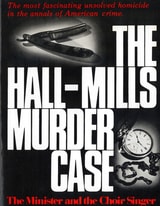
The Hall-Mills Murder Case
The Minister and the Choir SingerKunstler, William
Rutgers University Press, 1980

The Highlands
Critical Resources, Treasured LandscapesLathrop, Richard G
Rutgers University Press, 2011
Think of the Highlands as the “backyard” and “backstop” of the Philadelphia–New York–Hartford metroplex. A backyard that spans over three million acres across Pennsylvania, New York, and Connecticut, the Highlands serves as recreational open space for the metroplex’s burgeoning human population. As backstop, Highlands’ watersheds provide a ready source of high-quality drinking water for over fifteen million people.
The Highlands is the first book to examine the natural and cultural landscape of this four-state region, showing how it’s distinctive and why its conservation is vital. Each chapter is written by a different leading researcher and specialist in that field, and introduces readers to another aspect of the Highlands: its geological foundations, its aquifers and watersheds, its forest ecology, its past iron industry.
In the 1800s, the Highlands were mined, cutover, and then largely abandoned. Given time, the forests regenerated, the land healed, and the waters cleared. Increasingly, however, the Highlands are under assault again—polluted runoff contaminating lakes and streams, invasive species choking out the local flora and fauna, exurban sprawl blighting the rural landscape, and climate change threatening the integrity of its ecosystems.
The Highlands makes a compelling case for land use planning and resource management strategies that could help ensure a sustainable future for the region, strategies that could in turn be applied to other landscapes threatened by urbanization across the country. The Highlands are a valuable resource. And now, so is The Highlands.
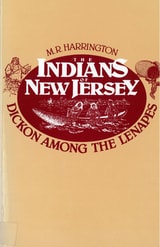
The Indians of New Jersey
Dickon Among the LenapesHarrington, M. R
Rutgers University Press, 1963
In presenting the lore and heritage of the Lenapes, Dr. M.R. Harrington does so through the eyes of a shipwrecked English boy who became a captive of the Indians, and was eventually adopted into the tribe. The narrative is lively reading, and the facts on which it is based are accurate. With the accompanying Clarence Ellsworth line drawings, the reader can understand and even reproduce many of the objects the author describes: the Lenape bows and arrows, muccasins and mats, baskets and bowls.
This new edition is a reissue of an often asked for an unavailable New Jersey classic, first published in 1938.
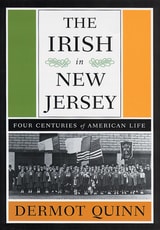
The Irish in New Jersey
Four Centuries of American Life, First Paperback EditionDermot Quinn
Rutgers University Press, 2004
In this richly illustrated history, Dermot Quinn uncovers the story of how the Irish in New Jersey maintained their cultural roots while also laying the foundations for the social, economic, political, and religious landscapes of their adopted country. Quinn chronicles the emigration of families from a conflict-torn and famine-stricken Ireland to the unfamiliar land whose unwelcoming streets often fell far short of being paved with gold.
Using case histories from Paterson, Jersey City, and Newark, Quinn examines the transition of the Irish from a rejected minority to a middle-class, secular, and suburban identity. The Irish in New Jersey will appeal to everyone with an interest in the cultural heritage of a proud and accomplished people.
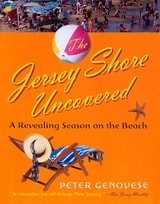
The Jersey Shore Uncovered
A Revealing Season on the BeachGenovese, Peter
Rutgers University Press, 2003
This is not your typical Jersey Shore book.
Yes, you'll find the obvious-beaches and boardwalks, lifeguards and lighthouses, fishing and food. But Peter Genovese will also take you off the beaten track for an insider's look at this famous (and infamous) 127-mile stretch from Sandy Hook to Cape May.
Birders, tiki hut builders, beach cleaners, wheel-of-chance operators, she-crab soup makers-they're all here. You'll check out an Airstream-only trailer park and visit a Point Pleasant Beach house where the music of Frank Sinatra plays nearly 24/7. Genovese will introduce you to the owner of the Stone Pony and to participants at the grueling Atlantic City Around-the-Island Swim as they describe their battles with tides, exhaustion, and face-stinging jellyfish. All of that, plus you'll find out why Ocean Grove residents write their names on their flowerpots.
Beach reading just doesn't get any better than this.
Spend a summer with Peter Genovese as he chronicles a typical wild and wacky, kitschy and classy season along the New Jersey coastline.
Lifeguards, surfers, beachgoers, birders, ice cream vendors, seashell sellers, banner pilots-they're all here. You'll be on the scene when Atlantic City's mayor officially begins summer by "unlocking the ocean," get a whiff of the state barbeque championship, watch the nation's longest-running all-women lifeguard competition, and even spend a weekend, Survivor-style, on a Barnegat Bay island.
The Ocean City Baby Parade, Clownfest, the state's hottest bikini contest, and the World Series of Surf Fishing are all covered. You'll also meet the folks at the Diamondback Terrapin Conservation Project, the Cape May Migratory Bird Refuge, and the Marine Mammal Stranding Center.
Genovese introduces you to Little Miss Chaos and the King of Corn, the Jersey Shore Hot Dog Queen, and Lucky Leo. You'll go on patrol with the New Jersey State Marine Police, meet the man behind Big Mike's E-Z Bail Bonds, and find salvation at the Boardwalk Chapel.
The Jersey Shore Uncovered flawlessly depicts the timeless allure of New Jersey beach culture. Along with his stories, Genovese brings readers hundreds of color and black-and-white photos that brilliantly capture exactly what makes this 127-mile stretch of shoreline unique. Whether you've never been to a New Jersey beach or you're a Jersey native who spends your summers "down the Shore," you're certain to learn a thing or two from this book. So get settled in your beach chair, put on some suntan lotion, and enjoy.
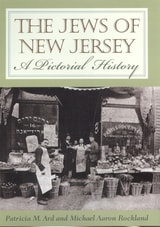
The Jews of New Jersey
A Pictorial HistoryPatricia M. Ard and Michael Aaron Rockland
Rutgers University Press, 2001
Jews have called New Jersey home since the late seventeenth century, and they currently make up almost 6 percent of the states residents. Yet, until now, no book has paid tribute to the richness of Jewish heritage in the Garden State. The Jews of New Jersey: A Pictorial History redresses this lack with a lively narrative and hundreds of archival and family photographsmany rarethat bring this history to life.
Patricia Ard and Michael Rockland focus on representative Jewish communities throughout the state, paying particular attention to the extraordinary stories of ordinary people. Through the joys and struggles of homemakers, storekeepers, factory workers, athletes, children, farmers, activists, religious leaders, and Holocaust survivors, the authors tell the stories of how these communities have evolved, thrived, and changed. They note the difficulties posed by intermarriage and assimilation and, at the same time, depict a burgeoning revival of Jewish orthodoxy and traditions.
The Jews of New Jersey will please both the historian and general reader. Its heartwarming stories and pictures truly make the point that it is through the joys, triumphs, and defeats of everyday people that history is made.
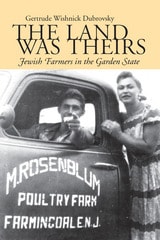
The Land Was Theirs
Jewish Farmers in the Garden StateGertrude W. Dubrovsky
University of Alabama Press, 1992
A historical account of Jewish agricultural colonies in New Jersey that examines how immigrants built farming communities in early America.
The Land Was Theirs is about Farmingdale, New Jersey, a community of Jewish farming communities in the United States established with the help of the Jewish Agricultural Society. The 50 year history of Farmingdale provides a perspective on the pressures, problems, and satisfactions of rural Jewish life as experienced in one community.
Beginning in 1919, the community grew around the small town of Farmingdale, when two Jewish families pooled their resources to establish a farm. The community evolved gradually as unrelated individuals with no previous farm experience settled and then created the institutions and organizations they needed to sustain their Jewish life. By 1945 Farmingdale was one of the leading egg-producing communities in the United States, and contributed in large measure to New Jersey’s reputation as the “egg basket of America.”
The Land Was Theirs draws from life-history interviews with 120 farmers, from the author’s personal experiences, and from a variety of private and community papers and documents. They are the pieces from which a full picture of a single Jewish farm community emerges.

The Life and Times of Richard J. Hughes
The Politics of CivilityWefing, John B
Rutgers University Press, 2009
This biography illuminates the governor's accomplishments between 1962 and 1970, including the creation of the Hackensack Meadowlands Commission, formation of the county college system, establishment of stringent antipollution laws, design of the public defender system, and the adoption of a New Jersey sales tax, as well as his pivotal role during the Newark riots. As chief justice, Hughes faced difficult issuesùschool funding, low and moderate income housing needs, freedom of speech, and his decision in the rightto-die case involving Karen Ann Quinlan. With a career characterized by liberal activism, Hughes also contributed nationally and internationally, from serving as host of the 1964 Democratic National Convention to monitoring elections in South Vietnam.
John B. Wefing's research includes interviews with prominent politicians and leaders who worked with Hughes at various points in his career. The result is a rich story of a public servant who possessed a true ability to work with members of both political parties and played a significant role in shaping modern New Jersey.

The Lindbergh Case
A Story of Two LivesFisher, Jim
Rutgers University Press, 1987

The Long Retreat
The Calamitous Defense of New Jersey, 1776Lefkowitz, Arthur S
Rutgers University Press, 1999
On the morning of November 20, 1776, General Charles Cornwallis overran patriot positions at Fort Lee, on the New Jersey side of the Hudson River. The attack threw George Washington's army into turmoil. Thus began an American retreat across the state, which ended only after the battered rebels crossed the Delaware river at Trenton on December 7. It was a three-week campaign that marked the most dramatic and desperate period of the War for Independence. In The Long Retreat, Arthur Lefkowitz has written the first book-length study of this critical campaign. He adds compelling new detail to the narrative, and offers the most comprehensive account in the literature of the American retreat to the Delaware and of the British pursuit. What emerges is a history misconceptions about the movements of the armies, the intentions of their leaders, and the choices available to rebel commanders and their British counterparts. Lefkowitz presents a patriot military pounded into desperate straights by the forces of the Crown, but in the end more resilient and wily than most previous scholarship has allowed. If brought low over November and December of 1776, Washington's battalions were still a force to reckon with as they pulled away from the advancing British. Despite serious losses in material and personnel, Washington managed to keep his units operational; and even while making mistakes, he sought to consolidate patriot regiments and longed for a chance to counterattack. The Christmas night riposte at Trenton, a dramatic reversal of fortune in any case, stemmed from measures the rebel Commander-in-Chief had initiated even as he completed his retrograde across New Jersey. How all of this came about emerges and crisp narrative of The Long Retreat. It is the definitive book on a crucial chapter in the history of American Arms.
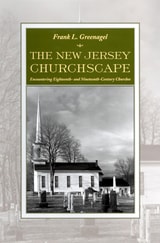
The New Jersey Churchscape
Encountering Eighteenth- and Nineteenth-Century ChurchesFrank L. Greenagel
Rutgers University Press, 2001
Although best known as the Garden State, New Jersey could also be called the Church State. The state boasts thousands of houses of worship, with more than one thousand still standing that were built in the eighteenth and nineteenth centuries. Frank L. Greenagel has photographed more than six hundred. He has selected two hundred of these historic landmarks for an examination of why they are sited where they are and why they look the way they do.
Greenagel has sought out and included images of not only mainstream Christian churches, but also Jewish synagogues as well as the places of worship of religious groups such as the Moravians, the Church of the Brethren, and the Seventh Day Baptists. The photographs are arranged chronologically within sections on three major early settlement regions of the state ¾ the Hudson River, the Delaware River, and the Raritan Valley. For each building, Greenagel details the date of construction, the cultural, historic, and religious influences that shaped it, the architectural details that distinguish it, and what purpose it currently serves.
The New Jersey State Constitution
A Reference GuideWilliams, Robert F
Rutgers University Press, 1997
The year 1997 marks the fiftieth anniversary of New Jerseys wellregarded state constitution. State constitutions, although the highest source of law within a state, are not well understood by citizens, government officials, historians, political scientists, lawyers, or even judges.
This book is the first single volume to combine a detailed review of New Jersey's constitutional history and analysis of each section of the current constitution. It is the standard work on New Jersey constitutional development and law. Divided into two parts, the book first covers the historical development of the constitutions of 1776, 1844, the Constitutional Commission of 1873, and the current constitution written in 1947. It then traces the origins and major judicial interpretations of each section of the present-day constitution. It concludes with an exhaustive bibliographical essay which organizes the most complete listing of primary and secondary sources to date.
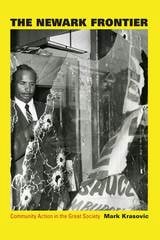
The Newark Frontier
Community Action in the Great SocietyMark Krasovic
University of Chicago Press, 2016
The Newark Frontier shows how, during the Great Society, urban liberalism adapted and grew, defining itself less by centralized programs and ideals than by administrative innovation and the small-scale, personal interactions generated by community action programs, investigative commissions, and police-community relations projects. Paying particular attention to the fine-grained experiences of Newark residents, Krasovic reveals that this liberalism was rooted in an ethic of experimentation and local knowledge. He illustrates this with stories of innovation within government offices, the dynamic encounters between local activists and state agencies, and the unlikely alliances among nominal enemies. Krasovic makes clear that postwar liberalism’s eventual fate had as much to do with the experiments waged in Newark as it did with the violence that rocked the city in the summer of 1967.
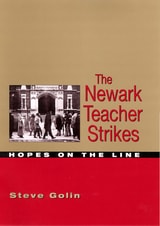
The Newark Teacher Strikes
Hopes on the LineGolin, Steve
Rutgers University Press, 2002
Winner of the Richard P. McCormick 2003 Prize for Scholarly Publication, given by the New Jersey Historical Commission
For three weeks in 1970 and for eleven weeks in 1971, the schools in Newark, New Jersey, were paralyzed as the teachers went on strike. In the wake of the 1971 strike, almost two hundred were arrested and jailed. The Newark Teachers Union said their members wanted improved education for students. The Board of Education claimed the teachers primarily desired more money. After interviewing more than fifty teachers who were on the front lines during these strikes, historian Steve Golin concludes that another, equally important agenda was on the table, and has been ignored until now. These professionals wanted power, to be allowed a voice in the educational agenda.
Through these oral histories, Golin examines the hopes of the teachers as they picketed, risking arrest and imprisonment. Why did they strike? How did the union represent them? How did their action—and incarceration—change them? Did they continue to teach in impoverished schools? Golin also discusses the tensions arising during that period. These include differences in attitudes toward unions among black, Jewish, and Italian teachers; different organizing strategies of men and women; and conflict between teachers’ professional and working-class identities.
The first part of the book sets the stage by exploring the experience of teachers in Newark from World War II to the 1970 strike. After covering both strikes, Golin brings the story up to 1995 in the epilogue, which traces the connection between educational reform and union democracy. Teacher Power enhances our understanding of what has worked and what hasn’t worked in attempts at reforming urban schools. Equally importantly, the teachers’ vivid words and the author’s perceptive analysis enables us to view the struggles of not just Newark, but the entire United States during a turbulent time.
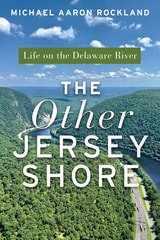
The Other Jersey Shore
Life on the Delaware RiverMichael Aaron Rockland
Rutgers University Press, 2024
The Other Jersey Shore takes readers on a personal tour of the New Jersey portion of the Delaware River and its surroundings. You will learn about the role that the river played in human history, including Washington’s four crossings of the Delaware during the Revolutionary War. And you will also learn about the ecological history of the river itself, once one of the most polluted waterways in the country and now one of the cleanest, providing drinking water for 17 million people. Michael Aaron Rockland, a long-time New Jersey resident, shows readers his very favorite spots along the Delaware, including the pristine waterfalls and wilderness in the Delaware Water Gap recreation area. Along the way, he shares engrossing stories and surprising facts about the river that literally defines western New Jersey.
The Political State of New Jersey
Edited by Gerald M. Pomper
Rutgers University Press, 1986
A major theme of this book is the emergence of the state government as a significant factor in New Jersey political life. Only recently has the state, as opposed to local or private institutions, become a dominant influence. This trend is evident in the political culture and political parties, the legislature, the governor's office and the courts, the state's finances, and in the agencies for education, environmental protection, and economic development.
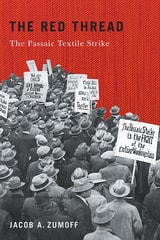
The Red Thread
The Passaic Textile StrikeJacob A. Zumoff
Rutgers University Press, 2021
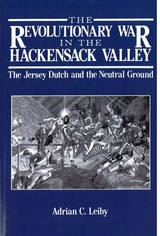
The Revolutionary War in the Hackensack Valley
The Jersey Dutch and the Neutral Ground, 1775-1783Leiby, Adrian C.
Rutgers University Press, 1980
Adrian Leiby offers an exciting narrative of the people of Dutch New Jersey and New York during this conflict. Historians will find colorful details about the Revolutionary War, and genealogists will find much previously unpublished material on hundreds of men and women of Dutch New Jersey and New York in the 1700s.
The Status and Distribution of New Jersey's Birds
Leck, Charles F
Rutgers University Press, 1984
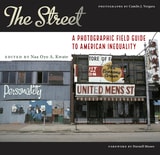
The Street
A Photographic Field Guide to American InequalityNaa Oyo A. Kwate
Rutgers University Press, 2021
Using MacArthur fellow Camilo José Vergara’s intimate street photographs of Camden, New Jersey as reference points, the essays in this collection analyze these images within the context of troubled histories and misguided policies that have exacerbated racial and economic inequalities. Rather than blaming Camden’s residents for the blighted urban landscape, the multidisciplinary array of scholars contributing to this guide reveal the oppressive structures and institutional failures that have led the city to this condition. Tackling topics such as race and law enforcement, gentrification, food deserts, urban aesthetics, credit markets, health care, childcare, and schooling, the contributors challenge conventional thinking about what we should observe when looking at neighborhoods.
The Teacup Ministry and Other Stories
Subtle Boundaries of ClassBy Rhoda H. Halperin
University of Texas Press, 2001
In the global world of the twenty-first century, class boundaries are subtle and permeable, though real nonetheless. Markers of identity, authenticity, and belonging can change with a gesture or a glance, making people feel they do or don't belong in certain places, with certain people, at certain times. In these powerfully written ethnographic stories, Rhoda Halperin maps the boundaries of class by examining three themes: crossing class boundaries, class creativity, and class vulnerability.
In telling these stories, Halperin draws on a wealth of ethnographic experiences in this country and abroad. Her book challenges class stereotypes in ways that touch on universals across cultures and over time.
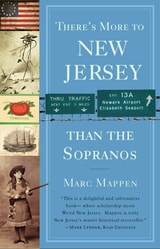
There's More to New Jersey than the Sopranos
Mappen, Marc
Rutgers University Press, 2009
Even fans of that popular show, one that held viewers captive, may be a bit disheartened to discover that the first thing that pops into minds around the world about New Jersey is a dysfunctional crime family, just an exit or two off the infamous N.J. Turnpike. But there's no need to live in fear that the only culture and history that the state is known for is, well, let's say, a bit of bada bing. Actually, the echo of the Big Bangùthe cosmic event that marked the birth of our universe some 13.7 billion years agoùwas first identified by scientists from Bell Labs in Murray Hill, New Jersey.
In this lively romp through history from the primitive past to the present day, Marc Mappen's message resonatesùThere's More to New Jersey than the Sopranos. Real tales, wise tales, tall tales abound throughout the pages of Mappen's collection, filled with zest, humor, scandal, and occasionally tragedy. Annie Oakley. Ulysses S. Grant. Benedict Arnold. Ezra Pound. Shoeless Joe Jackson. These luminaries and many others share a common bond with the state that witnessed prehistoric elephants roaming its pastures, the explosion on the USS Princeton, a Martian invasion, famous firsts like the phonograph, electric light, and movies, and, well, step aside Tony Soprano: mobster Al Capone strolling along the Atlantic City boardwalk.
Providing a lens into American history through lively prose and more than twenty-five illustrations, There's More to New Jersey than the Sopranos is as much fun as a trip to the Jersey Shore and definitely more rewarding than a night home watching televisionù simply stated, this book is one you can't refuse to read.
This Is New Jersey
Cunningham, John T
Rutgers University Press, 1995
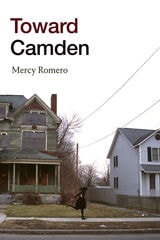
Toward Camden
Mercy Romero
Duke University Press, 2021
Duke University Press Scholars of Color First Book Award recipient
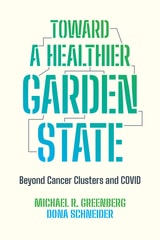
Toward a Healthier Garden State
Beyond Cancer Clusters and COVIDMichael R. Greenberg
Rutgers University Press, 2023
This book uses the past fifty years of New Jersey history as a case study to illustrate just how much public policy decisions and other upstream factors can affect the health of a state’s citizens. It reveals how economic and racial disparities in health care were exacerbated by bad policies regarding everything from zoning to education to environmental regulation. The study further chronicles how New Jersey struggled to deal with public health crises like the AIDS epidemic and the crack epidemic. Yet it also explores how the state has developed some of the nation’s most innovative responses to public health challenges, and then provides policy suggestions for how we might build an even healthier New Jersey.