Results by title
152 books match the query 'New York (N.Y.)' and 27 start with t
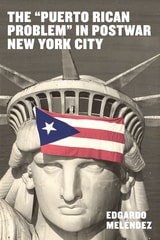
The "Puerto Rican Problem" in Postwar New York City
Edgardo Meléndez
Rutgers University Press, 2023
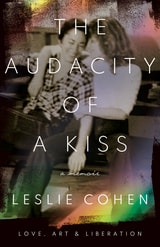
The Audacity of a Kiss
Love, Art, and LiberationLeslie Cohen
Rutgers University Press, 2021
Rendered in bronze, covered in white lacquer, two women sit together on a park bench in Greenwich Village. One of the women touches the thigh of her partner as they gaze into each other’s eyes. The two women are part of George Segal’s iconic sculpture “Gay Liberation,” but these powerful symbols were modeled on real people: Leslie Cohen and her partner (now wife) Beth Suskin.
In this evocative memoir, Cohen tells the story of a love that has lasted for over fifty years. Transporting the reader to the pivotal time when brave gay women and men carved out spaces where they could live and love freely, she recounts both her personal struggles and the accomplishments she achieved as part of New York’s gay and feminist communities. Foremost among these was her 1976 cofounding of the groundbreaking women’s nightclub Sahara, which played host to such luminaries as Betty Friedan, Gloria Steinem, Pat Benatar, Ntozake Shange, Rita Mae Brown, Adrienne Rich, Patti Smith, Bella Abzug, and Jane Fonda. The Audacity of a Kiss is a moving and inspiring tale of how love, art, and solidarity can overcome oppression.
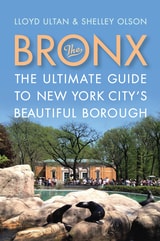
The Bronx
The Ultimate Guide to New York City's Beautiful BoroughUltan, Lloyd
Rutgers University Press, 2015
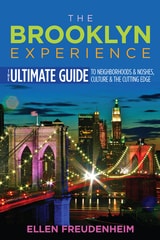
The Brooklyn Experience
The Ultimate Guide to Neighborhoods & Noshes, Culture & the Cutting EdgeFreudenheim, Ellen
Rutgers University Press, 2016
Targeting the independent, curious traveler, The Brooklyn Experience includes a dozen “do-it-yourself” tours, including a visit to Woody Allen’s childhood neighborhood, and amazing Revolutionary and Civil War sites.
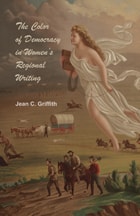
The Color of Democracy in Women's Regional Writing
Jean Carol Griffith
University of Alabama Press, 2009
Exploring how women writers used regional fiction to reimagine democracy, identity, and belonging in America.
American regionalism has become a contested subject in literary studies alongside the ubiquitous triad of race, class, and gender. The Color of Democracy in Women's Regional Writing enters into the heart of an ongoing debate in the field about the significance of regional fiction at the end of the 19th century. Jean Griffith presents the innovative view that regional writing provided Edith Wharton, Ellen Glasgow, and Willa Cather with the means to explore social transformation in a form of fiction already closely associated with women readers and writers.
Griffith provides new readings of texts by these authors; she places them alongside the works of their contemporaries, including William Faulkner and Langston Hughes, to show regionalism's responses to the debate over who was capable of democratic participation and reading regionalism's changing mediations between natives and strangers as reflections of the changing face of democracy.
This insightful work enriches the current debate about whether regionalism critiques hierarchies or participates in nationalist and racist agendas and will be of great interest to those invested in regional writing or the works of these significant authors.
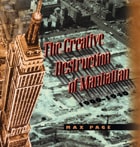
The Creative Destruction of Manhattan, 1900-1940
Max Page
University of Chicago Press, 1999
"It'll be a great place if they ever finish it," O. Henry wrote about New York City. This laconic remark captures the relentlessly transitory character of New York, and it points toward Max Page's synthetic perspective. Against the prevailing motif of a naturally expanding metropolis, Page argues that the early-twentieth-century city was dominated by the politics of destruction and rebuilding that became the hallmark of modern urbanism.
The oxymoron "creative destruction" suggests the tensions that are at the heart of urban life: between stability and change, between particular places and undifferentiated spaces, between market forces and planning controls, and between the "natural" and "unnatural" in city growth. Page investigates these cultural counterweights through case studies of Manhattan's development, with depictions ranging from private real estate development along Fifth Avenue to Jacob Riis's slum clearance efforts on the Lower East Side, from the elimination of street trees to the efforts to save City Hall from demolition.
In these examples some New Yorkers celebrate planning by destruction or marvel at the domestication of the natural environment, while others decry the devastation of their homes and lament the passing of the city's architectural heritage. A central question in each case is the role of the past in the shaping of collective memory—which buildings are preserved? which trees are cut down? which fragments are enshrined in museums? Contrary to the popular sense of New York as an ahistorical city, the past—as recalled by powerful citizens—was, in fact, at the heart of defining how the city would be built.
Beautifully illustrated and written in clear, engaging prose, The Creative Destruction of Manhattan offers a new way of viewing the development of the American city.
"An excellent, multifaceted analysis of the process of urban development-not the inevitability of development but the choices individuals, organizations, and developers made that transformed Manhattan. The politics of place was, Max Page convincingly argues, an ongoing battle to define and thereby control the evolving shape of the city."—David Schuyler, author of Apostle of Taste: Andrew Jackson Downing 1815-1852
"Max Page transcends the usual dichotomy between those who glorify destruction for the sake of change and those who would avoid both at all cost. The sizeable borderland between architecture and preservation reveals new dimensions about science and history, innovation and memory, the cities that have been, and those yet to come."—Gwendolyn Wright, author of The Politics of Design in French Colonial Urbanism
"A sober, humane explanation of how and why New York City became a place of continuous rebuilding. . . . For real or armchair New Yorkers, the whole package is a treat."—Kirkus Reviews
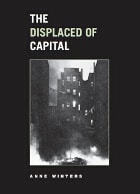
The Displaced of Capital
Anne Winters
University of Chicago Press, 2004
The long-awaited follow-up to The Key to the City—a finalist for the National Book Critics Circle Award in 1986—Anne Winters's The Displaced of Capital emanates a quiet and authoritative passion for social justice, embodying the voice of a subtle, sophisticated conscience.
The "displaced" in the book's title refers to the poor, the homeless, and the disenfranchised who populate New York, the city that serves at once as gritty backdrop, city of dreams, and urban nightmare. Winters also addresses the culturally, ethnically, and emotionally excluded and, in these politically sensitive poems, writes without sentimentality of a cityscape of tenements and immigrants, offering her poetry as a testament to the lives of have-nots. In the central poem, Winters witnesses the relationship between two women of disparate social classes whose friendship represents the poet's political convictions. With poems both powerful and musical, The Displaced of Capital marks Anne Winters's triumphant return and assures her standing as an essential New York poet.
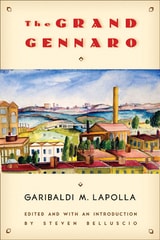
The Grand Gennaro
Belluscio, Steven
Rutgers University Press, 2009
The Grand Gennaro, a riveting saga set at the turn of the last century in Italian American Harlem, reflects on how youthful acts of cruelty and desperation follow many to the grave. A classic in the truest sense, this operatic narrative is alive once again, addressing the question: How does one become an "American"?
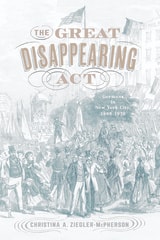
The Great Disappearing Act
Germans in New York City, 1880-1930Christina A. Ziegler-McPherson
Rutgers University Press, 2022
This study examines these questions in relation to the German immigrant community in New York City between 1880-1930, and seeks to understand how German-American New Yorkers assimilated into the larger American society in the early twentieth century.
By the turn of the twentieth century, New York City was one of the largest German-speaking cities in the world and was home to the largest German community in the United States. This community was socio-economically diverse and increasingly geographically dispersed, as upwardly mobile second and third generation German Americans began moving out of the Lower East Side, the location of America’s first Kleindeutschland (Little Germany), uptown to Yorkville and other neighborhoods. New York’s German American community was already in transition, geographically, socio-economically, and culturally, when the anti-German/One Hundred Percent Americanism of World War I erupted in 1917.
This book examines the structure of New York City’s German community in terms of its maturity, geographic dispersal from the Lower East Side to other neighborhoods, and its ultimate assimilation to the point of invisibility in the 1920s. It argues that when confronted with the anti-German feelings of World War I, German immigrants and German Americans hid their culture – especially their language and their institutions – behind closed doors and sought to make themselves invisible while still existing as a German community.
But becoming invisible did not mean being absorbed into an Anglo-American English-speaking culture and society. Instead, German Americans adopted visible behaviors of a new, more pluralistic American culture that they themselves had helped to create, although by no means dominated. Just as the meaning of “German” changed in this period, so did the meaning of “American” change as well, due to nearly 100 years of German immigration.
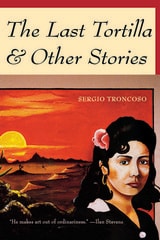
The Last Tortilla
and Other StoriesSergio Troncoso
University of Arizona Press, 1999
Writing in a straightforward, light-handed style reminiscent of Grace Paley and Raymond Carver, he spins charming tales that reflect his experiences in two worlds. Troncoso's El Paso is a normal town where common people who happen to be Mexican eat, sleep, fall in love, and undergo epiphanies just like everyone else. His tales are coming-of-age stories from the Mexican-American border, stories of the working class, stories of those coping with the trials of growing old in a rapidly changing society. He also explores New York with vignettes of life in the big city, capturing its loneliness and danger.
Beginning with Troncoso's widely acclaimed story "Angie Luna," the tale of a feverish love affair in which a young man rediscovers his Mexican heritage and learns how much love can hurt, these stories delve into the many dimensions of the human condition. We watch boys playing a game that begins innocently but takes a dangerous turn. We see an old Anglo woman befriending her Mexican gardener because both are lonely. We witness a man terrorized in his New York apartment, taking solace in memories of lost love. Two new stories will be welcomed by Troncoso's readers. "My Life in the City" relates a transplanted Texan's yearning for companionship in New York, while "The Last Tortilla" returns to the Southwest to explore family strains after a mother's death—and the secret behind that death. Each reflects an insight about the human heart that has already established the author's work in literary circles.
Troncoso sets aside the polemics about social discomfort sometimes found in contemporary Chicano writing and focuses instead on the moral and intellectual lives of his characters. The twelve stories gathered here form a richly textured tapestry that adds to our understanding of what it is to be human.
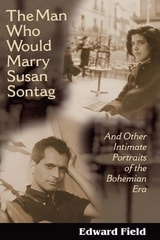
The Man Who Would Marry Susan Sontag
And Other Intimate Literary Portraits of the Bohemian EraEdward Field
University of Wisconsin Press, 2007
Long before Stonewall, young Air Force veteran Edward Field, fresh from combat in WWII, threw himself into New York’s literary bohemia, searching for fulfillment as a gay man and poet. In this vivid account of his avant-garde years in Greenwich Village and the bohemian outposts of Paris’s Left Bank and Tangier—where you could write poetry, be radical, and be openly gay—Field opens the closet door to reveal, as never been seen before, some of the most important writers of his time.
Here are young, beautiful Susan Sontag sitting at the feet of her idol Alfred Chester, who shrewdly plotted to marry her; May Swenson and her two loves; Paul and Jane Bowles in their ambiguous marriage; Frank O’Hara in and out of bed; Fritz Peters, the anointed son of Gurdjieff; and James Baldwin, Isabel Miller (Patience and Sarah), Tobias Schneebaum, Robert Friend, and many others. With its intimate portraits, Field’s memoir brings back a forgotten era—postwar bohemia—bawdy, comical, romantic, sad, and heroic.
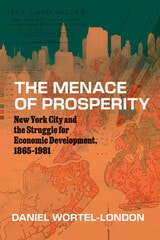
The Menace of Prosperity
New York City and the Struggle for Economic Development, 1865–1981Daniel Wortel-London
University of Chicago Press, 2025
Many local policymakers make decisions based on a deep-seated belief: what’s good for the rich is good for cities. Convinced that local finances depend on attracting wealthy firms and residents, municipal governments lavish public subsidies on their behalf. Whatever form this strategy takes—tax-exempt apartments, corporate incentives, debt-financed mega projects—its rationale remains consistent and assumed to be true. But this wasn’t always the case. Between the 1870s and the 1970s, a wide range of activists, citizens, and intellectuals in New York City connected local fiscal crises to the greed and waste of the rich. These figures saw other routes to development, possibilities rooted in alternate ideas about what was fiscally viable.
In The Menace of Prosperity, Daniel Wortel-London argues that urban economics and politics are shaped by what he terms the “fiscal imagination” of policymakers, activists, advocates, and other figures. His survey of New York City during a period of explosive growth shows how residents went beyond the limits of redistributive liberalism to imagine how their communities could become economically viable without the largesse of the wealthy. Their strategies—which included cooperatives, public housing, land-value taxation, public utilities, and more—centered the needs and capabilities of ordinary residents as the basis for local economies that were both prosperous and just.
Overturning stale axioms about economic policy, The Menace of Prosperity shows that not all growth is productive for cities. Wortel-London’s ambitious history demonstrates the range of options we’ve abandoned and hints at the economic frameworks we could still realize—and the more democratic cities that might result.
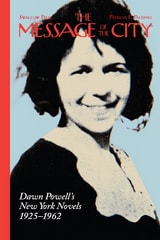
The Message of the City
Dawn Powell’s New York Novels, 1925–1962Patricia E. Palermo
Ohio University Press, 2016
Dawn Powell was a gifted satirist who moved in the same circles as Dorothy Parker, Ernest Hemingway, renowned editor Maxwell Perkins, and other midcentury New York luminaries. Her many novels are typically divided into two groups: those dealing with her native Ohio and those set in New York. “From the moment she left behind her harsh upbringing in Mount Gilead, Ohio, and arrived in Manhattan, in 1918, she dove into city life with an outlander’s anthropological zeal,” reads a recent New Yorker piece about Powell, and it is those New York novels that built her reputation for scouring wit and social observation.
In this critical biography and study of the New York novels, Patricia Palermo reminds us how Powell earned a place in the national literary establishment and East Coast social scene. Though Powell’s prolific output has been out of print for most of the past few decades, a revival is under way: the Library of America, touting her as a “rediscovered American comic genius,” released her collected novels, and in 2015 she was posthumously inducted into the New York State Writer’s Hall of Fame.
Engaging and erudite, The Message of the City fills a major gap in in the story of a long-overlooked literary great. Palermo places Powell in cultural and historical context and, drawing on her diaries, reveals the real-life inspirations for some of her most delicious satire.
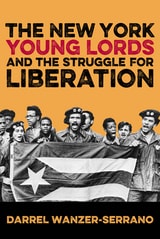
The New York Young Lords and the Struggle for Liberation
Darrel Wanzer-Serrano
Temple University Press, 2015
In The New York Young Lords and the Struggle for Liberation, Darrel Wanzer-Serrano details the numerous community initiatives that advanced decolonial sensibilities in El Barrio and beyond. Using archival research and interviews, he crafts an engaging account of the Young Lords’ discourse and activism. He rescues the organization from historical obscurity and makes an argument for its continued relevance, enriching and informing contemporary discussions about Latino/a politics.
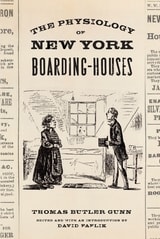
The Physiology of New York Boarding-Houses
Faflik, David
Rutgers University Press, 2008
In his introduction, David Faflik considers what made Gunn's book a compelling read in the past and how today it can elucidate our understanding of the formation and evolution of urban American life and letters.
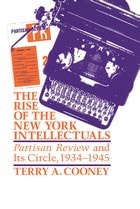
The Rise of the New York Intellectuals
Partisan Review and Its Circle, 1934–1945Terry A. Cooney
University of Wisconsin Press, 1986
Cosmopolitan visions
Terry A. Cooney traces the evolution of the Partisan Review—often considered to be the most influential little magazine ever published in America—during its formative years, giving a lucid and dispassionate view of the magazine and its luminaries who played a leading role in shaping the public discourse of American intellectuals. Included are Lionel Trilling, Philip Rahv, William Phillips, Dwight Macdonald, F. W. Dupee, Mary McCarthy, Sidney Hook, Harold Rosenberg, and Delmore Schwartz, among others.
“An excellent book, which works at each level on which it operates. It succeeds as a straightforward narrative account of the Partisan Review in the 1930s and 1940s. The magazine’s leading voices—William Phillips, Philip Rahv, Dwight MacDonald, Lionel Trilling, and all the rest—receive their due. . . . Among the themes that engage Cooney. . . . are: how they dealt with ‘modernism’ in culture and radicalism in politics, each on its own and in combination; how Jewishness played a complex and fascinating role in many of the thinkers’ lives; and, especially, how ‘cosmopolitanism’ best explains what the Partisan Review was all about.”—Robert Booth Fowler, Journal of American History
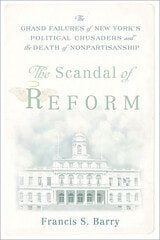
The Scandal of Reform
The Grand Failures of New York's Political Crusaders and the Death of NonpartisanshipBarry, Francis S
Rutgers University Press, 2009
The Scandal of Reform pulls the curtain back on New York's reformers past and present, revealing the bonds they have always shared with the bosses they disdain, the policy failures they still refuse to recognize, and the transition they have made from nonpartisan outsiders to ideological insiders.
Francis S. Barry examines the evolution of political reform from the frontlines of New York City's recent reform wars. He offers an insider's account and analysis of the controversial 2003 referendum debate on nonpartisan elections, and he challenges reformersùand members of both partiesùto reconsider their faith in reforms that are no longer serving the public interest.
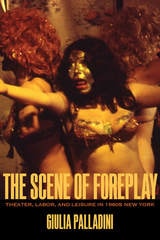
The Scene of Foreplay
Theater, Labor, and Leisure in 1960s New YorkGiulia Palladini
Northwestern University Press, 2017
Matching an original approach to historical materials and theoretical reflection, Palladini addresses the peculiar forms of production, reproduction, and consumption developed in the 1960s as labors of love, creating for artists a condition of “preliminarity” toward professional work and also functioning as a counterforce within productive economy, as a prelude where value is not yet assigned to labor.
The Scene of Foreplay proposes that such labors of love can be considered both as paradigmatic for contemporary forms of precarious labor and also resonating with echoes from marginal histories of the performing arts, in a nonlinear genealogy of queer resistance to ideas of capitalist productivity and professionalism. The book offers much for those interested in performance theory as well asin the history of theater and performance arts in the 1960s.
The Scene of Harlem Cabaret
Race, Sexuality, PerformanceShane Vogel
University of Chicago Press, 2009
Harlem’s nightclubs in the 1920s and ’30s were a crucible for testing society’s racial and sexual limits. Normally tacit divisions were there made spectacularly public in the vibrant, but often fraught, relationship between performer and audience. The cabaret scene, Shane Vogel contends, also played a key role in the Harlem Renaissance by offering an alternative to the politics of sexual respectability and racial uplift that sought to dictate the proper subject matter for black arts and letters. Individually and collectively, luminaries such as Duke Ellington, Lena Horne, Langston Hughes, Claude McKay, Wallace Thurman, and Ethel Waters expanded the possibilities of blackness and sexuality in America, resulting in a queer nightlife that flourished in music, in print, and on stage.
Deftly combining performance theory, literary criticism, historical research, and biographical study, The Scene of Harlem Cabaret brings this rich moment in history to life, while exploring the role of nightlife performance as a definitive touchstone for understanding the racial and sexual politics of the early twentieth century.
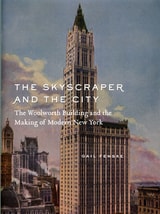
The Skyscraper and the City
The Woolworth Building and the Making of Modern New YorkGail Fenske
University of Chicago Press, 2008
Fenske shows here that the building’s multiplicity of meanings reflected the cultural contradictions that defined New York City’s modernity. For Frank Woolworth—founder of the famous five-and-dime store chain—the building served as a towering trademark, for advocates of the City Beautiful movement it suggested a majestic hotel de ville, for technological enthusiasts it represented the boldest of experiments in vertical construction, and for tenants it provided an evocative setting for high-style consumption. Tourists, meanwhile, experienced a spectacular sightseeing destination and avant-garde artists discovered a twentieth-century future. In emphasizing this faceted significance, Fenske illuminates the process of conceiving, financing, and constructing skyscrapers as well as the mass phenomena of consumerism, marketing, news media, and urban spectatorship that surround them.
As the representative example of the skyscraper as a “cathedral of commerce,” the Woolworth Building remains a commanding presence in the skyline of lower Manhattan, and the generously illustrated Skyscraper and the City is a worthy testament to its importance in American culture.
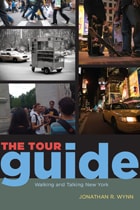
The Tour Guide
Walking and Talking New YorkJonathan R. Wynn
University of Chicago Press, 2011
Everyone wants to visit New York at least once. The Big Apple is a global tourist destination with a dizzying array of attractions throughout the five boroughs. The only problem is figuring out where to start—and that’s where the city’s tour guides come in.
These guides are a vital part of New York’s raucous sidewalk culture, and, as The Tour Guide reveals, the tours they offer are as fascinatingly diverse—and eccentric—as the city itself. Visitors can take tours that cover Manhattan before the arrival of European settlers, the nineteenth-century Irish gangs of Five Points, the culinary traditions of Queens, the culture of Harlem, or even the surveillance cameras of Chelsea—in short, there are tours to satisfy anyone’s curiosity about the city’s past or present. And the guides are as intriguing as the subjects, we learn, as Jonathan R. Wynn explores the lives of the people behind the tours, introducing us to office workers looking for a diversion from their desk jobs, unemployed actors honing their vocal skills, and struggling retirees searching for a second calling. Matching years of research with his own experiences as a guide, Wynn also lays bare the grueling process of acquiring an official license and offers a how-to guide to designing and leading a tour.
Touching on the long history of tour-giving across the globe as well as the ups and downs of New York’s tour guide industry in the wake of 9/11, The Tour Guide is as informative and insightful as the chatty, charming, and colorful characters at its heart.
The Transformation of the Avant-Garde
The New York Art World, 1940-1985Diana Crane
University of Chicago Press, 1989
Crane's account is built around discussions of seven styles: Abstract Expressionism in the forties; Pop art and Minimalism in the sixties; Figurative painting, Photorealism, and Pattern painting in the early seventies; and Neo-Expressionism in the early eighties. Demonstrating that the New York art world moved toward increasing acceptance of dominant American cultural trends, Crane offers a fascinating look not only at the intricacies of New York's artistic inner circle but also at the sociology of work and professions, the economics of culture markets such as "dealing art," and the sociology of culture.
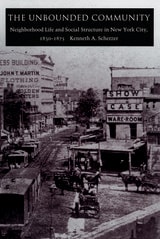
The Unbounded Community
Neighborhood Life and Social Structure in New York City, 1830–1875Kenneth A. Scherzer
Duke University Press, 1992
After a critical examination of recent historical renderings of neighborhood life, Scherzer focuses on the ecological, symbolic, and social aspects of nineteenth-century community life in New York City. Employing a wide array of sources, from census reports and church records to police blotters and brothel guides, he documents the complex composition of neighborhoods that defy simple categorization by class or ethnicity. From his account, the New York City neighborhood emerges as a community in flux, born out of the chaos of May Day, the traditional moving day. The fluid geography and heterogeneity of these neighborhoods kept most city residents from developing strong local attachments. Scherzer shows how such weak spatial consciousness, along with the fast pace of residential change, diminished the community function of the neighborhood. New Yorkers, he suggests, relied instead upon the "unbounded community," a collection of friends and social relations that extended throughout the city.
With pointed argument and weighty evidence, The Unbounded Community replaces the neighborhood of nostalgia with a broader, multifaceted conception of community life. Depicting the neighborhood in its full scope and diversity, the book will enhance future forays into urban history.
The Urban Voter
Group Conflict and Mayoral Voting Behavior in American CitiesKaren M. Kaufmann
University of Michigan Press, 2004

Today in the Taxi
Sean Singer
Tupelo Press, 2022
—Laurie Sheck
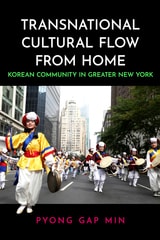
Transnational Cultural Flow from Home
Korean Community in Greater New YorkPyong Gap Min
Rutgers University Press, 2023
Transnational Cultural Flow from Home examines New York Korean immigrants’ collective efforts to preserve their cultural traditions and cultural practices and their efforts to transmit and promote them to New Yorkers by focusing on the Korean cultural elements such as language, foods, cultural festivals, and traditional and contemporary performing arts.
This publication was supported by the 2022 Korean Studies Grant Program of the Academy of Korean Studies (AKS-2022-P-009).
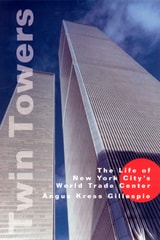
Twin Towers
Gillespie, Angus K
Rutgers University Press, 1999
A readable account of both the history of the construction of the Twin Towers and the life of the people who work there.
The Twin Towers of the World Trade Center are more than office buildings. They are symbols of America, just as the Eiffel Tower and Big Ben represent their countries. Commissioned in 1962 and completed in 1976, these edifices are still the tallest man-made structures in New York City. Indeed, the builders intended the towers to make a statement about the importance of the Port of New York and New Jersey. The complex rises like Emerald City, with fountains and sculpture from what was once a dilapidated area of half-abandoned stores.
Folklorist Angus Gillespie takes us on a tour that goes back in time and continues to the present day. He recounts the political maneuvering necessary to get the State of New Jersey to agree to situate the project at its present location. Deftly presenting portraits of the men responsible for mooring the World Trade Center at its present location, Gillespie provides ample evidence that the World Trade Center backers were “second to none in self promotion.”
Twin Towers also demonstrates how engineers prepared the site and solved complex problems (wind patterns, elevator placement, ground-water complications) in order to erect the towers, each with 110 stories. And he discusses the contrast between the architectural community’s almost universal disdain for the towers’ design and the public’s enthusiastic acceptance of the buildings as a symbol of New York.
There is more to the Twin Towers than its architecture, however. People give this complex life, purpose, vibrancy, Gillespie points out. The World Trade Center houses more than 400 businesses and organizations from some 60 different countries engaged in a broad range of international business activities. Through his numerous first-hand interviews conducted with the people who daily work there, Gillespie vividly portrays the world of bankers, shippers, freight forwarders, and traders. With skill and insight, he captures what happens during a normal 24-hour day in the Twin Towers, starting with early morning food deliveries and ending with the patrols of nighttime security guards.
Twin Towers is both a fitting tribute and careful analysis of one of the most resonating symbols in American culture.