Results by title
71 books match the query 'North Carolina' and 24 start with t

Terry Sanford
Politics, Progress, and Outrageous AmbitionsHoward E. Covington Jr. and Marion A. Ellis
Duke University Press, 1999
After defeating a segregationist campaign in 1960 to win the governorship, Sanford used his years in office to boost public education and advance race relations. A decade later, at the height of tumult on American campuses, Sanford assumed the presidency of Duke University and led it to its position as one of the top universities in the nation. During his more than fifty years as a public servant he was associated with presidents John F. Kennedy, Lyndon B. Johnson, Richard Nixon, and Jimmy Carter. Sanford was a presidential candidate himself in 1972 and 1976, and he won election to the United States Senate in 1986 where his international commission produced an economic recovery plan for Central America. As one of the last New Deal Democrats in the Senate, he remained passionate about the opportunity for leaders to use government to improve people’s lives.
Terry Sanford draws on Sanford’s considerable private and public archive as well as on the recollections of Sanford himself and his family, colleagues, and friends. This biography offers a unique perspective on North Carolina life, politics, political personalities, and the shifting public allegiances of the second half of the twentieth century that transformed life both in North Carolina and throughout the American South.
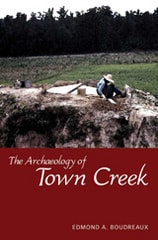
The Archaeology of Town Creek
Edmond A. Boudreaux III
University of Alabama Press, 2007
The sequence of change for public architecture during the Mississippian period may reflect a centralization of political power through time. In the research presented here, some of the community-level assumptions attributed to the appearance of Mississippian mounds are tested against the archaeological record of the Town Creek site—the remains of a town located on the northeastern edge of the Mississippian culture area. In particular, the archaeological record of Town Creek is used to test the idea that the appearance of Mississippian platform mounds was accompanied by the centralization of political authority in the hands of a powerful chief.
A compelling argument has been made that mounds were the seats and symbols of political power within Mississippian societies. While platform mounds have been a part of Southeastern Native American communities since at least 100 B.C., around A.D. 400 leaders in some communities began to place their houses on top of earthen mounds—an act that has been interpreted as an attempt to legitimize personal authority by a community leader through the appropriation of a powerful, traditional, community-oriented symbol. Platform mounds at a number of sites were preceded by a distinctive type of building called an earthlodge—a structure with earth-embanked walls and an entrance indicated by short, parallel wall trenches. Earthlodges in the Southeast have been interpreted as places where a council of community leaders came together to make decisions based on consensus. In contrast to the more inclusive function proposed for premound earthlodges, it has been argued that access to the buildings on top of Mississippian platform mounds was limited to a much smaller subset of the community. If this was the case and if ground-level earthlodges were more accessible than mound-summit structures, then access to leaders and leadership may have decreased through time.
Excavations at the Town Creek archaeological site have shown that the public architecture there follows the earthlodge-to-platform mound sequence that is well known across the South Appalachian subarea of the Mississippian world. The clear changes in public architecture coupled with the extensive exposure of the site's domestic sphere make Town Creek an excellent case study for examining the relationship among changes in public architecture and leadership within a Mississippian society.
The Balm of Gilead Tree
New and Selected StoriesRobert Morgan
Ohio University Press, 1999
Published in 1999 by Gnomon Press
In The Balm of Gilead Tree, acclaimed author and poet Robert Morgan presents a masterful collection of seventeen short stories—ten new and seven selected from earlier volumes—that illuminate the lives of working-class people in the American South, particularly in the Appalachian region. With lyrical precision and deep empathy, Morgan explores themes of hardship, resilience, and transformation across generations.
From the haunting historical imagination of “The Tracks of Chief de Soto” to the visceral immediacy of “The Ratchet,” where a truck driver faces a terrifying descent with failed brakes, Morgan’s stories are rich in sensory detail and emotional depth. Characters grapple with environmental peril, economic uncertainty, and the quiet dramas of rural life, all rendered with Morgan’s signature clarity and reverence for the natural world.
This collection affirms Morgan’s place as a vital voice in Southern literature, offering readers both the balm of storytelling and the grit of lived experience.
The Browning of the New South
Jennifer A. Jones
University of Chicago Press, 2019

The Brummer Collection of Medieval Art
Duke University Museum of ArtCaroline Bruzelius and with Jill Meredith
Duke University Press, 1991
Five studies by leading art scholars focus on key works in the collection and contribute to a new understanding of the origins of many of the pieces. Two introductory essays comment on the character of the collection as a whole, its acquisition by Duke University, and its conservation. Finally, the catalog section discusses the more important pieces in the collection and is followed by a checklist of entries and smaller photographs of all other objects.
Contributors. Ilene H. Forsyth, Jean M. French, Dorothy F. Glass, Dieter Kimpel, Jill Meredith, Linda S. Roundhill

The Carter Journals
Time Travels in Early U.S. HistoryShane Phipps
Indiana Historical Society Press, 2014

The Colonel's Dream
Charles W. Chesnutt
West Virginia University Press, 2014
Charles Waddell Chesnutt (1858-1932) was an African American writer, essayist, Civil Rights activist, legal-stenography businessman, and lawyer whose novels and short stories explore race, racism, and the problematic contours of African Americans’ social and cultural identities in post-Civil War South. He was the first African American to be published by a major American publishing house and served as a beacon-point for future African American writers.
The Colonel’s Dream, written in 1905, is a compelling tale of the post-Civil War South’s degeneration into a region awash with virulent racist practices against African Americans: segregation, lynchings, disenfranchisement, convict-labor exploitation, and endemic violent repression. The events in this novel are powerfully depicted from the point of view of a philanthropic but unreliable southern white colonel. Upon his return to the South, the colonel learns to abhor this southern world, as a tale of vicious racism unfolds. Throughout this narrative, Chesnutt confronts the deteriorating position of African Americans in an increasingly hostile South. Upon its publication The Colonel’s Dream was considered too controversial and unpalatable because of its bitter criticisms of southern white prejudice and northern indifference, and so this groundbreaking story failed to gain public attention and acclaim.
This is the first scholarly edition of The Colonel’s Dream. It includes an introduction and notes by R. J. Ellis and works to reestablish this great novel’s reputation.

The Encyclopedia of Duke Basketball
John Roth
Duke University Press, 2006
The Encyclopedia of Duke Basketball is the ultimate reference source for true-blue fans, with profiles of great games, classic finishes (both wins and losses), and compelling personalities, including players, coaches, and opponents. While it is filled with a wealth of statistical information, the Encyclopedia goes well beyond the numerical record to deliver insights on people and performances and anecdotes that will surprise even the most seasoned Duke supporter.
The Encyclopedia features:
— A timeline of key events in men’s and women’s basketball history.
— Capsules of the most important men’s and women’s games in the program’s history, including the men’s buzzer-beating overtime win against Kentucky in 1992 and the women’s stunning victory over Tennessee to reach the Final Four in 1999.
— An alphabetical encyclopedia with entries on players from Alaa Abdelnaby to Bill Zimmer and on coaches, customs, opponents, venues, and records.
— Exclusive interviews in which standout players, including Danny Ferry, Mike Gminski, Grant Hill, Christian Laettner, and Jason Williams, recount moments they’ll never forget.
— A statistical record book covering every season through 2005–06.
—130 photographs of Duke basketball history.
A source of entertainment as well as information, this volume will be a great resource for fans hoping to settle arguments, relive favorite games, or simply enjoy hours of pleasurable reading.
The Frank C. Brown Collection of NC Folklore
Vol. II: Folk Ballads from North CarolinaFrank C. Brown
Duke University Press, 0
The Frank C. Brown Collection of NC Folklore
Vol. V: The Music of the Folk SongsFrank C. Brown
Duke University Press, 1970
The Frank C. Brown Collection of NC Folklore
Vol. VI: Popular Beliefs and Superstitions from North Carolina, pt. 1Frank C. Brown
Duke University Press, 0
The Frank C. Brown Collection of NC Folklore
Vol. VII: Popular Beliefs and Superstitions from North Carolina, pt. 2Frank C. Brown
Duke University Press, 1970
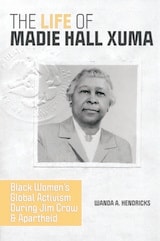
The Life of Madie Hall Xuma
Black Women's Global Activism during Jim Crow and ApartheidWanda A. Hendricks
University of Illinois Press, 2022
The North Carolina Shore and Its Barrier Islands
Restless Ribbons of SandOrrin H. Pilkey, William J. Neal, Stanley R. Riggs, Craig A. Webb, David M. Bush, Deborah F. Pilkey, Jane Bullock, and Brian A. Cowan
Duke University Press, 1998
Evidence that the North Carolina shore is changing is never hard to find, but recently the devastation wrought by Hurricane Fran and the perilous situation of the historic lighthouse at Cape Hatteras have reminded all concerned of the fragility of this coast. Arguing for a policy of intelligent development, one in which residential and commercial structures meet rather than confront the changing nature of the shore, the authors have included practical information on hazards of many kinds—storms, tides, floods, erosion, island migration, and earthquakes. Diagrams and photographs clearly illustrate coastal processes and aid in understanding the impact of hurricanes and northeasters, wave and current dynamics, as well as pollution and other environmental destruction due to overdevelopment. A chapter on estuaries provides related information on the shores of back barrier areas that are growing in popularity for recreational residences. Risk maps focus on the natural hazards of each island and together with construction guidelines provide a basis for informed island management. Lastly, the dynamics of coastal politics and management are reviewed through an analysis of the controversies over the decision to move the Cape Hatteras lighthouse and a proposed effort to stabilize Oregon Inlet.
From the natural and historic perspective of the opening chapters to the regional discussions of individual barrier islands, this book is both a primer on coastal processes for the first time visitor as well as a guide to hazard identification for property owners.

The Pivot
One Pandemic, One UniversityRobert J. Bliwise
Duke University Press, 2022

The United States Governed by Six Hundred Thousand Despots
A True Story of SlaveryJohn Swanson Jacobs
University of Chicago Press, 2024
For one hundred and sixty-nine years, a first-person slave narrative written by John Swanson Jacobs—brother of Harriet Jacobs—was buried in a pile of newspapers in Australia. Jacobs’s long-lost narrative, The United States Governed by Six Hundred Thousand Despots, is a startling and revolutionary discovery. A document like this—written by an ex-slave and ex-American, in language charged with all that can be said about America outside America, untampered with and unedited by white abolitionists—has never been seen before. A radical abolitionist, sailor, and miner, John Jacobs has a life story that is as global as it is American. Born into slavery, by 1855 he had fled both the South and the United States altogether, becoming a stateless citizen of the world and its waters. That year, he published his life story in an Australian newspaper, far from American power and its threats. Unsentimental and unapologetic, Jacobs radically denounced slavery and the state, calling out politicians and slaveowners by their names, critiquing America’s founding documents, and indicting all citizens who maintained the racist and intolerable status quo.
Reproduced in full, this narrative—which entwines with that of his sister and with the life of their friend Frederick Douglass—here opens new horizons for how we understand slavery, race, and migration, and all that they entailed in nineteenth-century America and the world at large. To truly reckon with the lives of John Jacobs is to see with new clarity that in 1776, America embarked on two experiments at once: one in democracy, the other in tyranny.
The United States Governed by Six Hundred Thousand Despots
A True Story of Slavery; A Rediscovered Narrative, with a Full BiographyJohn Swanson Jacobs
University of Chicago Press, 2024
For one hundred and sixty-nine years, a first-person slave narrative written by John Swanson Jacobs—brother of Harriet Jacobs—was buried in a pile of newspapers in Australia. Jacobs’s long-lost narrative, The United States Governed by Six Hundred Thousand Despots, is a startling and revolutionary discovery. A document like this—written by an ex-slave and ex-American, in language charged with all that can be said about America outside America, untampered with and unedited by white abolitionists—has never been seen before. A radical abolitionist, sailor, and miner, John Jacobs has a life story that is as global as it is American. Born into slavery, by 1855, he had fled both the South and the United States altogether, becoming a stateless citizen of the world and its waters. That year, he published his life story in an Australian newspaper, far from American power and its threats. Unsentimental and unapologetic, Jacobs radically denounced slavery and the state, calling out politicians and slaveowners by their names, critiquing America’s founding documents, and indicting all citizens who maintained the racist and intolerable status quo.
Reproduced in full, this narrative—which entwines with that of his sister and with the life of their friend Frederick Douglass—here opens new horizons for how we understand slavery, race, and migration, and all that they entailed in nineteenth-century America and the world at large. The second half of the book contains a full-length, nine-generation biography of Jacobs and his family by literary historian Jonathan Schroeder. This new guide to the world of John Jacobs will transform our sense of it—and of the forces and prejudices built into the American project. To truly reckon with the lives of John Jacobs is to see with new clarity that in 1776, America embarked on two experiments at once: one in democracy, the other in tyranny.
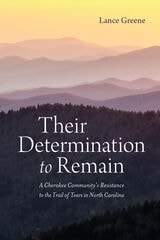
Their Determination to Remain
A Cherokee Community's Resistance to the Trail of Tears in North CarolinaLance Greene
University of Alabama Press, 2023
The remarkable story of a North Carolina Cherokee community who avoided forced removal on the Trail of Tears
During the 1838 forced Cherokee removal by the US government, a number of close-knit Cherokee communities in the Southern Appalachian Mountains refused to relinquish their homelands, towns, and way of life. Using a variety of tactics, hundreds of Cherokees avoided the encroaching US Army and remained in the region.
In his book Their Determination to Remain: A Cherokee Community’s Resistance to the Trail of Tears in North Carolina, Lance Greene explores the lives of wealthy plantation owners Betty and John Welch who lived on the southwestern edge of the Cherokee Nation. John was Cherokee and Betty was White. Although few Cherokees in the region participated in slavery, the Welches held nine African Americans in bondage.
During removal, the Welches assisted roughly 100 Cherokees hiding in the steep mountains. Afterward, they provided land for these Cherokees to rebuild a new community, Welch’s Town. Betty became a wealthy and powerful plantation mistress because her husband could no longer own land. Members of Welch’s Town experienced a transitional period in which they had no formal tribal government or clear citizenship yet felt secure enough to reestablish a townhouse, stickball fields, and dance grounds.
Greene’s innovative study uses an interdisciplinary approach, incorporating historical narrative and archaeological data, to examine how and why the Welches and members of Welch’s Town avoided expulsion and reestablished their ways of life in the midst of a growing White population who resented a continued Cherokee presence. The Welch strategy included Betty’s leadership in demonstrating outwardly their participation in modern Western lifestyles, including enslavement, as John maintained a hidden space—within the boundaries of their land—for the continuation of traditional Cherokee cultural practices. Their Determination to Remain explores the complexities of race and gender in this region of the antebellum South and the real impacts of racism on the community.

This Destructive War
The British Campaign in the Carolinas, 1780-1782John S. Pancake
University of Alabama Press, 1985
An exciting and accurate portrayal of the military action in the southern colonies that led to a new American nation
Following up the success of his 1777: The Year of the Hangman about the northern theaters of the American Revolutionary War, historian John Pancake now cover the war in the South, from General Clinton's attack on Charleston in the spring of 1780 to Cornwallis's surrender at Yorktown in October 1781.
Pancake expertly takes the reader back and forth between British and American headquarters to provide a brisk and sharp view from both sides of the conflict. His artful analysis also adds insights to the familiar narrative of the British losing because of their mistakes, American victory thanks to tenacity (particularly in the person of southern Continental forces commander Nathanael Greene), and British failure to overcome logistical problems of geography. Readers enjoy Pancake's wide-ranging knowledge of military history as applied to the Revolution as where, for example, he cites that tests conducted by the US Navy in World War II demonstrated that gun crews that were 100 percent efficient in training lost 35 percent of their efficiency in their first performance in combat.
Pancake has a writer's eye for telling details, and he creates characters sketches of the main players in the conflict that readers will always remember. This Destructive War includes a number of figures as well as detailed maps of the region where battle took place. General readers as well as scholars and students of the American Revolution will welcome anew this classic, definitive study of the campaign in the Carolinas.
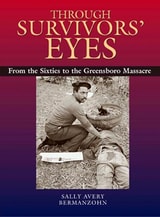
Through Survivors' Eyes
From the Sixties to the Greensboro MassacreSally Avery Bermanzohn
Vanderbilt University Press, 2003
In passionate first-person accounts, Through Survivors' Eyes tells the story of six remarkable people who set out to change the world. The survivors came of age as the "protest generation," joining the social movements of the 1960s and 1970s. They marched for civil rights, against war, for textile and healthcare workers, and for black power and women's liberation. As the mass mobilizations waned in the mid-1970s, they searched for a way to continue their activism, studied Marxism, and became communists.
Nelson Johnson, who grew up on a farm in eastern North Carolina in a family proud of its African American heritage, settled in Greensboro in the 1960s and became a leader of the Black Liberation Movement and a decade later the founder of the Faith Community Church. Willena Cannon, the daughter of black sharecroppers, witnessed a KKK murder as a child and was spurred to a life of activism. Her son, Kwame Cannon, was only ten when he saw the Greensboro killings. Marty Nathan, who grew up the daughter of a Midwestern union organizer and came to the South to attend medical school, lost her husband to the Klan/Nazi gunfire. Paul Bermanzohn, the son of Jewish Holocaust survivors, was permanently injured during the shootings. Sally Avery Bermanzohn, a child of the New York suburbs who came south to join the Civil Rights Movement, watched in horror as her friends were killed and her husband was wounded.
Through Survivors' Eyes is the story of people who abandoned conventional lives to become civil rights activists and then revolutionaries. It is about blacks and whites who united against Klan/Nazi terror, and then had to overcome unbearable hardship, and persist in seeking justice. It is also a story of one divided southern community, from the protests of black college students of the late 1960s to the convening this January of a Truth and Community Reconciliation Project (on the South African model) intended to reassess the Massacre.
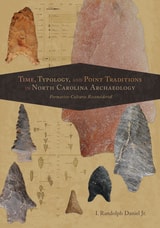
Time, Typology, and Point Traditions in North Carolina Archaeology
Formative Cultures ReconsideredI. Randolph Daniel Jr.
University of Alabama Press, 2021
Revisiting the stone tools that reshaped our understanding of North Carolina's prehistoric past.
In the 1964 landmark publication The Formative Cultures of the Carolina Piedmont, Joffre Coe established a projectile point typology and chronology that, for the first time, allowed archaeologists to identify the relative age of a site or site deposit based on the point types recovered there. Consistent with the cultural-historical paradigm of the day, the “Coe axiom” stipulated that only one point type was produced at one moment in time in a particular location. Moreover, Coe identified periods of “cultural continuity” and “discontinuity” in the chronology based on perceived similarities and differences in point styles through time.
In Time, Typology, and Point Traditions in North Carolina Archaeology: Formative Cultures Reconsidered, I. Randolph Daniel Jr. reevaluates the Coe typology and sequence, analyzing their strengths and weaknesses. Daniel reviews the history of the projectile point type concept in the Southeast and revisits both Coe’s axiom and his notions regarding cultural continuity and change based on point types. In addition, Daniel updates Coe’s typology by clarifying or revising existing types and including types unrecognized in Coe’s monograph. Daniel also adopts a practice-centered approach to interpreting types and organizes them into several technological traditions that trace ancestral-descendent communities of practice that relate to our current understanding of North Carolina prehistory.
Appealing to professional and avocational archaeologists, Daniel provides ample illustrations of points in the book as well as color versions on a dedicated website. Daniel dedicates a final chapter to a discussion of the ethical issues related to professional archaeologists using private artifact collections. He calls for greater collaboration between professional and avocational communities, noting the scientific value of some private collections.
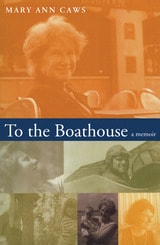
To the Boathouse
A MemoirMary Ann Caws
University of Alabama Press, 2008
From Southern roots to scholarly heights—one woman’s journey to find peace, purpose, and her place in the world.
A neat and lavish, if constricting, childhood in the lush landscapes of North Carolina. Summers at a calm, remote beach house. A proper and religiously influenced prep school in Washington. Years at Bryn Mawr, an impulsive study trip to Paris, further education at Yale, married life, and divorced life. These are the settings for Mary Ann Caws’s passionate memoir, in which she recounts the highs and lows of her journey through life. Marked by complicated relationships and a passion for learning, Caws’s story is one that resonates not only with writers like herself, but with all who have struggled with determining their path within the surrounding world.
Caws writes of her formal, stylish parents, her rebellious and deeply admired sister, and her artistic grandmother, whom she respected and idolized more than anyone else. She describes her marriage and subsequent divorce, her bouts with therapy, her children, and her growth as a student and writer. Throughout the memoir is evidence of her love for writing, teaching, art, and poetry as well as her deep respect for the people in her life that ultimately guided her into her career.
The author describes Southern society and her own life with fondness, nostalgia, and a tinge of honest criticism. The carefully selected details and delicate balance of sentiment and fact bring readers into the fascinating, complicated, and all-too-real world of Caws’s—and our own—past.
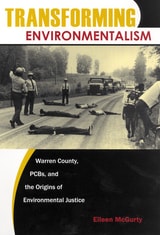
Transforming Environmentalism
Warren County, PCBs, and the Origins of Environmental JusticeMcGurty, Eileen
Rutgers University Press, 2006
In Transforming Environmentalism, Eileen McGurty explores a moment central to the emergence of the environmental justice movement. In 1978, residents of predominantly African American Warren County, North Carolina, were horrified to learn that the state planned to build a landfill in their county to hold forty thousand cubic yards of soil that was contaminated with PCBs from illegal dumping. They responded to the state's plans with a four-year resistance, ending in a month of protests with over 500 arrests from civil disobedience and disruptive actions.McGurty traces the evolving approaches that residents took to contest "environmental racism" in their community and shows how activism in Warren County spurred greater political debate and became a model for communities across the nation. Transforming Environmentalism explores how the specific circumstances of the Warren County events shaped the formation of the environmental justice movement and influenced contemporary environmentalism.
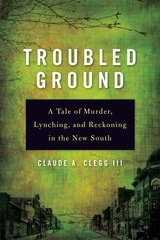
Troubled Ground
A Tale of Murder, Lynching, and Reckoning in the New SouthClaude A. Clegg III
University of Illinois Press, 2010