Results by title
69 books match the query 'Nursing' and 9 start with t
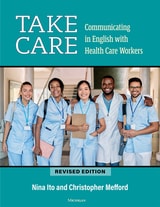
Take Care
Communicating in English with Health Care WorkersNina Ito and Christopher Mefford
University of Michigan Press, 2023
A high level of communicative skills are essential and expected for health care workers. Take Care is designed to give readers the strategies and tools to build, maintain, and repair communication within interactions that take place in health care settings. It is designed for students who are enrolled in health care training as well as nurses or health care workers who are already on the job but may want to improve their English. This text is designed to provide readers with a firm grasp of verbal and non-verbal communication strategies for more successful interactions. It will also help readers develop strategic competence by asking them to practice formulaic phrases needed to get things done. Carefully selected situations will also help readers to understand some of the social situations health care workers need to prepare for, such as apologizing, expressing condolences, or giving advice.
Take Care breaks each unit into the following sections to teach readers new skills:
- Listening for Language
- Dialogue
- Vocabulary
- Communication Strategy
- Pronunciation
- Dialogue Review
- Role Plays
- End-of-Unit Discussion
- Culture Point
This revised edition is updated to include information about pandemics, vaccines, and other medical developments. Audio files for the listening activities are available online.

Take Care
Communicating in English with U.S. Health Care WorkersNina Ito and Christopher Mefford
University of Michigan Press, 2011
Take Care was written to help nursing students and other health care workers communicate better in health care settings, with a focus on improving speaking and listening skills, vocabulary, and pronunciation. The aim was to provide users with the tools and specific communication strategies to build, maintain, or repair interactions that take place on the job. This book is also designed to develop the pragmatic competence necessary to get things done on the job and to understand some of the social situations required by health care workers, like expressing condolences or giving advice.
The individuals most likely to benefit from the material in the book are:
- Nursing students enrolled in community college (e.g., pre-nursing courses or RN students who have a special class)
· ESL students enrolled in specific CNA or medical assistant classes
· ESL students enrolled in U.S. universities who are here to learn more about nursing or health care as profession (they may or may not already have a degree in their own countries)
· Nurses or health care workers who already work in a health care setting but who are not proficient in English and so may be taking an English course sponsored by the hospital or local health system
It is therefore generally assumed that students have some knowledge of common medical and health care terms, so the book does not attempt to teach medical terminology, except in the context of communicating effectively in a health care setting. The various Vocabulary sections in each unit can therefore be used as review or as a new lesson—whatever works best for your students.
Instructors using this book do not need knowledge of the field of nursing or health care because the majority of material covered focuses on the language, not the industry.
Taking Care of Time
Cortney Davis
Michigan State University Press, 2018
Teaching the Practitioners of Care
New Pedagogies for the Health ProfessionsEdited by Nancy L. Diekelmann
University of Wisconsin Press, 2003
Nancy L. Diekelmann
Karin Dahlberg
Margaretha Ekebergh
Pamela M. Ironside
Kathryn Hopkins Kavanagh
Melinda M. Swenson
Sharon L. Sims
Rosemary A. McEldowney
Jan D. Sinnott
The Nursing Clio Reader
Histories of Sex, Reproduction, and JusticeJacqueline D. The Nursing Clio Editorial Collective
Rutgers University Press, 2025
The Nursing Clio Reader answers that call, bringing together essays that examine reproductive health through historical research and personal experience. Featuring both new and classic pieces from the Nursing Clio blog, leading historians of reproductive health provide insights that connect past struggles with today’s ongoing battles over bodies, reproductive rights, and health care. This collection offers intimate, urgent scholarship that speaks to the present moment.
A powerful resource for classrooms and individual readers alike, The Nursing Clio Reader invites reflection on how the past informs current debates, urging us to engage deeply with the history of reproductive justice in a time of unprecedented change, underscoring that indeed "the personal is historical."

The Origins and Rise of Associate Degree Nursing Education
Patricia T. Haase
Duke University Press, 1990
Advocates have long contended that the associate degree nurse is vital to the American health care system. This study, funded by the W. K. Kellogg Foundation, confirms this view. In recent years the Foundation has invested more than $6.1 million in the development of the ADN, awarded by junior and community colleges. Many participants in the ADN projects for the Kellogg Foundation have noted that, despite the importance of the ADN and the controversy about its place in nursing education, the literature is scattered and hard to identity. The Origins and Rise of Associate Degree Nursing Education and the companion bibliography will provide much-needed information to educators, hospital and nursing administrators, nursing leaders, and public policy makers—all of whom must cope with the growing nursing shortage and increasingly difficult issues in health policy and administration.
The Physician's Hand
Work Culture and Conflict in American NursingBarbara Melosh
Temple University Press, 1982
This book recasts nursing history and places it in the context of women’s history, labor history, medical history, and sociology. Removed from the limited framework of professionalization, nursing history can provide a fresh perspective on broader issues in social history. First, it offers an illuminating example of the ways in which gender informs work and, conversely. How work reproduces and transforms relationships of power and inequality.
Second, the experience of nurses adds a new dimension to our understanding of work. More than a study of professionalization, nursing history is the story of women workers’ experience in a rationalizing service industry. Like other workers, nurses faced a fundamental reorganization of work that changed the content and experience of nursing. But unlike many others, they did not suffer a dilution of skill. The book also explores the shifting configurations of social relations on the job and their implications for nurses’ work.
Third, nurses’ history provides a useful standpoint for analyzing the possibilities and limitations of women’s work.
Finally, nursing history alerts us to the complexities of working women’s consciousness, countering the common notion of women’s passivity in the workplace.
The Physician’s Hand traces nursing history from the twenties to the seventies. It begins just after World War I when the "trained nurse" had gained a secure place in medical care but not yet found a niche in the hospital. Most worked in private duty. Chapter 1 outlines the theoretical framework of professionalization. Chapter 2 examines the history and culture of hospital schools, and the following chapters focus on the changing structure and experience of nursing in its three major settings: private duty nursing, public health care, and hospital work. The conclusion weighs the competing traditions of professionalization and occupational culture in nurses’ history and their meaning for the current crisis in nursing.
The Renewal of Generosity
Illness, Medicine, and How to LiveArthur W. Frank
University of Chicago Press, 2004
The Renewal of Generosity evokes medicine as the face-to-face encounter that comes before and after diagnostics, pharmaceuticals, and surgeries. Frank calls upon the Roman emperor Marcus Aurelius, philosopher Emmanuel Levinas, and literary critic Mikhail Bakhtin to reflect on stories of ill people, doctors, and nurses who transform demoralized medicine into caring relationships. He presents their stories as a source of consolation for both ill and professional alike and as an impetus to changing medical systems. Frank shows how generosity is being renewed through dialogue that is more than the exchange of information. Dialogue is an ethic and an ideal for people on both sides of the medical encounter who want to offer more to those they meet and who want their own lives enriched in the process.
The Renewal of Generosity views illness and medical work with grace and compassion, making an invaluable contribution to expanding our vision of suffering and healing.
The Well-Being of the Elderly in Asia
A Four-Country Comparative StudyAlbert I. Hermalin, Editor
University of Michigan Press, 2002