Results by title
74 books match the query 'Origin' and 16 start with t
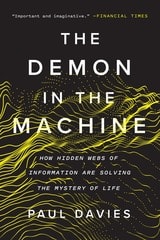
The Demon in the Machine
How Hidden Webs of Information Are Solving the Mystery of LifePaul Davies
University of Chicago Press, 1991
A Financial Times, Sunday Times, and Telegraph Best Science Book of the Year
What is life? For generations, scientists have struggled to make sense of this fundamental question, for life really does look like magic: even a humble bacterium accomplishes things so dazzling that no human engineer can match it. Huge advances in molecular biology over the past few decades have served only to deepen the mystery.
In this penetrating and wide-ranging book, world-renowned physicist and science communicator Paul Davies searches for answers in a field so new and fast-moving that it lacks a name; it is a domain where biology, computing, logic, chemistry, quantum physics, and nanotechnology intersect. At the heart of these diverse fields, Davies explains, is the concept of information: a quantity which has the power to unify biology with physics, transform technology and medicine, and force us to fundamentally reconsider what it means to be alive—even illuminating the age-old question of whether we are alone in the universe.
From life’s murky origins to the microscopic engines that run the cells of our bodies, The Demon in the Machine journeys across an astounding landscape of cutting-edge science. Weaving together cancer and consciousness, two-headed worms and bird navigation, Davies reveals how biological organisms garner and process information to conjure order out of chaos, opening a window onto the secret of life itself.
The Evolutionary Origins of Life and Death
Pierre M. Durand
University of Chicago Press, 2021
These two processes have been studied from philosophical, theoretical, experimental, and genomic angles, but no one has yet integrated the information from these various disciplines. In this work, Durand synthesizes cellular studies of life and death looking at the origin of life and the evolutionary significance of programmed cellular death. The exciting and unexpected outcome of Durand’s analysis is the realization that life and death exhibit features of coevolution. The evolution of more complex cellular life depended on the coadaptation between traits that promote life and those that promote death. In an ironic twist, it becomes clear that, in many circumstances, programmed cell death is essential for sustaining life.
The Genesis Quest
The Geniuses and Eccentrics on a Journey to Uncover the Origin of Life on EarthMichael Marshall
University of Chicago Press, 2020
How did life begin? Why are we here? These are some of the most profound questions we can ask.
For almost a century, a small band of eccentric scientists has struggled to answer these questions and explain one of the greatest mysteries of all: how and why life began on Earth. There are many different proposals, and each idea has attracted passionate believers who promote it with an almost religious fervor, as well as detractors who reject it with equal passion.
But the quest to unravel life’s genesis is not just a story of big ideas. It is also a compelling human story, rich in personalities, conflicts, and surprising twists and turns. Along the way, the journey takes in some of the greatest discoveries in modern biology, from evolution and cells to DNA and life’s family tree. It is also a search whose end may finally be in sight.
In The Genesis Quest, Michael Marshall shows how the quest to understand life’s beginning is also a journey to discover the true nature of life, and by extension our place in the universe.
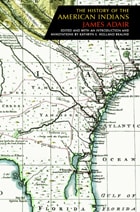
The History of the American Indians
A Critical EditionJames Adair; edited, introduced, and annotated by Kathryn E. Holland Braund
University of Alabama Press, 2009
A fully annotated edition of a classic work detailing the cultures of five southeastern American Indian tribes during the Contact Period
James Adair was an Englishman who lived and traded among the southeastern Indians for more than 30 years, from 1735 to 1768. During that time he covered the territory from the Appalachian Mountains to the Mississippi River. He encountered and lived among Indians, advised governors, spent time with settlers, and worked tirelessly for the expansion of British interests against the French and the Spanish. Adair’s acceptance by the Creeks, Choctaws, Cherokees, and Chickasaws provided him the opportunity to record, compare, and analyze their cultures and traditions.Adair’s written work, first published in England in 1775, is considered one of the finest histories of the Native Americans. His observations provide one of the earliest and what many modern scholars regard as the best account of southeastern Indian cultures. This edition adheres to current standards of literary editing, following the original closely, and provides fully annotated and indexed critical apparatus.
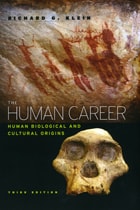
The Human Career
Human Biological and Cultural Origins, Third EditionRichard G. Klein
University of Chicago Press, 2009
Since its publication in 1989, The Human Career has proved to be an indispensable tool in teaching human origins. This substantially revised third edition retains Richard G. Klein’s innovative approach while showing how cumulative discoveries and analyses over the past ten years have significantly refined our knowledge of human evolution.
Klein chronicles the evolution of people from the earliest primates through the emergence of fully modern humans within the past 200,000 years. His comprehensive treatment stresses recent advances in knowledge, including, for example, ever more abundant evidence that fully modern humans originated in Africa and spread from there, replacing the Neanderthals in Europe and equally archaic people in Asia. With its coverage of both the fossil record and the archaeological record over the 2.5 million years for which both are available, The Human Career demonstrates that human morphology and behavior evolved together. Throughout the book, Klein presents evidence for alternative points of view, but does not hesitate to make his own position clear.
In addition to outlining the broad pattern of human evolution, The Human Career details the kinds of data that support it. For the third edition, Klein has added numerous tables and a fresh citation system designed to enhance readability, especially for students. He has also included more than fifty new illustrations to help lay readers grasp the fossils, artifacts, and other discoveries on which specialists rely. With abundant references and hundreds of images, charts, and diagrams, this new edition is unparalleled in its usefulness for teaching human evolution.
The Limits of Ancient Christianity
Essays on Late Antique Thought and Culture in Honor of R. A. MarkusWilliam E. Klingshirn and Mark Vessey, Editors
University of Michigan Press, 1999
William Klingshirn and Mark Vessey have assembled some of the most influential scholars in the study of Late Antiquity to test the limits of Christianity. The sixteen essays in this collection investigate the ways in which the concept of "limits" (temporal, spatial, ideological, social, and cultural) can help us to understand the texture of Christianity during this formative period. Taken together, the essays in this volume constitute as yet the most sustained study of cultural transformations evoked by Robert Markus's phrase "the end of ancient Christianity."
This timely volume will interest students of early Christian history and theology, as well as historians of the Roman empire and early middle ages. Because it examines a formative period of western civilization, it will also speak to anyone who wonders why Christianity takes the form it does today.
Contributors include Gerald Bonner, Peter Brown, Virginia Burrus, John Cavadini, Elizabeth Clark, Paula Fredriksen, Sidney Griffith, David Hunter, Conrad Leyser, Paul Meyvaert, Oliver Nicholson, James O'Donnell, Philip Rousseau, Frederick Russell, Carole Straw, and Robert Wilken.
William E. Klingshirn is Associate Professor of Greek and Latin, The Catholic University of America. Mark Vessey is Associate Professor of English, University of British Columbia.

The Origin and Development of Scholarly Historical Periodicals
Margaret F. Stieg
University of Alabama Press, 2005
"This is a pioneering study and represents a major undertaking. . . . Stieg succeeds in making intelligible the diffuse and highly diversified nature of the historical periodical. At minimum, this title should be required reading of all history graduate students in methodology courses. Many senior historians would also benefit from a review of its contents. . . . Information and library science students specializing in scholarly communication should digest the entire study." —Journal of Education for Library and Information Science
The Origin and Development of the Pueblo Katsina Cult
E. Charles Adams
University of Arizona Press, 1991
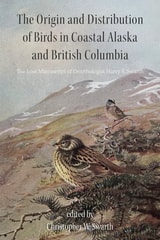
The Origin and Distribution of Birds in Coastal Alaska and British Columbia
The Lost Manuscript of Ornithologist Harry S. SwarthChristopher W. Swarth
Oregon State University Press, 2022
In 2019, Christopher Swarth, Harry’s grandson and a scientist in his own right, discovered the forgotten manuscript. This book includes the original unpublished manuscript, accompanied by contextual essays from contemporary ornithologists who examine the impact and relevance of Swarth’s research on coastal bird diversity, fox sparrow migration, and the systematic puzzle of the timberline sparrow. Expedition maps display field camps and exploration routes, and species checklists illustrate the variety of birds observed at key field sites. To bring additional color and insight, The Origin and Distribution of Birds in Coastal Alaska and British Columbia also includes excerpts from Harry Swarth’s field notes, a comprehensive list of Harry Swarth’s publications, and a glossary with historic and contemporary bird names. Naturalists, ornithologists, birders, and all those who want to learn more about the natural history of the region will delight in the rediscovery of this long-lost treasure.
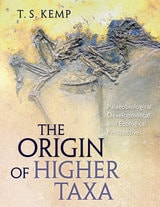
The Origin of Higher Taxa
Palaeobiological, Developmental, and Ecological PerspectivesT. S. Kemp
University of Chicago Press, 2015
Looking beyond the microevolutionary force of Darwinian natural selection, Kemp enters the realm of macroevolution, or evolution above the species level. From the origin of mammals to the radiation of flowering plants, these large-scale patterns—such as the rise of novel organismal design, adaptive radiations, and lineage extinctions—encompass the most significant trends and transformations in evolution. As macroevolution cannot be studied by direct observation and experiment, scientists have to rely on the outcome of evolution as evidence for the processes at work, in the form of patterns of species appearances and extinctions in a spotty fossil record, and through the nature of species extant today. Marshalling a wealth of new fossil and molecular evidence and increasingly sophisticated techniques for their study, Kemp here offers a timely and original reinterpretation of how higher taxa such as arthropods, mollusks, mammals, birds, and whales evolved—a bold new take on the history of life.

The Origin of Table Manners
Mythologiques, Volume 3Claude Lévi-Strauss
University of Chicago Press, 1990
"An immense anthropological erudition is here wielded by one of the world's finest minds, and the myths themselves have never been taken more seriously. . . . [Lévi-Strauss] raises issues and then resolves them with the suspenseful cunning of a mystery novelist."—John Updike, New Yorker
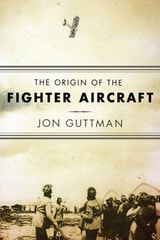
The Origin of the Fighter Aircraft
Jon Guttman
Westholme Publishing, 2009
From Scouts to Balloon-busters, the Emergence of Air-to-Air Combat in World War I
When World War I began in August 1914, the airplane had already proven its worth as an intelligence gathering “eye-in-the-sky.” These scouting aircraft soon became indispensable to armies on both sides, and the attempt to drive enemy planes away began in earnest. Local air superiority was incorporated into battlefield strategy, and the use of aircraft to conduct offensive operations would change warfare as dramatically as the first firearms 300 years before. By the end of 1915, the basic formula of the armed scout settled on a single-seater with a machine gun synchronized to fire through its propeller blades. This heavily armed aircraft became the first true fighter plane whose primary function was to destroy enemy aircraft, whether scouts, balloons, bombers, or other fighters. A new glamorized “knight of the air” was born: the ace, a fighter pilot who brought down five or more opponents. From 1916 on, as the combatants relied on airplanes more, flying tactics and strategy—including mass formations—were developed for what would become a deadly struggle for complete air superiority. By 1918, the final year of the war, air battles could be as sprawling as those on the ground.
In The Origin of the Fighter Aircraft, historian Jon Guttman tells the engrossing story of how one of the most amazing inventions became a integral component of warfare. Balancing technical description, personalities, and battle accounts, the author demonstrates that by the end of World War I most of the fundamentals for modern aerial combat had been established.
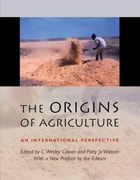
The Origins of Agriculture
An International PerspectiveEdited by C. Wesley Cowan and Patty Jo Watson
University of Alabama Press, 2006
The eight case studies in this book -- each a synthesis of available knowledge about the origins of agriculture in a specific region of the globe -- enable scholars in diverse disciplines to examine humanity's transition to agricultural societies. Contributors include: Gary W. Crawford, Robin W. Dennell, and Jack R. Harlan.
The Roots of Theatre
Rethinking Ritual and Other Theories of OriginEli Rozik
University of Iowa Press, 2002
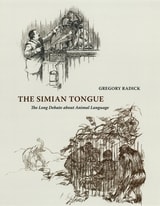
The Simian Tongue
The Long Debate about Animal LanguageGregory Radick
University of Chicago Press, 2007
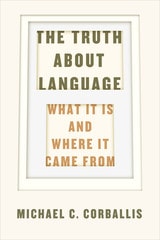
The Truth about Language
What It Is and Where It Came FromMichael C. Corballis
University of Chicago Press, 2017
But as Michael C. Corballis shows in The Truth about Language, it’s time to reconsider those assumptions. Language, he argues, is not the product of some “big bang” 60,000 years ago, but rather the result of a typically slow process of evolution with roots in elements of grammatical language found much farther back in our evolutionary history. Language, Corballis explains, evolved as a way to share thoughts—and, crucially for human development, to connect our own “mental time travel,” our imagining of events and people that are not right in front of us, to that of other people. We share that ability with other animals, but it was the development of language that made it powerful: it led to our ability to imagine other perspectives, to imagine ourselves in the minds of others, a development that, by easing social interaction, proved to be an extraordinary evolutionary advantage.
Even as his thesis challenges such giants as Chomsky and Stephen Jay Gould, Corballis writes accessibly and wittily, filling his account with unforgettable anecdotes and fascinating historical examples. The result is a book that’s perfect both for deep engagement and as brilliant fodder for that lightest of all forms of language, cocktail party chatter.