Results by title
60 books match the query 'Paleo-Indians' and 13 start with t
The American Southeast at the End of the Ice Age
Edited by D. Shane Miller, Ashley M. Smallwood, and Jesse W. Tune
University of Alabama Press, 2022
Synthesizes archaeological and environmental evidence to reinterpret how early human populations adapted to dynamic climatic changes during the Late Pleistocene, reshaping our understanding of Paleoindian lifeways and migration in the Southeastern United States.
The 1996 benchmark volume The Paleoindian and Early Archaic Southeast, edited by David G. Anderson and Kenneth E. Sassaman, was the first study to summarize what was known of the peoples who lived in the Southeast when ice sheets covered the northern part of the continent and mammals such as mammoths, saber-toothed cats, and ground sloths roamed the landscape.
The American Southeast at the End of the Ice Age provides an updated, definitive synthesis of current archaeological research gleaned from an array of experts in the region. It is organized in three parts: state records, the regional perspective, and reflections and future directions. Chapters survey a diversity of topics including the distribution of the earliest archaeological sites in the region, chipped-stone tool technology, the expanding role of submerged archaeology, hunter-gatherer lifeways, past climate changes and the extinction of megafauna on the transitional landscape, and evidence of demographic changes at the end of the Ice Age. Discussion of the ethical responsibilities regarding the use of private collections and the relationship of archaeologists and the avocational community, insight from outside the Southeast, and considerations for future research round out the volume.
The Archaeology of the Eastern Nevada Paleoarchaic, Part 1
The Sunshine LocalityCharlotte Beck
University of Utah Press, 2009
The Sunshine Locality in the geographic center of the Great Basin has been the focus of scientific research since the mid-1960s. Authors Charlotte Beck and George T. Jones began studies there in 1992 and carried out excavations between 1993 and 1997 with the assistance of Hamilton College Field School. The area has yielded a rich and varied collection of diagnostic lithic tools, including fluted and unfluted lanceolate projectile points and a crescent, and a variety of gravers, scrapers, notches, and other tools common in Paleoindian toolkits across North America.
This volume provides the first comprehensive treatment that combines historical research with the more recent studies. Analysis and interpretations of the stratigraphic sequence in Sunshine Wash are presented, including analyses of sedimentary textures and structure, depositional processes, and chronology. Faunal remains are used to evaluate local and regional environmental changes. Finally, the authors address the nature of the processes that created the archaeological record at Sunshine Locality, its age, and whether artifacts and remains of extinct mammals also recovered at the site are associated. This work begins to answer unresolved questions about the paleoenvironmental resources of the Sunshine Locality.
The Cochise Cultural Sequence in Southeastern Arizona
E. B. Sayles
University of Arizona Press, 1983
The First Rocky Mountaineers
Coloradans before ColoradoMarcel Kornfeld
University of Utah Press, 2013
Chosen by Foreword as the 2014 bronze winner in science.
The Fisher Site
Archaeological, Geological and Paleobotanical Studies at an Early Paleo-Indian Site in Southern Ontario, CanadaPeter L. Storck
University of Michigan Press, 1997
The Leavitt Site
A Parkhill Phase Paleo-Indian Occupation in Central MichiganMichael J. Shott, with a foreword by Henry T. Wright
University of Michigan Press, 1993
The Paleoindian Southwest
Edited by J. David Kilby and Bruce B. Huckell
University of Utah Press, 2025
The North American Southwest looms large in American archaeology, well known for the agricultural societies that dominated its austere landscape in later times. However, the traces of its earliest occupants, Native American ancestors who shared the ancient landscape with mammoth and giant bison toward the end of the last Ice Age, remain more obscure.
The Paleoindian Southwest provides the first comprehensive overview focused on the earliest human occupants of the Southwest, exploring past investigations, the current state of research, and directions for future discovery. Experts in the field examine individual archaeological sites—some classic and some newly discovered—as well as broader patterns of human behavior across varied regions of both the United States and Mexico. Chapter authors present new and unexpected discoveries, ranging from a gomphothere kill to fossil footprints, pushing the boundaries of the Paleoindian period and investigating nontraditional archaeological data. This collection is a critical resource and landmark volume for those interested in Southwest prehistory, Paleoindian archaeology, and Ice Age human ecology.
The Paleoindian and Early Archaic Southeast
Edited by David G. Anderson and Kenneth E. Sassaman
University of Alabama Press, 1996
The southeastern United States has one of the richest records of early human settlement of any area of North America. This book provides the first state-by-state summary of Paleoindian and Early Archaic research from the region, together with an appraisal of models developed to interpret the data. It summarizes what we know of the peoples who lived in the Southeast more than 8,000 years ago—when giant ice sheets covered the northern part of the continent, and such mammals as elephants, saber-toothed tigers, and ground sloths roamed the landscape. Extensively illustrated, this benchmark collection of essays on the state of Paleoindian and Early Archaic research in the Southeast will guide future studies on the subject of the region's first inhabitants for years to come.
Divided in three parts, the volume includes:
Part I: Modeling Paleoindian and Early Archaic Lifeways in the Southeast
Environmental and Chronological Considerations, David G. Anderson, Lisa D. O'Steen, and Kenneth E. Sassaman
Modeling Paleoindian and Early Archaic Settlement in the Southeast: A Historical Perspective, David G. Anderson and Kenneth E. Sassaman
Models of Paleoindian and Early Archaic Settlement in the Lower Southeast, David G. Anderson
Early Archaic Settlement in the South Carolina Coastal Plain, Kenneth E. Sassaman
Raw Material Availability and Early Archaic Settlement in the Southeast, I. Randolph Daniel Jr.
Paleoindian and Early Archaic Settlement along the Oconee Drainage, Lisa D. O'Steen
Haw River Revisited: Implications for Modeling Terminal Late Glacial and Early Holocene Hunter-Gatherer Settlement Systems in the Southeast, John S. Cable
Early Archiac Settlement and Technology: Lessons from Tellico, Larry R. Kimball
Paleoindians Near the Edge: A Virginia Perspective, Michael F. Johnson
Part II: The Regional Record
The Need for a Regional Perspective, Kenneth E. Sassaman and David G. Anderson
Paleoindian and Early Archaic Research in the South Carolina Area, David G. Anderson and Kenneth E. Sassaman
The Taylor Site: An Early Occupation in Central South Carolina, James L. Michie
Paleoindian and Early Archaic Research in Tennessee, John B. Boster and Mark R. Norton
A Synopsis of Paleoindian and Early Archaic Research in Alabama, Eugene M. Futato
Statified Late Pleistocene and Early Holocene Deposits at Dust Cave, Northwestern Alabama, Boyce N. Driskell
Bone and Ivory Tools from Submerged Paleoindian Sites in Florida, James S. Dunbar and S. David Webb
Paleoindian and Early Archaic Data from Mississippi, Samuel O. McGahey
Early and Middle Paleoindian Sites in the Northeastern Arkansas Region, J. Christopher Gillam
Part III: Commentary
A Framework for the Paleoindian/Early Archaic Transition, Joel Gunn
Modeling Communities and Other Thankless Tasks, Dena F. Dincauze
An Arkansas View, Dan F. Morse
Comments, Henry T. Wright
The Sandy Ridge and Halstead Paleo-Indian Sites
Unifacial Tool Use and Gainey Phase Definition in South-Central OntarioLawrence J. Jackson with a foreword by Henry T. Wright and phytolith analysis by Anita Buehrle
University of Michigan Press, 1998
The Settlement of the American Continents
A Multidisciplinary Approach to Human BiogeographyEdited by C. Michael Barton, Geoffrey A. Clark, David R. Yesner, and Georges A. Pearson
University of Arizona Press, 2004
This book approaches the human settlement of the Americas from a biogeographical perspective in order to provide a better understanding of the mechanisms and consequences of this unique event. It considers many of the questions that continue to surround the peopling of the Western Hemisphere, focusing not on sites, dates, and artifacts but rather on theories and models that attempt to explain how the colonization occurred.
Unlike other studies, this book draws on a wide range of disciplines—archaeology, human genetics and osteology, linguistics, ethnology, and ecology—to present the big picture of this migration. Its wide-ranging content considers who the Pleistocene settlers were and where they came from, their likely routes of migration, and the ecological role of these pioneers and the consequences of colonization. Comprehensive in both geographic and topical coverage, the contributions include an explanation of how the first inhabitants could have spread across North America within several centuries, the most comprehensive review of new mitochondrial DNA and Y-chromosome data relating to the colonization, and a critique of recent linguistic theories.
Although the authors lean toward a conservative rather than an extreme chronology, this volume goes beyond the simplistic emphasis on dating that has dominated the debate so far to a concern with late Pleistocene forager adaptations and how foragers may have coped with a wide range of environmental and ecological factors. It offers researchers in this exciting field the most complete summary of current knowledge and provides non-specialists and general readers with new answers to the questions surrounding the origins of the first Americans.
Thedford II
A Paleo-Indian Site in the Ausable River Watershed of Southwestern OntarioD. Brian Deller and Christopher J. Ellis with a foreword by Henry T. Wright
University of Michigan Press, 1992
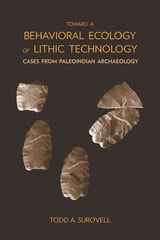
Toward a Behavioral Ecology of Lithic Technology
Cases from Paleoindian ArchaeologyTodd A. Surovell
University of Arizona Press, 2009
Because the fundamental processes of making, using, and discarding stone tools are, at root, exercises in problem solving, Todd Surovell asks what conditions favor certain technological solutions. Whether asking if a biface should be made thick or thin or if a flake should be saved or discarded, Surovell seeks answers that extend beyond a case-by-case analysis. One avenue for addressing these questions theoretically is formal mathematical modeling.
Here Surovell constructs a series of models designed to link environmental variability to human decision making as it pertains to lithic technology. To test the models, Surovell uses data from the analysis of more than 40,000 artifacts from five Rocky Mountain and Northern Plains Folsom and Goshen complex archaeological sites dating to the Younger Dryas stadial (ca. 12,600-11,500 years BP). The primary result is the production of powerful new analytical tools useful to the interpretation of archaeological assemblages.
Surovell's goal is to promote modeling and explore the general issues governing technological decisions. In this light, his models can be applied to any context in which stone tools are made and used.
Transitions
Archaic and Early Woodland Research in the Ohio CountryMartha P. Otto
Ohio University Press, 2008
The late archaic and early woodland peoples lived in the Ohio region between 5,000 and 2,000 years ago. This was a time of transition, when hunters and gatherers began to grow native seed crops, establish more permanent settlements, and develop complex forms of ritual and ceremonialism, sometimes involving burial mound construction.
The focused archaeological studies described in Transitions: Archaic and Early Woodland Research in the Ohio Country shed light on this important episode in human cultural development. The authors describe important archaeological sites such as the rich Late Archaic settlements of southwestern Ohio and the early Adena Dominion Land Company enclosure in Franklin County. They present detailed accounts of Native American behavior, such as the use of smoking pipes by Adena societies and a reconstruction of mound use and ritual.
Transitions is the result of a comprehensive, long-term study focusing on particular areas of Ohio with the most up-to-date and detailed treatment of Ohio’s native cultures during this important time of change. This book will be of great value to students and other readers who wish to go beyond the general and often dated treatments of Ohio archaeology currently available.