Results by title
116 books match the query 'Palestine' and 17 start with t
Tangled Roots
The Emergence of Israeli CultureIsrael Bartal
SBL Press, 2020
A new interpretation of the roots of Israeli culture
In Tangled Roots: The Emergence of Israeli Culture, Israel Bartal traces the history of modern Hebrew culture prior to the emergence of political Zionism. Bartal examines how traditional and modernist ideals and Western and non-European Jewish cultures merged in an unprecedented encounter between an ancient land (Israel) and a multigenerational people (the Jews). Premodern Jewish traditionalists, Palestinian locals, foreign imperial forces, and Jewish intellectuals, writers, journalists, and party functionaries each affected the Israeli culture that emerged. As this new Hebrew culture was taking shape, the memory of the recent European past played a highly influential role in shaping the image of the New Hebrew, that mythological hero who was meant to supplant the East European exilic Jew.
Features
- A critical revision of most contemporary politicized histories of Jewish nationalism
- An examination of the history of modern Hebrew culture prior to political Zionism
The Battles of Armageddon
Megiddo and the Jezreel Valley from the Bronze Age to the Nuclear AgeEric H. Cline
University of Michigan Press, 2002
> Best Popular Book on Archaeology
--Biblical Archaeology Society
Apocalypse. Judgment Day. The End Time. Armageddon. Students of the Bible know it as the place where the cataclysmic battle between the forces of good and the forces of evil will unfold. Many believe that this battle will take place in the very near future. But few know that Armageddon is a real place--one that has seen more fighting and bloodshed than any other spot on earth.
The name Armageddon is a corruption of the Hebrew phrase Har Megiddo, and it means "Mount of Megiddo." More than thirty bloody conflicts have been fought at the ancient site of Megiddo and adjacent areas of the Jezreel Valley during the past four thousand years. Egyptians, Israelites, Greeks, Muslims, Crusaders, Mongols, British, Germans, Arabs, and Israelis have all fought and died here. The names of the warring leaders reverberate throughout history: Thutmose III, Deborah, Gideon, Saul and Jonathan, Jezebel, Saladin, Napoleon, and Allenby, to name but the most famous. Throughout history Megiddo and the Jezreel Valley have been ground zero for battles that determined the very course of civilization. No wonder that the author of Revelation believed Armageddon, the penultimate battle between good and evil, would also take place here!
The Battles of Armageddon introduces readers to a rich cast of ancient and modern warriors, while bringing together for the first time the wide range of conflicts that have been fought at Megiddo and the Jezreel Valley from the Bronze Age to the Nuclear Age.
Eric H. Cline has participated in more than seventeen seasons of excavation and survey in Israel, Egypt, Jordan, Greece, and the United States. He is currently a Senior Staff Archaeologist at the ongoing excavations of Megiddo.
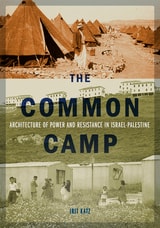
The Common Camp
Architecture of Power and Resistance in Israel–PalestineIrit Katz
University of Minnesota Press, 2022
Seeing the camp as a persistent political instrument in Israel–Palestine and beyond
The Common Camp underscores the role of the camp as a spatial instrument employed for reshaping, controlling, and struggling over specific territories and populations. Focusing on the geopolitical complexity of Israel–Palestine and the dramatic changes it has experienced during the past century, this book explores the region’s extensive networks of camps and their existence as both a tool of colonial power and a makeshift space of resistance.
Examining various forms of camps devised by and for Zionist settlers, Palestinian refugees, asylum seekers, and other groups, Irit Katz demonstrates how the camp serves as a common thread in shaping lands and lives of subjects from across the political spectrum. Analyzing the architectural and political evolution of the camp as a modern instrument engaged by colonial and national powers (as well as those opposing them), Katz offers a unique perspective on the dynamics of Israel–Palestine, highlighting how spatial transience has become permanent in the ongoing story of this contested territory.
The Common Camp presents a novel approach to the concept of the camp, detailing its varied history as an apparatus used for population containment and territorial expansion as well as a space of everyday life and subversive political action. Bringing together a broad range of historical and ethnographic materials within the context of this singular yet versatile entity, the book locates the camp at the core of modern societies and how they change and transform.
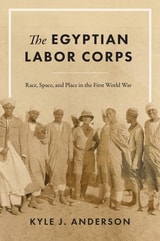
The Egyptian Labor Corps
Race, Space, and Place in the First World WarKyle J. Anderson
University of Texas Press, 2021
During World War I, the British Empire enlisted half a million young men, predominantly from the countryside of Egypt, in the Egyptian Labor Corps (ELC) and put them to work handling military logistics in Europe and the Middle East. British authorities reneged on their promise not to draw Egyptians into the war, and, as Kyle Anderson shows, the ELC was seen by many in Egypt as a form of slavery. The Egyptian Labor Corps tells the forgotten story of these young men, culminating in the essential part they came to play in the 1919 Egyptian Revolution.
Combining sources from archives in four countries, Anderson explores Britain’s role in Egypt during this period and how the ELC came to be, as well as the experiences and hardships these men endured. As he examines the ways they coped—through music, theater, drugs, religion, strikes, and mutiny—he illustrates how Egyptian nationalists, seeing their countrymen in a state akin to slavery, began to grasp that they had been racialized as “people of color.” Documenting the history of the ELC and its work during the First World War, The Egyptian Labor Corps also provides a fascinating reinterpretation of the 1919 revolution through the lens of critical race theory.
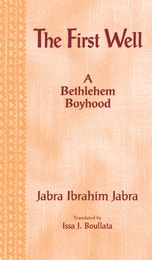
The First Well
A Bethlehem BoyhoodJabra Ibrahim Jabra
University of Arkansas Press, 1995
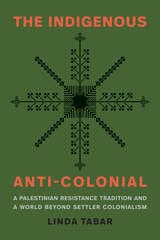
The Indigenous Anti-Colonial
A Palestinian Resistance Tradition and a World Beyond Settler ColonialismLinda Tabar
Duke University Press, 2026
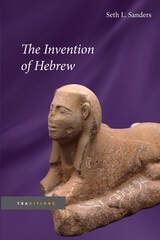
The Invention of Hebrew
Seth L. Sanders
University of Illinois Press, 2011
Seth L. Sanders connects the Bible's distinctive linguistic form--writing down a local spoken language--to a cultural desire to speak directly to people, summoning them to join a new community that the text itself helped call into being. Addressing the people of Israel through a vernacular literature, Hebrew texts reimagined their audience as a public. By comparing Biblical documents with related ancient texts in Hebrew, Ugaritic, and Babylonian, this book shows Hebrew's distinctiveness as a self-conscious political language. Illuminating the enduring stakes of Biblical writing, Sanders demonstrates how Hebrew assumed and promoted a source of power previously unknown in written literature: "the people" as the protagonist of religion and politics.
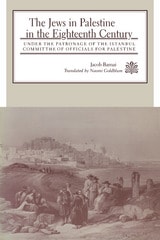
The Jews in Palestine in the Eighteenth Century
Under the Patronage of the Istanbul committee of Officials for PalestineJacob Barnai
University of Alabama Press, 1992
Research reveals a clear connection between the legal and social status of the Jews in Palestine in the 18th century and their ties with the Diaspora. The Jews who had immigrated to Palestine in that period were mostly poor and elderly. The country was economically backward and politically unstable, which made it impossible for the immigrants to support themselves through productive work. Therefore they lived off the contributions of their brethren overseas. Taxes and fees imposed by the Ottoman rulers increased the financial desperation of the Jews in Palestine. Prohibitions against young unmarried immigrant men and women made for an unstable population largely of old men, many of whom died shortly after immigrating. Families succumbed to disease, earthquakes, and famine, but in the face of these problems, the Jewish communities in Palestine persevered.
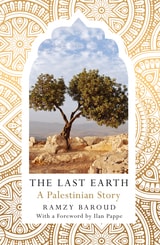
The Last Earth
A Palestinian StoryRamzy Baroud
Pluto Press, 2018
Ordinary Palestinians have rarely narrated their own history. In this groundbreaking book, acclaimed author Ramzy Baroud draws on dozens of interviews to produce vivid, intimate and beautifully written accounts of Palestinian lives - in villages, refugee camps, prisons and cities, in the lands of their ancestors and in exile. Baroud's empathetic and lyrical approach reveals new human dimensions of the Palestinian saga, telling it as it has never before been told.
Against dominant narratives, the last earth reclaims Palestine's past - and present - for all its people.
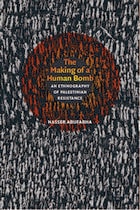
The Making of a Human Bomb
An Ethnography of Palestinian ResistanceNasser Abufarha
Duke University Press, 2009
Abufarha draws on the life histories of martyrs, interviews he conducted with their families and members of the groups that sponsored their operations, and examinations of Palestinian literature, art, performance, news stories, and political commentaries. He also assesses data—about the bombers, targets, and fatalities caused—from more than two hundred martyrdom operations carried out by Palestinian groups between 2001 and 2004. Some involved the use of explosive belts or the detonation of cars; others entailed armed attacks against Israeli targets (military and civilian) undertaken with the intent of fighting until death. In addition, he scrutinized suicide attacks executed by Hamas and Islamic Jihad between 1994 and 2000. In his analysis of Palestinian political violence, Abufarha takes into account Palestinians’ understanding of the history of the conflict with Israel, the effects of containment on Palestinians’ everyday lives, the disillusionment created by the Oslo peace process, and reactions to specific forms of Israeli state violence. The Making of a Human Bomb illuminates the Palestinians’ perspective on the conflict with Israel and provides a model for ethnographers seeking to make sense of political violence.
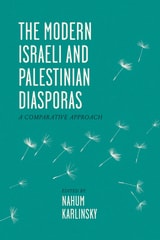
The Modern Israeli and Palestinian Diasporas
A Comparative ApproachEdited by Nahum Karlinsky
University of Texas Press, 2024
A comparative study of contemporary Israeli and Palestinian diasporas.
Exilic and diasporic experience have become ubiquitous in recent decades. Jews, lacking a homeland, spread to various parts of the world, making the Jewish diaspora paradigmatic. But after the establishment of Israel in 1948, a different kind of diaspora emerged, as more than a tenth of Israeli citizens have chosen to leave their newly established state and resettle. Meanwhile, about half of all Palestinians, including Palestinian citizens of Israel, now reside in exile, predominantly as a result of the ongoing Palestinian-Israeli conflict.
Recognizing that Israeli-Jewish and Palestinian-Arab societies coexist and are engaged in constant relations, Nahum Karlinsky has assembled an impressive array of contributors to explore these diasporas alongside one another and in dialogue with other diasporic communities. The collected essays cover such topics as Palestinian exiles and diasporas, the demographics of today’s Israeli diaspora, immigrant enterprises, transnationalism and development, the unique place of Israeli Jews in the United States, the literature of Palestinian transnationals, and the emergence of Berlin as a queer Israeli-Jewish immigrant enclave.The Modern Israeli and Palestinian Diasporas challenges and reimagines the very notion of a homeland.
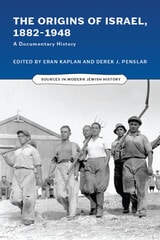
The Origins of Israel, 1882–1948
A Documentary HistoryEran Kaplan
University of Wisconsin Press, 2011
In 1880 the Jewish community in Palestine encompassed some 20,000 Orthodox Jews; within sixty-five years it was transformed into a secular proto-state with well-developed political, military, and economic institutions, a vigorous Hebrew-language culture, and some 600,000 inhabitants. The Origins of Israel, 1882–1948: A Documentary History chronicles the making of modern Israel before statehood, providing in English the texts of original sources (many translated from Hebrew and other languages) accompanied by extensive introductions and commentaries from the volume editors.
This sourcebook assembles a diverse array of 62 documents, many of them unabridged, to convey the ferment, dissent, energy, and anxiety that permeated the Zionist project from its inception to the creation of the modern nation of Israel. Focusing primarily on social, economic, and cultural history rather than Zionist thought and diplomacy, the texts are organized in themed chapters. They present the views of Zionists from many political and religious camps, factory workers, farm women, militants, intellectuals promoting the Hebrew language and arts—as well as views of ultra-Orthodox anti-Zionists. The volume includes important unabridged documents from the origins of the Arab-Israeli conflict that are often cited but are rarely read in full. The editors, Eran Kaplan and Derek J. Penslar, provide both primary texts and informative notes and commentary, giving readers the opportunity to encounter voices from history and make judgments for themselves about matters of world-historical significance.
Best Special Interest Books, selected by the Public Library Reviewers
Best Books for General Audiences, selected by the American Association of School Librarians

The Politics of Change in Palestine
State-Building and Non-Violent ResistanceMichael Broning
Pluto Press, 2011
This book contradicts the dominant myth that incompetent, corrupt, and uncompromising Palestinian decision-makers are responsible for the lasting stalemate in the Middle-East Peace Process. It highlights recent political developments in Palestine that fundamentally redefine important parameters of the Israeli-Palestinian conflict.
Contrary to public perception, new political trends in the Palestinian Territories bolster prospects for the realisation of Palestinian national aspirations. Michael Bröning identifies key indicators which fundamentally question dominant Israeli narratives and pose an unprecedented strategic challenge to the Israeli leadership. These include the re-invention of Hamas, the reform of the Fatah movement, Palestinian Prime Minister Salam Fayyad’s state-building efforts and the surge of non-violent resistance against Israel.
This persuasive book forces us to reconsider the perceived wisdom that the Palestinians are powerless to influence events as they struggle for peace.
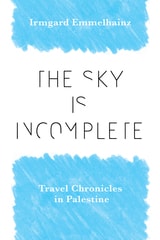
The Sky Is Incomplete
Travel Chronicles in PalestineIrmgard Emmelhainz
Vanderbilt University Press, 2023
In order to render the issue of representation, of speaking on behalf of the Palestinian ordeal in all its complexity, The Sky Is Incomplete is composed as a collage, gathering diary entries, letters, experimental passages, script, poetry, art criticism, political analysis, and other genres to convey an opaque view of the Palestine Question. Beyond representation in the sense of giving testimony or speaking on behalf of the Palestinians, however, the author’s parting point is relational: The Sky Is Incomplete is about encounters—with friends, mentors, interlocutors, lovers, children, activists, and soldiers (Israeli and Palestinian).
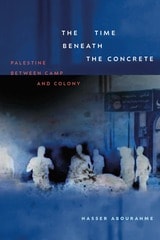
The Time beneath the Concrete
Palestine between Camp and ColonyNasser Abourahme
Duke University Press, 2025
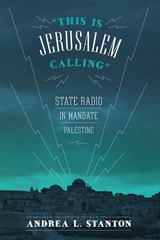
This Is Jerusalem Calling
State Radio in Mandate PalestineBy Andrea L. Stanton
University of Texas Press, 2013
Modeled after the BBC, the Palestine Broadcasting Service was launched in 1936 to serve as the national radio station of Mandate Palestine, playing a pivotal role in shaping the culture of the emerging middle class in the region. Despite its significance, the PBS has become nearly forgotten by scholars of twentieth-century Middle Eastern studies. Drawn extensively from British and Israeli archival sources, “This Is Jerusalem Calling” traces the compelling history of the PBS’s twelve years of operation, illuminating crucial aspects of a period when Jewish and Arab national movements simultaneously took form.
Andrea L. Stanton describes the ways in which the mandate government used broadcasting to cater to varied audiences, including rural Arab listeners, in an attempt to promote a “modern” vision of Arab Palestine as an urbane, politically sophisticated region. In addition to programming designed for the education of the peasantry, religious broadcasting was created to appeal to all three main faith communities in Palestine, which ultimately may have had a disintegrating, separatist effect. Stanton’s research brings to light the manifestation of Britain’s attempts to prepare its mandate state for self-governance while supporting the aims of Zionists. While the PBS did not create the conflict between Arab Palestinians and Zionists, the service reflected, articulated, and magnified such tensions during an era when radio broadcasting was becoming a key communication tool for emerging national identities around the globe.
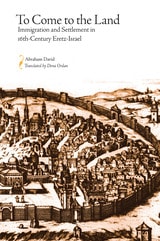
To Come to the Land
Immigration and Settlement in 16th-Century Eretz-IsraelAbraham David, translated by Dena Ordan
University of Alabama Press, 1999
To Come to the Land makes available in English a vast body of research,
previously available only in Hebrew, on the early history of the land now
known as Israel.
Abraham David here focuses on the Spanish and Portuguese Jews who fled
the Iberian Peninsula during the 16th century, tracing the beginnings of
Sephardic influence in the land of Israel.
After the Ottoman Turks conquered Syria, Palestine, and Egypt in 1516,
the Ottoman regime, unlike their Mamluk predecessors, encouraged economic
development and settlement throughout the region. This openness to immigration
offered a solution to the crisis Iberian Jews were undergoing as a result
of their expulsion from Spain and the forced conversions in Portugal. Within
a few years of the Ottoman conquest, Jews of Spanish extraction, many of
them clustered in urban areas, dominated the Jewish communities of Eretz-Israel.
In this carefully researched study, David examines the lasting impression
made by these enterprising Jewish settlers on the commercial, social, and
intellectual life of the area under early Ottoman rule. Of particular interest
is his examination of the cities of Jerusalem and Safed and David's succinct
biographies of leading Jewish personalities throughout the region.
This first English translation of a ground-breaking Hebrew work provides
a comprehensive overview of a significant chapter in the history of Israel
and explores some of the factors that brought to it the best minds of the
age. Essential for scholars of late Medieval Jewish history, To Come to
the Land will also be an important resource for scholars of intellectual
history, as it provides background crucial to an understanding of the intellectual
flourishing of the period.