Results by title
194 books match the query 'People' and 39 start with t

Taking Flight
A History of Birds and People in the Heart of AmericaMichael Edmonds
Wisconsin Historical Society Press, 2018
Today, more than fifty million Americans traipse through wetlands at dawn, endure clouds of mosquitoes, and brave freezing autumn winds just to catch a glimpse of a bird. The human desire to connect with winged creatures defies age and generation. In the Midwest, humans and birds have lived together for more than twelve thousand years. Taking Flight explores how and why people have worshipped, feared, studied, hunted, eaten, and protected the birds that surrounded them.
Author and birder Michael Edmonds has combed archaeological reports, missionaries’ journals, travelers’ letters, early scientific treatises, the memoirs of American Indian elders, and the folklore of hunters, farmers, and formerly enslaved people throughout the Midwest to reveal how our ancestors thought about the very same birds we see today. Whether you’re a casual bird-watcher, a hard-core life-lister, or simply someone who loves the outdoors, you’ll look at birds differently after reading this book.
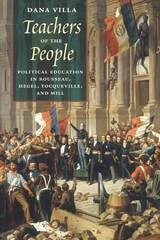
Teachers of the People
Political Education in Rousseau, Hegel, Tocqueville, and MillDana Villa
University of Chicago Press, 2017
In Teachers of the People, Dana Villa takes us back to the moment in history when “the people” first appeared on the stage of modern European politics. That moment—the era just before and after the French Revolution—led many major thinkers to celebrate the dawning of a new epoch. Yet these same thinkers also worried intensely about the people’s seemingly evident lack of political knowledge, experience, and judgment. Focusing on Rousseau, Hegel, Tocqueville, and Mill, Villa shows how reformist and progressive sentiments were often undercut by skepticism concerning the political capacity of ordinary people. They therefore felt that “the people” needed to be restrained, educated, and guided—by laws and institutions and a skilled political elite. The result, Villa argues, was less the taming of democracy’s wilder impulses than a pervasive paternalism culminating in new forms of the tutorial state.
Ironically, it is the reliance upon the distinction between “teachers” and “taught” in the work of these theorists which generates civic passivity and ignorance. And this, in turn, creates conditions favorable to the emergence of an undemocratic and illiberal populism.

Texas on the Table
People, Places, and Recipes Celebrating the Flavors of the Lone Star StateBy Terry Thompson-Anderson, Photos by Sandy Wilson
University of Texas Press, 2014
With a bounty of locally grown meats and produce, artisanal cheeses, and a flourishing wine culture, it’s a luscious time to be cooking in Texas. From restaurant chefs to home cooks, Texans are going to local dairies, orchards, farmers’ markets, ranches, vineyards, and seafood sellers to buy the very freshest ingredients, whether we’re cooking traditional favorites or the latest haute cuisine. We’ve discovered that Texas terroir—our rich variety of climates and soils, as well as our diverse ethnic cultures—creates a unique “taste of place” that gives Texas food a flavor all its own.
Written by one of Texas’s leading cookbook authors, Terry Thompson-Anderson, Texas on the Table presents 150 new and classic recipes, along with stories of the people—farmers, ranchers, shrimpers, cheesemakers, winemakers, and chefs—who inspired so many of them and who are changing the taste of Texas food. The recipes span the full range from finger foods and first courses to soups and breads, salads, seafood, chicken, meat (including wild game), sides and vegetarian dishes, and sweets. Some of the recipes come from the state’s most renowned chefs, and all are user-friendly for home cooks. Finally, the authors and winemakers tell which recipes they turn to when opening their favorite wines.
This delicious compilation of recipes and stories of the people behind them, illustrated with Sandy Wilson’s beautiful photographs, makes Texas on the Table the must-have cookbook for everyone who relishes the flavors of the Lone Star State.
The Blood of the People
Revolution and the End of Traditional Rule in Northern SumatraAnthony Reid
National University of Singapore Press, 2014
The events in northern Sumatra were among the most dramatic episodes of Indonesia’s national revolution, and brought about more profound changes even than in Java, from where the revolution is normally viewed. Some ethnic groups saw the revolution as a popular, peasant-supported movement that liberated them from foreign rule. Others, though, felt victimised by a radical, levelling agenda imposed by outsiders. Java, with a relatively homogeneous population, passed through the revolution without significant social change. The ethnic complexity of Sumatra, in contrast, meant that the revolution demanded an altogether new “Indonesian” identity to override the competing ethnic categories of the past.
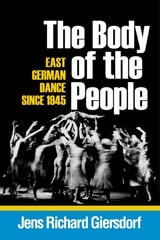
The Body of the People
East German Dance since 1945Jens Richard Giersdorf
University of Wisconsin Press, 2013
Giersdorf looks closely at uniquely East German dance forms—including mass exercise events, national folk dances, Marxist-Leninist visions staged by the dance ensemble of the armed forces, the vast amateur dance culture, East Germany’s version of Tanztheater, and socialist alternatives to rock ‘n’ roll—to demonstrate how dance was used both as a form of corporeal utopia and of embodied socialist propaganda and indoctrination. The Body of the People also explores the artists working in the shadow of official culture who used dance and movement to critique and resist state power, notably Charlotte von Mahlsdorf, Arila Siegert, and Fine Kwiatkowski. Giersdorf considers a myriad of embodied responses to the Communist state even after reunification, analyzing the embodiment of the fall of the Berlin Wall in the works of Jo Fabian and Sasha Waltz, and the diasporic traces of East German culture abroad, exemplified by the Chilean choreographer Patricio Bunster.

The Companion Species Manifesto
Dogs, People, and Significant OthernessDonna J. Haraway
Prickly Paradigm Press, 2003
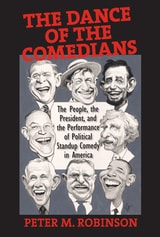
The Dance of the Comedians
The People, the President, and the Performance of Political Standup Comedy in AmericaPeter M. Robinson
University of Massachusetts Press, 2010
Why did Barack Obama court Jon Stewart and trade jokes with Stephen Colbert during the campaign of 2008? Why did Sarah Palin forgo the opportunity to earn votes on the Sunday morning political talk shows but embrace the chance to get laughs on Saturday Night Live? The Dance of the Comedians examines the history behind these questions—the merry, mocking, and highly contested anarchies of standup political comedy that have locked humorists, presidents, and their fellow Americans in an improvisational three-way “dance” since the early years of the American republic.
Peter M. Robinson shows how the performance of political humor developed as a celebration of democracy and an expression of political power, protest, and commercial profit. He places special significance on the middle half of the twentieth century, when presidents and comedians alike—from Calvin Coolidge to Ronald Reagan, from Will Rogers to Saturday Night Live's “Not Ready for Prime Time Players”—developed modern understandings of the power of laughter to affect popular opinion and political agendas, only to find the American audience increasingly willing and able to get in on the act. These years put the long-standing traditions of presidential deference profoundly in play as all three parties to American political humor—the people, the presidents, and the comedy professionals—negotiated their way between reverence for the office of the presidency and ridicule of its occupants.
Although the focus is on humor, The Dance of the Comedians illuminates the process by which Americans have come to recognize that the performance of political comedy has serious and profound consequences for those on all sides of the punch line.
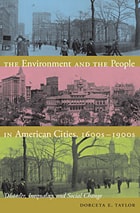
The Environment and the People in American Cities, 1600s-1900s
Disorder, Inequality, and Social ChangeDorceta E. Taylor
Duke University Press, 2009
Taylor traces the progression of several major thrusts in urban environmental activism, including the alleviation of poverty; sanitary reform and public health; safe, affordable, and adequate housing; parks, playgrounds, and open space; occupational health and safety; consumer protection (food and product safety); and land use and urban planning. At the same time, she presents a historical analysis of the ways race, class, and gender shaped experiences and perceptions of the environment as well as environmental activism and the construction of environmental discourses. Throughout her analysis, Taylor illuminates connections between the social and environmental conflicts of the past and those of the present. She describes the displacement of people of color for the production of natural open space for the white and wealthy, the close proximity between garbage and communities of color in early America, the cozy relationship between middle-class environmentalists and the business community, and the continuous resistance against environmental inequalities on the part of ordinary residents from marginal communities.
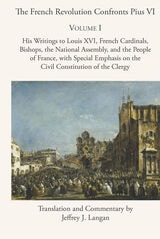
The French Revolution Confronts Pius VI
Volume 1: His Writings to Louis XVI, French Cardinals, Bishops, the National Assembly, and the People of France with Special Emphasis on the Civil Constitution of the ClergyJeffrey J. Langan
St. Augustine's Press, 2020
The writings of Pope Pius VI, head of the Catholic Church during the most destructive period of the French Revolution, were compiled in two volumes by M.N.S. Guillon and published in 1798 and 1800. But during the Revolution, the reign of Napoleon, and the various revolutionary movements of the 19th century, there were extraordinary efforts to destroy writings that critiqued the revolutionary ideology. Many books and treatises, if they survived the revolution or the sacking from Napoleon’s armies. To this day, no public copy of Guillon’s work exists in Paris.
Now, for the first time in English, these works comprising the letters, briefs, and other writings of Pius VI on the French Revolution are available. Volume I treats the first shock of the Revolution and the efforts of the Pope in 1790 and 1791 to oppose the Civil Constitution of the Clergy (which famous revolutionary and shrewd diplomat Talleyrand referred to as “the greatest fault of the National Assembly”). Volume II will be published later, and deals with the aftermath of the Civil Constitution through Pius’s death in exile). Editor and translator Jeffrey Langan presents the materials leading up to and directly connected with these decrees, in which the National Assembly attempted to set up a Catholic Church that would be completely submissive to the demands of the Assembly. Volume I also covers Pius’s efforts to deal with the immediate aftermath of the Constitution after the National Assembly implemented it, including his encyclical, Quod Aliquantum.
The letters will show how Pius chose to oppose the Civil Constitution. He did so not by a public campaign, for he had no real temporal power to oppose the violence, but by attempting to work personally with Louis XVI and various archbishops in France to articulate what were the points on which he could concede (matters dealing with the political structures of France) and what were the essential points in which he could not concede (matters dealing with the organization of dioceses and appointment of bishops).
Since the 1980s, with the writings and school that developed around François Furet, as well as Simon Schama’s Citizens, a new debate over the French Revolution has ensued, bringing forth a more objective account of the Revolution, one that avoids an excessively Marxist lens and that brings to light some of its defects and more gruesome parts – the destruction and theft of Church property, and the sadistic methods of torture and killing of priests, nuns, aristocrats, and fellow-revolutionaries.
An examination of the writings of Pius VI will not only help set the historical record straight for English-speaking students of the Revolution, it will also aid them to better understand the principles that the Catholic Church employs when confronted with chaotic political change. They will see that the Church has a principled approach to distinguishing, while not separating, the power of the Church and the power of the state. They will also see, as Talleyrand himself also saw, that one of the essential elements that makes the Church the Church is the right to appoint bishops and to discipline its own bishops. The Church herself recognizes that she cannot long survive without this principle that guarantees her unity.
Pius VI’s efforts were able to keep the Catholic Church intact (though badly bruised) so that she could reconstitute herself and build up a vibrant life in 19th-century France. (He did this in the face of the Church’s prestige having sunk to historic lows; some elites in Europe thought there would be no successor to Pius and jokingly referred to him as “Pius the Last.”) He began a process that led to the restoration of the prestige of the Papacy throughout the world, and he initiated a two-century process that led to the Church finally being able to select bishops without any interference from secular authorities. This had been at least a 1,000-year problem in the history of the Church. By 1990, only two countries of the world, China and Vietnam, were interfering in any significant way in the process that the Church used to select bishops.
Pius VI’s papacy, especially during the years of the French Revolution, was a pivotal point for the French Revolution and for the interaction between Church and state in Western history. All freedom-loving people will be happy to read his distinc-tions between the secular power and the spiritual power. His papacy also was important for the internal developments that the Church would make over the next 200 years with respect to its self-understanding of the Papacy and the role of the bishop.
The Gold in the Rings
The People and Events That Transformed the Olympic GamesStephen R. Wenn and Robert K. Barney
University of Illinois Press, 2019
Entertaining and expert, The Gold in the Rings maps the Olympics' course from paragon of purity to billion-dollar profits.

The Handholder's Handbook
A Guide for Caregivers of People with Alzheimer's or Other DementiasTeitel, Rosette
Rutgers University Press, 2001
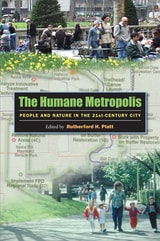
The Humane Metropolis
People and Nature in the 21st-Century CityRutherford H. Platt
University of Massachusetts Press, 2006
Four-fifths of Americans now live in the nation's sprawling metropolitan areas, and half of the world's population is now classified as “urban.” As cities become the dominant living environment for humans, there is growing concern about how to make such places more habitable, more healthy and safe, more ecological, and more equitable—in short, more “humane.”
This book explores the prospects for a more humane metropolis through a series of essays and case studies that consider why and how urban places can be made greener and more amenable. Its point of departure is the legacy of William H. Whyte (1917-1999), one of America's most admired urban thinkers. From his eyrie high above Manhattan in the offices of the Rockefeller Brothers Fund, Whyte laid the foundation for today's “smart growth” and “new urbanist” movements with books such as The Last Landscape (1968). His passion for improving the habitability of cities and suburbs is reflected in the diverse grassroots urban design and regreening strategies discussed in this volume.
Topics examined in this book include urban and regional greenspaces, urban ecological restoration, social equity, and green design. Some of the contributors are recognized academic experts, while others offer direct practical knowledge of particular problems and initiatives. The editor's introduction and epilogue set the individual chapters in a broader context and suggest how the strategies described, if widely replicated, may help create more humane urban environments.
In addition to Rutherford H. Platt, contributors to the volume include Carl Anthony, Thomas Balsley, Timothy Beatley, Eugenie L. Birch, Edward J. Blakely, Colin M. Cathcart, Steven E. Clemants, Christopher A. De Sousa, Steven N. Handel, Peter Harnik, Michael C. Houck, Jerold S. Kayden, Albert LaFarge, Andrew Light, Charles E. Little, Anne C. Lusk, Thalya Parilla, Deborah E. Popper, Frank J. Popper, Mary V. Rickel, Cynthia Rosenzweig, Robert L. Ryan, Laurin N. Sievert, Andrew G. Wiley-Schwartz, and Ann Louise Strong.
Included in the back of the book is a DVD of a 22-minute film created by Ted White, which serves as a companion to the text.
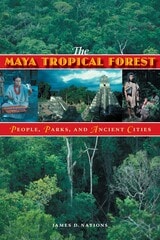
The Maya Tropical Forest
People, Parks, and Ancient CitiesBy James D. Nations
University of Texas Press, 2006
The Maya Tropical Forest, which occupies the lowlands of southern Mexico, Guatemala, and Belize, is the closest rainforest to the United States and one of the most popular tourist destinations in the Western Hemisphere. It has been home to the Maya peoples for nearly four millennia, starting around 1800 BC. Ancient cities in the rainforest such as Palenque, Yaxchilan, Tikal, and Caracol draw thousands of tourists and scholars seeking to learn more about the prehistoric Maya. Their contemporary descendants, the modern Maya, utilize the forest's natural resources in village life and international trade, while striving to protect their homeland from deforestation and environmental degradation.
Writing for both visitors and conservationists, James Nations tells the fascinating story of how ancient and modern Maya peoples have used and guarded the rich natural resources of the Maya Tropical Forest. He opens with a natural history that profiles the forest's significant animals and plants. Nations then describes the Maya peoples, biological preserves, and major archaeological sites in Mexico, Guatemala, and Belize. Drawing on more than twenty-five years of conservation work in the Maya Tropical Forest, Nations tells first-hand stories of the creation of national parks and other protected areas to safeguard the region's natural resources and archaeological heritage. He concludes with an expert assessment of the forest's future in which he calls for expanded archaeological tourism to create an ecologically sustainable economic base for the region.
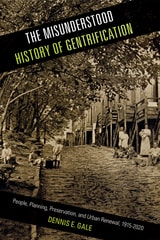
The Misunderstood History of Gentrification
People, Planning, Preservation, and Urban Renewal, 1915-2020Dennis E. Gale
Temple University Press, 2021
The origins of gentrification date back to World War I—only it was sometimes known as “remodeling” then. Dennis Gale’s insightful book, TheMisunderstood History of Gentrification, provides a recontextualization of American gentrification, planning, and policymaking. He argues that gentrification must be understood as an urban phenomenon with historical roots in the very early twentieth century.
Gale uses solid empirical evidence to trace the embryonic revitalization of Georgetown, Greenwich Village, Beacon Hill, and elsewhere back to 1915. He shows how reinvestment and restoration reversed urban decline and revitalized neighborhoods. The Misunderstood History of Gentrification also explains how federal policies such as the Urban Redevelopment Program (later named Urban Renewal), which first emerged in 1949, razed urban slums and created an “urban crisis” that persisted in the 1960s and ‘70s. This situation soon prompted city gentrifiers and historic preservationists to reuse and rehabilitate existing structures.
Within a more expansive historical framework, Gale offers a fresh perspective on and debunks misperceptions about gentrification in America.
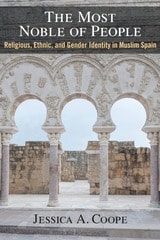
The Most Noble of People
Religious, Ethnic, and Gender Identity in Muslim SpainJessica A. Coope
University of Michigan Press, 2017
The opening chapters define Arab and Muslim identity as those categories were understood in Muslim Spain, highlighting the unique aspects of this society as well as its similarities with other parts of the medieval Islamic world. The book goes on to discuss what it meant to be a Jew or Christian in Spain under Islamic rule, and the degree to which non-Muslims were full participants in society. Following this is a consideration of gender identity as defined by Islamic law and by less normative sources like literature and mystical texts. It concludes by focusing on internal rebellions against the government of Muslim Spain, particularly the conflicts between Muslims who were ethnically Arab and those who were Berber or native Iberian, pointing to the limits of Muslim solidarity.
Drawn from an unusually broad array of sources—including legal texts, religious polemic, chronicles, mystical texts, prose literature, and poetry, in both Arabic and Latin—many of Coope’s illustrations of life in al-Andalus also reflect something of the larger medieval world. Further, some key questions about gender, ethnicity, and religious identity that concerned people in Muslim Spain—for example, women’s status under Islamic law, or what it means to be a Muslim in different contexts and societies around the world—remain relevant today.
The Neopopular Bubble
Speculating on "the People" in Late Modern DemocracyPéter Csigó
Central European University Press, 2017

The Other Oregon
People, Environment, and History East of the CascadesThomas R. Cox
Oregon State University Press, 2019
With a staggering variety of landscapes, from high desert to alpine peaks, Oregon east of the Cascades encompasses seventeen counties and two time zones. Although this vast region defies generalization, its history is distinct from the rest of Oregon. The interrelationship between its people and the land has always been central, but that relationship has evolved and changed over time. Regional economies that were once largely exploitive and dedicated to commodity exports have slowly moved toward the husbanding of resources and to broader and deeper appreciations.
Historian Thomas Cox reveals the complexity of interactions between the people of Eastern Oregon, the land, natural resources, and one another, demonstrating how the region’s history speaks to larger American issues. The 2016 occupation of the Malheur National Wildlife Refuge, covered in detail within these pages, further reveals the relevance of Eastern Oregon to the larger world.
Written in clear and engaging prose and informed by extensive research, The Other Oregon will be a valuable resource for anyone interested in the environment, social change, and the relationships among the diverse people who make up Oregon society east of the Cascades. It will appeal to area residents and visitors, students of the American West, environmental historians, biologists, land managers, and anyone with an abiding interest in the region.
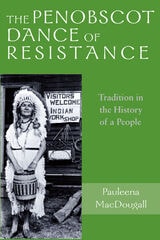
The Penobscot Dance of Resistance
Tradition in the History of a PeoplePauleena MacDougall
University of New Hampshire Press, 2004
Although historians predicted the demise of the Penobscot Indians early in the nineteenth century, the tribe is thriving at the opening of the twenty-first century. Having by the early 1800s been rendered all but invisible to the dominant culture, the Penobscots, by selectively adapting to changing circumstances, won back land and visibility. The vital importance of employing elements of cultural resistance as a survival mechanism has, until now, been underestimated. In a larger context, Dance of Resistance demonstrates how an examination of the history of one Indian nation provides a window on the complex interaction of cultural systems in America.
MacDougall demonstrates that Penobscot legend, linguistics, dance, and oral tradition became foundations of resistance against assimilation into the dominant culture. She thoughtfully and accessibly reconstructs from published, archival, and oral sources the tribe's metaphorical and triumphant Dance of Resistance—founded on spiritual power, reverence for homeland, and commitment to self-determination—from colonial times to the present. A decade of political activism culminated in the precedent-setting 1980 Maine Indian Land Claims settlement. Today the Penobscots run small industries, manage their natural resources, and provide health services, K through 8 education, and social services to the poor and elderly of their community.

The People
Jules Michelet
University of Illinois Press, 1973
The People is a moving picture of France on the eve of 1848. Michelet saw tensions, divisions, and hatreds tearing France apart, and he sought to provide a new faith that would unite the conflicting groups in the love of country.
This book, Michelet wrote, "is the product of my experience rather than of my studies. I have derived it from my observation and my conversations with friends and neighbors." Because of Michelet's countless discussions with people from all ranks of society and his precise observations, his portrait of France is unsurpassed, and representative of general European problems in a time of rapid social and economic change.
The People and the King
The Comunero Revolution in Colombia, 1781John Leddy Phelan
University of Wisconsin Press, 1978
In The People and the King, John Leddy Phelan reexamines a well-known but long misunderstood event in eighteenth-century Colombia. When the Spanish colonial bureaucratic system of conciliation broke down, indigenous groups resorted to armed revolt to achieve their political ends.
As Phelan demonstrates in these pages, the crisis of 1781 represented a constitutional clash between imperial centralization and colonial decentralization. Phelan argues that the Comunero revolution was not, as it has often been portrayed, a precursor of political independence, nor was it a frustrated social upheaval. The Comunero leaders and their followers did not advocate any basic reordering of society, Phelan concludes, but rather made an appeal for revolutionary reform within a traditionalist framework.
The People and the Word
Reading Native NonfictionRobert Warrior
University of Minnesota Press, 2005
Focusing on autobiographical writings and critical essays, as well as communally authored and political documents, The People and the Word explores how the Native tradition of nonfiction has both encompassed and dissected Native experiences. Warrior begins by tracing a history of American Indian writing from the eighteenth century to the late twentieth century, then considers four particular moments: Pequot intellectual William Apess’s autobiographical writings from the 1820s and 1830s; the Osage Constitution of 1881; narratives from American Indian student experiences, including accounts of boarding school in the late 1880s; and modern Kiowa writer N. Scott Momaday’s essay “The Man Made of Words,” penned during the politically charged 1970s. Warrior’s discussion of Apess’s work looks unflinchingly at his unconventional life and death; he recognizes resistance to assimilation in the products of the student print shop at the Santee Normal Training School; and in the Osage Constitution, as well as in Momaday’s writing, Warrior sees reflections of their turbulent times as well as guidance for our own.
Taking a cue from Momaday’s essay, which gives voice to an imaginary female ancestor, Ko-Sahn, Warrior applies both critical skills and literary imagination to the texts. In doing so, The People and the Word provides a rich foundation for Native intellectuals’ critical work, deeply entwined with their unique experiences.
Robert Warrior is professor of English and Native American studies at the University of Oklahoma. He is author of Tribal Secrets: Recovering American Indian Intellectual Traditions (Minnesota, 1994) and coauthor, with Paul Chaat Smith, of Like a Hurricane: The Indian Movement from Alcatraz to Wounded Knee.
The People from Heaven
John Sanford
University of Illinois Press, 1996

The People of Alor
A Social-Psychological Study of an East Indian IslandCora Du Bois
University of Minnesota Press, 1944
The People of Denendeh
Ethnohistory of the Indians of Canada's Northwest TerritoriesJune Helm
University of Iowa Press, 2000
Helm begins with a broad-ranging, stimulating overview of the social organization of hunter-gatherer peoples of the world, past and present, that provides a background for all she has learned about the Dene. The chapters in part 1 focus on community and daily life among the Mackenzie Dene in the middle of the twentieth century. After two historical overview chapters, Helm moves from the early years of the twentieth century to the earliest contacts between Dene and white culture, ending with a look at the momentous changes in Dene-government relations in the 1970s. Part 3 considers traditional Dene knowledge, meaning, and enjoyments, including a chapter on the Dogrib hand game. Throughout, Helm's encyclopedic knowledge combines with her personal interactions to create a collection that is unique in its breadth and intensity.
The People of Sonora and Yankee Capitalists
Ramón Eduardo Ruiz
University of Arizona Press, 1988

The People of the Abyss
Jack London
Pluto Press, 2001
As well as being a literary masterpiece, The People of the Abyss stands as a major sociological study. While other American writers were blindly celebrating the glories of the British Empire at its peak, Jack London was asking why such misery was to be found in the heart of a capital city of immense wealth.
This is a work of reportage - London lets his observations speak for themselves. A precursor to the writings of George Orwell, this book remains a standard-bearer critique of capitalism, as powerful today as it was then.
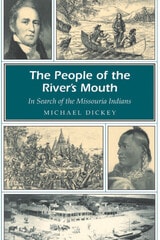
The People of the River's Mouth
In Search of the Missouria IndiansMichael E. Dickey
University of Missouri Press, 2011
The Missouria people were the first American Indians encountered by European explorers venturing up the Pekitanoui River—the waterway we know as the Missouri. This Indian nation called itself the Nyut^achi, which translates to “People of the River Mouth,” and had been a dominant force in the Louisiana Territory of the pre-colonial era. When first described by the Europeans in 1673, they numbered in the thousands. But by 1804, when William Clark referred to them as “once the most powerful nation on the Missouri River,” fewer than 400 Missouria remained. The state and Missouri River are namesakes of these historic Indians, but little of the tribe’s history is known today. Michael Dickey tells the story of these indigenous Americans in The People of the River’s Mouth.
Accessible to general readers, this book recovers the lost history of an important people. The People of the River’s Mouth sheds light on an overlooked aspect of Missouri’s past and pieces together the history of these influential Native Americans in an engaging, readable volume.
The People of the Sierra
Julian Pitt-Rivers
University of Chicago Press, 1972
For his second edition of The People of the Sierra Julian A. Pitt-River has unmasked the village of Grazalema which had been protectively cloaked in pseudonym for the original version. In addition he has added a new preface which elaborates upon his earlier theories on norms, values, and social structure, and reconsiders them in the light of current theories of other social scientists.
Because of its unique and penetrating observations, not only Hispanic, Mediterranean, and European but also Latin American scholars regard this book as one of the foundation stones of contemporary cultural studies in several disciplines. Beyond the significance of its substance and theory, this study has considerable merit as a humane work of subtle perception and artful execution.
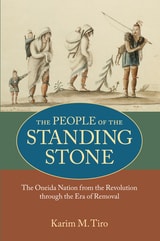
The People of the Standing Stone
The Oneida Nation from the Revolution through the Era of RemovalKarim M. Tiro
University of Massachusetts Press, 2011
The Oneidas' physical, political, and emotional division persists to this day. Even for those who stayed put, their world changed more in cultural, ecological, and demographic terms than at any time before or since. Oneidas of the post-Revolutionary decades were reluctant pioneers, undertaking more of the adaptations to colonized life than any other generation. Amid such wrenching change, maintaining continuity was itself a creative challenge. The story of that extraordinary endurance lies at the heart of this book.
The People, in Parts
The Majoritarian Work of the Minority FormNatasha S. Raheja
University of Chicago Press, 2027
Offers a new theory of the minority as a political form and shows how majoritarian projects are built through its appropriation.
Around the world, national majorities are telling themselves a potent story: that they are the ones in danger. In the United States and Serbia, Christian and white nationalists warn of “replacement.” In Turkey and Pakistan, Muslim nationalists cast religious “others” as existential threats. In India, Hindu nationalists claim that Hindus are becoming minorities in “their own” land. These movements, and the migration and citizenship policies that accompany them, are not aberrations, but rather expressions of a logic embedded in the modern nation-state—a logic that turns people into numbers, numbers into votes, and difference into enmity.
In The People, in Parts, anthropologist Natasha S. Raheja homes in on a paradox visible along the India-Pakistan border. When Hindus cross into India from Pakistan seeking refuge, they are admitted as minorities in need of protection. Yet in India, their welcome into the putative majority is selective and conditional. How does majority-minority status shift by crossing a border? Drawing on long-term research in the Thar Desert region, across Sindh and Rajasthan, Raheja traces how caste and religion shape people's encounters with the state and argues that this bureaucratic confusion is political machinery. Where liberal democracy treats the minority as a shifting, procedural category, nation-state governance fixes it as a substantive identity. The suffering of minoritized populations becomes raw material for majoritarian projects, converted into demographic justification, electoral arithmetic, and nationalist grievance. The minority form, in other words, does majoritarian work.
The People, in Parts offers not only a searing diagnosis of minority-majority politics and the governance of migration but a reframing: the problem is not simply about who belongs and who does not, but how nationalist belonging crosses state borders, pointing to strains within liberal democracy and the nation-state order.
The Scripps School
Its Stories, People, and LegacyRalph Izard
Ohio University Press, 2018
An anecdotal history published on the occasion of the one hundredth anniversary of Ohio University’s renowned E. W. Scripps School of Journalism.
After its founding in 1924, what is now the E. W. Scripps School of Journalism at Ohio University quickly became one of the premier programs in the country. For decades, it has produced leaders who have reached the highest levels of journalism and communication in their careers, and their success is a direct product not only of the education they get in Athens but of the community the school fosters.
In this book, nearly one hundred alumni, faculty, friends, and students offer their stories of life at and after Scripps. The result is a multilayered, inspiring portrait of the school and how it shapes those who pass through its doors. At the same time, The Scripps School gives a nuanced history of journalism education at Ohio University. From covering assassinations and presidential elections to major moments in sports, alumni have documented the unprecedented and the historic, and here they show just how Scripps prepared them to be there.
The Scripps School, edited by former director Ralph Izard, is a love letter to the people and the institution. At a time when journalism is more important than ever, this book humanizes and contextualizes the profession in ways that will resonate in the Scripps community and beyond.
The Sonoran Desert
Its Geography, Economy, and PeopleRoger Dunbier
University of Arizona Press, 1968
Although the significance of geographic regionalism is implicit throughout this study, no attempt is made to show any overriding unity at work, geographical or otherwise, welding together a "desert region." Instead the desert acts as a stage for social drama in which drought and extreme heat provide the essential backcloth. The scarcity of water and man's inability to grow crops without irrigation have not, indeed, changed with time, and only constant reference to this immutable factor can give meaning to the evolution of human activities within the desert.
The University and the People
Envisioning American Higher Education in an Era of Populist ProtestScott M. Gelber
University of Wisconsin Press, 2011
The University and the People chronicles the influence of Populism—a powerful agrarian movement—on public higher education in the late nineteenth century. Revisiting this pivotal era in the history of the American state university, Scott Gelber demonstrates that Populists expressed a surprising degree of enthusiasm for institutions of higher learning. More fundamentally, he argues that the mission of the state university, as we understand it today, evolved from a fractious but productive relationship between public demands and academic authority.
Populists attacked a variety of elites—professionals, executives, scholars—and seemed to confirm academia’s fear of anti-intellectual public oversight. The movement’s vision of the state university highlighted deep tensions in American attitudes toward meritocracy and expertise. Yet Populists also promoted state-supported higher education, with the aims of educating the sons (and sometimes daughters) of ordinary citizens, blurring status distinctions, and promoting civic engagement. Accessibility, utilitarianism, and public service were the bywords of Populist journalists, legislators, trustees, and sympathetic professors. These “academic populists” encouraged state universities to reckon with egalitarian perspectives on admissions, financial aid, curricula, and research. And despite their critiques of college “ivory towers,” Populists supported the humanities and social sciences, tolerated a degree of ideological dissent, and lobbied for record-breaking appropriations for state institutions.
The Will of a People
A Critical Anthology of Great African American SpeechesEdited with Introductions by Richard W. Leeman and Bernard K. Duffy
Southern Illinois University Press, 2012
Normal0falsefalsefalseEN-USX-NONEX-NONE
Drawing upon nearly two hundred years of recorded African American oratory, The Will of a People: A Critical Anthology of Great African American Speeches,edited by Richard W. Leeman and Bernard K. Duffy, brings together in one unique volume some of this tradition’s most noteworthy speeches, each paired with an astute introduction designed to highlight its most significant elements.
Arranged chronologically, from Maria Miller Stewart’s 1832 speech “Why Sit Ye Here and Die?” to President Barack Obama’s 2009 inaugural address, these orations are tied to many of the key themes and events of American history, as well as the many issues and developments in American race relations. These themes, events, and issues include the changing roles of women, Native American relations, American “manifest destiny,” abolitionism, the industrial revolution, Jim Crow, lynching, World War I and American self-determination, the rise of the New Deal and government social programs, the Civil Rights Movement and desegregation, the Vietnam War, Nixon and Watergate, gay and lesbian rights, immigration, and the rise of a mediated culture. Leeman and Duffy have carefully selected the most eloquent and relevant speeches by African Americans, including those by Sojourner Truth, Frederick Douglass, Frances Ellen Watkins Harper, Ida B. Wells-Barnett, Booker T. Washington, Mary Church Terrell, W. E. B. Du Bois, Marcus Garvey, Martin Luther King Jr., Malcolm X, Stokely Carmichael, Barbara Jordan, Jesse Jackson, and Marian Wright Edelman, many of which have never received significant scholarly attention.
The Will of a People is the first book to pair the full texts of the most important African American orations with substantial introductory essays intended to guide the reader’s understanding of the speaker, the speech, its rhetorical interpretation, and the historical context in which it occurred. Broadly representative of the African American experience, as well as what it means to be American, this valuable collectionwill serve as an essential guide to the African American oratory tradition.
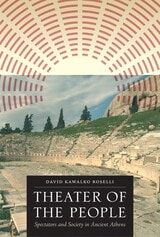
Theater of the People
Spectators and Society in Ancient AthensBy David Kawalko Roselli
University of Texas Press, 2011
Greek drama has been subject to ongoing textual and historical interpretation, but surprisingly little scholarship has examined the people who composed the theater audiences in Athens. Typically, scholars have presupposed an audience of Athenian male citizens viewing dramas created exclusively for themselves—a model that reduces theater to little more than a medium for propaganda. Women's theater attendance remains controversial, and little attention has been paid to the social class and ethnicity of the spectators. Whose theater was it?
Producing the first book-length work on the subject, David Kawalko Roselli draws on archaeological and epigraphic evidence, economic and social history, performance studies, and ancient stories about the theater to offer a wide-ranging study that addresses the contested authority of audiences and their historical constitution. Space, money, the rise of the theater industry, and broader social forces emerge as key factors in this analysis. In repopulating audiences with foreigners, slaves, women, and the poor, this book challenges the basis of orthodox interpretations of Greek drama and places the politically and socially marginal at the heart of the theater. Featuring an analysis of the audiences of Aeschylus, Sophocles, Euripides, Aristophanes, and Menander, Theater of the People brings to life perhaps the most powerful influence on the most prominent dramatic poets of their day.
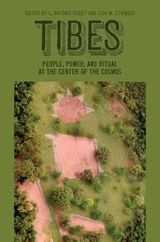
Tibes
People, Power, and Ritual at the Center of the CosmosEdited by L. Antonio Curet and Lisa M. Stringer
University of Alabama Press, 2009
The prehistoric civic-ceremonial center of Tibes is located on the southern coast of Puerto Rico, just north of the modern coastal city of Ponce. Protected on two sides by a river, and on the other two sides by hills, this approximately 10.5-acre site remains as fertile and productive today as when first occupied over 2,000 years ago. Such a rich region would have been a choice location for native peoples because of the diversity in all resources, from land, air, and sea--and also symbolically crucial as a liminal space within the landscape. It may have been regarded as a space charged with numen or cosmic energy where different parts of the cosmos (natural vs. supernatural, or world of the living vs. world of the dead) overlap. Archaeological evidence reveals a long occupation, about 1,000 years, possibly followed by an extensive period of sporadic ceremonial use after the site itself was practically abandoned.
In this volume, nineteen Caribbeanists, across a wide academic spectrum, examine the geophysical, paleoethnobotanical, faunal, lithics, base rock, osteology, bone chemistry and nutrition, social landscape, and ceremonial constructs employed at Tibes. These scholars provide a concise, well-presented, comprehensive analysis of the evidence for local level changes in household economy, internal organization, accessibility to economic, religious, and symbolic resources related to the development and internal operation of socially stratified societies in the Caribbean.
Towards a New Ethnohistory
Community-Engaged Scholarship among the People of the RiverKeith Thor Carlson
University of Manitoba Press, 2018
Traffick
The Illicit Movement of People and ThingsGargi Bhattacharyya
Pluto Press, 2005
Tribune of the People
The Minnesota Legislature and Its LeadershipRoyce Hanson
University of Minnesota Press, 1990