Results by title
56 books match the query 'Philadelphia (Pa.)' and 13 start with t
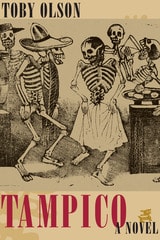
Tampico
A NovelBy Toby Olson
University of Texas Press, 2008
Four old men—John, Gino, Larry, and Frank—have been warehoused at "the Manor," a long-eroded home for the forgotten. The men take turns telling stories, stalling death as they relive pivotal parts of their pasts. Outside, the cliff crumbles and a lighthouse slips toward the sea.
John, in particular, enthralls the others with his tale of Tampico, Mexico, where he met an Indian woman named Chepa who owned a house at the edge of a mountain wilderness. She was his first love—and his first lesson in the dangers of foreign intrigue. But his is not the only memory haunted by mysteries born in Mexico. Sick of waiting for death, stirred by the shifting ground beneath their feet, the Manor's residents finally resolve to quit that place and head out for Tampico.
With inexorable pull, and exquisite scenes that could only come from Toby Olson, Tampico celebrates a sublime band of calaveras, "those skeleton messengers of mortality," who seek self-discovery even as their lives are ending.
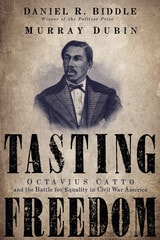
Tasting Freedom
Octavius Catto and the Battle for Equality in Civil War AmericaDaniel R. Biddle
Temple University Press, 2017
Octavius Valentine Catto was an orator who shared stages with Frederick Douglass, a second baseman on Philadelphia’s best black baseball team, a teacher at the city’s finest black school and an activist who fought in the state capital and on the streets for equal rights. With his racially-charged murder, the nation lost a civil rights pioneer—one who risked his life a century before Selma and Birmingham.
In Tasting Freedom Murray Dubin and Pulitzer Prize winner Dan Biddle painstakingly chronicle the life of this charismatic black leader—a “free” black whose freedom was in name only. Born in the American south, where slavery permeated everyday life, he moved north where he joined the fight to be truly free—free to vote, go to school, ride on streetcars, play baseball and even participate in July 4th celebrations.
Catto electrified a biracial audience in 1864 when he proclaimed, “There must come a change,” calling on free men and women to act and educate the newly freed slaves. With a group of other African Americans who called themselves a “band of brothers,” they challenged one injustice after another. Tasting Freedom presents the little-known stories of Catto and the men and women who struggled to change America.
The Back Bench
Margaret Hope Bacon
QuakerPress, 2007
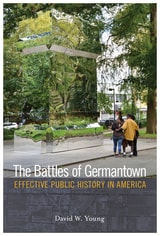
The Battles of Germantown
Effective Public History in AmericaDavid W. Young
Temple University Press, 2019
2020 Philip S. Klein Book Prize Winner, Pennsylvania Historical Association
Known as America’s most historic neighborhood, the Germantown section of Philadelphia (established in 1683) has distinguished itself by using public history initiatives to forge community. Progressive programs about ethnic history, postwar urban planning, and civil rights have helped make historic preservation and public history meaningful. The Battles of Germantown considers what these efforts can tell us about public history’s practice and purpose in the United States.
Author David Young, a neighborhood resident who worked at Germantown historic sites for decades, uses his practitioner’s perspective to give examples of what he calls “effective public history.” The Battles of Germantown shows how the region celebrated “Negro Achievement Week” in 1928 and, for example, how social history research proved that the neighborhood’s Johnson House was a station on the Underground Railroad. These encounters have useful implications for addressing questions of race, history, and memory, as well as issues of urban planning and economic revitalization.
Germantown’s historic sites use public history and provide leadership to motivate residents in an area challenged by job loss, population change, and institutional inertia. The Battles of Germantown illustrates how understanding and engaging with the past can benefit communities today.
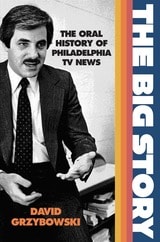
The Big Story
The Oral History of Philadelphia TV NewsDavid Grzybowski
Temple University Press, 2025
“We were the only station that stayed on the air continuously. We even pre-empted the CBS evening news.”—Larry Kane, anchor at WCAU, about covering the MOVE bombing
“The highs of working during the pandemic were keeping people informed of this deadly virus and what they had to do to take care of themselves and each other.”—Ukee Washington, KYW anchor, on the pandemic
The Big Story is David Grzybowski’s engrossing oral history of Philadelphia TV news from the perspective of reporters, photographers, producers, and news directors. Covering all the big stories from the late 1970s through the present, this fast-paced running commentary reflects on the uncertainty of the Three Mile Island disaster, the thrill of the Live Aid concert, the “Storm of the Century” (that wasn’t), and the championship victories of the Phillies and the Eagles, among other notable events, local, national, and global.
The Big Story features more than 200 interviews, including anecdotes from seasoned Philadelphia anchors Jim Gardner, Larry Kane, Lisa Thomas-Laury, Mike Jerrick, Vai Sikahema, Tamala Edwards, Pat Ciarrocchi, and Cecily Tynan, among others, about their experience on and off the job. Decision makers reflect on how to cover hot news stories such as Pennsylvania State Treasure R. Budd Dwyer’s on-air suicide. (“It was a big bloody horrifying mess,” according to Chris Wagner, WPVI anchor.)
Grzybowski highlights the Mummers, the launch of Good Day Philadelphia, off-the-air scandals, and how the Action News style secured a loyal following with Philadelphians while the Eyewitness News format competed hard to gain ratings. But the Big Story is how The Big Story provides compelling stories about Philadelphia’s news breakers and newsmakers.
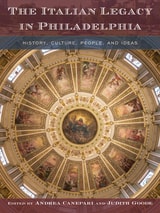
The Italian Legacy in Philadelphia
History, Culture, People, and IdeasEdited by Andrea Canepari and Judith Goode
Temple University Press, 2021
Italian arts and culture have been a significant influence on Philadelphia dating back to Thomas Jefferson and colonial times. Throughout the ensuing decades, Italian art and architecture styles flourished, and wealthy Philadelphians traveled to Italy and brought back objects to display in emerging institutions of art and culture. New immigration formed neighborhoods—such as South Philly, home to the Italian Market—and Italian business leaders, politicians, artists, musicians and sports figures came to prominence and became part of the social fabric of the city.
This glorious volume, The Italian Legacy in Philadelphia, celebrates the history, impact, and legacy of this vibrant community, tracing four periods of key transformation in the city’s political, economic, and social structures. The editors and contributors chronicle the changing dynamics of the city as Italian immigrants established themselves and as they continue to have lively interactions with people and institutions in Italy.
Interdisciplinary essays, along with nearly 250 gorgeous images, explore the changing perspectives and styles of those who contributed Italian influences. As settlers and their descendants brought everyday cultural practices, memories, and traditions, they created different Italian-American experiences that became important parts of American culture, a legacy that is thriving in contemporary, globalized Philadelphia.
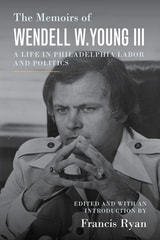
The Memoirs of Wendell W. Young III
A Life in Philadelphia Labor and PoliticsFrancis Ryan
Temple University Press, 2019
Philadelphia native Wendell W. Young III was one of the most important American labor leaders in the last half of the twentieth century. An Acme Markets clerk in the 1950s and ’60s, he was elected top officer of the Retail Clerks Union when he was twenty-four. His social justice unionism sought to advance wages while moving beyond collective bargaining to improve the conditions of the working-class majority, whether in a union or not. Young quickly gained a reputation for his independence, daring at times to publicly criticize the policies of the city’s powerful AFL-CIO leadership and tangle with the city’s political machine.
Editor Francis Ryan, whose introduction provides historical context, interviewed Young about his experiences working in the region’s retail and food industry, measuring the changes over time and the tangible impact that union membership had on workers. Young also describes the impact of Philadelphia’s deindustrialization in the 1970s and ’80s and recounts his activism for civil rights and the anti-war movements as well as on John F. Kennedy’s presidential campaign.
The Memoirs of Wendell W. YoungIII provides the most extensive labor history of late twentieth-century Philadelphia yet written.
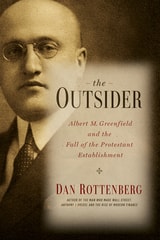
The Outsider
Albert M. Greenfield and the Fall of the Protestant EstablishmentDan Rottenberg
Temple University Press, 2018
In The Outsider, veteran journalist and best-selling author Dan Rottenberg deftly chronicles the astonishing rises, falls, and countless reinventions of this savvy businessman. Greenfield's power allowed him to cross social, religious, and ethnic boundaries with impunity. He alarmed Philadelphia's conservative business and social leaders-Christians and Jews alike-some of whom plotted his downfall.
In this engaging account of Greenfield's fascinating life, Rottenberg demonstrates the extent to which one uniquely brilliant and energetic man pushed the boundaries of society's limitations on individual potential. The Outsider provides a microcosmic look at three twentieth-century upheavals: the rise of Jews as a crucial American business force, the decline of America's Protestant establishment, and the transformation of American cities.
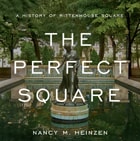
The Perfect Square
A History of Rittenhouse SquareNancy M. Heinzen
Temple University Press, 2009
One of the five squares William Penn established when he founded the city, the southwest-situated Rittenhouse Square has transformed from a marshy plot surrounded by brickyards and workers’ shanties into the epicenter of Philadelphia high society. A keystone of center city Philadelphia, it was once home to great dynasties, elegant mansions, and grand dames of the Victorian era. Today it is lined with million-dollar high-rise condominiums, where nouveau-riche entrepreneurs and descendants of ethnic immigrants live side-by-side.
Heinzen lovingly chronicles this urban space’s development and growth, illustrating that not only is Rittenhouse Square unique, but so is the combination of human events and relationships that have created and sustained it.
Painstakingly researched and generously illustrated with black-and-white photos from public archives, The Perfect Square will appeal to lay readers interested in history, to professional historians and urban planners, and to the thousands of new residents who have settled on or near Rittenhouse Square since the dawn of the 21st century.
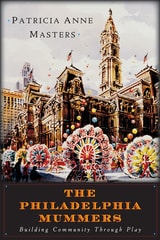
The Philadelphia Mummers
Building Community Through PlayPatricia Anne Masters
Temple University Press, 2007
Every New Year's Day since 1901, the Philadelphia Mummers have presented a spectacular show of shows that raucously snakes and shimmies its way through city streets. The Mummers Parade features music, dance, comedy, and mime, along with dazzling costumes and floats. Although the lavish event is now televised to a wide audience, it is still rooted in the same neighborhoods where it began.
This book explores the community created and annually reaffirmed by the Philadelphia Mummers. The author spent more than five years with the Mummers, observing their lives and rituals as she took part in their preparations and parades. Writing with the fascination of a sociologist and the excitement of a participant, Masters examines the Mummers from their beginnings. Through the prism of their century-long history, we can see how communities retain their identities and how they are affected by larger cultural trends.
The Philadelphia Reader
Robert Huber
Temple University Press, 2006
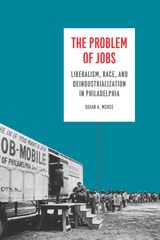
The Problem of Jobs
Liberalism, Race, and Deindustrialization in PhiladelphiaGuian A. McKee
University of Chicago Press, 2008
With a focus on Philadelphia, this volume illuminates the central role of these local political and policy struggles in shaping the fortunes of city and citizen alike. In the process, it tells the remarkable story of how Philadelphia’s policymakers and community activists energetically worked to challenge deindustrialization through an innovative series of job retention initiatives, training programs, inner-city business development projects, and early affirmative action programs. Without ignoring the failure of Philadelphians to combat institutionalized racism, Guian McKee's account of their surprising success draws a portrait of American liberalism that evinces a potency not usually associated with the postwar era. Ultimately interpreting economic decline as an arena for intervention rather than a historical inevitability, The Problem of Jobs serves as a timely reminder of policy’s potential to combat injustice.
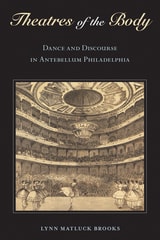
Theatres of the Body
Dance and Discourse in Antebellum PhiladelphiaLynn Matluck Brooks
Temple University Press, 2025
Reviewing print culture in the 1840s, Brooks shows how newspapers, magazines, and popular fiction provided documentation of dancing in Philadelphia as well as the responses of dance commentators, practitioners, and moralists. Theatres of the Body also considers the interplay of science with dance in the 1850s, which impacted both dance practices and reception.
Providing an expansive historiography of these significant contributions to dance in the United States, Brooks deepens our understanding of antebellum culture and history.