Results by title
52 books match the query 'Philanthropy & Charity' and 10 start with t
The Community Table
Effective Fundraising through EventsSusan Cole Urano
Ohio University Press, 2016
In resource-challenged Athens County, Ohio, staff and volunteers at the nonprofit Athens County Foundation came up with a daring idea: to host a locally sourced, gourmet dinner for four hundred people. The meal would be held on the brick-paved main street of the city of Athens, to raise funds for the food bank, and increase awareness of the persistent local struggle with food insecurity, as well as raise the visibility of the foundation. The logistical challenges were daunting, but the plan would unite the community around the common theme of providing for its own.
Since then, Bounty on the Bricks has become a touchstone event that raises close to one hundred thousand dollars for the food bank. In The Community Table, Athens County Foundation executive director Susan Urano translates her years of nonprofit experience with large-scale annual fundraisers into a step-by-step guide for development professionals, community leaders, and volunteers.
Urano guides readers to consider when to mount a fundraiser, who the stakeholders are, what social and financial value the event will bring to the community, and how partnerships might augment the payoff. Using real-life examples, she explains how organizers can learn from mistakes and illustrates methods of team building, conflict resolution, and problem solving. Sample ideas, timelines, budgets, publicity plans, and committee structures round out The Community Table.

The Foundation Administrator
A Study of Those Who Manage America's FoundationsArnold John Zurcher
Russell Sage Foundation, 1972

The Global Shelter Imaginary
Ikea Humanitarianism and Rightless ReliefAndrew Herscher
University of Minnesota Press, 2021
Examines how the humanitarian order advances a message of moral triumph and care while abandoning the dispossessed
Prompted by a growing number of refugees and other displaced people, intersections of design and humanitarianism are proliferating. From the IKEA Foundation’s Better Shelter to Airbnb’s Open Homes program, the consumer economy has engaged the global refugee crisis with seemingly new tactics that normalize an institutionally sanctioned politics of evasion. Exploring “the global shelter imaginary,” this book charts the ways shelter functions as a form of rightless relief that expels recognition of the rights of the displaced and advances political paradoxes of displacement itself.
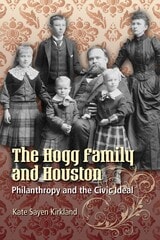
The Hogg Family and Houston
Philanthropy and the Civic IdealBy Kate Sayen Kirkland
University of Texas Press, 2009
Progressive former governor James Stephen Hogg moved his business headquarters to Houston in 1905. For seven decades, his children Will, Ima, and Mike Hogg used their political ties, social position, and family fortune to improve the lives of fellow Houstonians.
As civic activists, they espoused contested causes like city planning and mental health care. As volunteers, they inspired others to support social service, educational, and cultural programs. As philanthropic entrepreneurs, they built institutions that have long outlived them: the Houston Symphony, the Museum of Fine Arts, Memorial Park, and the Hogg Foundation. The Hoggs had a vision of Houston as a great city—a place that supports access to parklands, music, and art; nurtures knowledge of the "American heritage which unites us"; and provides social service and mental health care assistance. This vision links them to generations of American idealists who advanced a moral response to change.
Based on extensive archival sources, The Hogg Family and Houston explains the impact of Hogg family philanthropy for the first time. This study explores how individual ideals and actions influence community development and nurture humanitarian values. It examines how philanthropists and volunteers mold Houston's traditions and mobilize allies to meet civic goals. It argues that Houston's generous citizens have long believed that innovative cultural achievement must balance aggressive economic expansion.

The Ice Bucket Challenge
Pete Frates and the Fight against ALSCasey Sherman and Dave Wedge
University Press of New England, 2017

The Investment Policies of Foundations
Ralph Lowell Nelson
Russell Sage Foundation, 1967
The Landscape of Rural Service Learning, and What It Teaches Us All
Randy Stoecker
Michigan State University Press, 2016
The Politics of Knowledge
The Carnegie Corporation, Philanthropy, and Public PolicyEllen Condliffe Lagemann
University of Chicago Press, 1992

The Rise of West Coast Philanthropy
A History of the Hewlett and Packard FoundationsAsher Orkaby and Tim Mueller
University of Chicago Press, 0
The first full-length history of the Hewlett and Packard foundations and how they were at the forefront of the emergence of a distinctive West Coast approach toward giving.
A new generation of mega-wealthy tech tycoons purported to upend the twenty-first-century practice of philanthropy, but pioneering tech entrepreneurs William Hewlett and David Packard, the co-founders of the Hewlett-Packard Company, had already begun the process four decades earlier. The Rise of West Coast Philanthropy follows Silicon Valley’s first generation of philanthropists and how their work helped establish West Coast philanthropy as a major global force.
Drawing on unprecedented access to archival records and interviews with over 115 philanthropy leaders and insiders around the world, authors Asher Orkaby and Tim Mueller uncover the previously untold histories of the foundations established by William and Flora Hewlett and David and Lucile Packard, two of America’s most famous power couples. Through their foundations, these two families introduced philanthropic trends later echoed by philanthropies on both the West and East Coasts, demonstrating a successful adaptation of the management principles that first made HP a model company. The Rise of West Coast Philanthropy explores more than sixty years of Hewlett and Packard grant-making, from early family enterprises with local ambitions to major regional, national, and international powerhouses.
In telling this story, Orkaby and Mueller offer a fresh perspective on the distinctive model of West Coast philanthropy, which has been crucial in shaping the twenty-first-century global philanthropic landscape.

Trusteeship and the Management of Foundations
Donald Young
Russell Sage Foundation, 1969