Results by title
3785 books match the query 'Poetry' and 833 start with t
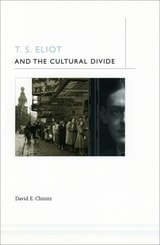
T. S. Eliot and the Cultural Divide
David E. Chinitz
University of Chicago Press, 2003
David Chinitz argues that Eliot was productively engaged with popular culture in some form at every stage of his career, and that his response to it, as expressed in his poetry, plays, and essays, was ambivalent rather than hostile. He shows that American jazz, for example, was a major influence on Eliot's poetry during its maturation. He discusses Eliot's surprisingly persistent interest in popular culture both in such famous works as The Waste Land and in such lesser-known pieces as Sweeney Agonistes. And he traces Eliot's long, quixotic struggle to close the widening gap between high art and popular culture through a new type of public art: contemporary popular verse drama.
What results is a work that will persuade adherents and detractors alike to return to Eliot and find in him a writer who liked a good show, a good thriller, and a good tune, as well as a "great" poem.
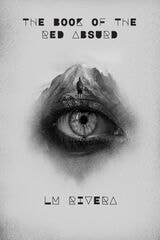
THE BOOK OF THE RED ABSURD
L.M. Rivera
Omnidawn, 2026
LM Rivera’s THE BOOK OF THE RED ABSURD is a poetic autobiography seen through the lens of literature, cinema, theory, history, mythology, and demonology. Presenting themselves in a sort of kinship with academic traditions, these poems move beyond scholarly preciousness to uncover something deeper, stranger, and more honest. This collection is a descent into an absurdist avant-garde performance, immersing the reader in the head of “red” experiences—those with sensations of extremity, despair, amusement, and derision. Here we find a heart laid bare through poetry that aims for the deadliest parts and dances wildly along the way.

THE WAYS WE TOUCH
POEMSMiller Williams
University of Illinois Press, 1997
"Of History and Hope,"
the 1997 Presidential Inaugural Poem
When Miller Williams
read his Inaugural Poem, "Of History and Hope," to a world-wide
audience in January, his proverbial "fifteen minutes of fame"
lasted far less--somewhere between three and four minutes. That was long
enough to make a big impact on many. Said poet Paul Zimmer, one of the
millions in his viewing audience, "I came up out of my Lazy-Boy and
cheered loudly!"
Williams is an
American original whose poems have been praised for both the elegance
of their style and the simplicity of their language, for their wonderful
humor and genuine passion. The works in his newest collection, The
Ways We Touch, may be nostalgic or challenging, humorous or full of
moral fortitude; always Williams speaks with the kind of insight that
rises from wisdom and experience.
Praise for Williams's
earlier work:
"Miller
Williams is one of those writers whose books drag me snorkeling happily
along. Happy as a pig among truffles, I hurry to the next treasure."
-- William Stafford
"Most contemporary
poets might well go to him for lessons in the art of speaking plainly
in disciplined lines alive with emotional energy." -- X. J. Kennedy
"Better
than almost anything else being published." -- Donald Justice

THINE
Kate Partridge
Tupelo Press, 2023
THINE’s observational approach draws together ecopoetics with art and myth, turning a skeptical eye toward predictions of both apocalypse and hope. In conversation with artistic renderings of and against the self in the West–Agnes Martin’s grids, Willa Cather’s letters, Walter di Maria’s The Lightning Field–these poems find beauty in the impermanence of land, animals, and people. THINE meditates, with affectionate irony, on what it means to make new lives in the midst of the unknown.
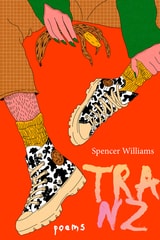
TRANZ
Spencer Williams
Four Way Books, 2024

Tahrir Suite
PoemsMatthew Shenoda
Northwestern University Press, 2015
Winner, Arab American National Museum's 2015 George Ellenbogen Poetry Award
Tahrir Suite is a book-length poem that contemplates immigration, homeland, and diaspora in the twenty-first century. The poem, inspired by recent events in Egypt, cycles through the journey of two Egyptians moving across borders, languages, cultures, landscapes, and political systems while their life in the U.S. diaspora evolves and their home country undergoes revolutionary change.
Written from a perspective and about a place that is virtually unexplored in contemporary American poetry, Tahrir Suite works to capture the complicated essence of what it means to be from a specific place that is experiencing such radical change and how our understandings of “home” and “place” constantly evolve. Tahrir Suite is a musical meditation on what it means to be a global citizen in contemporary times.
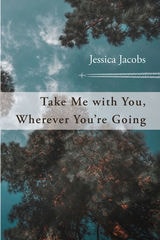
Take Me with You, Wherever You're Going
Jessica Jacobs
Four Way Books, 2019
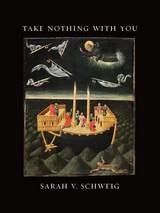
Take Nothing With You
Sarah V. Schweig
University of Iowa Press, 2016
These poems operate on the notion that the lyric can be discovered in scattered headlines, office-wide emails, road signs—the detritus of the everyday. But a poem doesn’t stop at found fragments; it creates something from them. These poems question and re-question what can be truthfully said, rediscovering the lyric in the very process of thinking, revising, and re-envisioning.
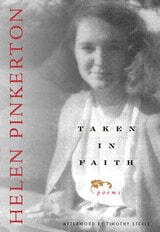
Taken In Faith
PoemsHelen Pinkerton
Ohio University Press, 2002
In 1967, Yvor Winters wrote of Helen Pinkerton, “she is a master of poetic style and of her material. No poet in English writes with more authority.” Unfortunately, in 1967 mastery of poetic style was not, by and large, considered a virtue, and Pinkerton’s finely crafted poems were neglected in favor of more improvisational and flashier talents. Though her work won the attention and praise of serious readers, who tracked her poems as they appeared in such journals as The Paris Review, The Sewanee Review, and The Southern Review, her verse has never been available in a trade book. Taken in Faith remedies that situation, bringing Pinkerton’s remarkable poems to a general audience for the first time.
Even her very earliest works embody a rare depth and seriousness. Primarily lyrical and devotional, they always touch on larger issues of human struggle and conduct. More recent poems, concerned in part with history, exhibit a stylistic as well as a thematic shift, moving away from the rhymed forms of her devotional works into a blank verse marked by a quiet flexibility and contemplative grace.
Like Virginia Adair, another poet who waited long for proper recognition, Pinkerton speaks as a woman who has lived fully and observed acutely and who has set the life and observations down in memorable verse. Taken in Faith represents a half-century of her poetic efforts.
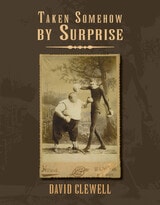
Taken Somehow By Surprise
David Clewell
University of Wisconsin Press, 2011
David Clewell’s spirited poems cut through the noise we too often accommodate in our daily lives. Breath by surprising breath, this poet takes us into chambers of the heart that have never been mapped quite this way before. By turns raucous and strangely soothing, narrative and lyrical, Clewell traffics in unlikely and compelling details of our mostly discernible world: a school custodian’s role in the burgeoning Space Race, the vastness of abandoned missile silos, the first lawn flamingos, and the living fossil still using a typewriter.
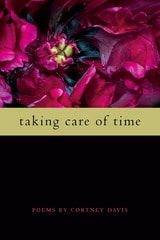
Taking Care of Time
Cortney Davis
Michigan State University Press, 2018
Tales Out of School
Selected InterviewsRobert Creeley
University of Michigan Press, 1994
Tales and Trials of Love, Concerning Venus’s Punishment of Those Who Scorn True Love and Denounce Cupid’s Sovereignty
A Bilingual Edition and StudyJeanne Flore
Iter Press, 2014
Tales of Dionysus
The Dionysiaca of Nonnus of PanopolisEdited by William Levitan and Stanley Lombardo
University of Michigan Press, 2022
Tales of Dionysus is the first English verse translation of one of the most extraordinary poems of the Greek literary tradition, the Dionysiaca of Nonnus of Panopolis. By any standard, the Dionysiaca is a formidable work. It is by far the longest poem surviving from the classical world, a massive mythological epic stretching to over 20,000 lines, written in the tradition of Homer, using Homer’s verse, Homer’s language, his narrative turns and motifs, and invoking his ancient Muses. But it is also the last ancient epic to follow a Homeric model, composed so late in fact that it stands as close in time to the Renaissance as it does to archaic Greece. Like its titular hero, Dionysus, with his fluidity of forms, names, and divine incarnations, the poem itself is continually shifting shape. Out of its formal epic frame spills a tumult of ancient literary types: tragedy, elegy, didactic, panegyric, pastoral idyll, and the novel are all parts of this gigantic enterprise, each genre coming to the fore one after the other.
Tales of Dionysus brings together forty-two translators from a wide range of backgrounds, with different experiences and different potential relationships to the text of Nonnus’ poem. All work in their own styles and with their own individual approaches to the poem, to translation, and to poetic form. This variety turns Tales of Dionysus into a showcase of the multiple possibilities open to classical translation in the contemporary world.
Tales of Trilussa
Carlo Albert Salustri
University of Arkansas Press, 1990
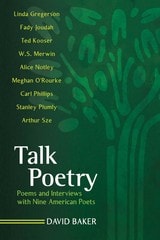
Talk Poetry
Poems and Interviews with Nine American PoetsDavid Baker
University of Arkansas Press, 2012
Talking All Morning
Robert Bly
University of Michigan Press, 1980
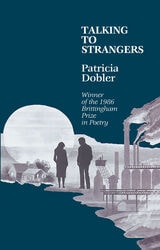
Talking to Strangers
Patricia Dobler
University of Wisconsin Press, 1986
In her first book of poems, Patricia Dobler records her memories of the Ohio mill town where she grew up in the 1950s. but the poems range over time and the memories of others, as well: her immigrant Hungarian grandparents, her parent's tensions during hard times (”Years spilled on the kitchen table, / picked over like beans or old bills”), the dangers, losses, and occasional triumphs of hard-working men and women.
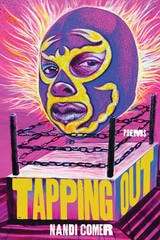
Tapping Out
PoemsNandi Comer
Northwestern University Press, 2020
The harsh realities of being migrant and immigrant, being birthright and oppressed, are as hard-pressed as the plancha move to the body. Each poem in Tapping Out is a “freestyle movement” of language and complexity put on full display, under the bright lights and roars of survival. Comer’s splendid and barbed, Detroit style of language melts the masks with searing words.
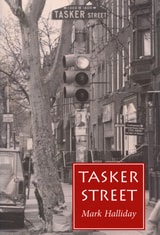
Tasker Street
Mark Halliday
University of Massachusetts Press, 1992
Tasker Street, winner of the Juniper Prize for poetry, is the second collection of poems by the acclaimed American poet Mark Halliday. Following his debut, Little Star (1987), which was selected for the National Poetry Series, Tasker Street confirmed Halliday as one of the most distinctive and engaging voices in contemporary American poetry.
Halliday's poems are marked by a restless, probing intelligence and a distinctly conversational energy. The poems in Tasker Street are personal in tone, narrative in impulse, and unafraid to range widely across the textures of everyday life: relationships, memory, desire, self-doubt, ambition, and the comic absurdities of being alive. These are poems that think out loud, circling back on themselves with a self-awareness that is at once disarming and deeply serious, even as they entertain with wit, verbal dexterity, and a refusal to settle for easy resolutions.
Drawing on the traditions of Frank O'Hara's personism and the narrative directness of the New York School, yet infused with a philosophical attentiveness honed by Halliday's scholarly engagement with the poetry of Wallace Stevens, the poems in Tasker Street balance accessibility with intellectual ambition. They invite readers into a voice that is simultaneously intimate and performative, one that embraces digression, self-interrogation, and the pleasures of language even while confronting questions of mortality, meaning, and the stubborn persistence of the self.
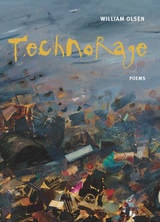
TechnoRage
PoemsWilliam Olsen
Northwestern University Press, 2017
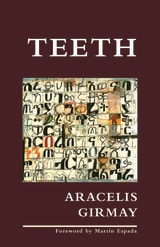
Teeth
Aracelis Girmay
Northwestern University Press, 2007
LOVE,
you be the reason why
we swagger & jive,
lift the guitar, & pick up the axe.
when it is i tilt my hat to the side,
wearing colors & perfumes, it's cause, love,
you did it to me. oh,
you do sure turn my tongue to fiddle,
& make the salt taste sweet. man,
i don't need a rooster, or peacock even,
to help me spend my time, nope,
just you, love, right & solid as
a line.
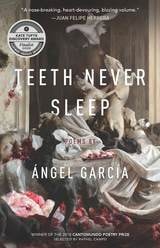
Teeth Never Sleep
PoemsÁngel García
University of Arkansas Press, 2018
Finalist, 2019 PEN Open Book Award
Winner, 2019 American Book Award, Before Columbus Foundation
Drawing on folklore and fantasy, childhood memory and hallucination, and marked by a tone of piercing divulgence, Teeth Never Sleep nimbly negotiates the split consciousness a culture of dominance requires of men (especially men of color), highlighting the fissures in selfhood created by the pressure to seek submission over intimacy while still wanting desperately to be loved, and tracing the contorted route by which emotional pain finds expression in violence. “The night my girlfriend tells my mother I beat her, / I feel betrayed. This was a secret we kept between us. / That night, I was no longer my mother’s loving son,” the speaker in one poem confesses, and later “I never wanted to be this kind of animal.”
And yet, through the lens of Ángel García’s sharp imagining, men frequently appear as beasts (sometimes literally)—as hybrid beings both tender and brutal—that he steadfastly refuses to let off the hook as he obsessively catalogs the origins of toxic masculinity (the first time I made my mother cry, the first time I pitied my father, the first time I saw a girl bleed) and its quiet, lasting effects: “Still a part of me believes a / man shouldn’t cry in front of a woman, even in the dark.”
In a culture of weaponized masculinity, the poems in Teeth Never Sleep make a doorway of a wound, inviting readers to walk through and sit down inside the raw pain they harbor to meditate on two central, urgent questions: what it means to be a man and how, as a man, to love.
Tell it Slant
John Yau
Omnidawn, 2023
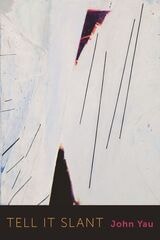
Emily Dickinson begins one of her poems with the oft-quoted line, “Tell all the truth but tell it slant." For Asian Americans, the word “slant” can be heard and read two ways, as both a racializing and an obscuring term. It is this sense of doubleness—culminating in the instability of language and an untrustworthy narrator—that shapes, informs, and inflects the poems in John Yau’s new collection, all of which focus on the questions of who is speaking and who is being spoken for and to. Made up of eight sections, each exploring the idea of address—as place, as person, as memory, and as event —Tell It Slant does as Dickinson commands, but with a further twist. Yau summons spirits who help the author “tell all the truth,” among whom are reimagined traces of poets, movie stars, and science fiction writers, including Charles Baudelaire, Thomas de Quincey, Philip K. Dick, Li Shangyin, and Elsa Lanchester.
Telling It Slant
Avant Garde Poetics of the 1990SMark Wallace
University of Alabama Press, 2001
The finest essays from the newest generation of critics and poet-critics are gathered together in this volume documenting the growth in readership and awareness of avant-garde poetries.
This collection demonstrates the breadth and openness of the field of avant-garde poetry by introducing a wide range of work in poetics, theory, and criticism from emerging writers. Examining the directions innovative poetry has taken since the emergence and success of the Language movement, the essays discuss new forms and the reorientation of older forms of poetry in order to embody present and ongoing involvements. The essays center around four themes: the relation between poetics and contemporary cultural issues; new directions for avant-garde practices; in-depth explorations of current poets and their predecessors; and innovative approaches to the essay form or individual poetics.
Diverging from the traditional, linear argumentative style of academic criticism, many of the essays in this collection instead find critical forms more subtly related to poetry. Viewed as a whole, the essays return to a number of shared issues, namely poetic form and the production of present-day poetry. While focusing on North American poetry, the collection does reference the larger world of contemporary poetics, including potential biases and omissions based on race and ethnicity.
This is cutting-edge criticism at its finest, essential reading for students and scholars of avant-garde poetry, of interest to anyone interested in contemporary American literature and poetry.
Telling Rhythm
Body and Meaning in PoetryAmittai Aviram
University of Michigan Press, 1994

Tendentious
Humor as Critique in Postwar and Contemporary PoetryScott Inniss
University of Iowa Press, 2027
Tender Machines
J. Mae Barizo
Tupelo Press, 2023
Tender the Maker
Christina Hutchins
Utah State University Press, 2015
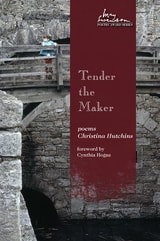
"Again and again in Christina Hutchins’s exquisite Tender the Maker, poems startle us into awareness of the overlooked, the nearly always invisible (such as a library’s unused dictionary), and the marvelous, those aspects of life that come under the rubric of ‘mystery,’ in all senses of the word. Hutchins combines a pitch-perfect and precise lyricism with a postmodern sensibility of language’s materiality.”
—Cynthia Hogue, judge for the 2015 May Swenson Poetry Award
"An elegantly crafted, dense work that invites readers to travel on spiritual, philosophical, and historical journeys."
—Kirkus Reviews
"Tender the Maker revisits the age-old comparison between poet and deity, highlighting its blind spots, namely the times when creating also means losing, destroying, forgetting. . . . Each poem becomes a map where time and space intersect and unearth connections that help us confront the weight of history, whether our own or that of others."
—Fjords Review
"[T]hroughout the book, Hutchins guides me into her patient, fragile, complex vision. . . . Both the depth and the precision of Hutchins’s work arise from her exact attention to the 'motion-in-relation' of herself as an artist, which is also attention to the tools of her work and to her imagination’s duty to honor the seen and the not seen."
—Beloit Poetry Journal
The May Swenson Poetry Award is an annual competition named for May Swenson, one of America’s most provocative and vital writers. During her long career, Swenson was loved and praised by writers from virtually every school of American poetry. She left a legacy of fifty years of writing when she died in 1989. She is buried in her hometown of Logan, Utah.
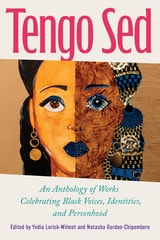
Tengo Sed
An Anthology of Works Celebrating Black Voices, Identities, and PersonhoodEdited by Yndia Lorick-Wilmot and Natasha Gordon-Chipembere
University of Illinois Press, 2026
A blend of text and visuals in genre fiction, nonfiction, poetry, memoir, art, and music, Tengo Sed engages in the expansive and nuanced meanings of Blackness across the diaspora, traversing linguistic, geographic, material, and formal boundaries. The collection interrogates how African-descended individuals theorize and articulate their racial, gender, ethnic, and national identities in relation to dominant discourse. Underscored by a transnational feminist cultural studies approach, the collection builds upon the legacy of The Sisterhood—an activist-literary collective founded by Alice Walker and June Jordan—by providing a contemporary platform for Black creatives to amplify their voices.
Singular and inspirational, Tengo Sed centers storytelling, self-making, and artistic practice, and contributes to ongoing dialogues on Black identity, liberation, and creative sovereignty.
Contributors: Vilna Bashi, Khytie Brown, Masauko Chipembere, Maria DeLongoria, Rosalina Diaz, Summer Edward, Natasha Gordon-Chipembere, Tonya Hegamin, Tiffani J. Johnson, Daphne Lamothe, Gabrielle Lawrence, Yndia S. Lorick-Wilmot, April Mojica-Clement, Courtney Desiree Morris, Anton Nimblett, Kasandra Pantoja, Michael D. Poole, Nelly Rosario, Alicia Anabel Santos, Michele L. Simms-Burton, Andrea Stith, Tawana Thompson, Tracey L. Walters, and N’deye Walton, and Janvieve Williams Comrie

Tennysonian Love
The Strange DiagonalGerhard Joseph
University of Minnesota Press, 1969
Tennysonian Love was first published in 1969. Minnesota Archive Editions uses digital technology to make long-unavailable books once again accessible, and are published unaltered from the original University of Minnesota Press editions.
In the century or so since Alfred Tennyson's poetry reached the height of its popularity and critical acclaim, the pendulum of criticism has swung wide in opposite directions. From the earlier idolatry to the later ridicule, that pendulum has now settled into a position of qualified and selective praise from which a more thoughtful consideration of the poet is possible. Consequently, as this critical study suggests, new values and dimensions are recognizable in his work.
Professor Joseph, concentrating on the theme of love but involving in his argument other facets of Tennyson's achievement, demonstrates the thesis that the poet moved as in a "strange diagonal." This phrase used as the subtitle of the book comes from Tennyson's poem The Princess in which the narrator "moved as in a strange diagonal / And maybe neither pleased myself nor them."
As the author shows, Tennyson throughout his work moved between a Platonic conception of love in which the highest kind of spiritual love has disencumbered itself of sense and a Neoplatonic ("Dantesque") one in which sense and soul tend to merge. In coming to terms with the nineteenth-century form of this divided Western heritage, the pietism of the evangelical revival on the one hand and the idealized eroticism of his Romantic predecessors on the other, Tennyson became the exemplary poet of Victorian love. No other Victorian poet, Professor Joseph concludes, exhibits quite his representative and successful blending of these clashing strains. For while moving between the alternate traditions of Western love, Tennyson was able to forge a large body of highly disciplined, beautifully wrought, and far-ranging verse.
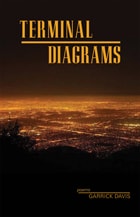
Terminal Diagrams
PoemsGarrick Davis
Ohio University Press, 2010
Garrick Davis’s Terminal Diagrams may have been inspired by the illustrated maps in airport lounges, or perhaps they are the blueprints of the Apocalypse, with their subjects and objects representing the bitter fruits of either some future nightmare or the present world. Regardless, their vision is so bleak and unsparing, only a few will be able to savor them. Here, the art of poetry has been mechanized just as the world has been mechanized. Whether his subject is a car accident on the freeways of Los Angeles or the Book of Revelation transmitted by television, Davis’s stanzas conjure a kind of futuristic noir. In poem after poem, he examines the artistic possibilities of the machine, and its alterations of human experience, with a modern spirit that—as Baudelaire defined it—has embraced “the sublimity and monstrousness of something new.”
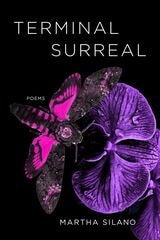
Terminal Surreal
PoemsMartha Silano
Acre Books, 2025
In her masterful poetry collection Terminal Surreal, Martha Silano confronts the reality of mortality with gorgeous attention to imagery and scene. The book follows a trajectory from early symptoms before diagnosis with amyotrophic lateral sclerosis (ALS) to full-blown illness and its effects on friends and family, including her children, who appear in poems like “After Dropping My Son Off at College” and “My Nineteen-Year-Old Daughter Is My Personal Assistant.”
With a devoted naturalist’s eye, Silano revels in birds, trees, and flowers in a way that reminds readers we are connected to the world around us. The book touches on the medical, the metaphysical, and even the cosmological (through encounters in medical offices and on a moon of Mars). With Nutter Butters and Lorna Doones, abecedarians and self-elegies, Silano’s singular, feisty, contemporary voice propels these poems of grief and acceptance as they explore the transformational power of art.
When I Learn Catastrophically
is an anagram of amyotrophic lateral sclerosis.
When I learn I probably have a couple years,
maybe (catastrophically) less, crossword puzzles
begin to feel meaningless, though not the pair
of mergansers, not the red cardinal of my heart.
The sky does all sorts of marvelously uncatastrophic
things that winter I shimmy between science
& song, between widgeons & windows, weather
& its invitation to walk. Walking, which becomes
my lose less, my less morsels, my lose smile
while more sore looms. . . .
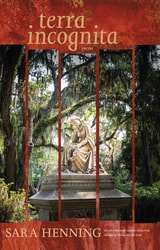
Terra Incognita
PoemsSara Henning
Ohio University Press, 2022
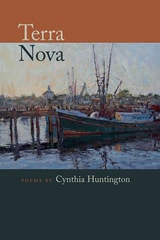
Terra Nova
Cynthia Huntington
Southern Illinois University Press, 2017
In this bold and ambitious book-length poem, National Book Award finalist Cynthia Huntington explores exile and migration—what it means to lose, seek, and find home in all its iterations—through a polyphonic work, written in multiple voices and evoking the method of Hart Crane’s The Bridge or the Nighttown episode in James Joyce’s Ulysses. Yet it is also a tough and vernacular work, owing as much to Patti Smith and the Clash as it does to High Modernism.
Again and again the work shows us outsiders forced into metaphorical and literal wildernesses, whether in a retelling of the biblical Israelites lost in the desert or in stories from Provincetown, Massachusetts, where the new world struggles into being at the edge of the sea. Yet the voices here, across many times and places, refuse to give in to desolation and despair.
Huntington’s approach is hybrid, oscillating between verse and lyrical prose to create a work that falls somewhere between an epic poem and a collection of lyric essays. Whether chronicling the creation of the world and the first exile from the Judeo-Christian Garden of Eden or imagining the terror and thrill of the first sea voyages, this is electric poetry: challenging, startling, and fulfilling.
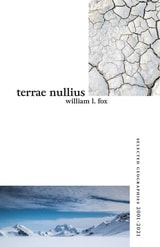
Terrae Nullius
Selected Geographies 2001-2021William L. Fox
University of Nevada Press, 2027
The Alaska Pipeline becomes a line of poetry, a line in the land—the beginning of an epic and the end of an era. A map in the Antarctic becomes the ground beneath the reader’s feet, erasing itself with every step. A monk in a monastery beneath Mount Everest writes a prayer as the mountain traces a contrail across the upper atmosphere, inscribing a path to be followed.
In each place, William L. Fox reveals how the world leaves its mark on us—and how, through language, we move toward a sense of belonging. His spare, minimalist poems inhabit the planet’s wide empty spaces: Nevada’s Great Basin, the Antarctic and Arctic, the red deserts of interior Australia, the immense playas of Chile’s Atacama, and beyond. Between and within these lines, the poems explore how land becomes landscape, how terrain becomes territory, and how meaning is made.
Terrestrial Music
John Bradley
Northwestern University Press, 2006
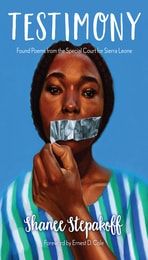
Testimony
Found Poems from the Special Court for Sierra LeoneShanee Stepakoff
Bucknell University Press, 2021
Sierra Leone’s devastating civil war barely caught the attention of Western media, but it raged on for over a decade, bringing misery to millions of people in West Africa from 1991 to 2002. The atrocities committed in this war and the accounts of its survivors were duly recorded by international organizations, but they run the risk of being consigned to dusty historical archives.
Derived from public testimonies at a UN-backed war crimes tribunal in Freetown, this remarkable poetry collection aims to breathe new life into the records of Sierra Leone’s civil war, delicately extracting heartbreaking human stories from the morass of legal jargon. By rendering selected trial transcripts in poetic form, Shanee Stepakoff finds a novel way to communicate not only the suffering of Sierra Leone’s people, but also their courage, dignity, and resilience. Her use of innovative literary techniques helps to ensure that the voices of survivors are not forgotten, but rather heard across the world.
This volume also includes an introduction that explores how the genre of “found poetry” can serve as a uniquely powerful means through which writers may bear witness to atrocity. This book’s unforgettable excavation and shaping of survivor testimonies opens new possibilities for speaking about the unspeakable.

Text/Politics in Island Southeast Asia
Essays in InterpretationD.M. Roskies
Ohio University Press, 1993
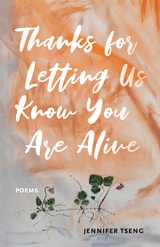
Thanks for Letting Us Know You Are Alive
PoemsJennifer Tseng
University of Massachusetts Press, 2024
Crafted with lines from her late father’s letters, Jennifer Tseng’s Thanks for Letting Us Know You Are Alive is a portrait of an immigrant, a rootless person whose unspoken loss—that of his native geography, family, traditions, language—underlies every word. Though her father’s first language was Mandarin, for more than twenty years he wrote these letters in English, so that she could understand them. Some are riddled with errors, some nearly unintelligible. Lines from his letters appear as titles and are scattered throughout the poems, blending voices of father and daughter. This collection enacts what it means to lose someone and commune with them simultaneously—the paradox of grief and all it gives us.
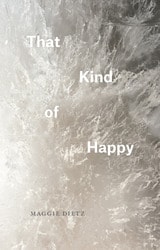
That Kind of Happy
Maggie Dietz
University of Chicago Press, 2016
If I slept too long, forgive me.
A north wind quickened the window frames
so the room pitched like a moving train
and the pillow’s whiff of hickory
and shaving soap conjured your body
beside me. So I slept in the berth
as the train chuffed on, unburdened
by waking’s cold water, ignorant
of pain, estrangement, hunger and
the crucial fuel the boiler burned
to keep the minutes’ pistons churning
while I slept. Forgive me.
That Kind of Happy, the long-awaited second collection by award-winning poet Maggie Dietz, explores the sharp, profound tension between a disquieted inner life and quotidian experience. Central to the book are poems that take up two major life events: becoming a mother and losing a father within a short stretch of time. Here, at the intersection of joy and grief, of persistence and attrition, Dietz wrestles with the questions posed by such conflicting experiences, revealing a mind suspicious of quick fixes and dissatisfied with easy answers. The result is a book as anguished as it is distinguished.
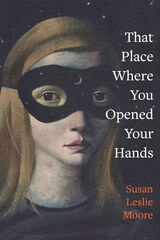
That Place Where You Opened Your Hands
Susan Leslie Moore
University of Massachusetts Press, 2020
Celebrating the tension between what we imagine and what we know the world to be, Susan Leslie Moore's debut collection moves between certainty and doubt, dead seriousness and determined playfulness. Exploring identity and the exterior and interior selves we create through the natural world, language, and relationships, the poems of That Place Where You Opened Your Hands bring the ordinary rhythms of life and motherhood into coexistence with wilder truths. As Moore writes, “If I can't be singular / in purpose, let me be quietly adrift,” but these are not quiet poems.
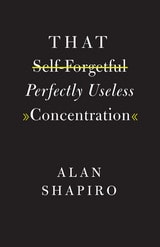
That Self-Forgetful Perfectly Useless Concentration
Alan Shapiro
University of Chicago Press, 2016
In this book, Shapiro brings his characteristic warmth, humor, and many years as both poet and teacher to bear on questions surrounding two preoccupations: the role of conventions—of literary and social norms—in how we fashion our identities on and off the page, and how suffering both requires and resists self-expression. He sketches affectionate portraits of his early teachers, revisits the deaths of his brother and sister, and examines poems that have helped him navigate troubled times. Integrating storytelling and literary analysis so seamlessly that art and life become extensions of each other, Shapiro embodies in his lively prose the very qualities he celebrates in the poems he loves.
Brimming with wit and insight, this is a book for poets, students and scholars of poetry, teachers of literature, and everyone who cares about the literary arts and how they illuminate our personal and public lives.
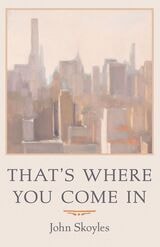
That’s Where You Come In
John Skoyles
Carnegie Mellon University Press, 2026
A meditation on loss and love.
The poems in That’s Where You ComeIn address the loss over time of friends and family. And yet several figures return, ghost-like, to make appearances in the speaker’s life: an uncle, a mother, a father, and close friends. Even a favorite dog returns to take the poet out to dinner in the afterlife. Despite the collection’s focus on these losses, the book has a central thread of new love; many of these love poems are set in the urban landscape of New York City, capturing its streets, characters, and institutions.
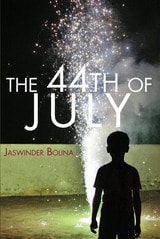
The 44th of July
Jaswinder Bolina
Omnidawn, 2019
In The 44th of July, Jaswinder Bolina offers bracing and often humorous reflections on American culture through the lens of an alienated outsider at a deliberately uncomfortable distance that puts the oddities of the culture on full display. Exploring the nuances of life in an America that doesn’t treat you as one of its own, yet whose benefits still touch your life, these exquisitely crafted poems sing in a kaleidoscopic collaging of language the mundane, yet surreal experience of being in between a cultural heritage of migration and poverty and daily life in a discriminatory yet prosperous nation. Both complicit in global capitalism and victims of the inequality that makes it possible, these are the Americans who are caught in a system with no clear place for them. Bolina opens the space to include the excluded, bringing voice and embodied consciousness to experiences that are essential to Americanness, but get removed from view in the chasms between self and other, immigrant and citizen.
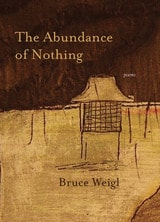
The Abundance of Nothing
PoemsBruce Weigl
Northwestern University Press, 2012
Finalist, 2013 Pulitzer Prize for Poetry
Throughout his award-winning career, Bruce Weigl has proven himself to be a poet of extraordinary emotional acuity and consummate craftsmanship. In The Abundance of Nothing, these qualities are on full display, animating and informing poems that combine rich, metaphoric imagery with direct, powerful language. Deftly weaving history and everyday experience, Weigl transports readers from the front lines of the Vietnam War and all the tangled cultural and emotional scenes of that time to the slow winds of the American Midwest that softly ease the voice of the veteran returning home. Though the poems struggle with themes of mortality and illness, violence and forgiveness, the poet’s voice never wavers in its meditative calm, poise, and compassion. Elegiac yet agile, ethereal yet embodied, The Abundance of Nothing is a work of searching openness, generous insight, and remarkable grace.
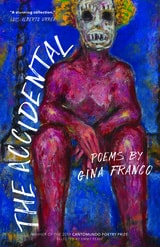
The Accidental
PoemsGina Franco
University of Arkansas Press, 2019
Cascading through each of the poems in Gina Franco’s The Accidental is a question: What does it mean to be human in a world where the soul is exalted but the body brutalized? Franco explores the terrain of the borderlands—not just the physical space of the American southwest, but the spaces where lines are drawn between body and soul, God and self, violence and ecstasy. Unfolding along these borders in a torrent of deep contemplation, Franco’s poems bring the reader to the line between accident and choice, delving into the role each plays in creating the lives we are born into and in determining how those lives end. A body caught in a tree after a flood—an accident—calls to mind deliberate violences: crucifixion and lynching.
Guided, even so, by a stark hopefulness, The Accidental makes a character of the soul and traces its pilgrimage from suffering toward transcendence. “The soul saw,” Franco writes, “that it saw through the wound.” This book tenders a creation myth steeped in existential philosophy and shimmering with the vernacular of the ecstatic.
The Accounts
Katie Peterson
University of Chicago Press, 2013

The Act and the Place of Poetry
Selected EssaysYves Bonnefoy
University of Chicago Press, 1989
The Advocates of Poetry
A Reader of American Poet-Critics of the Modernist EraR S Gwynn
University of Arkansas Press, 1996